
How do you feel about the idea of writing & publishing your book? Nervous? Feeling the Imposter Syndrome?
Over a decade ago, I wrote a few posts on the topic. Back then my first book on financial independence was selling well, and my daughter was working with me on my second. (Frankly, I was scrambling to keep up with her weekly word count.) Our readers like what we wrote (and recorded), and we’re both changing lives. Writing a book with her is one of the highlights of my life.
Also back then, the traditional publishing industry was still stumbling in zombified shock as hybrid publishers and indie publishers disrupted the gatekeepers. Blogging was still the wave of the future, and we were recording audiobooks with our podcast mics. The industry couldn’t even spell AI yet.
A few months ago, a founder of The 1% Better Conference asked:
“I’m curious about the book writing process if you don’t mind sharing. I know people have coaches, editors, agents, graphic designers, marketers, etc. There’s the traditional, self, and hybrid publishers. There’s also print, E-books, and audiobooks.
Did you get any help throughout the process?
Did you wish you would have had help with any part of the process?”
Wow, do I have thoughts.
First, I gratefully accepted a ton of help with writing & publishing. (No author writes alone, not even bestsellers.) In addition, my years of submarine service have given me a very thick skin for reviews (by shipmates & inspection teams) of all aspects of our jobs.
I don’t need my thick skin with editors or publishers, but my military experience helped me welcome their feedback. It not only makes my words better– it makes my writing more efficient in my preferred style.
Second, on the coaching side of helping writers, I greatly enjoy MK Williams’ books in her “Author Your Ambition” series. She also has a comprehensive YouTube channel that answers every question about writing & publishing. She helped Carol and I turn our book into reality, and it was the best author’s experience I’ve had so far. I’m giving her (and ChooseFI) the first look at my future manuscripts.
Finally, as far as the support team: when you choose an editor (perhaps freelance, perhaps part of a small publishing arm like ChooseFI or BiggerPockets) they’ll take care of hiring the different editors & graphic designers. They’ll also work on each of the formats– for example hiring an audio engineer for the audiobook.
Yet we authors are still generally left to handle our marketing, even with a traditional publisher.
Coincidentally, after answering those questions I got another query from Kate Horrell, who’s written a few books of her own:
“I’m doing a presentation at MilMoneyCon on writing and publishing a book. I’m gathering the experiences from a wide variety of authors so that I can present a wide variety of perspectives.
Would you be willing to answer a few written questions?”
I realized that I’ve learned lessons from three books. (I’m still writing the third one.) I looked back through my site and found that I’ve already written eight posts about blogs & books. (Those related articles are at the bottom of this post.) Now I’ll share my answers to Kate’s questions– here we go again!
TL; DR: BLUF
Here’s a summary of the rest of this post:
– Your publishing “Why?” is far more important than your “how.”
– Consistent writing requires internal motivation. Writing for external validation is unsustainable. Write because you have something to say– especially if you can’t shut up about it.
– An audience of military servicemembers (and their families) is about 1% of the America population. Veterans (and their families) are at least 10%.
– Writing your first book establishes your credibility.
– If you’re a financial advisor, your book is your gateway to your ideal clients finding you– and then buying your services.
– Writing books full-time is a career you have to save up for. Your living expenses come from a consistent & sustainable backlist of at least a dozen titles.
– I prefer writing the entire manuscript before approaching editors or publishers. (It avoids deadline stress.) Today I’d outline a book as an editorial calendar on a blog, and write the manuscript from a series of blog posts.
– Back in 2009, if I couldn’t find a traditional publisher for my first book then self-publishing would be Plan B.
Today, in my mind, hybrid publishing is my default for the paper, eBook, and audio editions. Self-publishing would be Plan B. The publishing feedback, education, and resources which used to be hoarded by traditional publishers are all now on the Internet. If a traditional publisher wants to pick up my backlist, then they know where to find me.
– Your publishing choices for your second book depend on the success of your first book. You can always self-publish, but consider hybrid publishing with a website or channel that already has a large group of your target audience.
– Self-publishing and hybrid publishing offer more real-time sales feedback (and more marketing options) than traditional publishing.
– Encourage your audience to try your book from the public library before they buy. This builds trust, and they’ll buy it to add their own notes– or they’ll buy it simply to say “Thank you!”
– The more audience questions that you answer on social media and in meetups, then the better you are at answering those questions in all other book formats and editions.
– Record your audiobook from your manuscript. Your audience wants to get to know you through your voice, and reading your manuscript into a mic helps you find many more typos.
– As you write and edit your manuscript, consider running polls on social media for your audience. They’ll help you decide on your format, the book cover, and other features. (Polling also builds your marketing campaign for your presales.) Share the excitement with your readers at every step of the way, and they’ll reward you with a strong launch.
The rest of this post’s headers answer Kate’s interview questions.
The Journey
Kate asked: “Can you describe your publishing journey from idea to finished book? What steps did you take to find (or create) the right publishing path, and what were some surprises along the way?”
First, your publishing “Why?” is far more important than your “how.” “How” is also not an irrevocable decision: many authors switch among self-publishing, hybrid publishing, and traditional publishers.
Writing is collaborative (with your audience and your editors), but eventually you have to park your butt in a chair and hammer on a keyboard.
It requires internal motivation and satisfaction, not external validation– and there won’t be any applause for a very long time. Even if you’re in a writer’s group or a coffee shop, you have to write because you can’t stop. Or as my spouse jokes, because I can’t shut up.
Writing your first book establishes your credibility. Maybe you just wanted to try it to see whether you have what it takes.
If that’s you, then stop reading this and go write your book.
Maybe you’re a financial advisor who writes to attract clients, or at least to scale your wisdom by answering their most common questions on their time (instead of individually on your time). Your book is your gateway to their purchase of your products & services. There are niche publishers who will promote your book for years (for a fee) because you’ll earn far more money by using it as a lead magnet for your business.
If you want to buy groceries with your writing then you should create a platform (a blog, social media, a podcast, a YouTube channel) that attracts advertising revenue and affiliate commissions. If you’re exclusively writing books then you’ll need to publish several of them with evergreen content for long-term sales (not just current events). Then you’ll need to market those books on your platform anyway.
If you want to quit your day job and write full-time then you’ll have to publish a dozen books and build an audience who buys whatever you’re selling. Even today’s best-selling award-winning authors learned that book publishing is a career you have to save up for.
I’ll break down the rest of my answers into my three books. Two of them are in print and I’m working on a third.
1.) The Military Guide to Financial Independence and Retirement:

The first one is the hardest?
In 2002 after I retired from active duty, I spent time on Internet forums learning even more about personal finance. As we discussed financial independence, it became clear that military families had all of the tools & benefits to accelerate their path to FI… yet very few managed to do it.
My spouse even said “Nords, you have a book in you.” 20 years later, she still says it.
In 2005 I crowdsourced the The Military Guide from the advice & stories of over 50 servicemembers, families, and vets on the Early-Retirement.org forum. I told the forum members that we’d donate all of the royalties to military-friendly charities. If the members contributed to the book somehow (drafting chapters, editing, beta readers) then they’d get a vote. We created an outline and I started writing. I published each chapter to our group’s subforum, and over the next few years we drafted the manuscript.
A few months later after we started the project, a local author hosted a one-day seminar (in person!) on self-publishing. One of the sessions was hosted by a retired acquisitions editor, who said that publishers still took his phone calls and agreed to listen to his advice. In front of the entire auditorium, he asked for volunteers to give him a one-sentence pitch.
He politely yet quickly responded to a dozen pitches with encouragement– and potential pitfalls. It was clear that he had a mental filter of a dozen categories, and he knew from experience how crowded (or hackneyed) they might be.
When it was my turn, I said: “I’m writing about financial independence and early retirement for U.S. military families.”
He paused for a few seconds, then asked: “Does this financial independence thing actually work? How early?” When I assured him that it certainly did, he said “Well, you have to convince your audience– but you might have something there.”
To my shock, I’d just given him a new mental filter.
I’m quite accustomed to criticism. I was surprised by his encouragement, and even more surprised by the small crowd of other wannabe authors who gathered around me afterward. They didn’t care about my book but they wanted to know more about this FI stuff.
Those questions convinced me that I had an audience– and that kept me going for the entire manuscript.
I’m a big fan of writing a manuscript before you contact a publisher, even though traditional publishers usually only want an outline and a draft chapter. If a publisher accepts your query letter, then that puts you on deadline to finish the manuscript. The forum approach (with its own support and peer tutoring) gave me plenty of time for discovering my writing skills and tinkering with the results.
Today I’d outline a book as an editorial calendar on a blog, and write a manuscript from a series of blog posts.
By 2009 blogs were taking off, but I wasn’t ready to learn that skill. I was busy drafting a traditional manuscript. Today I’d self-publish too, but years ago that was still a steep learning curve. Instead I took the traditional publishing approach of writing query letters.
The biggest benefits of using a traditional publisher are their feedback, their education, and their resources. (In that order.) The most important part of publishers (and editors) is their skill at helping you identify and clarify your ideal reader. Find your niche and write in a conversational style as if they’re sitting next to you while you’re typing.
Today, if I was seeking a traditional publisher, I’d write a query letter with a marketing plan. I’d shotgun tailored versions to every publisher on my list without waiting for individual responses. Back then every acquisitions editor had a different format for their pitches, and I waited for their responses before sending out the next letter to a different publisher.
The good news with this approach is that writing serial letters made me much better at crafting the next marketing plan. (The bad news is that it took nine months, one letter at a time.) On my ninth letter, the owner of Impact Publications told me that he’d accepted my pitch because I already had a robust marketing plan.
I knew that if I couldn’t convince a traditional publisher, then self-publishing would be Plan B. Today, in my mind, self-publishing is Plan A for the paper, eBook, and audio editions. The publishing feedback, education, and resources that used to be hoarded by traditional publishers are all now on the Internet.
Back then Impact Publications could do three things for a military author that I couldn’t do on my own:
– Publish an abridged pocket-guide version of the book in 3”x5”x 64 pages (useful for deployments),
– Distribute all editions of the book to the shelves of military exchanges all over the world through a national distributor (as well as public libraries), and
– Add the trade paperback to the federal government’s GSA catalog for military commands to buy with their funds.
All of those worked at the time… until they peaked. First, the pocket guide has been popular at military base family support centers, veteran’s centers, and job fairs. Second, in 2013 the military exchanges stopped selling print book and magazines, which moved most of the book’s sales to Amazon. The trade paperback is still listed with GSA but those sales are much less than Amazon and other commercial outlets.
Today, audiobooks sell at least as well as paper or eBooks (and far better than pocket guides). DoD and public libraries also offer free eBooks via their apps. When troops deploy, they’re more likely to listen or read on their smartphones than on paper or tablets.
In 2010, as the manuscript was being edited by Impact, I started the blog and several social-media channels. (My teen daughter helped me set up Facebook.) I published chapter excerpts as blog posts and shared updates on Facebook, Linkedin, and Twitter. (Today I prefer Bluesky instead of Twitter.) I built an audience and eventually networked to interviews on personal-finance podcasts and military websites.
During the manuscript’s editing, the publisher immediately deleted all of my classic-rock epigraphs. (They felt it was a trademark issue.) Instead I published those chapter subtitles on my site as “excerpts my publisher doesn’t want you to read.”
My high-school daughter said that her AP English teacher was a big fan of writing bullet summaries at the end of each chapter. She was right, and it worked very well.
Back then I wasn’t ready to learn podcasting, but today it’s easier to create simple audio versions of every blog post for readers to download and listen on the go instead of reading on a screen. I don’t bother with my own podcast or YouTube channel– but I have the gear for it. Instead I guest on everyone else’s shows for the 10% of their audience who are military families.
I encourage my audience to borrow the book (print or eBook) from their local military base library or public library before buying. That builds trust.
A final lesson from my first book: the more audience questions that you answer on social media, then the better you are at answering those questions in all other book formats and editions.
2.) Raising Your Money-Savvy Family for Next Generation Financial Independence:
In 2016 I started getting questions from my audience about teaching financial literacy to their kids. I had some ideas and babbled some advice, but it was mostly stories about raising our daughter. In 2018 my spouse and I visited Carol and her spouse, and I asked her what she remembered from her small-kid days.
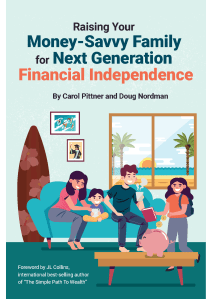
The winning cover by a landslide reader vote.
Carol lit up with memories, most of them good. 30 minutes later my spouse said “Nords, you guys have another book in you.”
At the time Carol was attending the military’s transition seminar for leaving active duty, and she sat in the back of that room writing the first three chapters of the book. At the time our generations lived six time zones apart, so she suggested that we draft the book on Google Docs. And of course Carol also wrote most of the bulleted chapter summaries.
As a published author, this time the publishers came to us.
At FinCon 2018, I met up with a friend who’s a BiggerPockets exec:
BP: “What have you been up to, Nords?”
Me (smiling and sipping coffee): “It’s a funny story. My daughter and I are writing a book.”
BP: “Really? We’d like to publish it!”
Me (nearly blowing coffee out my nose): “Um, wait, what? Would you like to know what the book is about?”
BP: “Personal finance, right?”
Me: “Well, yeah, and this time–”
BP: “That’s why we’d like to publish your book. Let me know when you’re ready.”
At a CampFI, one of the co-founders of ChooseFI approached me.
ChooseFI: “Nords, we’ve heard you’re writing another book. We’d like to publish it!”
Me: “You guys are publishing books?”
ChooseFI: “Not yet, but if you’re writing it then we’ll publish it!”
At FinCon19 I also connected with MK Williams, who has self-published her books since 2015. (I love her first book, the unique financial-independence novel “Enemies Of Peace.”) We talked through the publishing options and decided that, although ChooseFI had a smaller audience than BP (at the time), ChooseFI was more family-oriented than BP. Even the BP exec admitted that was a good choice.
MK started ChooseFI’s book division. Carol and I kept writing while MK brought in freelance editors for development, line edits, and copy edits. She also hired an audio engineer for us to record the book in our voices. I started promoting our new book on my “The Military Guide” blog and my social media.
Hybrid-publishing a personal-finance book is far better than traditional publishing. ChooseFI supplied their existing family-friendly audience and used their tremendous reach to amplify our marketing. We supplemented our book by creating more content (written, audio, and video) for their site. The print-on-demand edition is supplied by IngramSpark. We sell primarily through Amazon (for all three print, eBook and audio editions), and ChooseFI tracks the sales. As authors, we still do the marketing– but we have lots more support than a traditional publisher would ever supply to two inexperienced writers.
The developmental editor disliked our approach of alternating our stories: me starting a chapter with one of our brilliant financial parenting tactics, followed by Carol sharing her initial reaction as a child, and then adding her lessons learned as a young adult starting her own family. The editor (correctly) pointed out that our style was very difficult to write (let alone edit). They also felt very strongly that we’d be more credible by co-writing with one authoritative voice instead of quoting other finance authors or telling personal stories.
Carol and I only have experience with personal finance and raising families– and no credentials. Instead of arguing with the editor, we took it to social media for a Facebook poll. Our audience of military families voted overwhelmingly for our alternate-voices approach, and our editor agreed to hold us to it. Carol and I had to rigorously stick to our parts of the stories and not put words in each other’s mouths. The line-editing was brutal but the manuscript became a much better read– and a far better listen.
Our audiobook edition suffered an unintended consequence of this approach. Carol and I recorded our segments of the book in our voices, and that works very well when people hear our advice. (It’s popular when parents are driving their kids around, with everyone in the car listening to the audiobook on the car’s speakers.) However we each ended up with about 30 separate audio tracks for our respective sections of the manuscript, and we’d recorded them on different PCs with different microphones. This hairball landed in MK’s e-mail, and it was a labor-intensive pain to stitch everything together– in the correct order– for the final recording.
Carol and I still made the right choice to write & record the way our audience wanted it. ChooseFI just had to be willing to pay more money for editing– but the sales are higher.
An unexpected benefit of recording the audio was… more copy editing. When you’re reading your words into a microphone (with bright enthusiasm and a conversational tone!) you’ll stumble over every typo. You’ll basically be actually literally embarrassed by the number of times you used the adverbs “basically”, “actually”, and “literally.”
Record your audio before you bring in the copy editor (after developmental editing and line editing). Even if you can’t use that recording for your audiobook, you’ll strip out your adverbs and other blathering to end up with a better manuscript. When your copy editing is finally(!) finished, you can record the final version of your audiobook.
MK’s self-publishing experience paid off. Her trademark search for our original title discovered that “money-smart family” was already taken. We changed our title to “money-savvy family.” MK liked our idea of bullet summaries at the ends of the chapters, and she also suggested bullet goals at the start of each chapter.
MK also immediately ditched our manuscript’s Disney epigraphs and analogies, because Disney is hyperaggressive about protecting their brand and their copyright. This time we came up with better epigraphs, and our readers appreciate the humor.
The worst part of our second book was editing and publishing during a global pandemic. I wouldn’t recommend trying that approach– there were no book fairs and everyone was burned out on webinars.
In 2026 we learned a new lesson: free eBook downloads. ChooseFI created a spreadsheet with 100 download codes (from their corporate site) and we handed them out for book exchanges and contests. This was essentially free and certainly led to more paperback sales.
3.) “Living Your Financial Independence.”
In 2019 at a FI Chautauqua, my spouse and I realized that our 20 years of shared FI experience was bigger than the rest of the audience– combined.
A draft book cover?
She told me: “Nords, you have to write that book too.” (I’m sensing a trend here.)
During that week, Alan Donegan (of Rebel Finance) led a creativity exercise using my book idea as an example: “What advice do I need to give people to thrive for their next 50 years of FI?” Our small group brainstormed a stack of scribbled Post-It notes with ideas. Seven years later, I’m still using those notes.
I’ll move the book outline to my blog’s editorial calendar and write the chapters mostly in that order, although I can switch around the blog posts to whatever chapters I want.
Along the way I’ll include downloadable audio versions of each blog post, which will help me clean up my writing for the book chapters.
Kate asked: “What were the financial aspects of your publishing process? For example, how were costs handled, how were earnings or royalties structured, and what factors most affected your book’s profitability?”
For our first two books, the publisher fronted the costs of editing & publishing. We did not get advances but our royalties were paid right away instead of waiting on them to earn out the advance.
The good news about Impact Publication is that the eBook royalty rate is higher than the trade paperback royalty rate, and both are higher than the royalty rates of the largest publishers.
ChooseFI offered us an exceptionally generous royalty rate, perhaps because we were one of their first hybrid-published books. (Thank you, MK!) We also get monthly sales data and we can work with ChooseFI’s promotions, like package deals combining several books of their catalog.
I’m going to self-publish my third book and share the revenue with Amazon.
Kate asked: “Looking back, what do you see as the biggest advantages and drawbacks of publishing through your chosen method? How did those factors influence your satisfaction with the final outcome?”
Traditional publisher’s royalties suck at giving feedback. I receive two paper checks per year with sales data, and there’s no real-time dashboard. The publisher has to agree to bulk sales or discounts, and I have no idea which marketing campaigns work.
Impact Publication struggled with database errors on their sales reports, but I scrutinized those reports to help them fix their tracking.
Kate asked: “If you could give one piece of advice to a new author deciding between traditional, hybrid, or self-publishing, what would it be—and why?”
Consider a hybrid publisher with a built-in audience. Self-publishing is always an option that you can save for a last resort.
Kate asked: “Lastly, is there a resource (video, book, blog post, anything) that you would recommend that I include in a list for attendees? For example, I have found a lot of value in MK Williams You Tube videos. (Thanks to you!)”
I’m subscribed to the Creative Penn podcast. (I prefer the transcripts.)
I’ve also bought all of MK Williams’ “Author Your Ambition” books, although I’m not ready to tackle the fiction style yet.
I’ll never write a book with AI, but I’ll use it for all stages of editing and for marketing suggestions. As part of the publishing process, I’ll still run a manuscript by a human editor and use a human artist for a print cover.
Call To Action
There’s an apocryphal story about a writer’s workshop. The attendees cleared their calendars, paid their fees, and traveled hundreds of miles. They showed up in the conference room to take notes on the nuggets of an award-winning author’s wisdom.
The author smiled at the audience and asked “Why are you here instead of working on your book?”
Stop waiting for inspiration. Don’t even bother adding a comment on this post. (Just kidding. Add all the comments you want.)
Sit your butt in a chair, put your hands on your keyboard, and start writing your outline.
Everything after your first draft is just editing and publishing.
There are no affiliate links or paid ads in this post. Try your military base library or local public library before you pay money for these books– in any format.
Military Financial Independence on Amazon:
 |
|
Raising Your Money-Savvy Family on Amazon:
 |
|
Related articles:
Writing and Publishing – A Behind the Scenes Look at The Military Guide
“So, Nords, how did you start blogging?”
Update to “Just Write It”
Should You Self-Publish or Use a Traditional Publisher?
Selling A Personal Finance Book In The Military Exchanges
“The Military Guide” Sales Update (The GSA Schedule Rocks!)
Raising Your Money-Savvy Family For Next Generation Financial Independence
Lessons Learned (So Far) From a Money-Savvy Book Launch


 Military Financial Independence