

How a Roth IRA conversion feels?
Along your path to financial independence, have you ever contemplated doing Roth IRA conversions in your 32% income-tax bracket today— simply because (later in life) it’d save you money over taking Required Minimum Distributions in the 35% bracket?
Yeah, me neither.
Yet a couple of years ago I had the conversation with a member of the Millionaire Money Mentors forum who was earning a very high salary. They understand exponential compounding math, and they also planned to work (challenged & fulfilled!) into their 40s or early 50s. This concerned them about RMDs in their 70s, and they were considering Roth IRA conversions in their 30s. Despite that huge salary, when we considered the compounding math then the 32% income-tax bracket made sense.
I’ve also listened to wealthy retirees in their late 60s who are stunned by how much their retirement accounts have compounded in the last decade. Exponential growth is much less noticeable in your 20s and 30s with balances under $500K. Yet once those balances approach seven figures and then double every 7-10 years, suddenly you’re projecting RMDs at age 75 from accounts of $8M or even higher.
Here’s a more relatable example for military families in the Blended Retirement System.
When BRS families contribute to their Thrift Savings Plan accounts, they’re also piling up the Dept of Defense’s matching contributions in their traditional TSPs. They can do in-service Roth TSP conversions when it makes sense (especially when earning Combat Zone Tax-Exempt pay). Once they separate from service, they can also roll that TSP over to a traditional IRA and start Roth IRA conversions.
But here’s the problem: if you have a high military income (O-5, E-8, specialty pay, bonuses) or if you start a lucrative bridge career after the military, then it doesn’t make much sense to try to pull off a Roth IRA conversion while you’re pulling in all of that taxable income.
Your higher salary means that you’ll be paying taxes in a higher bracket. That’s especially the case for active-duty military retirees with (taxable) pension deposits. It even affects Reserve or National Guard retirees in their 60s who’ve started their military pensions.
If you quit your paid employment as soon as you reach financial independence in your 40s or 50s, the thought of RMDs in your 70s is still very difficult to visualize. Nobody wants to pay taxes today, but the federal government knows that exponential compounding is relentless. (Their actuaries are paid to do math!) The U.S. Treasury can patiently wait until Older You has been backed into a corner by your financial success.
It seems there’s never a good time to start a Roth IRA conversion. In this post, I’ll cover a number of situations that are especially good times (or bad times) for Roth IRA conversions, and maybe you can jumpstart yours now– before it’s too late.
What’s Your Time Worth?
Before we dig into the details of this challenge, here’s a bigger question: is the money worth your time or your effort?
Sure, you want to pay lower income taxes whenever you can. How hard are you willing to work to avoid those higher taxes?
Let’s break it down into three opportunities in uniform, and two more opportunities after military service. A couple of these might not even be applicable to your life plans.
Worth Your Time To Convert While You’re In Uniform: Three Opportunities
Maybe the easiest method is paying taxes up front– when you pay lower taxes, or earn the income in your younger years, or with a smaller salary– instead of deferring those taxes for decades of compounding. Congress and the IRS have designed the laws to psychologically encourage you to wait until you’re older, but that’s because the exponential compounding helps the tax code work in their favor.
1.) While You’re Paying Lower Taxes

Shoot a silver bullet now.
Your first opportunity is that active-duty military families are very lightly taxed compared to their civilian equivalents. Not only are they in lower income-tax brackets– they’re frequently eligible for child tax credits, the Earned Income Tax Credit, education credits, energy-efficiency credits, and electric vehicle credits.
Tax credits make it easier to pay zero income taxes, and these credits phase out quickly as income rises. (If you’re an active-duty family then please trust me on this one– or talk with a vet or a civilian friend about their income taxes after the military.) Instead of trying to take a large income-tax deduction on active duty in a traditional retirement account, maybe it makes sense to pay a small amount of income taxes during your career (up through E-7 or O-4) by contributing to Roth retirement accounts. You’ll simplify your life now, and you’ll avoid a larger Roth IRA conversion tax later.
2.) While You’re Earning Combat Zone Tax-Exempt Pay
Second, if you end up earning CZTE pay then it makes sense to fill up at least your income-tax standard deduction with an in-service Roth TSP conversion— even if you’re trying to contributing up to the Annual Additions Limit in your traditional TSP. This quickly gets complicated, so read that link and its related posts to learn the details.
3.) While You’re Leaving Active Duty
Third: in the distant future, do you know where you want to live after the military? While you’re on active duty (and perhaps not paying state income taxes), then you’re also not paying state taxes on contributions to your Roth TSP and your Roth IRA.
After you leave active duty, if you think you’ll be in a state with low income taxes then maybe you don’t care very much about Roth IRA conversions.
However if you’re planning to live in a state with higher income taxes (because family, climate, or outdoor lifestyle) then you might be very motivated to contribute to Roth accounts now– or to do Roth IRA conversions before you move to a state with higher taxes.
Worth Your Time For A Lot Of Money (After The Military)
How much tax will you avoid with the time & effort you spend on your Roth IRA conversions? If it’s $82 then you might not care. $1000? Well, now you’re thinking about putting in an hour or two on the project. $10K? Heck yeah, that’s a fantasy family vacation.
Everyone enjoys saving $10K in a year, but what if that $10K is the total saved over 10 years? Is it still worth doing Roth IRA conversions for that amount of long-term savings? You’ll have to decide whether the math makes a compelling case for jumping through those hoops every year over the long term.
While the amount of a Required Minimum Distribution in your 70s can look like a very painful (taxable) withdrawal, the only number that counts is your income tax that you’d pay on the RMD. If you have a smaller RMD (within your tax return’s standard deduction), or if you have a larger list of itemized deductions, then your RMD might not be taxed at all.
Even after you use all of the Roth IRA conversion calculators (see the Related Articles at the end of this post) you still might not have a clear answer. In that case you could do small annual Roth IRA conversions (up to the standard income-tax deduction) or combine Roth IRA conversions with large charitable donations. Which brings us to the final question about your time:
Worth Your Time For Philanthropy (After The Military)
Do you plan to donate to charities while you’re saving & investing for your financial independence? Will you ramp up your philanthropy after you reach FI? In that case you could take some of your RMDs as Qualified Charitable Distributions and avoid paying income taxes on them.
It’s hard to visualize QCDs in your 70s when you’re in your 20s. However if you’re a younger adult who feels strongly about tithing your income now, or you’re practicing effective altruism, then you’re highly likely to continue that practice for the rest of your life.
QCDs are also a consolation prize for people who’ve run out of time to do Roth IRA conversions.
Finally, if there’s any good news about RMDs in your 70s, they’re easier to calculate and automate than ever before. (Especially if you’re faced with health challenges or declining cognition.) Your IRA custodian will be very helpful with amounts, reminders, and income-tax withholding. Recent changes to the tax code have greatly reduced penalties for incorrect RMDs.
If you project that your RMDs will be smaller and more manageable, then maybe you just don’t care about complicating your life with annual Roth IRA conversions.
Do your math. Find a comprehensive Roth IRA conversion calculator, or consult a financial planner who specializes in advising military families.
Winning At Whack-A-Mole With The Income-Tax Variables
The hardest part of planning Roth IRA conversions is pushing on one part of your income-tax return– and watching a financial surprise pop up on a different part.
We have to:
-
- predict our income-tax brackets for the rest of our lives,
- forecast the exponential compounding of our traditional IRAs & traditional 401(k)s for RMDs,
- execute Roth IRA conversions in the optimal income-tax brackets during those phases of our lives, and
- know when we’re going to die… so that our surviving spouse isn’t forced into a higher income-tax bracket when our death moves them from Married Filing Jointly to Single.
But we also have to:
-
- manage our Modified Adjusted Gross Income for health insurance premiums with the Affordable Care Act (before starting Medicare),
- manage our Adjusted Gross Income for college financial aid (and educational tax credits),
- manage our AGI to pay capital gains taxes at the 0% bracket instead of 15-20% or even higher,
- manage our MAGI to avoid Net Investment Income Tax,
- include our starting date of Social Security in our tax planning,
- manage our MAGI with Medicare to avoid each year of IRMAA on our Part B premiums,
- have a plan for Qualified Charitable Distributions starting at age 70.5, and
- decide whether our heirs want to pay their own income taxes on our inherited traditional IRA, or zero income taxes on our inherited Roth IRA.
You read that last bullet correctly. The tax code can make your heirs pay income taxes on your money— for years after you’re dead.
There’s a very good reason that Ed Slott (a CPA and author) has made a 50-year career out of calling traditional retirement accounts “tax bombs and has a site using the words “IRA Help.”
Mr. Slott advocates Roth IRA conversions into the 24% income-tax bracket simply to avoid even higher taxes in your 60s and 70s. These are mostly retirees who (for their own many good reasons) didn’t accurately forecast how exponential compounding would take off in their traditional 401(k)s and IRAs. At the Bogleheads 2025 conference we watched Mr. Slott share that with a bunch of older people (including me!). The younger people in the Bogleheads audience were skeptical, but the older folks were nodding right along with Ed.
How High Can Our Income Taxes Go?!?
You’re not going to like reading this about RMDs in your 70s: if you have a significant amount of other taxable income (pensions, dividends & interest, capital gains, rental-property income, Social Security) then that first withdrawal could slam you smartly into the 24% income-tax bracket.
To clarify, that’s a marginal bracket. Only your income above the threshold of the 24% bracket is taxed at that rate. Income below that is still taxed in its appropriate brackets of 0%, 10%, 12%, or 22%… and maybe some long-term capital gains at 15%.
However other taxes can start piling on top: Social Security deposits become subject to income tax, Medicare Part B premiums jump higher for a year of IRMAA, and a few dollars might be taxed at the 3.8% rate for NIIT.
There’s another insidious tax that you might never see coming: families who buy health insurance on an Affordable Care Act exchange have to account for the impact of Roth IRA conversions on their ACA premium subsidies. (This is not an issue for military families with Tricare– or for most employer insurance.) If your income goes even a dollar above the subsidy limit then you could lose tens of thousands of dollars in that year’s tax credits.
The Widow’s Tax
The financial media loves to alarm audiences with their hysterical attention to inheriting a traditional IRA from your (deceased) spouse. In defense (not much) of the media, the Widow(er)’s Tax makes a great soundbite.
Well, how bad is this situation?
Of course the emotions are far worse than the finances. The surviving spouse is already dealing with one of life’s greatest stresses from the loss of a life companion. Piling on RMDs is one more insult to the rest of the financial injuries.
Is it worth avoiding this extra pain after death by doing Roth IRA conversions while you’re both still alive? How much money are you willing to spend now to save money after one of you is gone? Will it significantly affect your finances either way?
Let’s look at just one of many examples of the Widow’s Tax.
Here’s a partial screenshot of Fidelity’s table of 2026 income-tax brackets built from the IRS website. (You can see the full table at that link.) 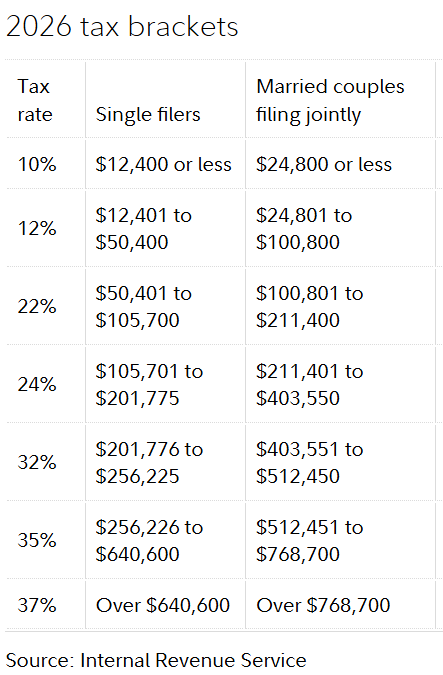 Note that a couple with $95K of taxable income (not gross income!) would be approaching the top of the 12% MFJ income-tax bracket. If one of the couple passes away, and if their retiree income remains the same in the next tax year, then that $95K is well into the 22% Single category.
10 percentage points of tax brackets looks like a pretty big hammer! But what’s the dollar difference? As a married couple they were paying:
10% x $24,800 + 12% x ($95,000-$24801) = $10,904.
Now the surviving spouse is paying:
10% x $12,400 + 12% x ($50,400-$12,401) + 22% x ($95,000 – $50,401) = $15,612.
In this situation, the widow’s tax is $4708 per year… assuming that the taxable income did not drop after the first spouse’s death. If that’s still $95K then the widow’s tax went up by 43%.
10 percentage points and 43% are pretty scary numbers. But if your widowed tax bill (after deductions!) is $4708 higher, will you wish that you’d spent your money on Roth IRA conversions earlier in your lives together?
Personally, I feel that the death of a spouse is one of the worst life experiences that we could ever have. Financially, though, the actual dollars of the widow’s tax might not be as painful as the media’s tax-bracket graphics would indicate.
If you’re a visual learner whose eyeballs glazed over at those numbers, please watch Sean Mullaney’s video at that link.
These numbers are highly dependent on your individual situations. If you’re the spouse who does the spreadsheets, then crunch the numbers before you decide about Roth IRA conversions. Use your taxable incomes before & after the first spouse dies (unlike the above example, they’ll probably be very different), your age differences, your RMD differences, and all of your other parameters.
You can read more of this analysis at Cody Garrett’s and Sean Mullaney’s outstanding book, Tax Planning To and Through Early Retirement. By the time you follow their examples and check your own math, you might decide that avoiding the widow’s tax with Roth IRA conversions is not worth your time.
At least one of you might feel that you’d rather spend that money on each other (while you’re both still alive to enjoy it together) instead of paying taxes on Roth IRA conversions.
“What About Proposed Legislation And Political Risk?”
This post focuses on the parameters you can control:
- Your asset allocation (traditional or Roth retirement accounts with stocks, bonds, or real estate)
- Your savings rate (how much you put in those accounts), and
- Your expense ratios (index funds with low expenses).
Political risk is beyond your control. Sure, you can try to steer it a little through investor activism, and that’s worth your efforts if you find it challenging & fulfilling in a sustainable manner. Otherwise you’d waste a tremendous amount of life energy and mental bandwidth on worrying about the latest speculation from the financial media’s frantic 24/7 news cycle.
If there’s any consolation to this loss of control, it’s the checks & balances of American government. If you choose a financial decision like a Roth IRA conversion, and the laws behind that decision are later amended, then you’re likely to be grandfathered on your previous actions. History has shown that you won’t be (financially) punished twice for that choice… although it might take months of lawsuits before the final decisions are official.
When you’ve done the math to decide whether it’s worth your time & effort to do a Roth IRA conversion, then you’re right. Get it done at the right time instead of waiting for the perfect time.
“Remind Me Again: Why Roth IRA Conversions?!?”
You’re trying to:
- Pay lower income taxes now instead of higher income taxes later.
- Simplify your finances in your elder years by avoiding RMDs and QCDs.
- Pay income taxes on your traditional retirement accounts so that your surviving spouse doesn’t have to.
- Pay income taxes on your traditional retirement accounts so that your heirs don’t have to.
How My Spouse And I Did Roth IRA Conversions:
We’re done! We finished this project eight years ago.
My spouse and I can do math, and I’m a financial nerd who enjoys optimizing. We’ve saved tens of thousands of tax dollars during our decades.
More importantly, our emotions of behavioral financial psychology have been incredibly powerful. It was a tremendous relief to do the analysis and then simplify our lives. It’s not just about my stress levels in my elder years. Someday when my spouse and our daughter are running our finances, they’ll also be tremendously relieved at not having to deal with our issues.
I’ll share what we did so that you can decide whether it helps your finances too.
First, in 2002 we were already financially independent when I retired from active duty. Instead of starting a typical post-military bridge career, I stopped working for paychecks. It wasn’t just about “working for The Man” or starting my own business. I simply didn’t want to trade any more of my life energy for money that I wouldn’t need. Besides: family, surfing, and slow travel.
After I retired, our taxable income plunged. I haven’t received a W-2 in over two decades, and my only 1099s have been for book royalties or my pension.
Unfortunately for our retirement accounts, most of our contributions went to traditional (tax-deferred) IRAs. Roth IRAs were only created in 1997, and we did what we could for a few years. The Thrift Savings Plan was only made available to military servicemembers in January 2002 (five months before I retired). The Roth TSP didn’t even start rolling out until 2012, years after we ended our TSP contributions.
My spouse and I had spent two decades maximizing our traditional IRA contributions, and she had a few years of traditional TSP contributions from Reserve drill weekends.
The vast majority of our investments ended up in taxable accounts, and we wanted to spend those down in a tax-efficient manner. We had plenty of room for minimizing our long-term capital-gains taxes by selling shares when it made sense, and we saw no reason to tap our traditional retirement accounts for early withdrawals before age 59.5.
I was 41 years old when I retired from active duty, and I projected three decades of growth in those traditional retirement accounts to our RMDs. When I added in the income taxes on my pension and our (someday) Social Security, I was not happy. When I discovered IRMAA I was even more annoyed.
Our game of Whack-A-Mole was just starting, and the hammers were flying.
Under the tax laws back then, we already knew we’d have to start RMDs in 2031 when I turned age 70.5. We’d have 28 years to finish Roth IRA conversions. We could try that.
In 2003 we started small annual incremental Roth IRA conversions. Each one depended on our estimated AGI as well as our deductions (standard or itemized) and any tax credits (solar power! energy-efficient windows!).
In 2004 the TSP kicked me out of the system because I’d only contributed for a few months before my 2002 retirement. (I rolled their check into my traditional IRA.) We continued converting my traditional IRA account to a Roth IRA, and then slowly did the same with my spouse’s traditional IRA. Finally we rolled her TSP into her (empty) IRA and finished those Roth IRA conversions.
Some years we moved $20K (a pro-rata combination of deductible contributions, non-deductible contributions, and growth) while other years we skipped the conversions in order to tweak our adjusted gross income. (Our daughter’s university still laughed at our FAFSA application and declined to offer any financial aid.) During 2004-07 our traditional retirement accounts grew faster than our conversions. The Great Recession gave us lots of capital losses, tax deductions, and tax credits.
In 2007 my spouse qualified for her Reserve pension that would start in 2021. As we celebrated her achievement, I also had to overhaul our entire conversion timeline. Her hard-earned success had whacked a decade out of our Roth IRA conversion deadline. We knew that her pension would launch us right into the 25% federal income-tax bracket, and we’d never see 15% ever again.
Regardless of her new deadline, it was a compelling case for a Roth IRA conversion. Reducing the taxes on our IRAs today by 10 percentage points on their smaller value, instead of after decades of compounding? Never having to calculate and track RMDs? Using tax-free Roth IRA withdrawals to manage our taxable income for the rest of our lives?
Totally worth our effort. We knew we needed to pay smaller taxes now to permanently simplify our tax bills.
Before 2017, our Roth IRA conversions filled up the old 15% federal income-tax bracket. In 2017, due to the new (unexpected!) political risk of the Tax Cuts and Jobs Act, I was supremely annoyed that we could now fill up the 12% income-tax bracket. Should I have waited for even bigger tax cuts?
When I did the math on those three percentage points, though, it turned out that we were still winning. We would have been taxed in lower *brackets* by waiting until after 2017, but we would have still paid more dollars on 14 years of higher compound growth.
Better yet, our new goal was finishing Roth IRA conversions before spending the rest of our lives in the TCJA’s 22% income-tax bracket instead of 25%. We were still winning.
We finished our 16 years of small annual Roth IRA conversions on our 2018 income-tax returns. We paid all of those conversion taxes from our taxable accounts, leaving more money in our Roth IRAs.
I was 57 years old by the time we finished, and we never needed to tap even the contributions to our Roth IRAs– let alone withdraw any of the converted funds or start a 72(t) withdrawal plan.
When my spouse’s Reserve pension started, our income taxes exploded in a very good way. Today we send more revenue to the U.S. Treasury than ever before, but it’s a lot lower than it could have been.
We’re still bumping up against the top of the 22% income-tax bracket. We’re giving it away as fast as we can (philanthropy and family gifting), and we’re delaying our Social Security until age 70. When we start SS then we’ll be in the 24% income-tax bracket and we’ll pay IRMAA on our Medicare premiums— for the rest of our lives.
The federal government is very patient. Their actuaries do more math than we ever will, and they’ll be happy to collect our income taxes for the rest of our (hopefully) very long lives. I’m glad we won’t have to pay a bigger bill.
Your Call To Action
Figure out where you could pay less taxes now rather than more taxes later.
Consider which plan works for your situation, especially if you’re buying health insurance through the ACA and saving money with premium tax credits.
Review the variables listed in the Whack-A-Mole section above and analyze out how they’ll hammer you.
If you’re just starting your career, or you’re in your 20s/30s with lower income, then you’ll still enjoy lower income-tax brackets and maybe a few tax credits. It might make sense to pass up the temptations of tax deductions & deferrals in traditional retirement accounts, and make all of your contributions into your Roth accounts.
It still hurts to pay income taxes now by contributing to Roth 401(k)s, Roth TSPs, and Roth IRAs– but paying those lower taxes today could save you even more pain of much higher income taxes in your 70s.
When you’re on military active duty then you’re already lightly taxed. You will probably pay lower taxes now by contributing to Roth retirement accounts instead of deferring taxes in traditional retirement accounts.
Read through the math examples in Cody Garrett’s & Sean Mullaney’s book
“Tax Planning To and Through Early Retirement” as well as Fritz Gilbert’s blog post about the “Golden Age of Roth Conversions”.
For you visual learners, watch Ed Slott’s video and reflect on where your compounding in your traditional retirement accounts could put you in your 60s– just as you’re signing up for Medicare and Social Security.
Do your math– or hire a CFP, CPA, or EA from the Military Financial Advisors Association (with the MQFP certification) to charge you a flat fee to go over your math.
Decide whether Roth IRA conversions are worth your time & effort. If you think your lifetime income taxes will work out about the same either way, then congratulations! You’ve optimized one of the most complicated parts of the tax code, and you don’t have to worry about Roth IRA conversions. Relax and enjoy your financial freedom.
Contact me (or comment below) with more questions. I’m not a financial planner but I’ve learned a lot of the answers, and I can guide you to the right resources.
There are no affiliate links or paid ads in this post. Try your military base library or local public library before you pay money for these books– in any format.
Military Financial Independence on Amazon:
 |
|
Raising Your Money-Savvy Family on Amazon:
 |
|
Related articles:
RetireSmartIRA
Dinkytown Roth IRA conversion calculations for hardcore math nerds like me. (Remember to include your state & local income taxes!)
Maxifi
Tax Planning To and Through Early Retirement by Cody Garrett and Sean Mullaney.
Ed Slott’s “The Retirement Savings Time Bomb Ticks Louder”
Ed Slott’s video at Bogleheads 2025
Avoiding The ACA Subsidy Cliff
The Golden Age of Roth Conversions
The Widow’s Tax Trap And RMDs
Roth TSP conversion calculator from Military Money Manual
Is All the Hype Around Roth IRA Conversions Justified? (and how Pralana Gold might help).
Another perspective from Jim Dahle at White Coat Investor:
Don’t Roth All of Your 401(k) Money


Thanks for the “reminder” post, Nords! My wife and I have been pushing having to do our Roth conversions (who wants to pay taxes now, when you can defer later?) but we are going to have to do so this year before she turns 63 next year and be subject to IRMAA (although it would seem that we might not totally avoid IRMAA surcharges in future years). We will be doing an Roth in-plan conversion from our TSP accounts. I wish the TSP would allow us to just convert the Traditional portion of our accounts and not pro-rata from Traditional, Tax- Exempt (from CZTE contributions), and Roth TSP. Not really looking forward to paying such a hefty tax by converting to the top of the 24% tax bracket but it makes sense after some analysis with the help of a financial planner and CPA. We are also looking into Donor Advised Funds (DAF) to consolidate our charitable giving and be able to itemize deductions (higher standard deductions made it difficult to itemize). Additionally, we are planning on rolling over some of our TSP into an IRA to facilitate being able to utilize QCDs later on (QCDs won’t allow direct TSP (nor 401k) contributions) when we are in our 70s. At this point, it seems like Tax Planning takes precedence over other aspect of our financial plan.
Good to hear from you again, ewabeachnazarene!
I feel your pain on IRMAA– it’s one of the minor reasons we’re delaying our Social Security to age 70.
I agree with you about in-plan Roth TSP conversions, especially confirming with a financial planner and a CPA! The only way to gain more control over the pro-rata problem would be rolling your TSP accounts over to your IRAs, maybe leaving a little in the TSP if you want the G fund– or their annuity feature for an RMD.
I think QCDs are a great option for philanthropy, too.