Will Your Retirement Plan Handle Long-Term Care Needs? How Your Genome Impacts Disability, Caregiving, And Estate Planning


Will your retirement plan stand up to long-term care needs?

Do you have an estate plan in place?

These are topics that few of us want to discuss. However, they are extremely important to your family’s long-term stability. Today, we’ll discuss some important considerations for your long-term financial stability— and how you can take action today to start planning for those needs.

[Disclosure: This article is a very personal post, and it’s also part of the Life Uninterrupted campaign sponsored by USAA. The #LifeUninterrupted campaign can help future retirees learn how to transition into retirement without worrying about financial interruptions. You can receive a free, no-obligation retirement review today by calling USAA.]

[Nords note: the site owner receives a fee for posting; however, the opinions expressed in this post are my own. I do not earn a fee, a commission, or a percentage of sales.  As usual, all of my writing revenue is donated to military-friendly charities.]

Welcome to another episode in a series of posts about how the Nords family’s financial independence life is changing after more than 17 years. It’s all good.

Over the years I’ve felt frustrated about personal-finance bloggers (you know who you are) who don’t write (or podcast or YouTube) about the tough situations affecting their personal lives and their financial credibility.

Some of us write about our impacts from disease, disability, divorce, and death, but too many are tempted to omit the difficult discussions. Maybe those public figures feel that a few topics are… personal… and perhaps private.

Unfortunately, our (understandable) writer reticence also impacts our financial credibility. If we don’t address the questions then the skeptics will make up their own answers:

  • “I can’t count on reaching FI by inheriting money.”
  • “If they can’t explain their math, then how do they know they’re FI?”
  • “You can’t get health insurance for that.”
  • “Divorce is expensive. They’ll have to go back to work.”
  • “I’d be FI too, if I could just buy cheap long-term care insurance.”

… and my personal favorite:
“Of course they’re FI! As long as their lifestyle convinces us to buy enough stuff from their website.”

More of us public figures could be more… public… with these personal issues. As painful as these life problems may be, they also offer a rare opportunity. Sharing the news about our experiences can help people who are also struggling with (and Googling about) similar issues.

Discussing it can be good keyboard therapy.

We could disarm the FI skeptics.

I’m finally able to share a very personal story after years of silence. It demonstrates why quality of life (and the choices offered by financial independence) should be so important to everyone.

I’ve hidden this information for over five years while I was a conservator under the benevolent scrutiny of the Denver probate court. I’ve beta-tested this revelation with family and close friends, along with a small forum of others who have the same situation.

This post will render me partially uninsurable, but I can afford it. The discussion needs to be public, and it’s worth the cost.

A Family History of Disability

Image of Dean & Doug Nordman after Dean's father's funeral in 2002 | The-Military-Guide.com

2002: Dad & me, after Grandpa’s funeral.

We’re all familiar with the “failure probability” of the 4% Safe Withdrawal Rate, yet my genome might turn out to be a much bigger failure probability in my lifestyle.

Most of you know that my father died of Alzheimer’s Disease in late 2017. As Dad’s conservator, I’ve written extensively about the financial aspects of dementia and care facilities. I had to apply for that conservator’s appointment from the Denver probate court in early 2011, and I could have been fired dismissed at any time during the six years that I handled Dad’s finances.

Image of three shrinkwrapped 23andMe genetic testing kits used by our family to map our genomes, which led to my learning that I have two APOE4 genes associated with a higher risk of Alzhieimer's Disease. | The-Military-Guide.com

Three 23andMe kits for our Ohana Nords.

In 2013, as Dad was approaching mid-stage Alzheimer’s, our family mapped our genomes with 23andMe. When the results posted on my 23andMe account, I had to click through about three different warnings. To my surprise, I learned that I was a carrier for cystic fibrosis.

In addition to my parents’ bullets in my genetic revolver, my paternal grandfather also lived with dementia until age 97. (We’re not sure it was Alzheimer’s, and he died of influenza.) My mother and her parents didn’t live long enough to show symptoms of the disease.

I’m still here. Keep reading. You want to know how to handle this.

I’m still unlikely to develop any sort of dementia. Not for another 15-30 years, anyway. (Tick. Tock. Tick. Tock.) As you might imagine, I’ve obsessed read a lot about this.

Remember that people still develop Alzheimer’s even without a clear genetic vulnerability or family history, and it’s just one of several different types of dementia. A few dementia symptoms respond to treatment, especially if the cause is related to blood pressure or medication side effects.

23andMe describes the situation in a number of different ways.

  • A third of Americans over the age of 85 have dementia regardless of their genome.
  • A family history means I’m roughly 30% more likely to develop Alzheimer’s during my life.
  • 28% of people with a genetic APOE4 vulnerability develop Alzheimer’s by age 75.
  • 51% of APOE4s show symptoms by age 85.

Of course, these are the people left after the “survivor bias” of heart attacks and cancer. Even elders whose brains show tangles and plaques (during an autopsy) have remained symptom-free while alive. It’s a testament to the brain’s neuroplastic ability to route around damage.

In general, people are fine until age 65. (Seven more years for me!) After that, the odds rise unpredictably.

Human cognitive skills reach their peak before our 70s. Dementia symptoms typically appear in the mid-70s, just like my Dad (age 74). After that, the Alzheimer’s bell curve is about 20 years wide. My grandmother covered Grandpa’s dementia symptoms for several years before her death, and then he spent over 14 years in a care facility.

People who are highly educated or skilled have a measure of cognitive reserve which can hide dementia symptoms for many years. My grandfather, an electrical tech and side-hustle farmer, coped with dementia for at least four years before he finally had to enter a care facility. (He left a trail of financial wreckage that took another five years to repair.) My father, an electrical engineer, did the same for three years until his cognitive neglect almost killed him.

For purposes of this post, let’s consider me highly educated. You can form your own opinion about my cognitive reserve. (My self-assessment may be biased– or oblivious.) Read the related posts below and feel free to contact me with questions. If we’re at a meetup, I’m happy to chat. We need to start the conversations.

Last month I went to yet another memorial service, and I’ve already lost too many family, shipmates, and friends. Of the “big three” causes of elder death, I’m convinced that I prefer dementia over cancer or cardiac arrest. Ironically, dementia can eventually set you free from worry and self-criticism. As I watched my grandfather deal with dementia, I heard Dad’s epic stories of fixing what Grandpa had neglected. Those years were some of Grandpa’s happiest times, although Dad’s caregiver stress was sky-high. Then I watched Alzheimer’s chew on my father’s cognition for over nine years. Once again those were some of the happiest years of his life.

Our caregiver stress with Dad was also sky-high. I’m not passing that on to the next generation.

Do You Really Want to Know?

Yes, knowledge is powerful, and it can help you plan for your future. 23andMe offers an FDA-approved “health predisposition report” for Alzheimer’s.

That knowledge is one of the most controversial aspects of genetics. Current testing for late-onset Alzheimer’s can only show a risk factor without a definite “Yes” or “No”. Some medical scans can show plaques and tangles in the brain, but they don’t always lead to Alzheimer’s.

Your genome loads the gun for your life of Russian roulette. (Hopefully, that gun is a revolver, not a semi-automatic.) Lifestyle pulls the trigger.

You want to keep your fingers outside of the trigger guard.

Image of the actor Clint Eastwood from the movie "Dirty Harry". He's pointing a .44 Magnum revolver at a bank robber, admitting that he doesn't remember whether the gun is empty or has a cartridge left, and asking the robber whether he feels lucky. | The-Military-Guide.com

What’s in your genetic revolver?

The want-to-know question never even occurred to me until I started clicking through the 23andMe disclosures. I’m a nuclear engineer: of course, I want to know my mortality risk factors so that I can mitigate them. As some motivational bloggers say, I want to “Take massive action” and “Crush it!”

Like the criminal told the police officer “Dirty Harry” Callahan: “I gots to know.”

I want to live my best life while I’m still self-aware.

You statisticians may have noticed that homozygous APOE4 people still have a meaningful probability of skipping Alzheimer’s. Ironically there’s at least one anti-Alzheimer’s gene which shuts down the Alzheimer’s genes. Genealogists know it exists, but geneticists haven’t located it yet.

Although people claim that they want to know, they misinterpret the results. Regardless of your APOE4 genes, something else on your genome could kill you first. While you may think your cognition is “safe”, you can still develop dementia without the APOE4 gene. This confusion is so widespread that even the Alzheimer’s Organization discourages genetic testing for Alzheimer’s.

What if “lifestyle” is simply where you were raised? About 4% of humans have Alzheimer’s disease at age 65, and the numbers grow rapidly after that age. First-degree relatives of a person with Alzheimer’s disease have a higher chance of developing Alzheimer’s. Yet 23andMe notes that this may be simply related to family members sharing a similar lifestyle and environment.

23andMe lists other factors correlated (positively or negatively) to Alzheimer’s:

  • More women than men develop Alzheimer’s.
  • African-Americans and Hispanics develop Alzheimer’s at higher rates than Europeans and Asians.
  • Obesity, high cholesterol, and high blood pressure raise the risk of Alzheimer’s.
  • Type 2 diabetes raises the risk of developing Alzheimer’s.
  • Green leafy vegetables, fruits, whole grains, and healthy fats lower the risk.
  • Fewer years of education correlates with a higher risk of developing Alzheimer’s.
  • Exercise benefits the brain and lowers the risk of developing Alzheimer’s.

Lifestyle Motivation

When a man knows he is to be hanged in a fortnight, it concentrates his mind wonderfully.”

— Samuel Johnson

There is nothing better than getting shot at and missed. It’s really great.”

— James N. Mattis

We all know we’re supposed to eat more fiber and leafy-green vegetables. More healthy fats. Avoid refined carbohydrates.

We all know we’re supposed to get off the keyboard couch. Exercise. Lift weights. Get more sleep. Meditate. Journal your goals.
Image of the cover of Charles Duhigg's book "The Power Of Habit" to help people substitute new good habits for old bad habits. | The-Military-Guide.com

Click the image for more info.

Is this knowledge really enough to persuade us to live our best lives?

As the TV psychologist says, “How’s that workin’ for ya?”

It’s the ultimate cognitive dissonance. We all know what we’re supposed to do, and we all judge others for not doing it… while we’re not doing it either.

That’s how I lived until I clicked on my 23andMe APOE results. Unlike my first 53 years of my life, I suddenly had a very specific reason to change my behavior.

I didn’t stop the riskier behaviors because they might be bad for me. (If that logic worked, I would’ve stopped decades ago.) Instead, I changed my behavior (one habit at a time) because I now have a very clear picture of the person I want to be. I’m not rigid and perfectionist, and I still eat a cookie once in a while… as long as it’s not a habit. I know that my good habits keep me on track the other 99% of the time.

Good lifestyle habits help mitigate risk factors. Good habits also help keep you on track when you’re losing your cognition.

Good habits do not come from good intentions– they come from the hard work of daily small behavior changes.  This applies to financial independence as well as your health.

Here’s another example of my lifestyle motivation.

My parents were social drinkers. Before Dad developed Alzheimer’s, he’d have a drink before dinner… and top it up with dinner… and maybe top it up after dinner. He had it under control.

I (secretly) joined that drinking club at age 13. I majored in it at college and during active duty. (You’ve heard the term “drinks like a sailor”? ) I eventually got it under control. By age 35 40 45 I’d drunk more than my lifetime quota of alcohol– and most of your lifetime quota too.

When Dad developed Alzheimer’s, his drinking habit was already firmly established. He just couldn’t remember how to stop.

He’d have a drink before dinner… and a drink before dinner… and a drink before dinner… and a drink before dinner. He’d pass out after a pint of bourbon and dinner never happened. The next day maybe he’d eventually eat lunch (once his stomach settled down). Maybe he’d do chores or hike his favorite national park. (Or maybe not.) Later on, he’d have a drink before dinner…

The alcohol eventually burned an ulcer through his duodenum. When a neighbor drove Dad to the emergency room at midnight, he was inebriated and incoherent and suffering incredible pain. When Dad lost consciousness and the CAT scan finally saw the problem, there was no dinner in Dad’s stomach… but his peritoneal cavity was flooded with Wild Turkey.

Dad was, to put it politely, a malnourished bag of bones suffering from withdrawal. He went from the ICU to the care facility and he never had the chance to drink alcohol again.

I’d known for decades that I should probably drink less, and by my late 40s, a couple of beers had adverse effects on my reflexes and my sleep. Still (for whatever reasons) I never quite got around to changing my behavior. My habits were firmly established.

A closeup image of spicy nachos with a cold, frosty mug of beer to show how advertising triggers the urge to drink alcohol. | The-Military-Guide.com

Eh, coffee for me please.

Yet when I got “the call” from Dad’s hospital (at 3 AM), I knew I was finally done with alcohol. My good intentions gained a much stronger motivation to build my new sobriety habit. It took a few years to stop being triggered by beer commercials or the smell of spicy food, and now I have better associations.

I’ve become someone who doesn’t want to pay any potential price for drinking alcohol, especially if it becomes a habit.

Police officers at sobriety checkpoints love hearing that my last drink was 27 February 2011.

As one APOE4 person says:

My quality of life has improved and money has become less important to me. I am actually glad to discover that I have the APOE4 gene because I avoided becoming complacent in my retirement.”

Caregiver Motivation

I thought I understood ”caregiver stress.”  I had no idea.

I served for 20 years in U.S. Navy submarines. I thought I knew stress, but with Dad, we leveled up for over six years of chronic (and acute) caregiver stress.

It started with finding a care facility in the 96 hours before he was discharged from the ICU. (I lived in the hospital for three days, napping in the “visitor” lounge.) It continued when the long-term care insurer denied the claim. (We appealed and won.) It elevated many times during the next nine months of legal petitions to be appointed his conservator. Our caregiver years were relatively trouble-free (compared to most families) yet the stress never went away.

In early 2019, 16 months after Dad’s death, I still felt flashback echoes of that caregiver stress. It was the first time since 2011 that I didn’t have to prepare his income-tax returns or submit a conservator’s report to the probate court.

When you have Alzheimer’s, you can still feel physical and emotional pain. You just can’t remember it, and that’s why my father and grandfather were so happy in their dementia.

But caregivers can’t avoid the constant physical and emotional pain. Caregiving for a loved one with dementia is brutal. Dad had an old will and an old medical directive and ample assets, but even with those resources, our care was still an ultramarathon of stress and emotional pain. If an elder has no assets or will or medical directive or estate plan or powers of attorney, then it’s almost impossible to be their caregiver.

The Nordman caregiver stress stops with me. I’m not dumping this on another generation.

Insurance?!?

Welp, this post renders me ineligible for some types of insurance.

No worries: I either don’t need the coverage or we’ve self-insured for it. Bookmark this post, because someday you might want to review these tips too.

Technically, the Genetic Information Nondiscrimination Act protects American citizens. Health insurers are not allowed to use genetic information to decide about our eligibility or our coverage.

However, (as that link mentions), the act does not apply to the U.S. military or the VA. It does not apply to disability insurance, long-term care insurance, or even life insurance.

Depositphotos image of a stethoscope on top of a pile of $20 bills to illustrate the impact of your health on your insurance premiums. | The-Military-Guide.com

Your health affects your premiums.

Insurers may learn about your genome anyway. Oncologists will routinely screen the genomes of cancer patients to identify the optimal chemotherapy. (Genetic screening also flags the cancer drugs which will kill you with an allergic reaction.) Your APOE4 information may end up in your health record without your consent or even awareness.

When I retired from active duty, we canceled my life insurance. (My spouse and I already had enough assets.) I don’t carry disability insurance. (I don’t need the income.) I won’t inflict long-term care insurance on my caregivers. (We have enough assets, and they don’t need the stress.) We carry Tricare health insurance, but we don’t even bother with dental insurance. We’re also comfortable with concierge medicine.

When my father died, I inherited his assets (and some insurance). It amounted to nearly 15% of our net worth, but the money doesn’t change my life. It won’t make my spouse and me any more financially independent than we already are, but it should cover a few more years of our long-term care.

More importantly, our daughter has immediate access to those inherited funds through Fidelity’s durable power of attorney. Caregivers suffer enough stress without having more financial stress.

By the way, we’re not going to make control-freak jokes about “Long-term care insurance by Glock”. (Submariners have a notorious reputation for that.) My father and grandfather enjoyed some of the happiest years of their lives with dementia, even though it wasn’t the life they would have chosen. I’m certainly interested in palliative care, yet I think that I’ll always be curious about the next sunrise… even if I can’t remember them. I’ve enjoyed over 6000 days of financial independence to develop that habit.

Disability Planning and Estate Planning
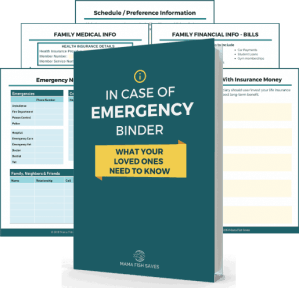
Image of Chelsea Brennan's "In Case Of Emergency" binder to organize your personal and financial information for your loved ones in case of your disability or death. | The-Military-Guide.com

Click on the image for more info.

When my father developed Alzheimer’s, he only had a minimal estate plan in place: a will and a medical directive. There was no plan for his disability… not even after his own father dumped that problem on him 20 years earlier. My father had six solid years of cognition after his father died, and yet he somehow never got around to putting the plans in place.

When I started handling Dad’s finances, my knowledge of disability planning for my spouse and me was even worse: only our “In Case of Emergency” file of logins & passwords. We had an estate plan, but it was legally useless for our disability.

Managing Dad’s assets for over six years gave my spouse and me plenty of opportunities to reflect on our plan. Despite our conclusions, it’s still taken months to put it into place.

When dementia appears, it’s too late to do the disability or estate planning. (Besides, once dementia starts, the word “No” is the easiest sentence in their vocabulary.) Lawyers and notaries won’t endorse a new general power of attorney, and existing general POAs become invalid with mental incompetence.

If you (or a loved one) end up in dementia or in a coma, then you can’t count on a general power of attorney. You might be able to rely on a durable POA (depending on the financial institution) and you should be able to depend on a revocable living trust.

You can always hire a lawyer and petition your local probate court for appointments as guardian and conservator. In our case that cost over $10K and several months of paperwork. It included an interview with a professional conservator (“Why should the court let you be your father’s conservator instead of hiring someone like me?”) and a criminal background check.

The real caregiver stress started with the conservator’s appointment. Many financial institutions either ignored the appointment or misunderstood it. (Pro tip: transfer the funds out of those corporations as soon as you can.) The probate court required annual reports and updates for every major change.

Again, this time the Ohana Nords caregiver stress stops with me. My spouse and I have spent hours researching and updating our disability plan. We’ve been married for over 32 years (and we’ve known each other for nearly 40) but the discussions have still been a little intense and revealed some emotional surprises.

It’s not just confronting your own vulnerability and mortality. No matter how ready you are, the legal hoops are darn hard to jump through. Even when you want to do the right thing (and when you trust your caregiver) it’s still too hard to create the paperwork. It’s prudent legal practice to protect well-meaning people from their own mistakes, but it’s just too hard.

I used to think that people couldn’t confront their disability planning. Now I know that many of us make an attempt and then simply give up in the face of legal bureaucracy.

The good news is that we finally worked through all the difficult conversations. Our daughter agrees with her part in the plan, and we’re drawing up the paperwork. We’re using an interesting combination of a revocable living trust, a pile of durable powers of attorney, and a couple of joint checking accounts. I’ll write another post about that when it’s in place.

Your Call To Action

3500 words. Got it. Now what?

I’m trying to boost a long-overdue intergenerational discussion. Hardly any of us mention our aging elders and their dementia challenges– yet when one of us shares a story, everyone in the room has a story too. Feel free to add yours to the comments below or in one of our Facebook groups.

Help other generations join the conversation. Even Gen Z is dealing with grandparents or parents who are living with dementia. I’m happy to talk through your questions and your problems.

In my next 25 years, long-term care expenses are going to level off or drop. Medications and care techniques are improving every year. There’s even the promise of caregiver robots. (Don’t laugh– I’m an angel investor, I’ve done the due diligence, and I’ve made meaningful investments in medtech.) We can track the care options.

Whether or not you decide to research your genome, learn how to live your healthiest lifestyle. If something bad happens, you want to know that you tried to mitigate it.

Carpe every diem. Regardless of your genes or your lifestyle, nobody knows how much time we have left. Would you prefer to live in the moment without worrying about the future? Would you stay in a terrible career out of a scarcity mentality and from fear of the unknown? Are your relationships sucking away your life energy?

Or would you rather save for financial independence and plan for your future with people who share your goals?

The next time we’re hanging out together, you can bring along this Alzheimer’s scorecard and see how we’re doing. One popular dementia check is drawing an analog clock face and showing the hour & minute hands at various times. (“Grandpa, what’s a clock face?”) Another spot check is spelling a two-syllable word backward– in your head or out loud to your skeptical potential caregiver.

Feel free to bring along your favorite adult beverage, and I’ll stick with my cup of coffee, thanks.

USAA’s “Life Uninterrupted” Campaign – Get a Free Retirement Review

My next post about our Nords family FI life will have a lot more info about our disability and estate planning, but you can explore your options now.

My father had 20 fantastic years of financial independence, and he lived his best life for all of them… until he couldn’t. He still had enough assets to have great care for the rest of his life and even left a legacy for his heirs.

I’m following Dad’s FI example, although my spouse and I aren’t so concerned about leaving a legacy. We’re putting the plans in place for our daughter and son-in-law to step in (if necessary) while we work on our own best lives. My spouse and I can easily expect another 30 years, and I’m highly motivated to stay cognizant for all of them.

What will your #LifeUninterrupted look like? Have you planned for doing the things that make you happy without worrying about finances? There are lots of advice and planning tools, and a fee-only advisor can help you pick your path.

You can start with USAA’s free retirement review. Simply visit the USAA website and set up a free, no-obligation retirement plan review. You don’t even have to be a USAA member to participate.

The USAA financial advisor can help you review your retirement plan and potentially help you identify coverage gaps or areas you may need to address, such as long-term care insurance, an estate plan, life insurance, increasing your retirement savings, paying off debt, etc. Your review will be tailored to your specific situation, goals, and needs. Click this link for a free retirement review from USAA.

Or I’m happy to answer questions and help you find whatever type of advisor you want.

My final advice—manage your own assets as simply as possible—especially if you want to make it easier for your heirs (or successor trustees) to manage them for you.

[earnist ref=”the-military-guide-to-financial-independence” id=”70177″]

Related articles:
Good News! How Our Nords Family Financial Independence Life Will Change In 2019
Our Retirement – The Spending Smile Of Financial Independence
In Memoriam: My Father
Alzheimer’s Care Financial Update (April 2016)
Why I Won’t Buy Long-Term Care Insurance (December 2014)
The Pitfalls of Your Parents’ Finances (May 2014)
How I Cost My Dad Over $2000 In Medicare Benefits (January 2014)
Geriatric financial management update (September 2012)
Forensic geriatric finances (June 2012)
Geriatric financial lessons learned (January 2012, becoming a conservator)
Geriatric financial management update (November 2011, claiming long-term care insurance)
More on caring for an elder’s finances (September 2011)
Financial lessons learned from caring for an elderly parent (August 2011)
Book report: “The 36-Hour Day”
Book review: “When The Time Comes”
23andMe genetic testing
10 Early Signs and Symptoms of Alzheimer’s

Posted in Insurance | 2 Comments

Our Retirement – The Spending Smile Of Financial Independence


Disclosure: This article is part of the Life Uninterrupted campaign sponsored by USAA. The #LifeUninterrupted campaign is designed to help future retirees learn how they can transition into retirement without worrying about financial interruptions. You can receive a free, no-obligation retirement review today by calling USAA.

Note: We are receiving a fee for posting; however, the opinions expressed in this post are my own. I do not earn a commission or percentage of sales.

After over 16 years of retirement, we’ve verified that we’re not spending fast enough. We have enough assets and income for the life we want, and for the rest of our lives. According to the statistics of the 4% Safe Withdrawal Rate studies, you’re likely to share the same experience. This post will help you figure out your retirement “Life Uninterrupted.” In other words, I’ll walk you through our 20 years of financial independence, how our spending had changed through the years, and how our retirement has remained on track the entire time – without financial interruptions.

If you would like a free retirement review from USAA to see how well you are on track, you can visit their site and schedule a free review.

In an earlier post, I promised more details on how our family financial independence life will keep getting better in 2019, and we’ll start by digging into our FI spending trends.

We have 40 years of spending history, so I think we can draw reasonable conclusions. I hope to collect at least another 40 years of data.

Track Your Spending and Cut the Waste

Image of Navy officers Marge and Doug Nordman in formal dress at the Navy Ball at the Naval Postgraduate School in Monterey CA. It was the start of their journey to financial independence. | MilitaryGuide.com

Starting the FI journey in 1987 fashions. Don’t judge.

I started budgeting in college when I finally got tired of running out of money. (“And this time I really mean it!”) A few years later when my spouse and I married, she elevated our skills to an Olympic level. I focused on the details by closely tracking our spending. Today our Quicken database has nearly 27 years of data in over 150,000 transactions.

While I dig into the numbers, my spouse is the big thinker in our couple. She usually pulls us back from my microscope to ask thoughtful questions.

Once we had a good track on our expenses, it was easy to find the waste. After a few thoughtful discussions, we were routinely aligning our spending with our values. (Pro tip: each of us has a monthly personal allowance for guilt-free spending with no judging.) Our savings rate shot up and we were on the road to financial independence.

Our “Why?” of FI was to regain control over our time (and our lives). We didn’t know how long we wanted to stay on active duty, and we were taking it one obligation at a time.

Today that’s still our “Why?” We don’t know how much time (or lives) we have left, and we want to make the best of both.

Financially Independent: Now What?

Image of Marge, Doug, and Carol Nordman in Waikiki Hawaii on the pier of the Atlantis submarine ride. | MilitaryGuide.com

Starting our FI life.

By late 1999 we’d saved and grown our investments to reach the tripwire of the 4% Safe Withdrawal Rate. (Hey, it was the peak of the Internet bull market. Millions of people reached FI that year.) It was also the first time in my military career when I was confident of earning a military pension. (That was not at all assured during the 1990s drawdown, because I’d fallen off the career track and then failed to promote.) Since I had less than three years to go in a billet which did not suck, I decided to hang on for the pension.

Financial independence paid another unexpected dividend: my spouse decided to leave active duty for the Reserves. Her last active-duty paycheck was in early 2001 and I retired in mid-2002.

It was an “interesting” time to stop working: the Internet recession was in full roar, and (in retrospect) the markets bottomed in October 2002. By that point, of course, everyone was convinced that the stock market and the economy were both going to zero.

We had done our reading and our analysis, and we were pretty sure we had enough investments for the lives we wanted. We started withdrawing money at the 4% Safe Withdrawal Rate.

Are you on track for financial independence? Get a free retirement review from USAA. You do not need to be a USAA member to take part in this offer.

16+ Years of FI Spending

2003 was our first full year of FI spending.

Before then, we did what every newly-FI person does: we reviewed every penny of our assumptions to make sure we’d caught all of our mistakes and still had a sustainable plan.

We rebuilt our budgets from zero. We reviewed every monthly bill, and we made a lot of phone calls to ask for our “retiree discount.” We had more time to find online bargains and shop at garage sales. We also kicked our do-it-yourself skills into high gear: more home-cooked meals and more home maintenance & repairs. We did our own chores and yardwork (and got plenty of exercise). We drove our (used) cars a lot less, but we still drove them into the ground.

Image of Carol Nordman at her Navy Reserve Officer Training Corps commissioning with Marge and Doug Nordman. Carol is in dress uniform and is removing the tape over her ensign's rank insignia. | MilitaryGuide.com

Joining the family business.

Yet we maintained the parts of our lifestyle that we’d worked for. We ate out whenever we wanted, and we still enjoyed plenty of travel and other entertainment.

Life went on, and it was very good. We navigated our daughter’s teen years and she started her own path to FI. We endured the Great Recession, although our investment portfolio briefly dropped over 50% from peak to trough. We explored new interests. (Surfing and taekwondo.) Since I’m an engineering nerd, we built our own photovoltaic array and our own solar water-heating system. We survived our 40s, and now we’re in our… high… 50s.

I tracked every penny of our FI spending in Quicken up through 2015. In 2016, I delegated that task to Personal Capital (we only use Personal Capital to track investments and spending, we do not use their investing service). We spend very little in actual cash, so we still have a close track on our spending.

During our first decade of retirement, we knew that a bad bear market could derail our 4% SWR and kill our investment portfolio. We had contingency plans for the worst-case scenarios, but we never needed them. Now after 16 years, it’s clear that we are no longer vulnerable to the dreaded sequence-of-returns risk.

The Retirement Spending Smile

Image of reseaercher David Blanchett's plot of changing retiree spending (the "smile") from Michael Kitces' post describing the results. | MilitaryGuide.com

Click the image for a bigger version.

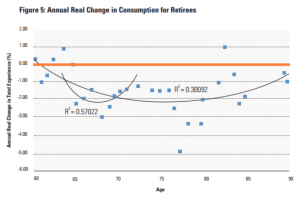
Michael Kitces was one of the earlier researchers to popularize what financial planners had observed for years: retirees start their spending at a sustainable rate, but then it declines.

A couple of years later, Wade Pfau’s analysis verified the conclusions about retiree spending. Researchers have shown that retirees start with a go-go lifestyle, later ease back to a slow-go phase, and eventually settle into a no-go routine. The majority of end-of-life spending (the other side of the smile) is for medical care.

We’ve been a very active family for our first 16 years of retirement, and we’re doing everything we’ve wanted to do. More importantly, we’ve continued our laser-like focus on cutting the waste. Today our bare-bones living expenses are the lowest we’ve ever had.  We could live extremely frugally if necessary, but otherwise, we have more money for more lifestyle!

Last year we finally finished 16 years of Roth IRA conversions to pay lower income taxes and avoid mandatory distributions. Thanks to the analysis of Personal Capital, this year we’re moving our investments from expensive sector exchange-traded funds (with expense ratios of 0.25%-0.39%) to a total stock market ETF (0.04%), which will save us thousands of dollars a year.

One of our 12-year-old cars started racking up the repair bills, so we upgraded to a used Nissan Leaf– which recharges its battery from our solar array and will cut our gas bill by $400/year.

At the same time, we’ve optimized our entertainment spending. I’ve joked about “Travel while you can,” but we’re going to keep going as long as we can.

Retirement travel is actually cheaper than work vacations. We roam for months instead of weeks, living like locals and avoiding the tourist crowds. Travel hacking (airline miles and Space A military flights) has reduced our airfare while AirBnB and VRBO let us rent cheap apartments (with kitchens) for months. (We were travel hacking before it was cool.) We’re paying off-peak long-term prices instead of living like two-week millionaires at a resort hotel.

Our saving & investing has paid off. How has all of our optimization affected our retirement spending? I’ve spent about 10 man-hours crunching the long-term numbers, and I was surprised to see the big picture.

“Let’s Look at the Graphs.”

[Note: “Comparison is the thief of joy.” I’ve indexed our actual spending to a starting value of $100, and we show actual spending as a percentage of the value of our investment portfolio. Instead of being distracted by how much we spent or our place in our journey, you can compare these ratios to your own numbers and your own progress.]

In these graphs, our expenses are compared to only our investment portfolio. That’s all we were able to rely on when we reached FI, and it’s turned out to be more than enough. We weren’t counting on home equity in 1999 because the Hawaii real estate market had declined nearly 50% from its 1990 peak. My military pension came three years after 1999, and our rental’s cash flow began much much later in 2008.

In 2019 this all seems pretty straightforward in hindsight. 20 years ago? Not so much.

We did not have any crystal balls in 1999, and we certainly didn’t have any in 2001 when my spouse decided to leave active duty. We made those decisions for a better quality of life because we had enough investments for the 4% SWR.

The 4% SWR’s 80% probability of success came through.

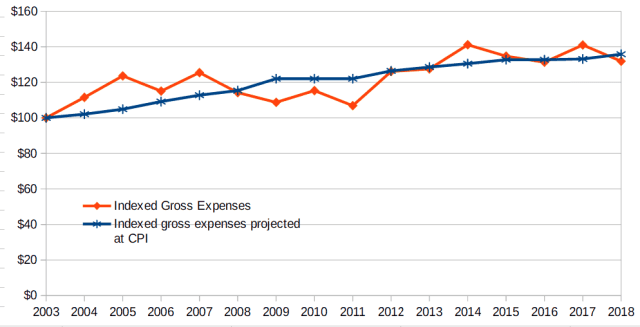
The first graph shows 16 years of retirement spending. The orange line is indexed to a starting value of $100 and has risen over the years to $132. The blue line starts at the same origin but assumes that our spending grows at the 4% SWR’s rate of inflation. After 16 retirement years of the Consumer Price Index (the same inflation index as the military pension and Social Security), our spending should be at $136.

We wandered above and below that 4% SWR curve, yet we still ended up on the low side.

Image showing actual retirement spending compared to retirement spending at the rate of inflation. The actual expenses tracked fairly closely to the projected expenses. | MilitaryGuide.com

Orange (actual) is pretty close to blue (the CPI trend).

In 2004-05 we were spending on home improvement projects like our photovoltaic array and our solar water heater. We were also ramping up our taekwondo training and doing more travel during school holidays.

We spent 2008-2011 coping with the Great Recession. Humans are not 4% SWR robots, and we traveled to less-expensive locations because we felt uncomfortable about partying like it was 1999. By 2011, though, our daughter had started college. We ramped up our lifestyle with home improvement and even more travel.

How did that affect our withdrawal rate?

Image of actual withdrawal rate compared to the 4% Safe Withdrawal Rate | Military-Guide.com

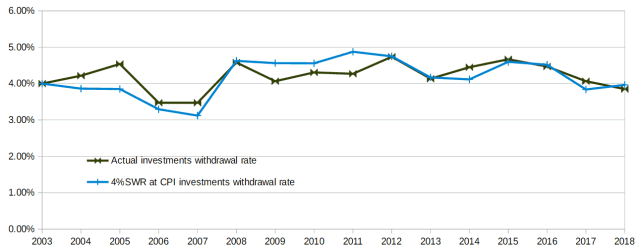
Again, this graph indexes our first full year of retirement to the 4% SWR. The black line shows our actual spending divided by our investment portfolio’s value. In 2006-07 our withdrawal rate dropped below 4% because the value of our investments grew much faster than our spending. That went the opposite direction in 2008-12 as our investments took much more of a beating than our spending.

The blue line shows what our withdrawal rate would have been if we rigidly spent the 4% Safe Withdrawal Rate by starting at a 4% withdrawal and raising our spending by the rate of inflation. The graph’s variation is caused by the changing value of our investment portfolio, yet everything recovered and converged back to that 4% line by 2017. Now it’s trending down below 4%.

We’ve been withdrawing from that investment portfolio for over 16 years and two very scary recessions. Despite the volatility, it’s doing just fine. We know our expenses will be lower in 2019, leaving more in our investments to grow even faster.

The Go-Go Years

We’re having as much retirement fun as our bodies can handle. (I don’t surf 20-foot waves anymore, but 10-15 feet is still fun.) Our retirement spending is in the middle of Michael Kitces’ “go-go” years of the retirement spending smile. We’ve kept it up for over 16 years and our investments have done just fine.

Although our total spending has tracked the 4% SWR, our non-discretionary spending has dropped dramatically since 2003. We have lower utility bills, lower insurance expenses, lower vehicle expenses, a lower interest rate on our mortgage, lower expense ratios on our investments, and a much lower income-tax bill. We’ve raised our family and our daughter is off our payroll. We’re eating healthier while spending less. Even home maintenance (and improvement) is cheaper.

I haven’t had a haircut since early 2002. We’re really racking up the savings on that one.

Controlling the essential expenses has given us a lot more to spend on entertainment.

Yet even our entertainment is less expensive. I’ve bought all the surfboards I can handle. (Surf wax is cheap.) Empty-nester travel during shoulder seasons costs less than family summer vacations. Travel hacking has dramatically improved, and these days we enjoy the occasional first-class lie-flat seat. (A sleeping bag and a yoga mat on the deck of a military cargo jet is still the ultimate aircraft lie-flat experience.) We can see plenty of room to ramp up that lifestyle.

More importantly, my inflation-fighting military pension now protects us from volatility risk and sequence-of-returns risk. The CPI has gone up a total of nearly 40% since we retired, but our annuity income has also risen by nearly 40%.

The Slow-Go Years

Image of comic-strip character "Ol' Surfer Dude" from Doonesbury comic strip. | MilitaryGuide.com

Doonesbury’s “Ol’ Surfer Dude” rocks.

We’ve already verified that our current lifestyle expenses are sustainable, and I’d like to think that I have another 30 years of travel and surfing in me. I’ll let you know how that goes.

In the meantime, we’ve won the financial independence game. The major risks have already been covered, and now we’re just running up the score.

Social Security is on the horizon if we need it. (We won’t need it.) We can finally afford the opportunity cost of our rental property. My spouse’s Reserve pension starts in 2022. Philanthropy and estate planning are in progress.

Our No-Go Years

I don’t have a clue on that part of our lives, except to hold it off as long as possible. There are a few surfers in our lineup who are in their 80s. I know of a couple of famous surfers who were paddling out in their 90s. I may not be popping up on a longboard, but if I can’t paddle a stand-up board then I’ll still be out there in a kayak.

When my father passed away in 2017, he passed on an inheritance (and some life insurance) to my brother and me. We’ve invested that in a total stock market index fund to self-insure our long-term care expenses. We expect at least 20 years of growth out of that fund before we’ll even think of using it.

USAA’s “Life Uninterrupted” Campaign – Get a Free Retirement Review

As I was researching and writing this post, I’ve realized that we’re years ahead of USAA’s new “Life Uninterrupted” campaign.

We saved for retirement as aggressively as we could, but we were keenly aware of the line between frugality and deprivation. (The former is challenging & fulfilling and you feel like you’re winning, while the latter is painful and unsustainable.) When we declared our financial independence, it was at our desired lifestyle with much more than a bare-bones survival budget.

It’s also a highly individual choice! These days the FI community is exploring categories like FreedomFI (a year off from work), leanFI, BaristaFI (part-time work), fatFI (you know that one), and even MOFI (“morbidly obese” FI). You’ll find your lifestyle comfort level– as long as you’re willing to work the months of life energy to afford it.

I’m a nuke and a hardcore spreadsheet nerd, so we didn’t seek much help from financial advisors. However, we spent many hours reading everything available in the 1980s and 1990s. When the Web exploded in the 21st century, we finally found our communities and crowdsourced even more advice. Today’s tools and retirement calculators are more widely available and better than ever before.

If that last paragraph doesn’t work for you, then it’s worth consulting a fee-only financial advisor. You can start with USAA’s free retirement review, or I’m happy to answer questions and help you find whatever type of advisor you want. (Interestingly, USAA recommends hanging on to your TSP account for as long as you can.)  Take the advice you want, and then manage your own assets as simply as possible.

Most significantly of all, you’ll stay invested in an asset allocation which will at least keep up with inflation. This means that your own retirement spending smile will gradually drop your initial 4% SWR to an even more sustainable rate. Once you get there, you’re practically bullet-proof for life.

Your call to action: 

[earnist ref=”the-military-guide-to-financial-independence” id=”70177″]

Related articles:
Good News! How Our Nords Family Financial Independence Life Will Change In 2019
How Do You Survive A Stock Market Crash?
How (And Why) To Transfer Your TSP To An IRA (when the income-tax bracket is right)
Revealed: Our Asset Allocation During Financial Independence (new post on this coming soon)
Surprising Secrets Of Slow Travel
How Many Years Does It Take To Become Financially Independent?
Retirement: Relax, Reconnect and Re-engage
The “Fog of Work”

Posted in Financial Independence, Military Retirement, USAA | 5 Comments

Good News! How Our Nords Family Financial Independence Life Will Change In 2019


2018 was quite the turbulent year for the financial independence crowd, and it’s just going to get busier in 2019.

Let me cover a few highlights from last year and then give a personal update. I’m here to reassure you that financial independence is sustainable and life is good.  At the end of the post, I’ll share a few more personal details from our years of FI experience.

Sit down, strap in, and hang on.

The Media

Image of American flag flying in the breeze beneath a rainbow in a Hawaii neighborhood as a metaphor for turbulence about the Financial Independence movement | The-Military-Guide.com

Turbulence even in Hawaii?

The media seems to have jumped on the FI bandwagon, but I don’t see any of them declaring their own FI with a mic drop. Instead, they’re going for the drama, bless their hearts: giving the public the impression that we’re all black-belt frugalists living under highway overpasses and dining on fresh roadkill. We’re recycling our toilet paper and missing out on life while chortling over our 98% savings rates.

Either that or (according to other astonished journalists) we’re all white males with tech careers and $300K salaries. We’re complaining on the fatFIRE groups about how hard it is to back our Teslas up to the free EV charging stations. We all earn six figures from our side hustles and we’re adding millions of points to our Chase Sapphire Reserve rewards accounts. With our 98% savings rates.

A few articles are concerned that we have no idea what we’re doing. We’ll lose all of our (working) friends, we’ll be so bored, we’ll run out of money, we’ll lack fulfillment and wither away into miserable outcasts.

Image of Suze Orman testifying in front of a Senate committee in 2007, long before she said how much she hated the FIRE movement. | The-Military-Guide.com

2007, long before she retired.

No, I’m not going to give those media outlets a backlink from this site. Here’s a better link from Paula Pant.

Personally, I think we (me included), were all snookered by that Mistress Maven of Marketing, Ms. Suze Orman herself, screeching at the crowd of stunned Afford Anything listeners about how intensely she hated the FIRE movement. Even by her drama standards, it was an epic rant– although she still managed to moderate her outrage enough to mention her book, her new show, and Oprah.

Fortunately, it turned out that mistakes were made (but not by Suze), and she was never adequately informed about what FIRE really means. A few weeks later she admitted that she’d been completely rehabilitated and she now enthusiastically supports the FIRE movement… with her book, her new show, and Oprah.

The Good News About FI

Meanwhile, we personal-finance bloggers and entrepreneurs are all growing older with the FIRE movement. (I’m still trying to avoid “maturity”.) Many of us are looking at sustainable lifestyles (not just sustainable finances) and considering our next acts. Even as J. Money grows his audience (and his net worth reports) at a record pace, he’s committed to being an at-home parent who blogs instead of a hardcore at-home blogger who parents. Kids will do that to us every time!

Military veteran Jeff Rose marked a decade of blogging with his biggest year ever. He joined a seemingly huge crowd of other successful online entrepreneurs who’ve moved to the vicinity of Franklin, Tennessee. He started 2019 with a bang by declaring that he’s sold his advisory firm and is starting a new phase of life.

Image of Brandon Turner of BiggerPockets real estate website (on left) next to Rich Carey of RichOnMoney.com, next to Doug Nordman of The-Military-Guide.com, next to Scott Trench of BiggerPockets.com. | The-Military-Guide.com

Brandon on the left, 2-4 feet of surf in the back.

In August 2018, Brandon Turner of BiggerPockets announced that the Turners were moving… to Franklin Tennessee. No, just kidding, they moved to Maui. (Seriously!) He’s been surfing since FinCon16, he’s spent months researching the surf breaks of Oahu, and they keenly appreciate how much warmer the ocean is around Hawaii than in the Northern Pacific. I’ve watched them work every real-estate tactic that he’s ever shared with the BP audience, from “How can we find a way to afford that?” to negotiating the price and fixing the permit issues.

2018’s FinCon and the Military Influencer Conference were by far the biggest ever— so big that I met more new friends than old friends. Camp Mustache continues working its magic up in North Bend WA and a few other sites. (I feel a twinge of FOMO every time I see the latest stories, but it’s not on our radar for another year or two.) Meanwhile, CampFI has expanded like crazy, bringing a similar small-crowd weekend experience to just about everybody’s time zone. Check CampFI’s 2019 schedule and make a commitment, because they’re selling out fast.

Image of the "Playing With FIRE" documentary book and audiobook on Amazon. | The-Military-Guide.com

Click the image to learn more.

Best of all, the “Playing With FIRE” documentary is hitting the streets soon. (The audiobook and the paperback & eBook are out this month, too.) Travis Shakespeare told me about his plans way back in 2016, and fate connected him with Scott & Taylor Rieckens to make it happen. (Scott brought me in for an interview… there was surfing… and we’ll know in a few months whether that made the editing cut.) They raised a monster six figures on Kickstarter to finish the production, but you should track down the book now… and either shell out the investment for your FIRE or ask your local public library to buy a copy for you.

(There are no affiliate links in that last paragraph. And I supported the Kickstarter campaign about 10 minutes after Scott announced it at FinCon.)

On the military side, the Department of Defense has finished implementing the biggest pension overhaul since WWII. Whether you’ve opted into the Blended Retirement System or decided to stick with legacy High Three, it’s irrevocable and we’re moving on. Now we’ll help you make the right military financial decisions to optimize your life, your career, and (possibly) your pension… in that order.

Also on the military FIRE side, my friend Grumpus Maximus had a huge year with his site, and he shared his analysis of the blinding epiphany that he can retire at 20. His military chain of command has obligingly agreed that he can start terminal leave this October. I need to connect him with a West Coast surfer (and military retiree) friend who can help with the remaining questions of longboard design.

The Other News

2018 wasn’t all unicorns and rainbows. It turns out that life after financial independence has many of the same challenges as life before FI.

Brandon Turner and Josh Dorkin have recorded over 250 episodes of the BiggerPockets podcast, but Josh announced that he was stepping down to spend more time with his family. Everyone’s doing much better but, as Josh said, they went through some truly terrible things on the road back to health. Brandon has partnered the podcast with David Greene and headed for the future. BiggerPockets is getting, well, bigger with more podcasts and their expanded book catalog.

J.D. Roth has released the surprising news that he’s no longer financially independent. He’s still doing well, and he’s living the purpose-filled life he wants, but he’s also making major changes. I suspect that this financial dip will be temporary and he’ll be back on a solid FI footing by 2020. Please read his thoughts and follow his site to watch him work through the finances of what everyone fears about life after FI.

Image of What's Up Next podcast logo and episode of a panel discussion about divorce with DocG, Paul Thompson, J.D. Roth, Mad Money Monster, and XRayVSN. | The-Military-Guide.com

Click to listen.

In other surprising news, Pete & Simi Adeney have divorced. His New Year’s Eve announcement was preceded by months of speculation. Many readers were less curious about why the divorce happened and much more concerned about the impact of divorce on FI. For example, a few skeptics are re-interpreting Pete’s financial updates of 2018 through the filter of whether they were raising money to pay for the divorce or for the division of marital assets. (Spoiler: they’re doing fine financially.) As Pete says, read the comments on his site to share in the messages of hope for post-divorce happiness.

In that vein, podcasters Doc G and Paul Thompson over at “What’s Up Next?” put together a very compelling panel on divorce. It includes J.D. Roth’s long-term perspective and other well-known financial writers who’ve dealt with their divorces. The discussion is both painful and inspiring.

I’ve cited enough examples here. I’ve heard about a few other FI relationships breaking up, and several FI bloggers who are struggling through market volatility or unexpected expenses. I’ll let them share their stories in their own way.

My point (and I do have one…)

As much as this spate of “other” news reflects life’s turbulent changes, it also raises a difficult issue about blogging and podcasting and YouTube channels. When we FI exemplars seek the limelight for our philosophies and share our lifestyles as a testament to our advice, then we become public figures. (We’re public even if we don’t have those little verification marks next to our social-media handles.) We’ve all invited our audiences to watch us pursue our goals of financial independence. We’ve generally been open about the successes and the failures. Especially the failures.

The media tropes have shown what audiences really want to know about our FI movement: whether we’re blindly optimistic, or sadly deluded, or (even worse) lying liars. People want to know how our FIRE advice applies to them, not just to our lifestyles. You can study the logical & mathematical nuances of the 4% Safe Withdrawal Rate for years, and you can follow dozens of mentors, but it’s still intensely personal. Everyone feels that terrifying leap of faith to embark on your post-FI journey and make your assets last for the rest of your (long, healthy) life.

I know that now, because I gutted it out on active duty and wasted years of my life pursuing the financial security that we’d already achieved.

Image of Great Garbo in the 1920s saying "I Want To Be Alone" as a public figure trying to regain her lost privacy. | The-Military-Guide.com

Is this reference too obscure?

In my opinion, when our blogger personal lives take a turn for the worse then we have to keep up our public narrative. We can’t just flip a personal switch from “PUBLIC, woo-hooo!!” to “Privacy please.” The sooner the better, we should announce: “We’re going through some difficult personal issues and we’d appreciate people respecting our privacy while we work this out. We’re still FI and we’ll share our thoughts later.”

We can’t just go dark. Even worse, if we create a vast sucking void of personal silence then everyone else will fill that vacuum with speculation. When you surrender control of your story then the media’s FI obsession will bring a Suze smackdown back on you.

As a writer, I own another bias: writers have to write. If you’re going to write about all the awesomesauce in your life, then you owe it to yourself (and your loved ones) to accept the challenge of writing about the less awesome. You can’t just turn off the stage lights and walk away for a few months of solitude and silence. In fact, when you’re a writer then you NEED to write about what’s happening in your life, if for no other reason than keyboard therapy. Maybe you write because you just can’t shut up (or so I’ve heard), but perhaps your writing process helps you make sense of your life.

Take control of your narrative before someone else does it to you.

Changes To Our Family’s FI… And Our Lifestyle

Here’s my 2019 narrative for Ohana Nords: it’ll look a lot like 2018. Life is good, and it goes on.

Life milestones.

Last June I reached 16 years of military retirement. My spouse and I have logged 19 years of financial independence. We’ve known each other for nearly 40 years and we’ve been married for over 32 years. We’ve also shared 17 years of dual-military active duty, which means that we’ve only lived together for 29 of those 32 years.

We’ve moved over a dozen times with the military, and not always together. Today we’ve lived at the same address for over 18 years, which is a personal record for each of us. I’d like to do a few more decades of that same-address lifestyle.

Our fellow Baby Boomers are experiencing that life stage when the kids are launched, the careers are winding down, and people reflect on their life choices. FI gave us a head start on our cohort, and we’ve already spent years working through those stages.

Image of Doug and Marge Nordman hiking the Lanikai Pillboxes trail on Oahu as a metaphor for healthy living. | The-Military-Guide.com

Hiking Oahu’s Lanikai Pillboxes trail

My generation’s “gray divorce” statistics are soaring, yet I feel that FI has made our marriage stronger than ever. The skills that get you to FI help you work together and share common goals in life as well as with money. Perhaps financial independence simply makes you more of what you already are.

Marge and I tend to discuss our life questions to absolute exhaustion before reaching a decision– even though we don’t always agree. Each of our major life changes means that our rules are subject to renegotiation, and we’ll keep talking through them. My spouse has very good longevity genes, and she frequently assures me that she will outlive me. I think that means we’ll have many more years together. Right? Right.

Investment milestones.

A few months ago I turned 58 years old, and now I’m only 16 months away from that fabled age of 59.5. I’ve spent years planning for early withdrawals from retirement accounts without penalties or taxes, and now that stage of my life is almost finished.

Ironically that milestone age won’t change anything. The math of the 4% SWR has a small failure rate, but it also has a much bigger success rate. More than 80% of the time, you’re going to end up with more money than you need– despite recessions, bear markets, volatility, and unexpected expenses. In our case, it’s way more. We never touched our Roth IRAs during the last 16 years, and unless we crank up our hedonic treadmill then we won’t touch them during the rest of our lives.

Once you get past FI’s first decade of “sequence of returns risk”, I’ll speculate that even divorce and eldercare won’t extinguish your FIRE. You already have assets, and you’ll be able to rebuild your wealth through a few years of cutting expenses, freelancing, and saving. Social Security will eventually kick in with its inflation-adjusted annuity.

Image of a bar chart of Nords net worth expressed as a percentage of Financial Independence, rising from 100% in 1999 to 253% in 2018. | The-Military-Guide.com

Click to read about the details

Volatility.

Our investment portfolio dropped in 2018. Instead of having 258% of the money needed for our continued FI, we were down to 253%. We’ve already recovered a bit of that drop in January.

Surprisingly our 2018 spending has remained flat… again. We started our FI at the 4% SWR and our expenses have lagged behind inflation. Meanwhile, my military pension has gone up 40% in 16 years and our investment portfolio has grown faster than inflation. Having more than 2.5 times the 25x assets for a 4% SWR means that our FI is darn near bulletproof. We’re not talking yachts and private jets, but we’re certainly enjoying cruises and first-class travel hacking.

Everybody fears running out of money, but our FI spending is following the typical “retirement spending smile”. As long as your portfolio keeps up with inflation, your FI is sustainable.

During Camp Mustaches and CampFIs I’ve given a talk titled “How I Wish I’d Invested Back Then”. I’ll turn that into a blog post with detailed examples of how much more robust the finances of FI are with today’s tools.

Estate planning.

As many of you may remember, my father passed away in November 2017 from late-stage Alzheimer’s. (I’m shocked to realize how long ago that was, because I’m still dealing with the files and the family photos.) My brother and I settled Dad’s estate by March 2018, and I’ve inherited half of it.

The inheritance won’t make a difference in our lives. I’ve put those funds into a personal account (invested in a total stock market index fund) which we’ll either give away or make our heirs very happy. My spouse and I have already self-insured for long-term care, and an inheritance won’t change that.

I’ll write more about Dad’s finances in another post. I’ve learned a lot of lessons about estate planning, settling an estate, and the emotions that go with it.

The important news about the inheritance account is that we jumped through Fidelity’s flaming circus hoops to give our daughter a durable power of attorney over it. If she ever needs to take care of us after an emergency (due to our disability) then she can tap the funds right away instead of having to petition the probate court for conservatorship. I’ll write a lot more about that as we put the rest of our assets into our revocable living trust.

Simplifying our finances.

As I settled Dad’s estate, my spouse and I realized that our finances have grown more complicated than necessary. We spent most of 2018 turning over our bill payments to her accounts. (As she says, our bills are already in autopilot and there’s nothing left for her to do!) The durable POA was a big step and our RLT will be quality lawyer time, but we’re also simplifying our asset allocation.

Over the next few tax-efficient years we’re moving to just one ETF (a total stock market index, 0.04% expense ratio) and our remaining Berkshire Hathaway “B” shares (0% expense ratio). I’m winding down my angel investments (“survivor bias” has already happened) and by my 60th birthday, our investments should be totally in autopilot.

Rebalancing? Nah. We’ll spend the ETF’s 1.8% dividends and sell the shares as needed (at lower capital-gains income-tax rates).

We stopped budgeting over three years ago, and now we track our spending in autopilot. Personal Capital has already helped us reduce our investment expense ratios and nudged us to raise our umbrella liability insurance. PC is our only financial tracking tool for the next few years. I hope they stay in business.

Spending trends.

PC works very well for us because our spending is largely flat (in the long term) with a few lumps (in the short term). Our spending has lagged inflation for over 16 years, even as we broaden our slow-travel lives. We enjoy buying used stuff and flexing our DIY skills, which means extended sweat equity (and low recurring expenses) punctuated by rare replacement purchases.

We’ll continue blowing out bigger bucks for months of slow travel. (Mostly for AirBnB apartments, because we prefer military Space A for our air travel.) We joke about “travel while you can”, yet we’re very glad that we reached FI while we’re young enough to have many years of travel left in us.

Image of a red 2015 Nissan Leaf in a driveway on Oahu. | The-Military-Guide.com

Cash for a 2015 Nissan Leaf with 13,298 miles.

Our 2006 Prius is running great but it’s racking up expensive repairs in auxiliary systems, so we gave it away and we bought a 2015 Nissan Leaf electric vehicle. We’ll recharge its battery from our photovoltaic array, which means that I’ll buy a few more solar panels. We’ll knock about $400/year off our vehicle operating expenses. The Leaf needs almost no maintenance, although our second car (a 2005 Prius) still has oil changes and other gas-engine chores. The Leaf is the ultimate in engineering nerd frugal cool… and way more entertainment per dollar than a Tesla.

Health.

Now that I’m no longer under the benevolent supervision of the probate court (for my father’s finances), I’m free to disclose more updates about my health. No worries, as the doctors say I’m doing “as well as can be expected for a man of your age”. (What the heck happened?!?) Much to my surprise, there are signs that I may be mortal after all.

My knee injuries and hearing losses are having their way with me like so many other military veterans. My muscle fatigue, recovery time, and stiff joints are more insulting every year. I also have a few genetic zingers which I’m minimizing with a healthy lifestyle. Luckily I know many ways to paddle around on the water, and I’m going to keep paddling as long as I can.

I’ll share more “financial life planning” details in another post.

Once again I’m very glad that we made FI a priority, and I’m keenly aware of unpredictable lifespans. If you’re afraid of the 4% SWR’s sustainability then I’ll put that into perspective with some bigger life fears. You never know how much time you have left, and you might not want to spend it in the workplace. It’s worth pursuing FI earlier in life so that you’re not deprived of your remaining life.

Travel plans.

Speaking of traveling while we still can, my spouse and I will be at CampFI Mid-Atlantic on 24-27 May in Spring Grove VA. Add your name to the standby list, because you’re in for a unique reunion. Justin (RootOfGood) and I have been online friends for over 15 years, and this will be the first time we meet IRL! You’ll want to witness this epic gathering. Please take pictures.

This fall we’ll be in Washington DC for FinCon19 (4-7 September) and the Military Influencer Conference (8-10 September). Afterward we’ll scamper for a Space A flight to attend our first Chautauqua in Portugal (21-28 September). We expect to spend October and November roaming the Iberian Peninsula. Seeing all those old buildings and ancient olive orchids makes us feel young again.

More of the FI crowd.

2018 changed many lives, but perhaps those are just the media’s attention-getting headlines. Consider the longevity of other FI rockstars, and understand that the FIRE lifestyle is sustainable.

Vicki Robin has put out a new call to the “Your Money Or Your Life” community, and rumor is that she’s working on another book. (She’s my longevity role model.) John Greaney has 25 years of experience with the 4% SWR and lots of advice for health insurance. He’s a 20th-century FIRE godfather. Meanwhile, Billy & Akaisha Kaderli continue to wander the world after nearly three decades of perpetual expat travel. Their net worth has also risen faster than inflation.

Our FI life seems pretty tame compared to their examples, let alone the media’s drama of 2018. I had plenty of excitement during my military years, and I’m happy to settle down to a more mellow routine.

We planned for the worst but we’re experiencing the best. Your FI life could be like that too.

Your Call To Action:

Start here to continue your 2019 journey of financial independence.

[earnist ref=”the-military-guide-to-financial-independence” id=”70177″]

Posted in Financial Independence, Investing & TSP, Military Retirement, Money Management & Personal Finance, Travel, What Do You DO All Day?!? | 10 Comments

Separating Or Retiring While Overseas (But Not With The Navy!)


A reader writes:

I’ve been commissioned from the Navy’s enlisted ranks and have not yet reached eight years of commissioned service. I’m eligible for retirement and I’ve enjoyed active duty– until now.

I’d like to retire as an officer but I’m not sure if I’ll be able to get to 10 years. I’m considering retiring a few years ahead of my plans because my assignment officer is pushing hard for me to go overseas for my final tour. I do not want to retire from overseas because it’s not conducive to financial planning, house hunting, or searching for a job in the U.S.

This is a very pertinent retirement question, and it’s also an opportunity to address another issue: the Navy’s quirky process for overseas orders.

I’m not going to try to change anyone’s mind about the timing of overseas assignments, but I’ll discuss some additional factors to help with the decision. They range from the best case to the worst case.

[Disclosure: I might be biased. I enjoyed overseas duty. More than 14 of my 20 years of active duty were spent outside CONUS. My spouse spent over 19 of her 25 years of Navy duty overseas, and we’ve lived in Hawaii since 1989. We keenly understand the challenges of separating from the military while overseas, and it might not be as critical of an issue as it seems.]

The Navy’s Rules on Separating from Overseas Duty

Image of the Naval Military Personnel Manual NAVPERS 15560D regarding separating from active duty overseas | The-Military-Guide.com

Click here to read more.

Separating or retiring from overseas frustrates my Navy readers, but it’s for exactly the opposite reason from this reader’s question. Many Navy families want to stay overseas after separating, yet the Navy only handles that under special circumstances.

The Army and the Air Force will happily separate their servicemembers overseas at just about any duty station around the globe, while the Navy normally transfers their servicemembers to the U.S. for several months of “outprocessing” before retirement.

I don’t understand the logic behind that requirement, although it can be waived in some situations. I’ve read rumors that the Navy claims the return to the U.S. is required by their accounting for sea duty OPTEMPO, and they close it out by having the servicemember transfer to San Diego or Norfolk for temporary duty in a Transient Personnel Unit. Apparently, this happens even for sailors on overseas shore duty. It sounds like something out of a 1920s history book.

Meanwhile, Navy families want to separate overseas to travel around Europe or Asia for a few months, and maybe even get a work visa. Army & Air Force families do it all the time, but Navy families have to come back to the U.S. (on the Navy’s travel budget) and then figure out how to get back overseas on their own expenses & logistics.

Here’s the guidance straight out of the Military Personnel Manual 1910-812:

Members eligible for separation while serving on a permanent station OCONUS, except Hawaii, unless immediately reenlisted on board, shall be transferred to the appropriate separation activity listed in this article, nearest to the port of debarkation in CONUS.”

The only way around this requirement appears to be finding a command which can handle separations of Navy servicemembers (under honorable conditions):

Members eligible for separation may be transferred to a separation activity not listed in this article, provided the gaining activity has no objections to receiving personnel for separation processing, and the gaining command’s Personnel Support Activity Detachment has separation capability”.

I hope the capability to process those separations means “has access to the Internet”. Then a few paragraphs later the MILPERSMAN goes into the waiver to separate overseas:

Member’s request to the Commanding Officer contains a statement that application has been made for a passport, that such passport will be granted upon separation, and that permission to remain in the foreign area has been, or will be, obtained; and”…

In the case of this reader, they’ll have no trouble transferring back to the U.S. for the temporary duty of outprocessing. Between that and terminal leave (as well as their own access to the Internet), they’ll have plenty of time and opportunity to start the career search.

Retiring with Less than 10 Years of Commissioned Service

This requirement causes tremendous confusion among prior-enlisted active-duty officers. Federal law requires that Navy and Marine officers have 10 years of commissioned service to retire at an officer rank. (The Army and the Air Force have similar federal laws.) Those laws allow the 10-year requirement to be waived down to eight years, but only through the end of September 2018.

Yet retiring now (at an enlisted rank) might not be as financially devastating as it seems.

If a prior-enlisted officer elects to retire at an enlisted rank, then after retiring they can still be advanced to the officer ranks (and an officer pension). A different federal law takes effect at the combination of 30 years of active service and time in retirement, when a Navy or Marine enlisted retiree can be advanced on the retired list to the highest grade held satisfactorily on active duty. (The Army and the Air Force also have similar federal laws.) This means that a 20-year retiree still has an inflation-fighting pension (and Tricare), and after 10 years of retirement their pension will revert to their officer rank.

This reduces the financial impact of retiring with less than 10 years of commissioned service, especially if they’re leaving active duty for a high-paying civilian bridge career.

The Search for the Bridge Career

If I had to rank the top ten concerns about the bridge career search, being overseas wouldn’t even make the list. Fortunately for overseas military, today’s job searches are largely done online. There are literally dozens of virtual job fairs for servicemembers, vets, and military spouses. That includes virtual networking (especially online webinars and conferences) and Skype interviews.

I’ve spent years helping vets navigate the bridge career transition, and one of the most annoying aspects of the process has been learning the corporate hiring cycle. Many companies will not make a decision more than 90 days out, and a few (defense contractors) won’t even hire a servicemember who’s on terminal leave. It’s their own ethics policies, based out of their interpretation of federal law for contract competitions.

A few officer ranks and specialties have federal ethics restrictions on being hired by corporations which they may have worked with while on active duty. That simplified summary comes from the 110-page “Compilation of Federal Ethics Laws” manual. Even if some of the requirements in those references don’t apply to certain enlisted ranks or situations, the corporation’s overall hiring policy may discourage any exceptions to their own rules.

Another complication for military retirees is the federal law requiring a 180-day wait before accepting employment as a civil servant in the Department of Defense. It’s caused a lot of confusion because of legal changes and proposed legislative amendments.

The 180-day requirement was waived shortly after the 9/11 attack but was reinstated in late 2016. There’s still a waiver process for hiring within the 180-day window, but the cynical punchline is that it takes a little over six months for approval.

The result is that separating servicemembers might not even meet the hiring committee in person until less than 90 days before their separation date. Then 180 days after separation, there’s another wave of opportunities for DoD civil service and more civilian corporations.
Financially, these delays are a compelling reason for building a transition fund of at least six months’ expenses before your final military paycheck.

On the other hand, when you’re pursuing financial independence then it’s easy to take a few months after the military to explore the world.

Fortunately, the bridge-career search process is the same whether you’re in the U.S. or overseas. It starts with narrowing down your interests to a few career fields and then figuring out what corporations you’d like to join. You’ll do a series of informational interviews to sort out those details, and then you’ll network your contacts to start the hiring process.

Make Your Job Search Easier and Faster with these Four Steps:

1. Read the book “The 2-Hour Job Search” and do the exercises.

2. Join the Linkedin group “Veteran Mentor Network”. (There’s a reason it’s one of the largest groups on the site.) Read the posts and apply the recommendations to your own career search.

3. Fix your Linkedin profile. Get rid of the military images & jargon and turn it into the description of your next job. List your achievements instead of your responsibilities.
Sign up for your free year of Linkedin Premium (along with every other vet and military spouse).

4. Once you’ve figured out your target industry and a few corporations, then contact others who are already in that industry and those corporations. (Your free year of Linkedin Premium makes it easier to contact people.) Ask them for a brief informational interview with a phone call or Skype. They already understand that you’re just learning about their career field, not asking them for a job.

Notice that you haven’t filled out a single résumé or application yet? You’ll figure out the résumé as you read the book and join the Linkedin group. You’ll only do a few applications, and it’ll be when one of your contacts asks you to interview with their company.

If you’re seeking a career with a multinational corporation which has an office near your overseas duty station, they might even be interested in hiring you to stay overseas. At the very least they’d be interested in hiring an overseas veteran to work in the U.S. because you’ll understand the cultural differences between their U.S. teams and their overseas teams.

Househunting in America While Overseas

Image of a black background with the words "Coming Home" and a yellow ribbon to represent returning from an overseas duty station. | The-Military-Guide.com

The “forever home” is a myth.

Your concerns about house hunting are shared by all servicemembers, not just the overseas ones returning to the U.S. Career searches take a lot longer if they’re limited to a specific location, so vets are advised to “go where the job offer is”.

Statistics indicate that nearly half of all veterans move again within two years of leaving active duty because the new location isn’t working out.  For those reasons, it makes a lot more sense to rent for 12-18 months in your new location.

Even when you have the world’s best career (or start your own business) then renting lets you learn every detail of your new location and figure out your neighborhood preferences. Once you decide where you want to live, you’ll have the time to wait for a desperate seller.

I hope this info helps everyone (and their families!) make the best decision. Please contact me if you have more questions!

[earnist ref=”the-military-guide-to-financial-independence” id=”70177″]

Military Financial Independence on Amazon:

The Military Guide cover
  • Reach your own financial independence
  • Retire on your terms
  • Success stories and personal checklists
  • Royalties donated to military charities

Use this link to order from Amazon.com!

Related articles:
Military Retirement With Enlisted And Officer Service
Don’t Buy A Home When You Leave Active Duty
Military Veterans And Spouses Rate A FREE One-year Linkedin Premium Upgrade

Posted in Career, Financial Independence, Military Retirement | 2 Comments

CampFI And Camp Mustache Are Worth Your Time (And Money)


[UPDATE: Use the discount code “Military” for $75 off each adult ticket to CampFI South.]
(This offer was in effect for the 2018 Camp FI South. Check the CampFI schedule for the current offers.)

[Disclosure: I’m not paid to write this, and there are no affiliate links.]

[If you’re looking for info about FinCon and the Military Influencer Conference, then scroll down to the “Related posts” links at the bottom.]

It’s that time of year again: people are looking at meetup dates and their travel budgets. They’re wondering why in the world anyone would want to spend hundreds of dollars to talk about financial independence.

You’re not the only person wondering about the value. Whenever someone recommends Camp Mustache or Camp FI (or even FinCon!), then someone else posts that they can’t understand why it costs “so much money”. The tickets and travel expenses can’t possibly be worth the presentations and the pro tips.

If you’re serious about frugality and a high savings rate, then spending money on a conference seems to be the antithesis of pursuing FI. Why, we can do that with local meetups! Let’s pitch tents at a state park, bring fishing gear, and cook our own potluck! Why should the organizers make a humongous profit from us?

[Spoiler: it’s not humongous. Sometimes it’s not even a profit. But there are still expenses.]

Well, I can help with those questions. I might be biased, but I’m experienced. I’ve spent thousands of dollars around the country on more expensive conferences, and yet the camps are among my favorite weekends.

Over the last couple years I’ve attended two Camp FIs (held all over the nation near you) and two Camp Mustaches (near Seattle). My spouse and I will be at Camp FI South on 7-10 September in Little Rock, so see if you can still snap up a ticket!

Camp FI (South, Southeast, Southwest, Mid-Atlantic, Midwest…)

Do you want to try a Financial Independence conference without the expense or the extended schedules and the work conflicts?

Would you like to have real-life FI people, bloggers, and podcasters answer your questions one-on-one over a meal or a cup of coffee?

Would you like to stay up way too late, talk until you’re hoarse, and nerd out about FI with people who share your life goals?

Image of large open field surrounded by trees and sunny blue skies for Camp FI south | The-Military-Guide.com

The grounds of the Camp FI retreat.

Take a look at Camp FI South near Little Rock, AR. It runs from Friday afternoon to Monday morning 7-10 September.

[UPDATE: Use the discount code “Military” for $75 off each adult ticket.]

It’s at a retreat center on a 1200-acre campus with rustic motel rooms, a central dining room, and recreational facilities.

The organizer, Stephen Baughier, has already executed a number of successful events. (He’s not running a non-profit but he’s working for about a nickel an hour.) I’ve received tremendous value out of other CampFI events. I thoroughly enjoyed CampFI Southeast in January and I’ve had serious FOMO for being unable to go to two others this year.

CampFI has a couple of formal presentations on Saturday & Sunday (if you want to attend them). The rest of the weekend is free time for networking, team building, using the campus recreational facilities, and talk story. There will be yummy comfort food, board games, and fire circles. There will possibly be adult beverages and indulgent snacks which we attendees bring to share. Rumor is that there will be chocolate-coated macadamia nuts imported from Hawaii.

Instead of freezing in a gigantic hotel conference room under fluorescent lights with hundreds of fans clustered 20-deep around rockstar bloggers, this CampFI is limited to about 63 more people (besides Stephen, the other featured guests, and we Nordmans).

Both my spouse and I will be at CampFI South: I’m giving a talk and I’ll also spend the weekend answering all of your questions (for free). She’s also a military retiree who can answer your questions about the Reserves, dual-military work-life balance, and the glamorous empty-nester slow-travel lifestyle. She’ll even commiserate with you about why submariners are the way they are.

Image of the logos of the websites of Ready Investor One, Money Nerds, Fly To FI, and DiverseFI | The-Military-Guide.com

Other guests include:

  • Paul Thompson of the ReadyInvestorOne podcast. Paul is another example of FI through real estate cash flow. I appreciate the 1980s arcade gamer reference and I’m always interested in rental properties (and landlord exit strategies).
  • Whitney Hansen, creator of the Money Nerds podcast. Hey, she printed it right on the t-shirt, and she runs a great show!
  • Cody Berman of FlyToFI. He’s recently finished college, he’s an entrepreneur on fire, and he’s having a tremendous year. I met him at CampFI in January and I’m looking forward to taking notes on his lessons from travel-hacking Australia.
  • Doc Green of DiverseFI. Doctors have a reputation of working their entire lives, yet I’ve met a bunch of them who are pursuing FI to gain more control of their time for a better quality of life.

When my spouse and I have the time in our slow-travel plans, we’ll make room for a camp. We’re happy to follow CampFI around wherever the organizers end up and then explore the local area. Believe it or not, this is the first time in my 57+ years when I’ve had a reason to visit Little Rock. I hope to remedy those deficiencies all over the country.

We’ve had so much fun (and learned so much) from the camp weekends that I actually feel a little guilty at repeating an event. They’re small enough that I’d hate to deprive someone else of their first chance.

If you can’t make CampFI South then we’ll be at more CampFI events in 2019. Take a look at the 2018 calendar and start saving some possible 2019 dates. (You may recognize a few of the folks in those photos.) Tickets tend to sell out within a few days of the announcement and you don’t want to be counting on the waitlist.

CampFI testimonial

I could blather on for a few hundred more words, but this CampFI attendee said it better:

Hey guys,

I went in January, and I am nowhere near FI. I honestly couldn’t recommend CampFI enough. I’ll break down the reasons why.

1. I thought I was in decent financial shape, but I wasn’t. Rarely (read: never) do you get a circle of millionaires offering to pore over your finances and give you personalized advice. I really benefited from the experience.

2. The dominant topics of conversation might not be what you think. The conversation when I went wasn’t “how to become FI”. It gets really personal and profound as the question changes to “who are you… really?” Money is no longer a crutch for identity and this is where the heart of the conversation lies as you watch people grapple with navigating a life that doesn’t revolve around money.

3. The Baughier twins and Doug Nordman are dope. Doug is the nicest person. If you’re still grappling with what kind of mindset one should have when pursuing FI, I’d really go to Camp FI. It’s a game changer. A really important one in my opinion.”

[Nords note on #3: They asked me whether they should opt in to the military’s Blended Retirement System. We both talked ourselves hoarse.]

Camp Mustache (North Bend WA, and a few other places)

I’ve been to Camp Mustache twice, and the second time I even dragged my spouse along for her own ticket.Image of a large black handlebar mustache: a Mr. Money Mustache for Camp Mustache | The-Military-Guide

This camp is the original financial independence model to which other camps aspire. The idea started in 2014 in a tiny town outside of Seattle by Mt. Si over Memorial Day weekend, and today it sells out for that location & date in mere minutes.

It’s hardcore non-profit, run as a labor of love. You can read more about Camp Mustache’s guiding principles at this link.

Several other Camp Mustaches have sprung up around North & South America, although I’ve only attended the one in Seattle. You can visit the Mr. Money Mustache forum to keep up with the planning for the other locations.

My first Camp Mustache was a life-changing event. I met the Baughier brothers (along with a few other military servicemembers & vets). Oh yeah, I also met some rockstar bloggers like Pete Adeney himself, Paula Pant, and Brandon the Mad FIentist. We recorded a podcast with a live audience that (over two years later) still sends traffic to my site (and e-mails to my IN box).

Image of the Camp Mustache Rainbow Lodge conference room with a fireplace and a table seating Pete Adeney (Mr. Money Mustache), Brandon Ganche (Mad FIentist), Paula Pant (Afford Anything) and Doug Nordman (The-Military-Guide)

Pete, Brandon, Paula, & me for a live Mad FIentist podcast.

One of the highlights of the weekend was the hike up Mt. Si to the summit: 4000 feet and four miles up, and then back down again. It took the entire afternoon, and it wasn’t pretty after 3000 feet, but I made it. The view was worth the climb (<insert FI metaphor here>), and it created a bunch of other comparisons to our life journeys.

I missed the first couple years of Camp Mustache, yet by the time I showed up it was running smoothly. During the first couple years the organizers tried to keep costs to a bare minimum by renting out a facility while everyone took turns with meal preparation and kitchen cleanup. Unfortunately the housekeeping tended to get in the way of the FI discussions, which led to the current model of conference facilities with staff preparing the meals. Other camps at other locations may try different ideas, but the North Bend version of Camp Mustache seems to have the right combination of frugal lifestyle and discussion time without going cheap.

You’ll stay in touch with these people all year long. Next year you’ll return to pay it forward with a new group.

Your call to action:

These conferences (and their price tags) help you make the personal commitment to apply what you’ve learned and to grow your business. You’ll have the resources, the contacts, and the community to make it happen– not just at the conference but all year long.  You’ll value what you pay for.  You’ll want to come back next year to show everyone what progress you’ve made, and to figure out how to level up.

If you have the time, sign up for CampFI South in Little Rock on 7-10 September. You could wait for another camp at another location, but people like to return every year and the tickets go fast.

The same sellout speed applies to Camp Mustache in Seattle. Keep an eye on those links and be ready to move quickly when the sales open up. As the date approaches then you might be able to clear a ticket or two from the waiting list, but I wouldn’t count on it.

Got a question for me? You don’t have to wait for one of the Camps. Post it here, or send me a Facebook message, or e-mail NordsNords at Gmail.

[earnist ref=”the-military-guide-to-financial-independence” id=”70177″]

Military Financial Independence on Amazon:

The Military Guide cover
  • Reach your own financial independence
  • Retire on your terms
  • Success stories and personal checklists
  • Royalties donated to military charities

Use this link to order from Amazon.com!

Related articles:
“How Can FinCon And The Military Influencer Conference Be Worth The Price?!?”
Camp Mustache 4 Encore

Posted in Financial Independence, What Do You DO All Day?!? | 4 Comments