Reserves and National Guard – Another Way to Earn a Military Retirement


Another way to get to 20 years for the pension & TRICARE

Everyone who approaches the end of a military obligation has a tough decision:

Stay in or get out?

The decision is even tougher after the first 10 years:

Stay in for retirement, or get out while it’s still easier to transition to a bridge career?

Servicemembers aren’t the only people grappling with that dilemma. Assignment officers are keenly aware that 15-year veterans are unlikely to leave before their 20th. As retirement gets closer the choices get narrower… and the nasty, difficult tours are more likely. Some hardship assignments may seem interesting at the beginning of a career. After the halfway point, it’s bad enough to contemplate a hardship assignment without noticing that your seniors are having even less fun.

When your head’s down in the trenches, doing your best for the mission while preparing for promotions, it’s nearly impossible to contemplate your alternatives. It’s also scary to think about giving up a familiar career and a steady income. The uncertainty of starting over (and perhaps no paycheck for a few months) keeps many servicemembers on active duty for far longer than they may desire.

It’s very easy to serve a decade of active duty in blissful ignorance of the Reserves or National Guard. Some commands never even work with the Reserves or Guard, and there’s little reason to teach active-duty personnel about those careers unless it’s part of their mission.

Each service’s Reserve and National Guard units vary widely in duties, operating tempo, and policies. For those who don’t know the system, here’s a very broad summary.

Members of the Reserves and National Guard can serve on active duty, drill status, or inactive status. (The details are more complicated than this overview.) Drilling is generally one weekend a month with two annual weeks of active duty, but there are many opportunities for longer periods of active duty. Some Reserve and Guard units may deploy every few years, requiring members to serve on continuous active duty for 6-15 months. Other Reservists manage their individual careers and deploy every 5-6 years with or without their unit.

Every drill is worth a point of credit toward retirement, and every day of active duty is worth another point. Members have to earn a minimum annual number of points, generally 35-50, for a “good year” toward retirement. Retirement eligibility is reached after 20 good years (including any active-duty years) and the amount of the pension is determined by the number of points.

Guard and Reserve Retirement Pay

Unlike an active-duty retirement, Reserve/NG pensions start payments at age 60. In general, Reservists and National Guard members will earn enough points during their career for a pension of about 15%-40% of an active-duty base pay scale. Some may earn more, and a few will earn quite a bit more. It’s not uncommon to accumulate 3000-4000 points over 20 good years.

Here are instructions for calculating Guard and Reserve retirement pay, or you can use this calculator as one example of determining your pension for your rank.

Although retiring from the Reserve/NG means that the pension doesn’t begin until age 60, it’s adjusted for both pay raises and inflation. When a retired veteran begins drawing retired pay, the base pay used for their first pension payment is taken from the latest pay charts. Even though a Reservist may have filed for retirement in 1990 at age 40 and spent 20 years awaiting the start of retired pay, in 2010 at age 60 they’ll use the latest pay scale in effect that year. Two decades of pay raises will hopefully have kept up with historic inflation, just as a pension with a cost-of-living-allowance increase will hopefully keep up with future inflation.

An even better benefit is that the pension is based on the pay chart’s maximum longevity in that pay grade. A retiree may only have 20-25 years of service but when the retirement payments begin, they’re paid at the maximum longevity of service in their retirement rank– the numbers under the 26-30-year columns.

This seems to be a suspiciously good deal– waiting 20 years for a pension is no surprise, but why would the military adjust it for years of pay raises and longevity?  Why are “they” being so nice to you?  The reason is that a member of the Reserves or National Guard has the choice to “retire” or “resign” after their 20 good years.

If they retire awaiting retired pay at age 60 then they’ll get the pay raise and longevity benefits. If they “resign” then they still get a pension at age 60, but it’s not adjusted for pay raises or longevity. It’s the exact same amount of pay in effect the day they filed for retirement, and with only their qualifying good years of service. The years they wait until they turn age 60 will subject that amount to decades of erosion by inflation.

The only “good” thing about resigning instead of retiring is that the veteran is not subject to emergency mobilization in time of war. The Department of Defense is willing to hand out the “retire” pay/longevity benefits in the hope that Reservists/NG will retire awaiting pension (and possibly be subject to wartime mobilization) instead of resigning.

Additional Retirement Benefits for Guard and Reserve Members

As attractive as the pension may seem, there are additional privileges with very substantial financial benefits. Reservists/NG are eligible for low-cost healthcare while on active duty. Medicare doesn’t start for most civilian retirees until age 65, but military Reserve/NG retirees are eligible for Tricare at age 60 and Tricare For Life after age 65. That’s five extra years of military medical insurance for only a few dollars a month, and it makes a big difference in states where a private insurer’s premiums are as much as $2500/month.

Learn more about healthcare after leaving the military, and healthcare options for retirement members of the Guard or Reserves.

During the years when a Reservist/NG member is retired awaiting retirement pay, they’re still eligible for access to the base and its commissary, exchange, fitness, and recreation facilities. They can still use benefits like a VA loan and the GI bill. Some of these benefits may be subject to time limits or space availability but they’re a potent way to bridge the gap between a paycheck and a pension.

Healthcare got even better in 2010 for members of the Reserves and National Guard, as well as for those retired awaiting retirement pay. I’ll cover those in a later blog post, or you can Google the terms “TRICARE Reserve Select“ and “TRICARE Retired Reserve”.

Serving in the Guard and Reserves offers Career Fulfillment

No one joins the military to get rich, and that’s especially true of the Reserves/NG. Some Navy Reserve components don’t even pay for some forms of drilling or training and your pension doesn’t start for years after you’ve retired. But you’re not in it just for the money– you’re improving your quality of life! The Reserves/NG can be a vast improvement over active duty because you’ll have much more control over your assignments and better choices for work/life/family balance.

Active-duty members are at the constant beck and call of the assignment officer. Even after years of service they’re still subject to hardship locations, unaccompanied duty, disrupted tours, and reassignment at “the needs of the service”. If the assignment officer calls, it’s probably not good news.

In the Reserve/NG, though, you can decide how much time you want to devote to the military. You can do the minimum required number of drills and mobilizations. You can go on active duty for months at the same command. If other life events make it difficult to balance your military career, you can apply for inactive status– the military’s version of unpaid leave. You can apply for schools and extra training or complete online work or correspondence courses for additional retirement points. You can complete a minimum assignment with a unit, “homestead” for years, or switch among different billets in the same geographic area. You can be your own best assignment officer with your career and your interests at heart.

It’s easy to transfer to the Reserves from active duty. (A short Reserve commitment might even be required after an active-duty obligation.) Active-duty service is credited toward the Reserve/NG retirement system. Veterans might even choose to live in the same area and drill at the same command, but the Reserve obligation is also a great chance to travel the world while working part-time. You can re-invent your life and your career, and you have far more control over your assignments.

Veterans can apply to rejoin the Reserves/NG months or even years later, and civilians can join without any prior military service.

Here’s another advantage of leaving active duty for a Reserve/NG career: It’s a fresh start. When you’re unhappy on active duty, it may be extraordinarily difficult to switch career tracks. You’ll have to apply to your current career field’s personnel mangers to leave, and you’ll have to apply to another career field’s personnel managers to join theirs– where you’re not always greeted with open arms and cries of joy. You’ll be under the gun to learn a new system and to stay competitive for promotion. You might even be expected to start at the bottom of the new ladder, despite all your years of experience (and rank) in your former community. If for some reason you were actually passed over for promotion, it’s next to impossible to recover from it and to remain competitive.

The Reserves/NG allows a do-over and maybe even a clean slate. It’s a chance to not only change your lifestyle but your military specialty, your rating, your location, your duty station, and your environment. Instead of working hours of overtime for months to stay ahead of the pack, you can find a niche where you’re more competitive. Reservists who don’t promote will continue to be considered at subsequent selection boards and may even be permitted to remain in a drilling status, accumulating retirement credit even though they may not be paid for their drills.

I have several more posts about the Reserve and National Guard, and perhaps we’ll finish with a personal sea story. It may be worth your time to subscribe to the blog for the next couple of weeks to make sure that I cover all your Reserve/NG questions. If not, then post a comment or send me an e-mail and we’ll get you the answer.


Posted in Career | 2 Comments

Construction Tour of the New USS ARIZONA Memorial Museums


So what do you do all day in early retirement? For starters, you can volunteer at the brand-new USS ARIZONA Memorial Visitor’s Center. Spouse wangled a hardhat tour of the museums as they get ready for their 7 December opening on the anniversary of the Pearl Harbor attack.

Panorama of the Battleship MISSOURI Memorial at Ford Island pier F-5 and the USS ARIZONA Memorial with the wake of a passenger boat heading toward its landing. Ford Island's air traffic control tower can be seen in the background. Funding was recently obtained to renovate and preserve the tower as part of the Pacific Aviation Museum.

USS ARIZONA Memorial and Battleship MISSOURI Memorial

First, the park’s names have changed to reflect the growth of the visitor’s center. It’s still the USS ARIZONA Memorial, but the property of the visitor’s center has been renamed the “World War II Valor in the Pacific National Monument at Pearl Harbor” to include the memorials for not just the USS ARIZONA but also the USS UTAH, the USS OKLAHOMA, and other ships and shore sites attacked that morning.

Visitor’s Center

The new visitor’s center also consolidates ticket sales and transportation for the USS BOWFIN Submarine Museum, the Battleship MISSOURI Memorial, and the Pacific Aviation Museum (on Ford Island).

Renovated theater

The old visitor’s center, built in 1979, had an undersized museum on a patchwork of properties along the waterfront.

Not all of the land was owned by the Navy, and some parcels were still in use for waterfront operations. When the USS ARIZONA association decided to renovate the old visitor’s center it was discovered to be sinking into the landfill.

After the Memorial’s association raised $56M in donations, the Navy consolidated ownership of the entire property from Halawa Stream to the Ford Island Causeway. The old visitor’s center and museum were demolished, the landfill was stabilized with new pilings, and a new center took its place. The old theater was renovated and two new museums were added along with the new visitor’s center and a large education & research center.

Museum plaza

The new national monument now stretches along the waterfront showing a panorama from the Battleship MISSOURI Memorial and the USS ARIZONA Memorial to the USS BOWFIN Submarine Museum.

USS BOWFIN Submarine Museum

Other monuments and memorials to other ships and sites attacked that morning are also placed along the waterfront promenade, including one of the USS ARIZONA’s anchors. This diagram shows the layout of the property.

The two new museums are the “Road to War” and “Attack” themes with modern display technologies. The first museum shows the Japanese and American perspectives of the events leading up to war, including the blatant racist attitudes of both 1930s cultures. It includes the typical static displays, murals, and newsreels along with new exhibits loaned from the National Archives and survivor’s oral/video histories.

“Road to War” museum

The “Attack” museum immediately immerses visitors in a mural showing the USS OKLAHOMA under attack. A scale model of a torpedo bomber overhead replicates the exact aircraft fuselage numbers and crew.

“Attack” second museum

All of the exhibits have been designed for wheelchair access and visually-impaired visitors. For example large murals are accompanied by a smaller mural on a pedestal at wheelchair height with textured features and Braille labels. (The smaller mural is also much more kid-friendly.) Display models of the aircraft carriers, battleships, and planes are accompanied by smaller castings of the figure for visitors to handle, along with more Braille labels.

Other models show how the torpedoes were modified to run in the harbor’s shallow waters. A new panoramic video shows a detailed CGI simulation of the Japanese carriers approaching Hawaii, the two waves of aircraft, and the sites attacked that morning. It includes actual movie-camera footage of the USS ARIZONA magazine explosion. The stark brutality of the imagery is intensified by survivor’s video testimony of what they saw and did that morning. You will cry.

Scale model of torpedo bomber

“Attack” museum almost ready for visitors

One theme carried through the museums starts with a photo mural of a dozen people, both civilian and military, American and Japanese, who were present that day. As visitors walk through the exhibits, they see what each person was doing and how they were affected by the attack. Not all of the people were survivors.

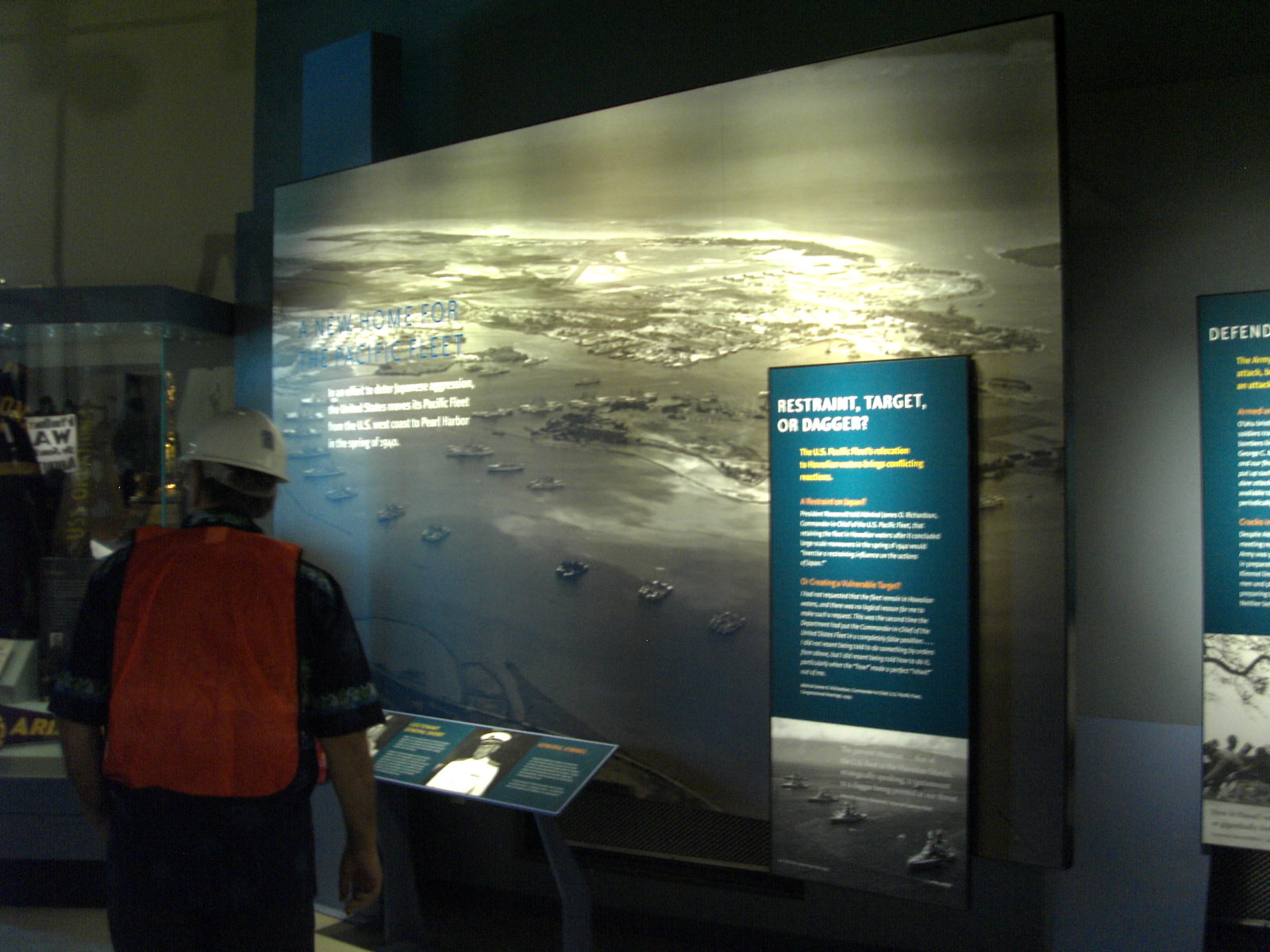
Museum photo display of Ford Island

“Crossroads of Pacific” looking back toward ticket booth

Water view past the renovated theater

Ford Island causeway

“Crossroads of the Pacific”

The USS ARIZONA Memorial stayed open during the entire renovation. The new visitor’s center opened several months ago and is putting the finishing touches on the renovations. The museums will open on 5 December with the formal ceremonies on 6-7 December.

Posted in Travel | Leave a comment

The command’s farewell and saying “See you later” to everyone else


Let’s wrap up the “Six months before retirement” series of posts with a few odds & ends on how to spend your last days around the office.

Various groups at your command will want to say their goodbyes separately from your retirement ceremony. This usually involves a lunch or even a dinner party. Since they’re doing all the work (and you’re just showing up) it’s hard to refuse. You’ll have to work with the group leader to decide what’s appropriate for you and for them.

If you’re an extrovert who loves parties then you’ll enjoy yourself. However, it may also be scheduled during a particularly busy and stressful time along with your physical exams, your retirement checklist, and maybe even a move out of your home. Unless you’re an extrovert, you may feel that the farewell gatherings are getting out of hand.

Keep talking with your friends and those group leaders. Make your desires simple and clear. If you feel that the affair is an additional burden on your retirement preparations, then say so! One alternative would be to schedule it a week or two before your ceremony. Another alternative, especially if you’re remaining in the area after retirement, would be to have it near the end of your terminal leave or even after you’ve retired. Have it at a local restaurant or park so that people won’t be interrupted at the office. You’ll have been away from the command for a while, so they’ll want to see how retirement suits you. You’ll have new stories to tell, and so will they. It’s a great way to relax with the group without feeling the pressure to get things done.

Another common farewell issue is retirement gifts. Most retirees (and, frankly, their commands) would prefer a simple plaque or shadowbox. Others may want a more significant memento, or the command may have a custom of “awarding” a gag gift. Once again you’ll have to make your desires known, especially to your friends who can take care of the details. For those who don’t particularly care or who prefer to avoid the entire issue, you could ask that the command make a donation to a military charity of your choice. It’s a simple yet noble gesture that will set the tone for your whole retirement.

Another surprise to many military retirees is the amount of time you’ll spend saying goodbye. Between the retirement ceremony and the command’s farewell you may feel that you’ve done enough: “So retire, already!” But a substantial portion of your day may be spent with people who drop by to chat for a few minutes, to figure out what you want for a part of a ceremony or a farewell, or even to ask a favor.

Be alert to these “chance” encounters. It’s more than sharing a few war stories and setting up a tee time or a surf session. If you’re a supervisor, you may be asked to write a number of recommendation or endorsement letters. This is your last chance to see that your troops get what they deserve. Like the retirement physical, it’s much easier to do a good deed for someone while you’re in the billet and wearing the rank. In a few weeks you’ll be “just another retiree” whose thoughts may not carry any weight with an award committee or a selection board. When you present the situation to one of your perpetual fence-sitters who’d be a great candidate for a special program or a commission, you may be able to get them to commit to a decision in exchange for your recommendation.

A final note about your final day in the office: don’t get ambushed. A prankster may have been planning something for months, or your chain of command may have “just one more thing”. If you’ve been keeping up with your retirement checklist then you should be able to finish the last item well before your final day. On your absolute last day in the office you should show up on time and maybe even say a few goodbyes, but arrange to have an appointment or other reason to leave early– before lunch or even before 10 AM. Go to lunch but don’t go back. Get your business done, finish your list, and go home!

Posted in Military Retirement | Leave a comment

Exit Interviews, Last-Minute Questions, and the Retirement Ceremony


You’ve been waiting years for this exit interview!  It’s finally time to tell your chain of command exactly what you think of them!!  All of your weapons are ready to fire, the missiles are ready for launch, and you have tons of bombs to drop. You’ve been holding back far too long and the military can’t possibly survive without your opinion of what’s broken, who should be fired, and how to fix everything.

Um, not so fast.  Take a deep breath, relax, and cool down a little.  Get that attitude well out of your system before you sit down with your chain of command.

Be classy– don’t be rude or crass or disrespectful. Although exit interviews are a great opportunity to tell your bosses and co-workers what you really think of them as you exit the smoking rubble, you don’t want to be remembered for this poor behavior. It’s doubtful that you’ll make anything better by hurling these hand grenades as you leave, and you certainly don’t want to make things worse than they already are for your friends & coworkers.

Besides, why were you saving it for the exit interview? Talking trash is also a confession that you were unwilling to deal with your issues when you were working with these people.  If you haven’t tried to fix it by now then the exit interview is the wrong place to start.  Focus on your new life, not your old scores.

Keep your comments on the command’s accomplishments and on what helped you succeed. If your bosses are doing a good job then they need to know that it’s working. Emphasize that anyone can do your job– especially your relief– if they have the right tools and if they’re set up to succeed. You might even want to talk about where the current projects could go or what other challenges should be tackled.

Be happy about your new life, but don’t go over the top. As you approach retirement you may be surprised to be lectured about it by jealous bosses and co-workers. Self-centered people won’t celebrate your retirement — they’ll feel sorry or envious that it’s not theirs.

They won’t compliment you or ask what you’re going to do the first day– they’ll say that they wish they knew how to invest like you did. Even worse, your boss may decide that you’re making a serious mistake and might spend the entire exit interview trying one more time to fix you before it’s too late. Share your plans but don’t feel that you have to justify them or account for your time. Agree to consider everyone’s helpful suggestions after you’ve taken a little time off.

Prepare Your Answers to Common Questions:

Before you start your exit interviews, decide how you’re going to respond to the following questions:

“Can you stay a couple days/weeks/months longer?”

“Um, thanks for your offer, but we’ve already made plans and reservations that would be difficult and expensive to change.”

“If we have a question after you leave, where can we reach you?”

“Here’s my phone number and my e-mail address, but we’ll be traveling and it may take a day or two to respond.”

“Can you come in for lunch next week?”

You’re on your own here.  If you don’t want to socialize with these people at that time then it might be possible to reschedule for a date after your retirement, or else you “have to sort out some schedule conflicts”.  Or maybe your boss was just trying to be polite and not really expecting you to accept the offer.

“Can you help us find a volunteer to…?”

Again this one is up to you, but eventually these people are going to have to figure out how to survive without your advice and presence.

“We know you’re retiring, but can you to come in to take care of…?”

Bad idea.  You’re either on duty at the command (and getting paid for it) or you’re retired.

“Hey, you’ll have plenty of time on your hands! Can you help us with…?”

If you can’t handle this one now, then you’re going to have a really hard time with your family, relatives, and neighbors!

The exit interview is not the place to fix things that you could have helped fix while you were on active duty.  However, there may have been issues that couldn’t be resolved without hurting others or causing even worse problems.  Once you’re out of the command, there’s nothing holding you back from blowing the whistle to higher authority.

Hold off a few weeks before taking this step, however, because the whole issue may seem trivial with some rest and a new retirement perspective. If it wasn’t a problem worth addressing when you were attached to that command, or if you couldn’t resolve it with your active-duty resources, then it’s probably not appropriate to try to correct it after you’ve left it.

The Retirement Ceremony

Some of you have been waiting for decades and you’ve exhaustively planned every minute of the event. Enjoy yourselves! You know what you want to do.

Some of you are retiring unexpectedly, or at least you haven’t thought much about your ceremony. Maybe you feel that the command owes you their appropriate recognition and validation for all your years of sacrifice, and you’d like as much ceremony as you’re entitled to. If that’s the case then please talk about your ceremony with your command as soon as your request has been approved. A command can’t be expected to figure out what every member wants included in their ceremony, and a number of honors may take weeks or even months to arrange– especially if they’re signed by an elected official or a celebrity.

A very small minority of you may not want any ceremony at all. That’s your privilege, but you may encounter significant resistance. Your command wants you to have a fair opportunity to enjoy a ceremony without intimidation or coercion. Your bosses, who have probably thought about their own retirement ceremonies occasionally, may have a hard time believing that you don’t share their enthusiasm for pomp & protocol.

They may feel that you’re mistakenly passing up the opportunity to celebrate your achievements and to bring closure to a long, distinguished career. Some commands (you know the type) may be concerned that you’ll change your mind about the ceremony and blame them for not accommodating your desires. They don’t want bitter retirees starting Congressional inquiries.

If you’d prefer to avoid a retirement ceremony then it’s best to express that sentiment early and often. Some retirees cite personal reasons while others prefer to avoid the extensive time, effort, and expense. Your command may feel obligated to give you a number of opportunities to change your mind, so be firm and consistent. Your preferences may never be understood, but eventually they’ll be accepted.

The timing of your ceremony may be difficult to arrange, especially if you’re bringing guests from long distances, but it’s best to arrange your turnover and leave so that your retirement ceremony is the last time you’re at the command. The people who say “Goodbye!” to you on Friday may be a bit nonplussed to see you again on Monday morning, and you may be perceived to have trouble letting go of the uniform.  Instead of a long, awkward, drawn-out departure, make the retirement ceremony your final appearance.  Your true friends will know where to find you.

Besides, if you show up at that place again after your ceremony, they may just try to put you back to work for a few hours…

Posted in Military Retirement | 2 Comments

Medical and dental exams


Next time you’re chatting with a bunch of veterans, ask them how their discharge physicals went– and listen to their groans of pain. But seriously, take a few minutes to ask these people what they wish they’d done differently during their physicals. Heed their advice and don’t repeat their oversights!

The basic advice hasn’t changed:  start early (at least six months before your terminal leave or retirement date) and be ready to spend several months taking care of other issues before you’re finally finished.

The Department of Defense performs your physical to make sure that you’re healthy and that you receive appropriate medical treatment before you’re discharged. It’s their legal due diligence to prove that they took care of you before you left active duty.  Frankly, it’s more for their benefit than yours.  You, on the other hand, need to make sure that you understand every aspect of your physical condition and correct as many things as possible during active duty before you have to do it through the Veteran’s Administration or Tricare. It’s the same idea as your other retirement paperwork:  get it right the first time or spend months of retirement trying to do it on your own.

When you fill out your physical’s paperwork and start your exams, you or the medical staff may discover new questions or old unresolved issues. Some can be handled immediately but others may require additional time and testing. It’s quite possible to need several months to chase down all the consultations with other doctors, to schedule the complicated examinations like MRIs or CAT scans, and to make a final assessment of the treatment. It’s an unpleasant process, but it’s even more excruciating if you delay.

Prepare yourself before you make your first appointment. Read your entire medical record from start to finish and go all the way back to your entrance exam. Make sure you understand every entry, especially any conditions or injuries or illnesses that may follow you into retirement. If you don’t understand the entries then research the vocabulary on the Internet or ask your shipmates. If you had a medical problem in uniform then you can confidently assume that it could grow to be an even bigger problem in retirement. Make a list of your issues and questions and be ready to spend the time discussing them with technicians, medical staff, and doctors.

When you’re completing the physical’s tests and exams, make sure that you understand everything added to your record. If something doesn’t look right, or if it isn’t thoroughly explained to you, then there’s a problem. An innocuous oversight now may miss an existing condition that could grow worse during your retirement, or it could even result in the denial of a disability claim.  Ask to see the instructions or the references to make sure you understand the issues.

It’s quite likely that you’ll leave the exam with a list of consultations, extra appointments, and more testing. Researching the issues and evaluating your treatment options could take a serious chunk out of your final few months. If you start early then you’ll have time to handle the inevitable delays, seek other opinions, and make thoughtful decisions.

Even if all of your questions were answered during the exams and tests, ask your doctor again during the final exam. Bring your list, work it all the way through, take good notes, and don’t get put off or distracted. If your doctor doesn’t seem to have the time for you then ask for another appointment– or another doctor! No one can take more care than you to make sure that your exam is correct, that all issues have been examined, and that you’re in the best possible condition before you retire. I can’t stress strongly enough how important it is to chase down these nagging questions before you complete the physical and retire.

If you’re fortunate enough to be attached to a command with its own independent-duty medical staff, give them an extra-nice favor in exchange for a review of your discharge physical. You might not recognize an incomplete entry or a missing signature, but they’ll know what to look for. This can help avoid errors and delays during your final checkout.

Determining disability ratings and dealing with the Veteran’s Administration are far beyond the scope of this book. If your separation physical discovers a condition that may lead to extensive medical care or even disability concerns, then seek professional help from the medical facility. You may even need to review your rights with your military legal staff. What seems to be a straightforward retirement may become mired in months of medical evaluation boards, disability rating reviews, and maybe even time on the Temporary Disabled Retired List. No one wants this disruption during the planning for the next phase of their life, but you have decades in front of you and the process may be worth tens of thousands of dollars in medical benefits. The person who you’ll become in 30 or 40 years will be heartily glad that you persevered.

It may even be possible that you’ll have to seek help from those who have already gone through the process.  Talk to your nearest Veterans Administration office (or the one near your retirement destination) about how they’d like to handle this issue when you’re retired.  Seek out a veteran’s organization in your area and see if they have anyone who’s dealt with your problem and can share their wisdom.  Contact your local chapter of the Military Officers Association of America for more resources. (Do this even if you’re enlisted– they’ll be glad to help and they’ll know who to contact.) Try the Veterans Benefits Network or the Physical Evaluation Board forum. Post to discussion boards like Military.com or Early-Retirement.org for their advice.

Prescriptions are an aspect of your retirement life that may require considerable thought and planning. Your prescription costs will be considerably cheaper than civilian retirees, but you’ll still need to make sure you can get what you want, in sufficient quantity, when you want it. Consider where you’ll be retired, whether the standard pharmaceutical formulary meets your medication needs, and whether or not you can obtain your medications through Tricare’s mail-order pharmacy. These questions should be asked during your first medical screening, not during the final physical exam.

Discuss the treatment/medication choices with your doctor, and then have a long talk with the pharmacy department. Once you’ve all decided on a long-term medication plan, stock up as much as you can before you retire. You don’t want to run low on your 30-day supply only to find out that there’s been a glitch with transferring your access to the retiree prescription system. Give yourself plenty of time to work through the procedures and, if necessary, to figure out another solution before you run out or have to pay out of your own pocket. This even applies to routine medications such as allergy pills or birth control.

Fully exploit your active-duty or Reserve benefits before you retire. If you’ve been planning to stop smoking or to lose weight or to deal with some other medical/lifestyle aspect, start that project while you’re still on active duty. Depending on your personal/family situation and how much you enjoy planning your life, you may even decide to complete a final pregnancy or vasectomy or tubal ligation with the military healthcare system. If you’re moving from a large military medical system with outstanding care to a remote retirement location with less than excellent facilities, this may be an important decision.

Your retirement physical includes a dental exam. Make the most of it, because retirement dental insurance can be expensive. Consider doing a full set of x-rays, get a good cleaning, and check the condition of any fillings or other dental work. Once you retire you may be fortunate enough to only need an exam every 18-24 months, and it’s frequently cheaper to negotiate a discount with your dentist than to pay for insurance.  If you have a history of root canals or gum disease then dental insurance may be a good investment, but i don’t even have any cavities then you may be able to stick to annual or biennial checkups and cleanings.

Whatever you do, don’t avoid seeking treatment.  No matter how painful you think it’s going to be, it’ll be even more painful when the doctor or dentist won’t sign your retirement checklist.  You don’t want to have to spend your final days of active duty running through the treatment gauntlet with painkillers and physical therapy.  Start early and get it done so that there’s time to do it right.

One final word of medical advice.  When you’re retired and you’ve settled into your new destination, take a few hours to register at the local Veteran’s Administration office.  You may not be eligible for treatment with them, but you may be pleasantly surprised to discover that they’re a Tricare primary care manager.  Whether you use their services or not, when you register with them they can add your name to their local roster to ensure that they get their fair share of federal funding for their local military population.  Another side benefit of hanging out at the VA is the opportunity to meet all sorts of experienced retirees who know your local area and can help you settle in.

Posted in Military Retirement | 2 Comments