Book review: The Complete Idiot’s Guide to Social Security and Medicare


I didn’t expect to be reading a book like this for at least another decade, let alone writing a review of it.

I’m no less than 12 years away from Social Security and nearly 15 years away from Medicare. I have a lot of zeroes in my SS earnings record, so by the time I start collecting the former, it may barely pay the premiums for the latter. Because of that, I’ve never really paid much attention to the news or the financial analysis of their futures. There’s plenty of time until I’ll be subject to either system, and they may go through dozens of changes before then. Why bother to learn more about them?

Then I got a call from the hospital about my father: he’d just had emergency surgery for an ulcer. He was expected to pull through but there would be a few days’ stay at the hospital followed by a longer stay at a skilled nursing facility for rehabilitation. The hospital’s billing department had a lot of questions about Medicare, supplemental health insurance, and other acronyms.

Over the next few weeks, the claims notifications began showing up in the mail. The cost of the emergency care alone was more than a year of my pension. Dad’s been in the SNF for over two months and I still don’t have their price list, let alone an invoice. Yet although I’ve seen over 20 different financial statements of benefits delivered, nobody has asked Dad to cough up a cent for all the care expended on his behalf. How can this be?!

Although Dad’s making a full physical recovery, I realized that I’d better give myself a fast tutorial on the finances to understand how this was supposed to work. I didn’t want to miss a requirement or a deadline.

“The Complete Idiot’s Guide to Social Security and Medicare”  explains both systems. Lita Epstein writes very clear descriptions of how they were originally set up and how they’ve changed over the years. Although the major healthcare legislation of 2010 was being passed as the book went to press, she also analyzes how it’s expected to affect the existing rules.

After describing the Social Security system, the book explains how to maximize your benefits. If you’ve ever been married, let alone paid FICA contributions, then even this aspect of your SS eligibility is not intuitive. By the time you work through the chapters, you’ll have a clear understanding of when you might want to file, whose earnings record to use, and what to do in case of divorce or death.

The book is even more critical for those beneficiaries with complicated situations. I highly recommend working through it if you or a loved one is widowed, coping with disability, contemplating remarriage, or parenting surviving children under the age of 18. I had no idea that these benefits even existed, let alone understood how to qualify for them or how to claim them.

The second half of the book dives into the mysteries of Medicare and all of its supplemental systems. Again it clearly explains the benefits, the qualifications, and the issues. Now I can comprehend what I’m reading on Dad’s Medicare statements (and all the other insurance paperwork) and I understand what needs to be done about it. Better still, I can look down my road a couple of decades for my spouse and I to address the potential gaps in our coverage under Tricare For Life and long-term care insurance.

As usual for “The Complete Idiot’s Guide” franchise, every chapter is broken down into bite-size sidebars and summaries with definitions, acronyms, key points and “the least you need to know”. You may not care about the 1930s politics that went into the creation of Social Security, but the book’s format lets you quickly skip past the boring or complex topics to get to the good stuff. You’ll immediately know when you’ve skimmed too far and need to back up for more reading comprehension.

If you’re in your 40s, especially if your parents are still in your life, then you’ll want to read this book for an appreciation of the challenges they’re facing now… and that we’ll soon be facing. If you’re in your 20s or 30s then you might want to flip through this book to understand the issues confronting the financial future of the programs. Despite the media’s alarming sound bites, Social Security will probably be OK.  You should include its distributions in your retirement planning.

Medicare’s prognosis is more treacherous, but there’s still a few years left for the bureaucracies and the legislators to work through the choices to arrive at a solution. It won’t be easy and it certainly won’t be fast. However, the American government has usually managed to cope with the large, ugly, slow-moving crises that are lurching toward imminent collapse. Medicare appears to fall into this category and should be able to return to fiscal health.

I was worried enough about my Dad’s physical health. I’m glad to learn that he doesn’t have to worry about his financial health.

If you have other resources to share about Social Security & Medicare, please post a comment or fill out the “Contact Me” box– thanks!

Related articles:
Military long term care insurance
Proposed Tricare fee hikes
Retiring on multiple streams of income

Does this post help? Sign up for more free military retirement tips via e-mail, Facebook, or Twitter!


Posted in Money Management & Personal Finance, Reviews | Leave a comment

Book Review: Liz Weston’s “The 10 Commandments of Money”


(Note: a shorter version of this review was published last week on the Dollar Stretcher website. Here’s the unabridged edition with formatting and more links.)

Every generation has a financial author who teaches them how to make their life’s money decisions. For readers of a certain age, Sylvia Porter and Jane Bryant Quinn come to mind. You might not even know what questions to ask, but they’d help you think through all the major issues.

This generation’s author is Liz Weston.  She’s already the Internet’s most widely read personal-finance columnist, and her latest book organizes her advice into The 10 Commandments of Money.

Part of the problem with learning how to handle your money is that the rules keep changing. What worked for your parents might not apply to your situation, and your offspring will roll their eyes at your own time-tested financial wisdom. Liz doesn’t preach a checklist of simplistic rules. She shows how these 10 commandments have changed over the years. This is not your parents’ financial advice because it’s a whole different set of rules. She categorizes each commandment by its generational wisdom: “Old School”, “Bubble Economy”, and “New Rule”.

You can read the commandments on the book’s Amazon.com website,  so let me skip to the conclusions. She shows young adults a simple way to set up a budget and when to modify it. (It works for older adults too!) If you’ve struggled to put together a budget that works for you, or if you’re too discouraged to even try, then read just this chapter of the book. Her suggestions on different expense categories and how much to allocate for “mandatory spending” or “discretionary spending” will get you started.

She shows you how to use credit responsibly. If you just can’t handle plastic (you know who you are), then she shows you how to live with cash. She explains why college tuition and home prices are practically out of reach for today’s generation. (Hint: it’s your parent’s fault.) She shows you how to get the most for your education and shelter dollars. She even suggests the right reasons to take on debt, and how to keep it from taking over your life. Debt is not inherently “good” or “evil.” It’s just a shiny tool with very sharp edges. You may not want to pile up six figures of student debt for that prestigious diploma, and you may not want your dream home (with its nightmare mortgage) for many more years. She even delves into the details of when to stop trying to pay your debts to negotiate a settlement, ask that they be forgiven, or declare bankruptcy. Then she moves on to fixing your credit score and building your retirement savings.

The book is not only for singles and couples but also for divorcees, single parents, empty nesters, and about-to-be-retirees. She includes plenty of stories from those who’ve sought her help and gone on to achieve success.

After you’ve made it through the first eight commandments, she concludes with life advice on marriages and consumerism. You could roll your eyes here in memory of your parents, but it’s a sound foundation to build your own financial wisdom.

I appreciated the opportunity to review this book. Now I’m going to pass it to my college daughter, let her roll her eyes at my feeble attempts to fix up her financial foundations, and then watch her “teach herself” how to do it.

Related articles:
Raising a money-smart kid
Would you like a financial planner with that?
How many years does it take to become financially independent?
Where to put your savings while you’re in the military
Simple ways to start saving
Start saving early
Retirement budgeting

Does this post help? Sign up for more free military retirement tips via e-mail, Facebook, or Twitter!

Posted in Reviews | 2 Comments

Raising a money-smart kid


Our college daughter (just survived freshman year!) spent the last couple weeks at home. As she was reviewing the packing list for next month’s NROTC training, she noticed that it included traveler’s checks.

“Traveler’s checks”?!? If you’re at least in your 40s then you may have dim memories of using them in your youth. If you’re in your 20s then you may not have any idea what they are or how they’re used. Heck, I don’t even know where to find them these days, let alone how much to pay for them.

It wouldn’t surprise me to discover that a 21st-century Navy activity is recycling a 1980s packing list. However, my spouse pointed out that there could still be 18-year-olds in the world (let alone in the military) who may not yet have their own checking accounts or credit cards. Unless they want to risk carrying around hundreds of dollars, traveler’s checks are about the only “safe” option. Provided, of course, that the young clerk at the cash register has ever seen a traveler’s check before.

Our young adult has carried a credit card for over five years, and she’s had her own checking account for nearly a decade. The experience has had a few speed bumps & potholes, yet she’s been managing her own finances for nearly half her life. She’s far ahead of her demographic in handling money and investing it. I can’t claim to be a financial guru at raising money-smart kids, but we know a few resources that have worked out just fine for us.

The first place to start a child’s financial education is: you.

If you have money problems then you’re going to have to figure out how to avoid passing the syndrome on to the next generation. You may have trouble managing a credit card, or you may be struggling with consumer debt, or you may just be blissfully financially ignorant. All of those situations can eventually be remedied. You’re already reading this blog, and from here it’s a matter of checking out the links in the sidebar blogroll (such as the Dollar Stretcher) or the Recommended Reading section.  Figure out your money problems, get help with solving them, or find a book/website that works for you. It’s a long journey, so start it today. If you have any inconsistencies between your own money behavior and the financial-management skills that you try to teach your kids, then one day they will inevitably notice the contradiction and throw it back in your face. No, I don’t want to get into how I learned that.

Before you start your kid’s financial education, however, I should emphasize that the point of this tutoring is “education”, not “amassing wealth”. For the first two decades of your child’s life, they’re going to be learning how to handle their money. Just as they consume hundreds of dollars of school supplies over the years, during their financial education they will consume hundreds of dollars of… dollars. They will only learn fiscal responsibility through several episodes of fiscal irresponsibility.

Let’s look at this debate from a kid’s perspective: you’re trying to teach deferred gratification to someone who’s still developing the emotional and mental capacity to even understand the vocabulary. You’re essentially asking them to turn their birthday money hard-earned assets over to some faceless financial institution where it apparently won’t see the light of day for a million years, or until they go to college. (To a kid, both of those time concepts are approximately equivalent.) Then you’re telling them how good it will feel when they finally exhume “their” money from its lockup and get to actually do something with it. This is hardly the time to start talking about saving for retirement.

To a kid, the only logical approach to this problem would be to spend all of their money right away, before you get your hands on it and make them do something “responsible” with it. The longer you persist in being the authority figure in this deferred-gratification save-your-money debate, the longer they’ll resist your tyranny and avoid learning how to manage their own money.

The only way to resolve this authority conflict is to not start it. Apply your parental jiu-jitsu. Be their friendly financial adviser, not the authoritarian rule-maker. Share their joy when they come into a pile of cash, and engage them in a happy discussion of their many options. Help them understand what can happen if they decide to spend it all on toys & candy. When they inevitably run out of money, then sympathize with them and validate their feelings… again and again and again. Show them how to avoid running out of money, and model the correct behavior in your own financial life, but let them handle their own tools. As they master the basics then you can give them bigger, sharper, and more powerful tools.

Eventually, they’ll get it. But for the first five years or so, it’s probably best to have a mental image of them lighting their allowance on fire and running around waving it around like a 4th of July sparkler. Get used to it. Remind them of their choices, but let them scorch their own fingers. Sooner or later they’ll realize that they’re in charge, that they’re tired of being poor, and that they can trust you to show them how to achieve their goals. Then, when they go through puberty, they’ll re-learn that lesson all over again. And when they go to college (where it’s harder for both you and for them to monitor their financial health), then they’ll probably test out the concept one final time.

With that frightening money-burning image seared into your cerebral cortex, let’s talk resources.

Kids are ready to start learning about money as soon as they stop eating it. For most kids, this happens around the age of two. Even at this stage, they’re able to understand that a trip to the grocery store means they can have “one special thing”. If they don’t follow the rules (let alone melt down about it), then the trip is over and they leave the store. It only takes one or two abandoned grocery carts before they understand the concept.

At the age of four or five, they’re ready for an allowance. The point of an allowance is to teach them how to handle money, not how to earn it.

They should get this allowance whether they do their chores or not, whether they behave or not, and even whether they’re learning the concept or not. If they want more money than their subsistence allowance then they have to do their chores, behave, and show that they “get it”. But the most important aspect of an allowance is that they receive it every week to learn how to handle money. It has to be reliable, not a random lottery win to be spent before it’s taken away. It’s not a gift or even a privilege:  money is a skill that they have to learn just like writing or reading. Of course, at this age you’ll want to limit the allowance to something like a dollar a week. Now when they choose their “one special thing” at the grocery store, you can point out what it costs and how money can buy it.

New readers will enjoy the book “If You Made A Million”.  It gives kids the vocabulary and makes it sound fun. The best part is that they can imagine having more money than they’ve ever dreamed of, and they’ll know what they can do with it.

As they start reading in elementary school, you’ll start reading David Owen. His “First National Bank of Dad” got us most of the way through high school. I’ll skip over the gory details (you’ll enjoy reading his explanations) but your kids will learn how to save their own money in their “Bank of Kid CD”. They’ll even learn to take better care of their toys so that they can resell them on eBay when they’re tired of them. When they learn to read, write, and do math then they’re also ready for a checking account.

We discovered that the Navy Federal Credit Union will let a kid open a checking account (with a parent’s joint custody) when they’re nine years old. NFCU even issued her an ATM card, and she learned her own important life lesson when she promptly lost the card. She made the hard choice to wait over a year to replace it (until the old card expired and a new one was issued) instead of forking over the $25 replacement fee.

The checking account caused many tears at first. She learned the real reason that you have to write neatly and do the math correctly (not just for a good grade!). She learned to record the checks as soon as she wrote them. She learned how frustrating it can be to have to take your time and figure out the mistakes, no matter how many attempts are necessary. A bounced check was a financial disaster. Some months the checkbook never even came out of her desk drawer. But she thought it was so worth it at school to see her teacher’s faces when she whipped out her own checkbook to pay for her classroom purchases, so she persevered. After a year she discovered Quicken and online statement reconciliation, and the tears eventually dried up.

For her 13th birthday, we learned that Citibank will issue a credit card (with a parent’s joint signature). She’s still using that card, although today it’s a backup to her American Express Blue. We’ve helped her balance her account a few times, and we’ve helped her talk to the “customer service” reps when necessary, but she’s done all the work.

Personally, I think the best part of her financial education was when she had to learn how to manage a clothing & toiletries budget. We eventually got to the point where she was given the funds only twice a year, and they had to last an entire six months. She could dress really good or smell good, but it was her choice. Being a girl, she learned this fashion/hygiene concept very quickly. Knowing my own teenage experience, this tactic will probably only work for boys after they discover girls.

Another teen financial resource, believe it or not, is Suze Orman. (Stay with me here– I’m talking about teen financial education!) Suze is the perfect combination of snark with basic financial skills, and she gets a lot of air time in our house. I may not agree with much of her teaching, but each show is worth an hour’s money conversation. Our teen now completely knows the rules for “Can I Afford It?” and has the big picture on “How Am I Doing?” When she hears the word “girlfriend”, she knows there’s trouble. The show’s best lines have become part of our household vocabulary. I highly recommend watching it with your kids when they’re 13-18 years old… even if it’s just so that you can tell them “You are SO denied.”

In our family, we even expanded David Owen’s “Bank of Dad” concept to the “Kid 401(k)”. When our kid turned eight years old, she knew that in another lifetime (just eight more years!) on her 16th birthday her 401(k) would have earned enough for her to afford a car. We skipped over a whole bunch of financial-math details back then (like “contribution matching” and exactly how much car you can buy with a few thousand bucks) but for the next eight years, she confidently knew that she’d acquire the skills and understanding to get her first car.

When our financial tyro turned 16, she surprised us with the idea of using her Kid 401(k) to buy a share of the family car that she’d sell back to us when she moved out for college. (Of course, she had to take care of her investment, washing it and changing its oil and not wrecking it.) She had nearly eight years to come up with that idea all by herself– it didn’t come from us. Now that she’s in college, her “401(k)” money is sitting in a CD ladder (at Pentagon Federal Credit Union) until she gets to a point in her life where she actually needs a car. (For now, she’s all about compound interest.) Just knowing that she controlled the resources was enough to keep her from squandering them.

Disclaimer: As I’ve said before, I’m no financial guru. Our teaching techniques have only been applied to a sample of one. They’ll probably work for your kid, but they may work at a different pace. You might find better resources or methods. (If you do, please post a comment here to share with us!) You have to tailor the education to your kid’s abilities and interests. (Many of my lessons to her came in the form of explaining how I screwed it up when I was her age. That sure captured her interest.) I can certainly attest that there will be failures, and you will have to be patient. There may not be progress every month, but you’ll see it from one year to the next.

Our daughter will quickly admit that her first college semester was financially rocky. (Let’s just say that the high-school graduation presents didn’t last very long.) I was more than a little frustrated by her explanations, but I took solace in knowing that she already understood the mechanics of managing her assets. She quickly got a handle on her flawed logic and she turned the situation around by herself. She did not go into debt, and she is building her net worth. She spent Christmas break transferring her assets to her new Fidelity Roth IRA and setting up an automatic savings deduction. She’s also doing her own tax returns. She’s almost off the family payroll!

So on her NROTC summer training when she sees someone using traveler’s checks, maybe she’ll take them under her wing and show them how to get a checking account and a credit card. She’s learned how to do it, and today she’s ready to learn how to teach it.

Right now our daughter’s reading Liz Weston’s “The 10 Commandments of Money”.  When she returns from sea duty in a couple of months (our daughter, not Liz), she wants to map out her asset allocation and start her dollar-cost averaging. I’m looking forward to that conversation. See you soon, honey!

Related articles:
Raising an ER-smart kid
Retiring early– with kids?
I’m going to retire. Now what? (part 1 of 2)

Does this post help? Sign up for more free military retirement tips via e-mail, Facebook, or Twitter!
Posted in Military Life & Family, Money Management & Personal Finance | 3 Comments

Raising an ER-smart kid


Short post today, but it’s building the foundation of raising a financially smart kid.

An earlier post talked about the challenges of retiring early when you’re still raising your kids.  That raises another question: How do you raise kids to value the early-retirement lifestyle? What kind of example does that make on their impressionable young minds? What will they do when they’re old enough to start working?

First, let’s back away from these questions for a few paragraphs. You’re reading this blog because you’re interested in financial independence, and perhaps you’re trying to decide whether to stick around for a military retirement. Yet very few of us spent our high-school days dreaming of financial independence, let alone retirement.  Back then we were excited about all the things we could do when we grew up. What changed?

Well, for starters, we did. We found out that growing up didn’t necessarily channel our unlimited potential straight to unlimited achievements and freedom. Maybe we enjoyed the military at first, but perhaps lately the fun balloon is starting to leak out a little air. Or maybe the military has been great but the prospect of a civilian career hasn’t been so compelling.

Perhaps we’ve learned that we enjoy our occupation when it’s autonomous, complex, and fulfilling. (See Malcolm Gladwell’s book “Outliers”.) For many military veterans, the most important aspect of those criteria may be having control over our own time. When you’re truly financially independent, you only have to work when you want to– on whatever you want to. You can retire on your own terms, or you can choose to keep working for those unlimited achievements you dreamed of when you were younger.

Now put yourself in your kid’s shoes: why should they value early retirement? They know darn little about work, and they certainly don’t know how it feels to be burned out by work yet trapped in the cycle of responsibilities or debts. Maybe they see that you’re tired of work, but they don’t know how to solve your problems. Early retirement has absolutely no context for them yet, and it probably won’t really hit them between their hard-working eyeballs until they’re at least in their 20s. When did you start thinking about early retirement? I doubt it was earlier than your 20s.

But what about financial independence? Every kid knows that money gives them choices. When they have money they may not be allowed to eat pizza for breakfast (yet), but they can get just about whatever they can afford at the toy store. They’re keenly aware of how they feel when they have to “choose” between doing their homework and cleaning their rooms. You don’t want to raise kids to a lifetime of money-grubbing penury, but you can certainly teach them that saving their money will someday give them lots of choices.

That’s what you tell your kids: When you were younger, you found work that you loved. You saved your money so that you’d have choices. When you got older, you decided that you wanted to do something else with the rest of your life– and because you’ve saved your money, you have choices. Maybe someday your kids will be fortunate enough to grow up to find their own work that they love doing for the rest of their lives. Until they do, their financial independence gives them choices.

In 10 or 20 years, they’ll look back on your lifestyle choices and understand how to figure out their own.

Once you finish with the important discussion of lifestyle philosophies, then you can relax and just spend more time having fun with your kids. That’s all they ever wanted in the first place!

The next post will suggest a few ways to make your kids smart about money choices. 

Related articles:
Retiring early– with kids?
Retirement: relax, reconnect and re-engage
I’m going to retire. Now what? (part 1 of 2)

Does this post help? Sign up for more free military retirement tips via e-mail, Facebook, or Twitter!
Posted in Military Life & Family, Money Management & Personal Finance | Leave a comment

Lifestyles in military retirement: Haleakala Crater redux


Last week we hiked Maui’s Haleakala Crater again.  This post stands on its own, but you’ll appreciate the background if you first read the post about our introduction to this beautiful yet harsh environment.

Wide view of crater from summit looking east

Four days, three nights, 20 miles of lava-rock trails at altitude.

(Here’s a two-page Haleakala Crater map showing elevations, trails, and cabin locations.)

Thank goodness for better gear and for spending the last eight months working out. Unlike last year’s endurance trial, this year we were able to enjoy the scenery and take more photos. We arrived at each cabin with enough energy to explore the surroundings and stay awake past sundown.  Of course I still picked up three blisters on the first day from not tying my hiking shoes tight enough. (Hey, some of us Hawaii residents only tie shoelaces maybe three times a year.)  My military-worn knees are sore but the lighter/tighter gear made a huge difference.  The weather even cooperated a bit more, too.

Sunset rainbow

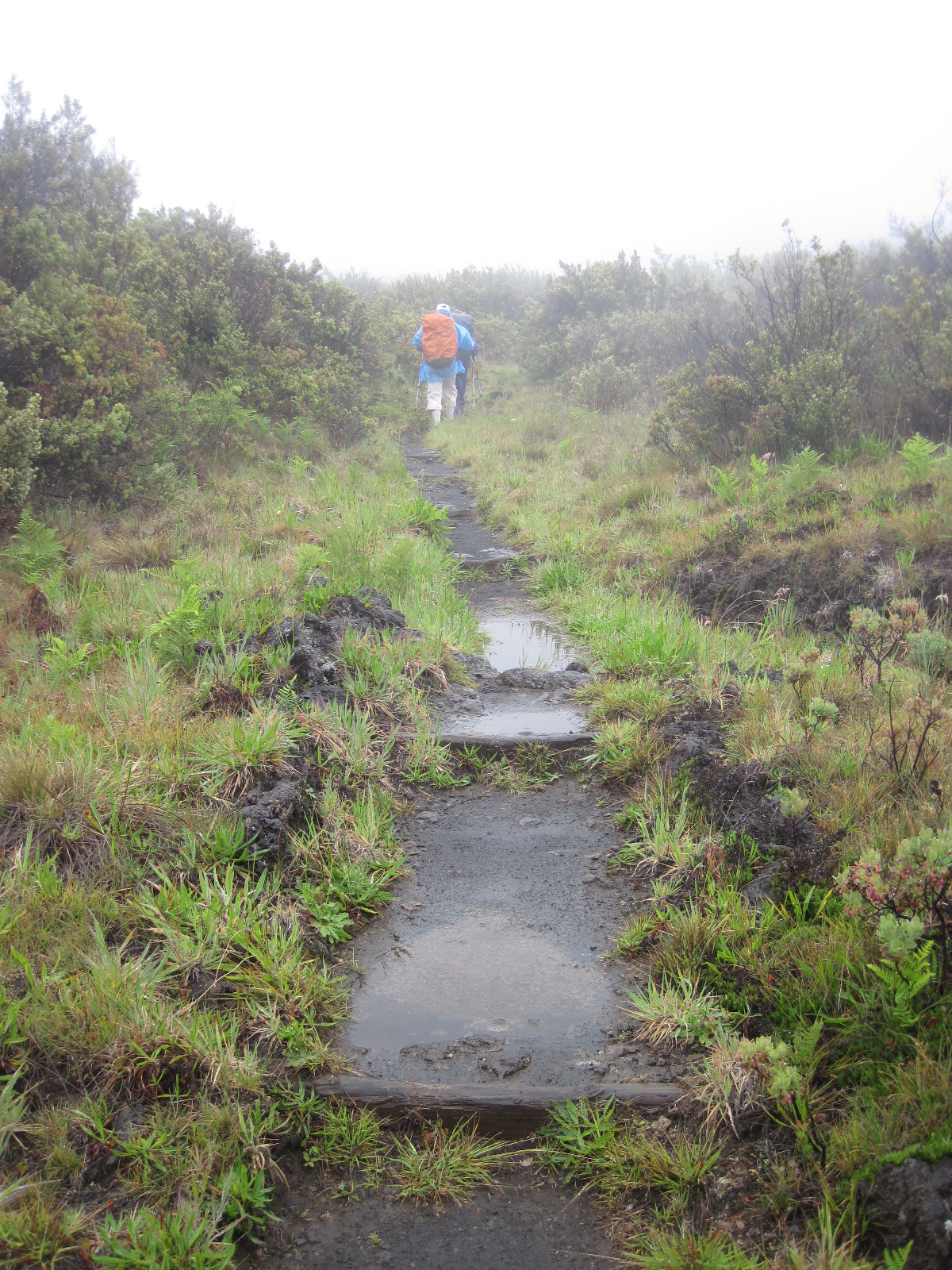
Worst part of the trip: Day 3’s cold, steady rain with ankle-deep puddles on the rocky trail of the six-mile hike from the Paliku cabin to Holua. At least this time it was “only” 30 minutes instead of “all afternoon”.  Best part: That same day, Maui friends who hiked 3.9 miles each way to the Holua cabin from the crater’s Halemau’u trail head (elevation 6900-8000 feet) to surprise us with chocolate chip cookies. Best cookies ever.  (Thanks, Chris & Guy!)  This rainbow over Kapalaoa cabin was pretty nice, too.

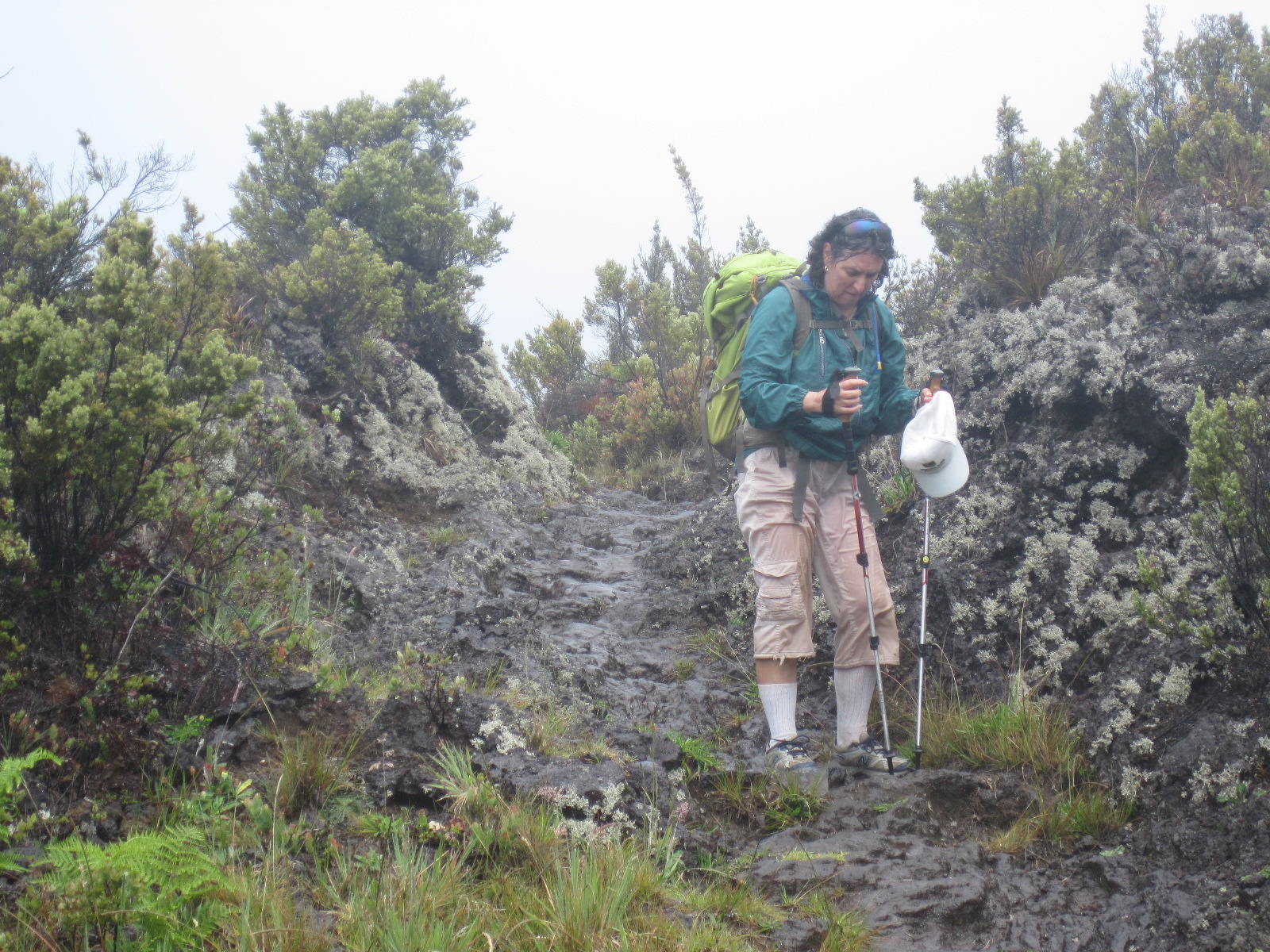
Thank goodness for trekking poles.

This year one of our party said “Money has no value in the crater, but spending it on the right gear will save your life.” We survived last year’s trip on very short notice with borrowed gear. Back then we made it mainly through perseverance and our high tolerance for pain. This year we started over. Our new backpacks are great (especially for spouse’s smaller frame) and we easily handled 30+ pounds. Our 27-ounce 55-degree sleeping bags are light yet still within the colder limit of the crater’s temperatures. Hiking shoes offered stability & control far better than last year’s sneakers, and this year we had the time to break them in. Unfortunately we needed our pack covers and rain ponchos, but they worked fine. Trekking poles  are also lifesavers– in the REI store spouse thought $99/pair was pretty pricey, but by the end of the trip she was ready to send them another thousand bucks.

Hiking out of Paliku cabin in the rain... again.

Haleakala Crater is not the average hike along a dirt track. The well-worn trails are ankle-deep sand, unstable gravel, and razor-sharp lava. (After just 20 miles my new hiking shoes show substantial wear.) We were always slipping and sliding. Most of the trails are eroded over a foot deep and stumbling can easily twist an ankle on the side wall. Even grabbing a lava outcrop risks slicing open a finger. Lava isn’t the only footing hazard– the trails are also used by pack horses. 30-knot winds, mist, and even driving rain were common. Our progress was 1.5-2 miles/hour, gasping for breath at elevations from 6500-10,000 feet.  By the third day we were beginning to adapt to the altitude.

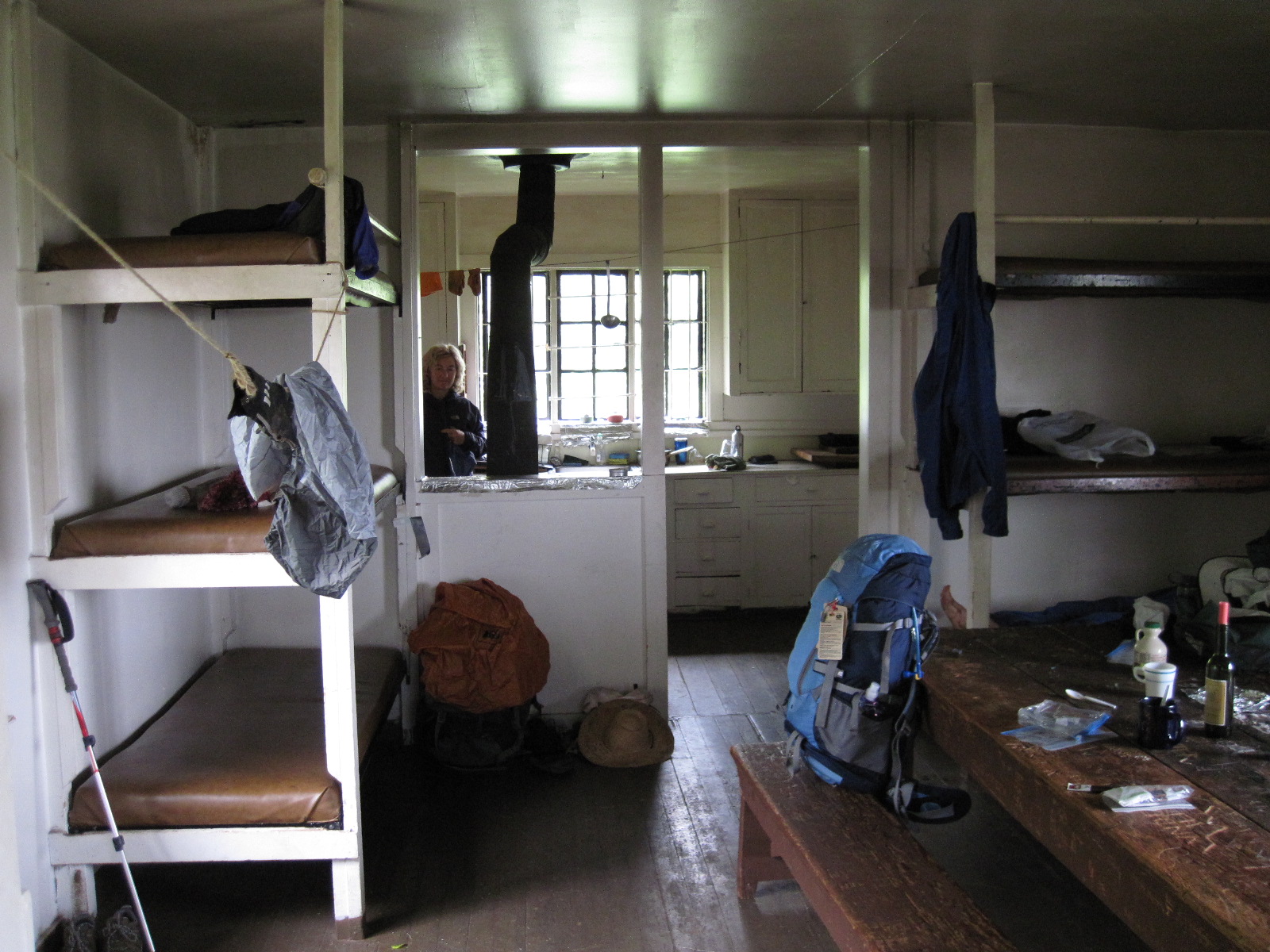
Home sweet home for the night.

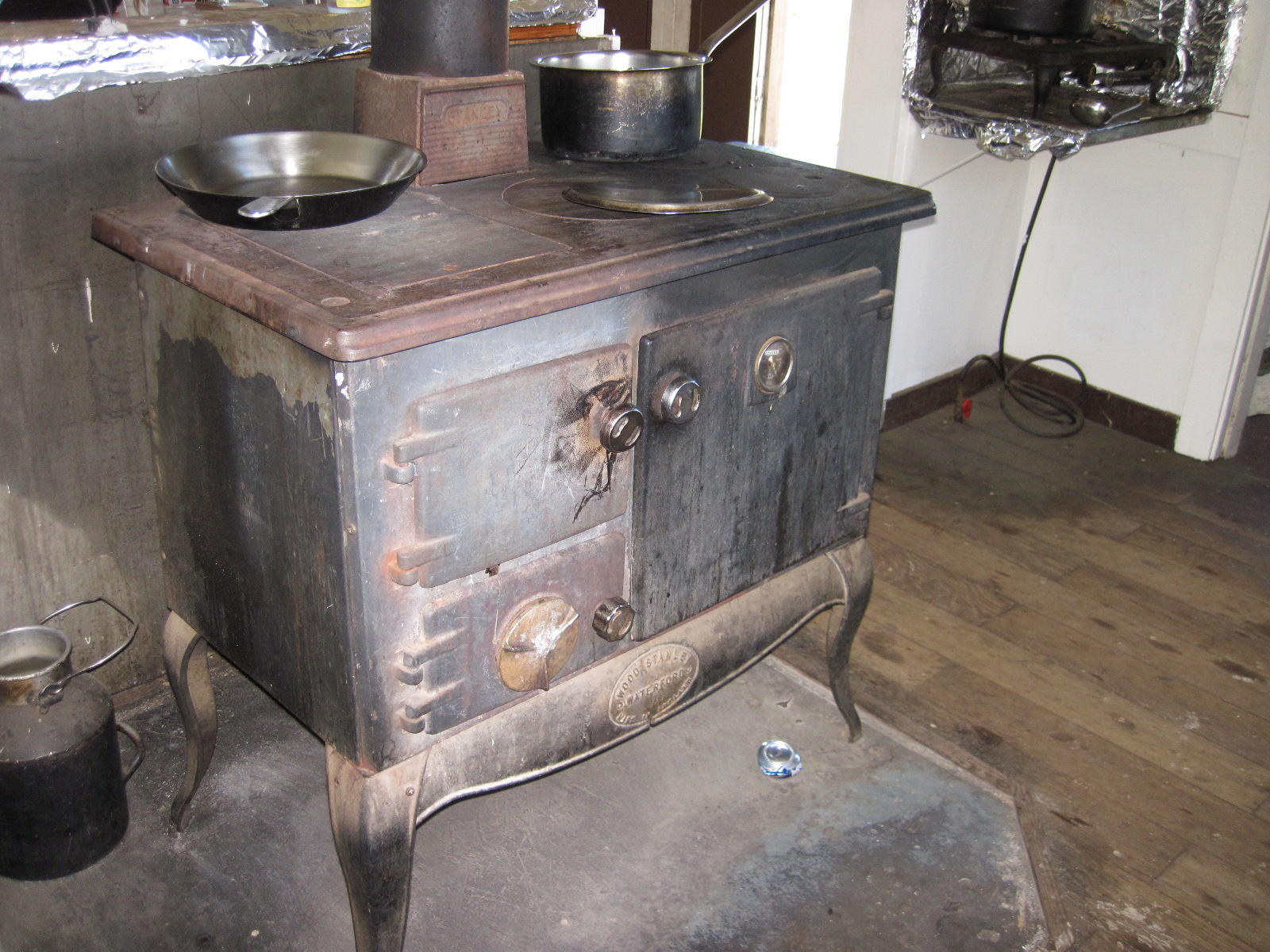
This year our hosts reserved all three cabins– very difficult since reservations fill up within minutes for 90 days in advance. Crater stays are limited to three nights  so most groups reserve one cabin per night (it’s almost impossible to get two nights at the same cabin). The 1930s 20’x30′ wood cabins sleep 12 on four three-stack bunks around two wooden tables. One side of each cabin includes a large wood stove, a small propane range with one or two rings, a small kitchen sink/counter area that can handle two people, and a wood-storage room. Water comes from catchment tanks so it has to be filtered or boiled. Wood & kitchen gear are provided. Extra food & supplies are abandoned by overpacked hikers. Tent camping is permitted near two of the cabins but no open fires are allowed so campers have to pack in cooking gear/fuel. Pit toilets. No electricity. Lighting from candles & lanterns. All trash has to be packed out but toilet paper is (usually) available.

Trail food.

Including spouse & me, our party was eight adults. One is 30 years old but the rest are age 49-64. Three grew up on Maui and two of them have hiked the crater for over 50 years. One is an outdoors expert, another backpacks & hikes several months a year, and a third is an Army Vietnam vet who hikes & skis. Spouse and I hiked & camped as kids but we have the least experience. Our group rotated breakfast & dinner duties among pairs of cooks & dishwashers. We generally started each hike around midmorning and finished in the early afternoons. We’d snack on the trail (protein bars and dried fruit) and make our own late lunches at the cabins.

The first cabin, Kapalaoa, is “only” 5.9 miles down from the summit– but the altitude changes from nearly 10,000 feet to 7000 feet through 15 switchbacks. (Yes, this time I counted all of them.) Sliding Sands trail is aptly named. Last year we lunched briefly at Kapalaoa before pressing on another 3.3 miles to Paliku cabin, and that was a nightmare marathon. This year we “took it easy”. We ate a late breakfast in Kula, arrived at the park ranger’s briefing after the morning rush, and didn’t hike in until after 9:30 AM– yet we still arrived at Kapalaoa four hours later.

"Watch your step"...

Our training paid off. About halfway down the crater’s rim a rock broke out from under my foot and I lost my balance. Thanks to my taekwondo skills I managed to twist and roll the impact. I still landed on my right humerus, gouged out a square inch of tissue, and had a walnut-sized swelling on the point of my elbow for the next three days. I couldn’t control the bleeding with gauze & band aids, so we finally had to stop for 20 minutes to clean up the wound’s ragged edges and apply a compression bandage of toilet paper & duct tape. Next morning I realized I’d also slammed my right hip on a rock for a 6″-diameter rainbow bruise. Thankfully I didn’t sprain ankles or knees– crater rescues use pack horses and take at least a day, sometimes two.  The crater’s altitude and weather are not friendly to helicopters.

Silverswords in bloom

The silverswords are still beautiful and seemed more plentiful than last year. But Kapalaoa has the crater’s clearest weather and this year the stars were awesome– thousands of them instead of just the usual few dozen. Hawaii has very bad light pollution so it was a real treat to see five planets, a dozen constellations, and the Milky Way. (The summit of Haleakala Crater houses some of the world’s best telescopes.)  Of course we had star maps for both the Greek/Roman constellations and the ancient Hawaiian ones. Sorting out all the patterns took nearly an hour, during which we saw several shooting stars. The full moon rose over the crater rim an hour later and wiped out most of the view, but by then we were freezing anyway.

The first glimpse of Paliku cabin through the rain... again.

Next morning it took nearly three hours to hike “only” 3.3 miles to the next cabin. The Paliku cabin (at the eastern edge of the crater) is surrounded by tropical rainforest but the trail drops 600 feet of elevation down winding, treacherous, knee-wracking stairsteps over slick ledges and crumbling lava flows. Trekking poles usually just get in my way but I should’ve had a pair here to help with my footing & stability. Last year people lost toenails because we pushed to Paliku on the first day, but this year it was only minor blisters & bruises. However, the winds were still gusting to 30 knots and the clouds enveloped us in a cold mist that turned into an overnight rainshower. The weather was too nasty for more hiking around the cabin, which is a shame. Paliku is surrounded by lush vegetation and nearby cinder cones with awesome views of Maui’s Kaupo Gap and the Big Island.

A mated pair of nene consider Paliku their home, especially the thicket of raspberry bushes behind the cabin. They’re too comfortable around humans and hikers have probably been feeding them. The nene didn’t have any chicks this year but the area was still filled with minefields of nene droppings. I flushed a bright red i’iwi  that was way too fast on the wing for my camera. Otherwise we holed up for the rest of the day drying our gear, napping, playing cribbage, reading, and talking story.

Pele's Paint Pot

The third morning dawned cold, windy, & rainy. (Just like last year.) We hunkered down until 11 AM when it finally began to ease, but by then the first mile of the trail was under water. We sloshed through and finally broke out above the clouds at 7000 feet to hike a total of 6.2 miles to Holua cabin. This trail winds through several different sandy & rocky lava fields– including a spectacular cinder cone of reds, yellows, oranges, and purples known as “Pele’s Paint Pot”. Last year it stormed constantly on this part of the trail and visibility was under 100 feet, but this year it was sunny with great views. The last mile of the hike changes from lava fields to alpine meadows. Pheasants were very shy but chukar partridges were practically underfoot.

The cabin woodstove with (instant) coffeepots

Holua cabin was dryer than Paliku but a lot colder than the first two nights. Our late start from Paliku meant that we missed our friends waiting for us at Holua, but their cookies were yummy! Stargazing was good again that night but three days of hiking were beginning to exact their toll on our alertness. We filled the woodstove at bedtime but its door latch didn’t catch, so around 11 PM a burning log nudged the door open and started to fill the cabin with smoke. The smoke alarm blasted us awake, and it took us a while to clean up the coals and air out the cabin. Between the smoke and the chilly air nobody slept very well that night.

Switchbacks up the trail out of the crater

The Halemau’u trail from Holua ends at a lower edge of the crater rim at “just” 8000 feet of elevation. That trailhead is still six miles away from the summit but most hikers leave a car here instead of slogging back up Sliding Sands. The first mile of the Halemau’u trail slopes down from Holua to the crater’s inner edge, so the subsequent 29 switchbacks up to the rim actually rise 1700 feet. Last year the views were spectacular but this year the mist closed in as soon as we hit the switchbacks. The humidity was unbelievable and we were soaked within minutes. At one point visibility was less than 50 feet and the temperature dropped into the low 60s. By the time we finally broke out of the clouds we were dripping & chilling.

Crossing the finish line felt great!  We lunched in the parking lot while drying off and getting the cars, and then drove to Kula for showers & a change of clothes. We enjoyed dinner at Milagro’s  in Paia (no wood stoves, cooking, or cleanup!) and then headed back to Kula Lodge.  We zonked out by 7:30 PM and I actually slept for 11 hours. I haven’t done that in nearly two decades.

On the drive back to Kula we saw a short-eared brown owl hovering over one of the meadows. It looked like it had a six-foot wingspan. Beautiful. I’ve lived in Hawaii for over 20 years but I’ve only seen three of our owls.

The military lifestyle might make us suckers for an irresistible challenge, even long after we’ve retired. Last year we hiked Haleakala Crater because we didn’t want to spend the rest of our lives wondering “What if?” and because it’s very hard to get reservations.  (Thanks, Peter & Tracey!)  This year we made the hike because we wanted to improve our performance, and we certainly achieved that goal. We also really enjoy the company and the crater’s beauty.

Next year? Well, first we’ll spend the next nine months wondering why we would want to hike the crater again. Maybe someday we’ll see Paliku without windy rain, but I’d hate to have to make the trip 10 more times before I enjoy that spectacle. Maybe we’ll turn this into an annual “off the grid” retreat, but I don’t know if that’s worth the effort and the very real risks. (Early retirement means that you don’t need retreats to get away from it all!) Maybe our daughter will want to go with us next year (another sucker for an irresistible challenge) but maybe she could just enjoy our pictures without having to grow her own blisters. Maybe next year I’ll actually win a game of cribbage?

We’ll have to think about it. North Shore winter surf is certainly enough challenge for the rest of my life.

I’ve skipped over the details of how the park is set up, where we stayed before & after, and other Maui amenities.  If you want more Haleakala Crater or Maui information, please e-mail me or fill out the “Contact me” form!

Related articles:

Lifestyles in military retirement: Haleakala Crater

Does this post help? Sign up for more free military retirement tips via e-mail, Facebook, or Twitter!
Posted in Military Retirement, Travel | Leave a comment