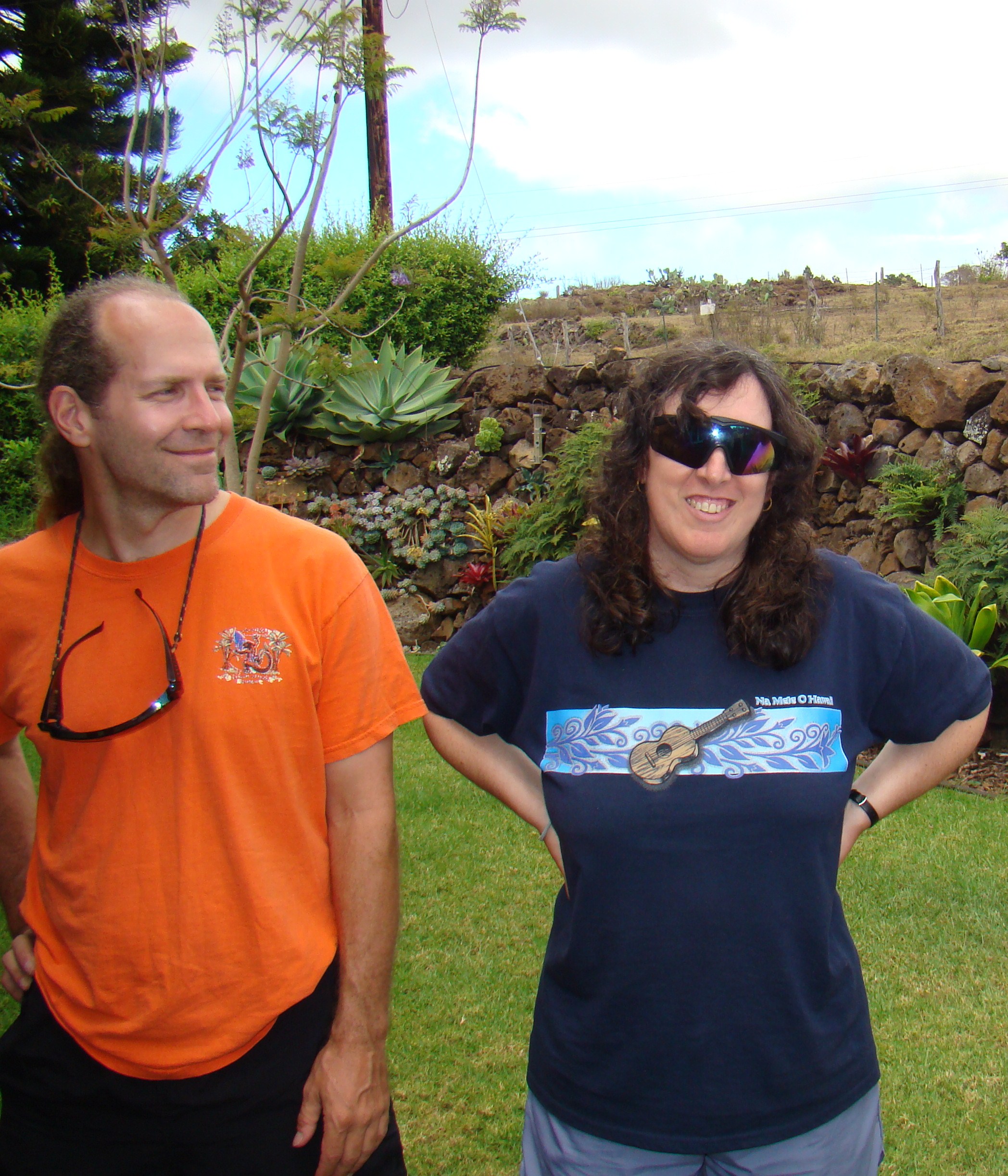
Lifestyles in military retirement: Haleakala Crater redux


Last week we hiked Maui’s Haleakala Crater again.  This post stands on its own, but you’ll appreciate the background if you first read the post about our introduction to this beautiful yet harsh environment.
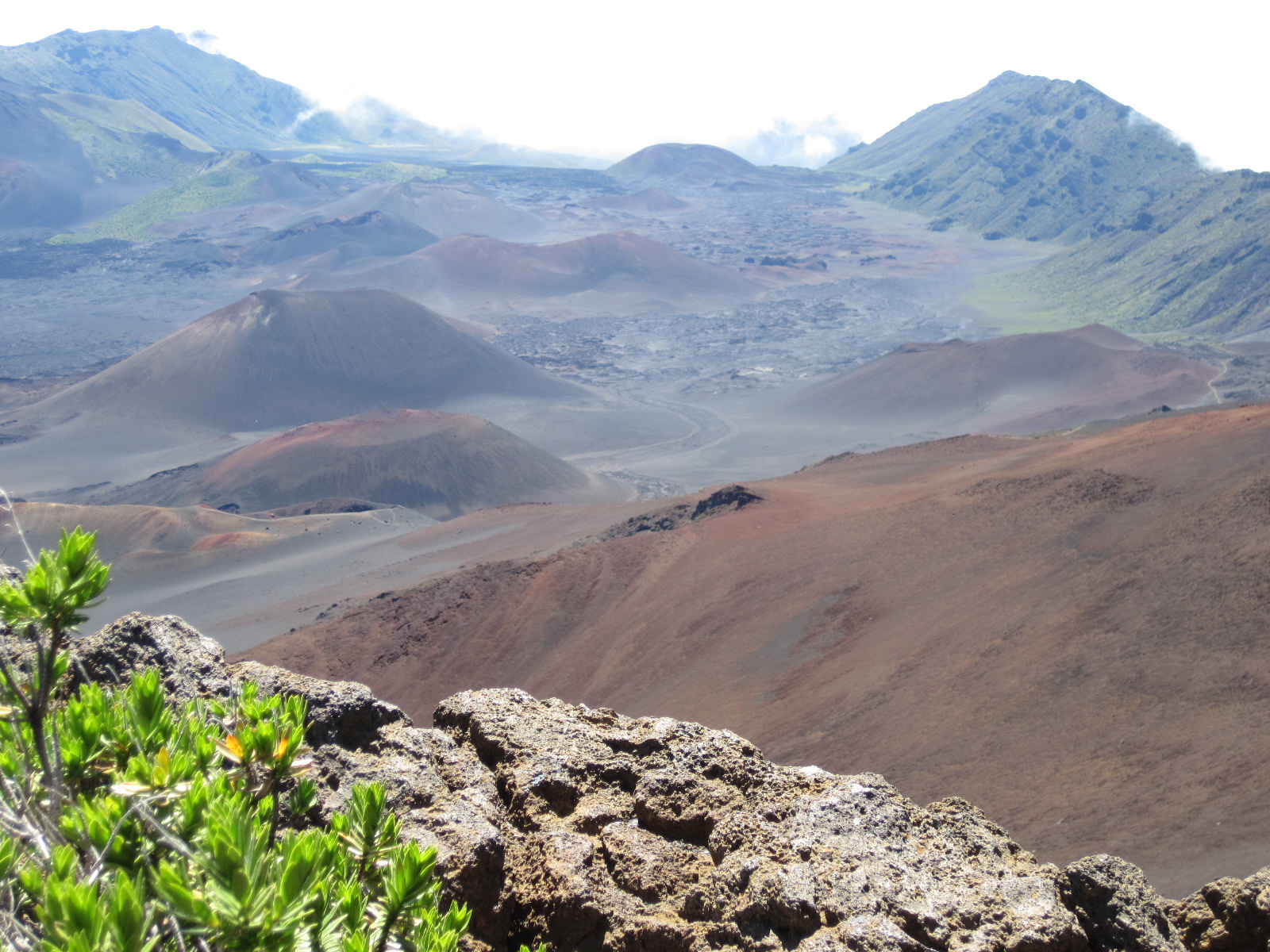
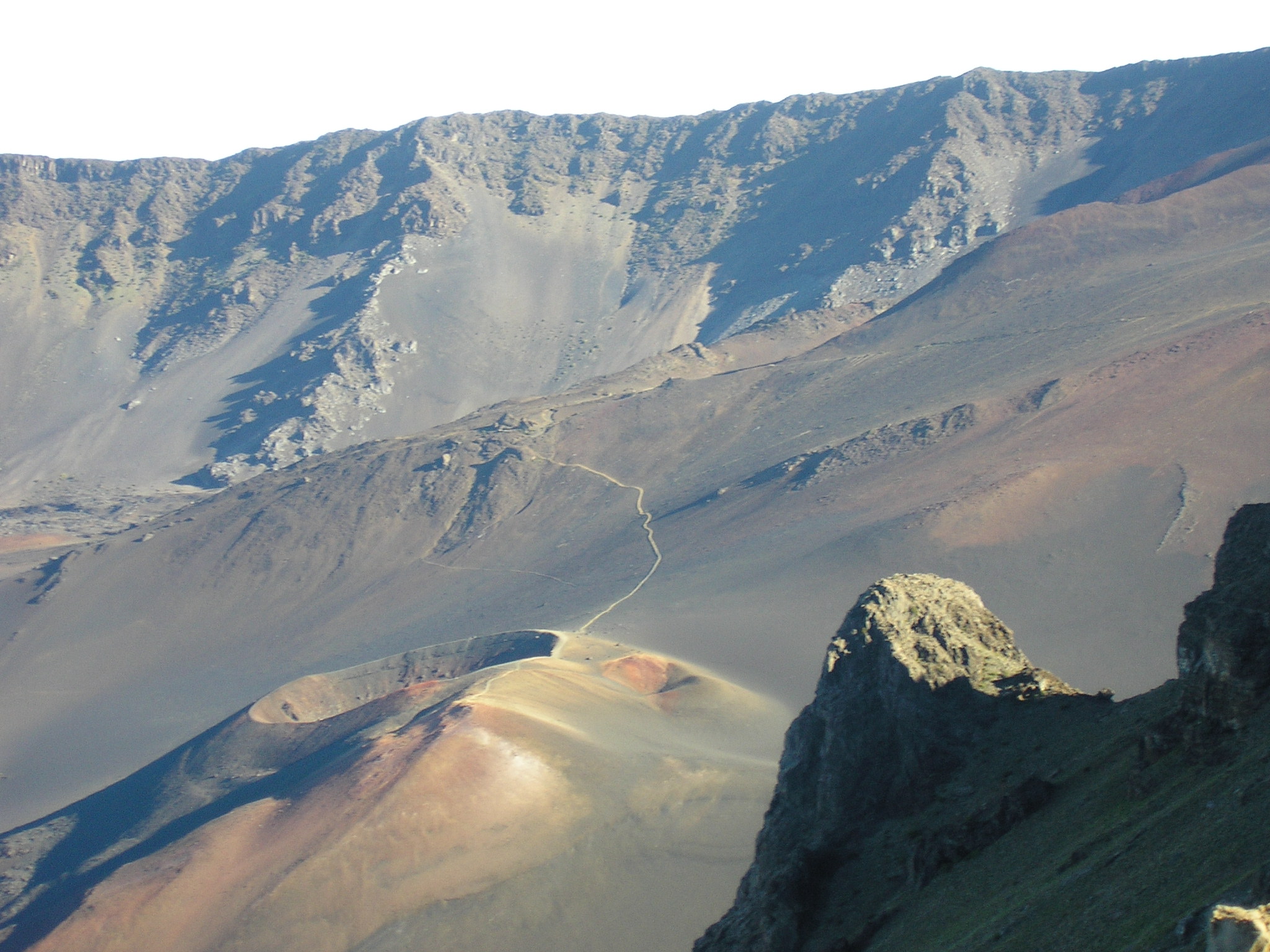
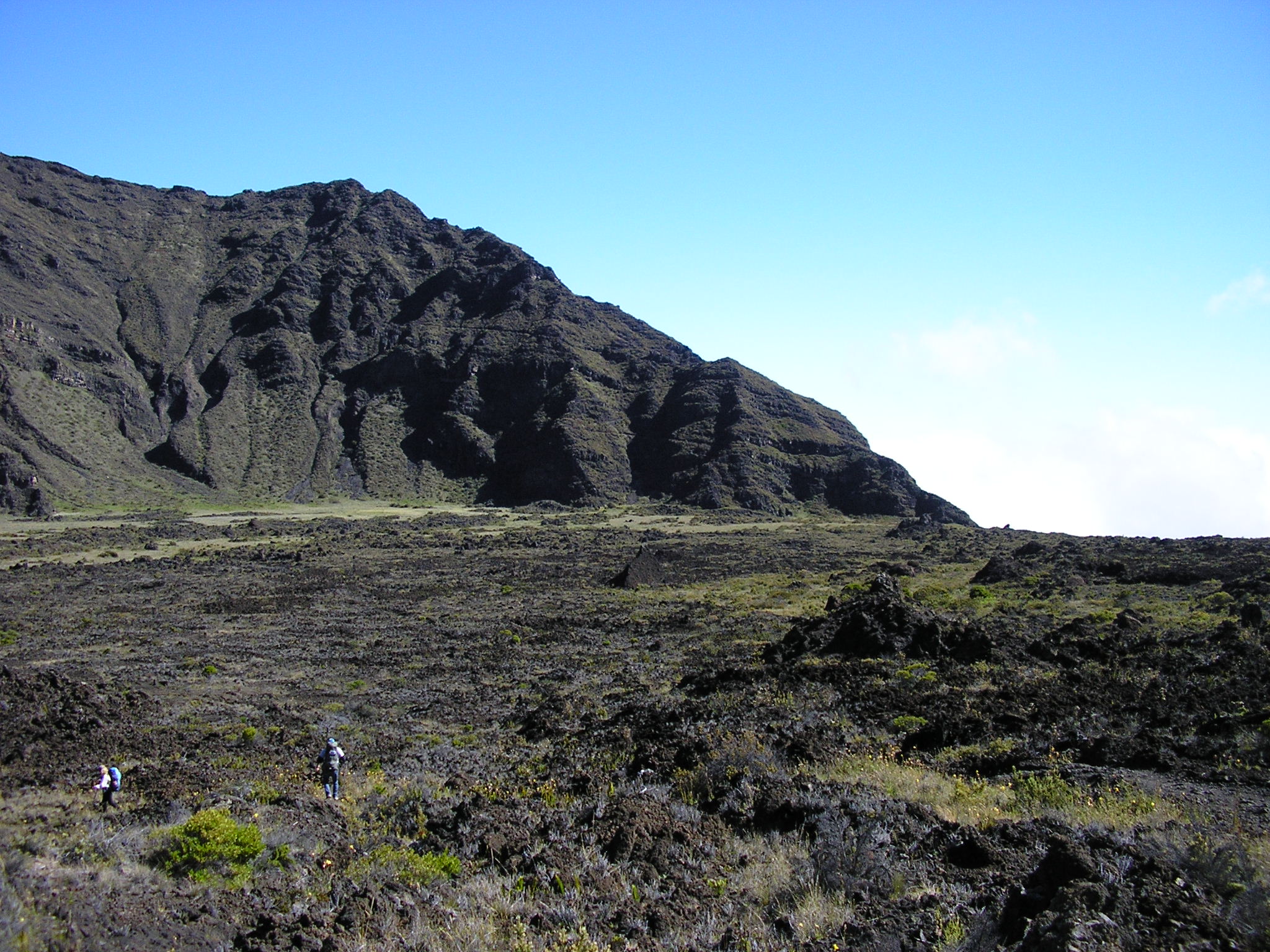
Wide view of crater from summit looking east

Four days, three nights, 20 miles of lava-rock trails at altitude.

(Here’s a two-page Haleakala Crater map showing elevations, trails, and cabin locations.)

Thank goodness for better gear and for spending the last eight months working out. Unlike last year’s endurance trial, this year we were able to enjoy the scenery and take more photos. We arrived at each cabin with enough energy to explore the surroundings and stay awake past sundown.  Of course I still picked up three blisters on the first day from not tying my hiking shoes tight enough. (Hey, some of us Hawaii residents only tie shoelaces maybe three times a year.)  My military-worn knees are sore but the lighter/tighter gear made a huge difference.  The weather even cooperated a bit more, too.

Sunset rainbow

Worst part of the trip: Day 3’s cold, steady rain with ankle-deep puddles on the rocky trail of the six-mile hike from the Paliku cabin to Holua. At least this time it was “only” 30 minutes instead of “all afternoon”.  Best part: That same day, Maui friends who hiked 3.9 miles each way to the Holua cabin from the crater’s Halemau’u trail head (elevation 6900-8000 feet) to surprise us with chocolate chip cookies. Best cookies ever.  (Thanks, Chris & Guy!)  This rainbow over Kapalaoa cabin was pretty nice, too.
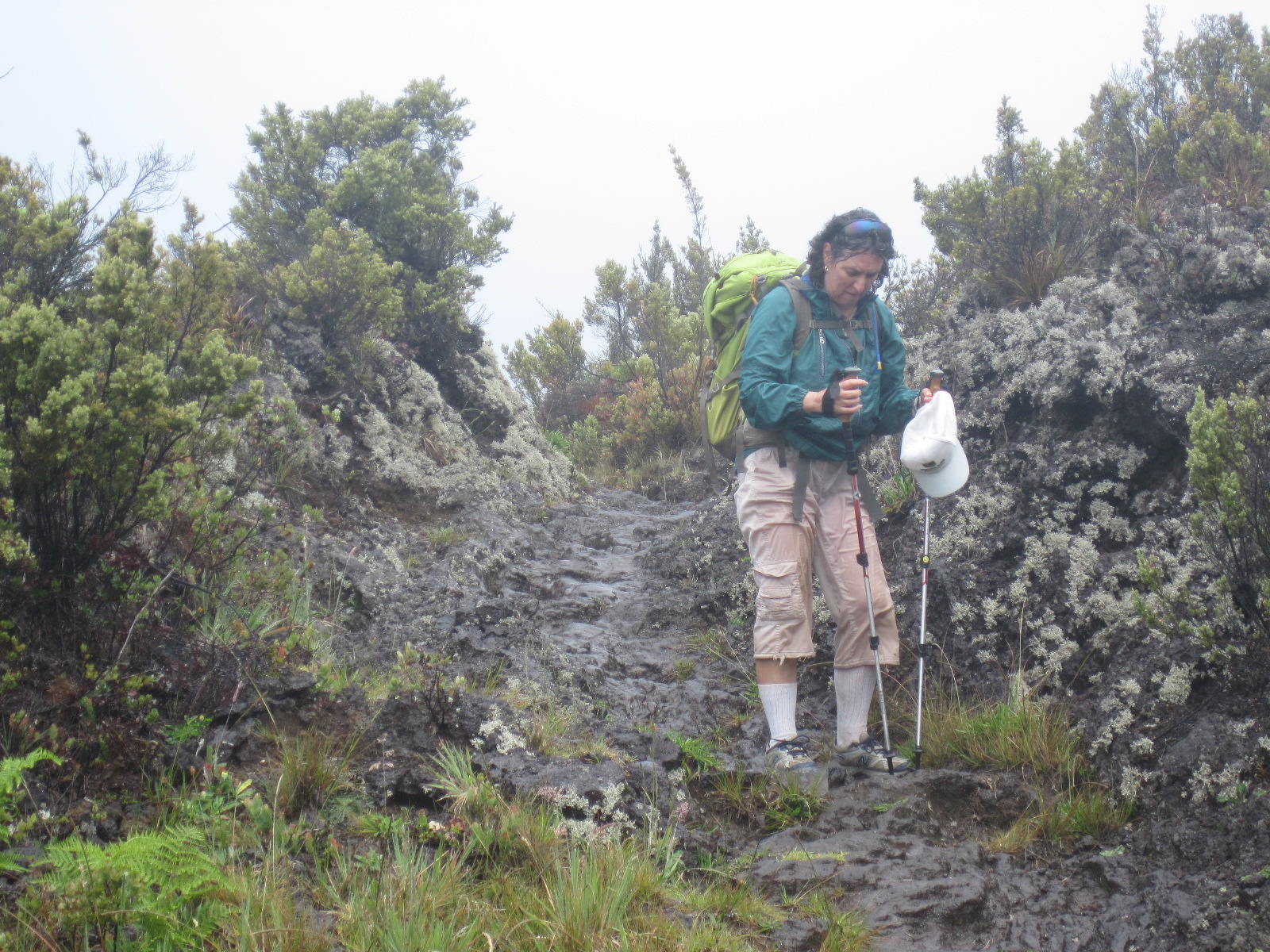
Thank goodness for trekking poles.

This year one of our party said “Money has no value in the crater, but spending it on the right gear will save your life.” We survived last year’s trip on very short notice with borrowed gear. Back then we made it mainly through perseverance and our high tolerance for pain. This year we started over. Our new backpacks are great (especially for spouse’s smaller frame) and we easily handled 30+ pounds. Our 27-ounce 55-degree sleeping bags are light yet still within the colder limit of the crater’s temperatures. Hiking shoes offered stability & control far better than last year’s sneakers, and this year we had the time to break them in. Unfortunately we needed our pack covers and rain ponchos, but they worked fine. Trekking poles  are also lifesavers– in the REI store spouse thought $99/pair was pretty pricey, but by the end of the trip she was ready to send them another thousand bucks.
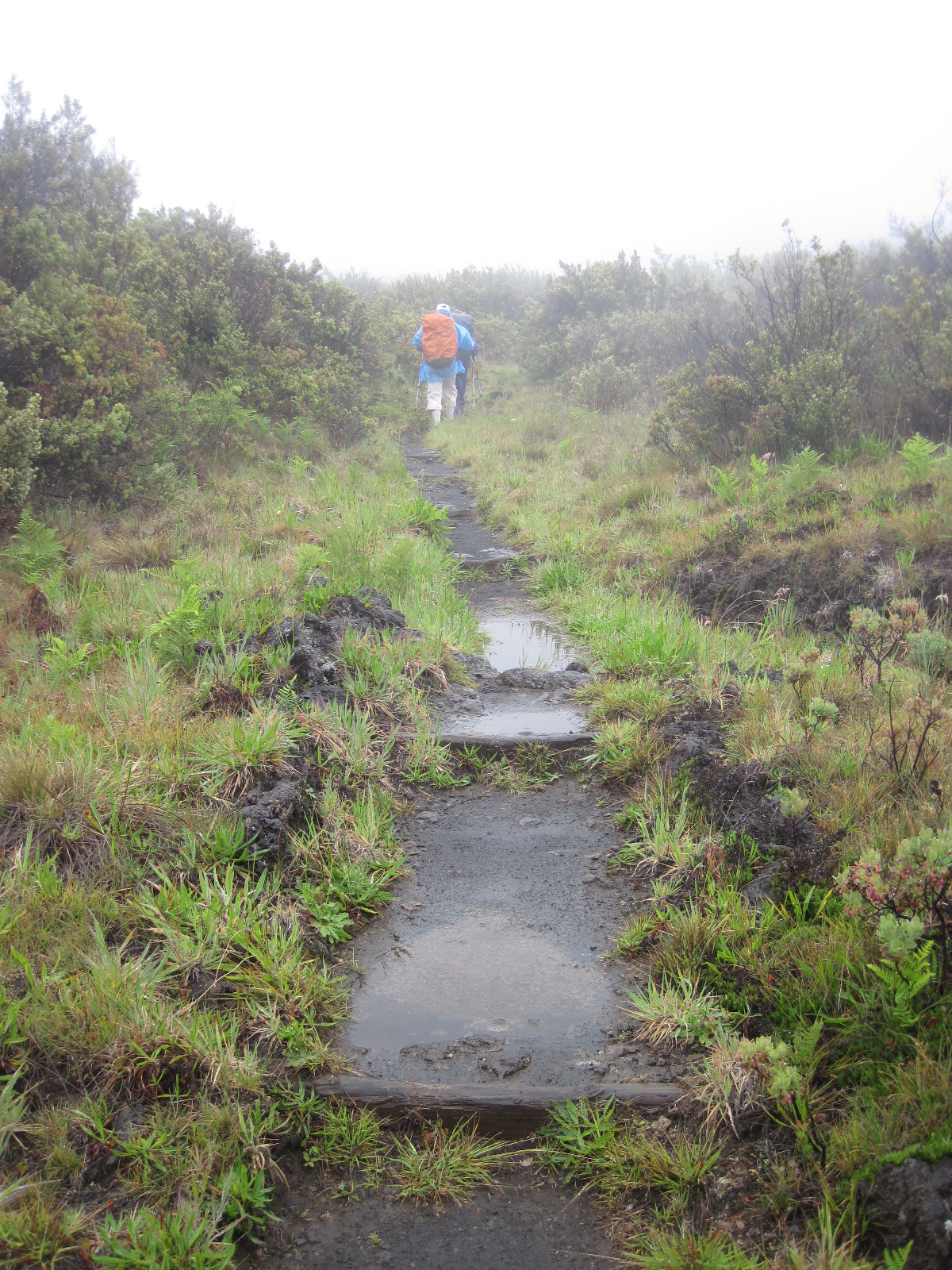
Hiking out of Paliku cabin in the rain... again.

Haleakala Crater is not the average hike along a dirt track. The well-worn trails are ankle-deep sand, unstable gravel, and razor-sharp lava. (After just 20 miles my new hiking shoes show substantial wear.) We were always slipping and sliding. Most of the trails are eroded over a foot deep and stumbling can easily twist an ankle on the side wall. Even grabbing a lava outcrop risks slicing open a finger. Lava isn’t the only footing hazard– the trails are also used by pack horses. 30-knot winds, mist, and even driving rain were common. Our progress was 1.5-2 miles/hour, gasping for breath at elevations from 6500-10,000 feet.  By the third day we were beginning to adapt to the altitude.

–
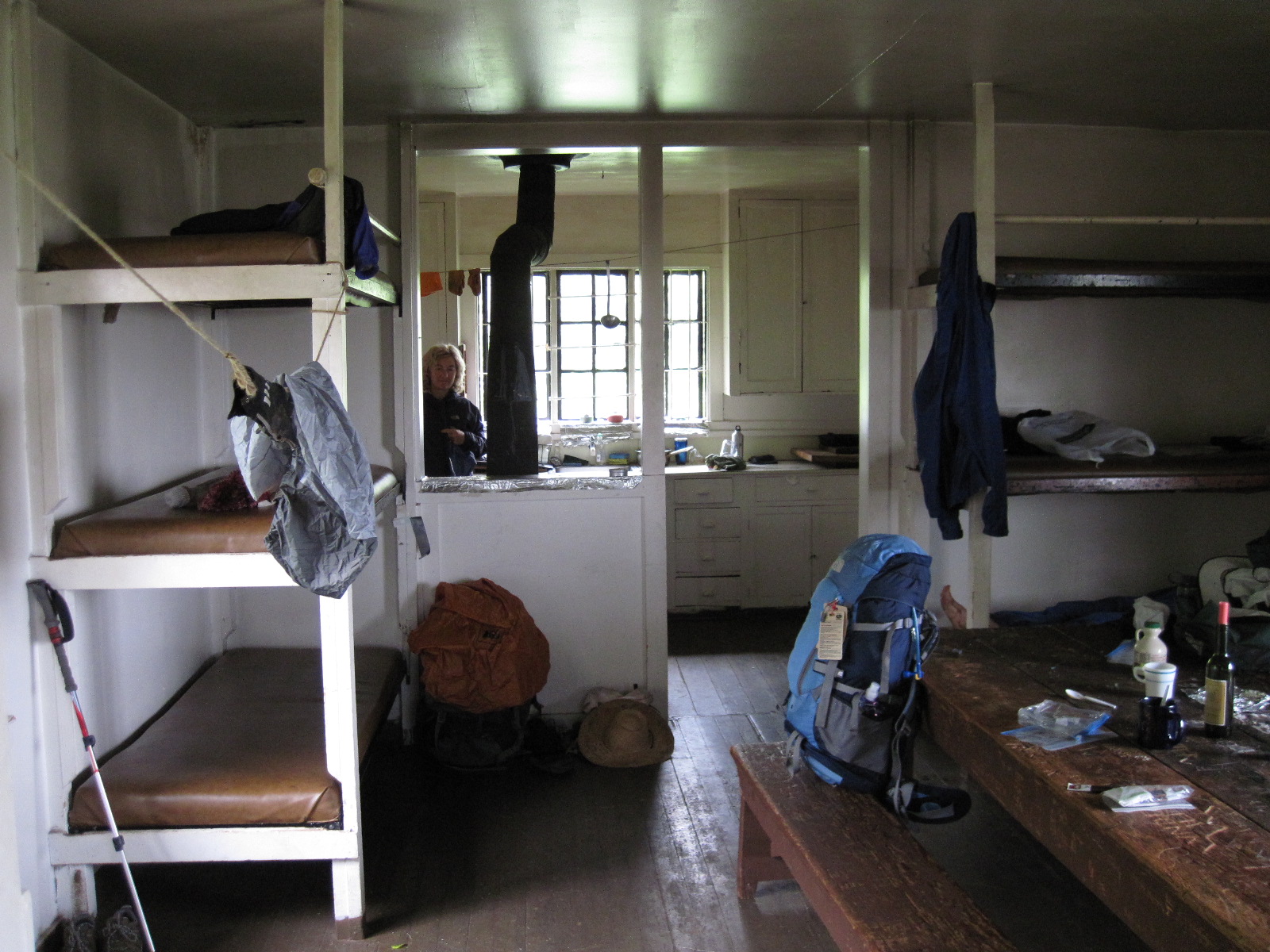
Home sweet home for the night.

This year our hosts reserved all three cabins– very difficult since reservations fill up within minutes for 90 days in advance. Crater stays are limited to three nights  so most groups reserve one cabin per night (it’s almost impossible to get two nights at the same cabin). The 1930s 20’x30′ wood cabins sleep 12 on four three-stack bunks around two wooden tables. One side of each cabin includes a large wood stove, a small propane range with one or two rings, a small kitchen sink/counter area that can handle two people, and a wood-storage room. Water comes from catchment tanks so it has to be filtered or boiled. Wood & kitchen gear are provided. Extra food & supplies are abandoned by overpacked hikers. Tent camping is permitted near two of the cabins but no open fires are allowed so campers have to pack in cooking gear/fuel. Pit toilets. No electricity. Lighting from candles & lanterns. All trash has to be packed out but toilet paper is (usually) available.
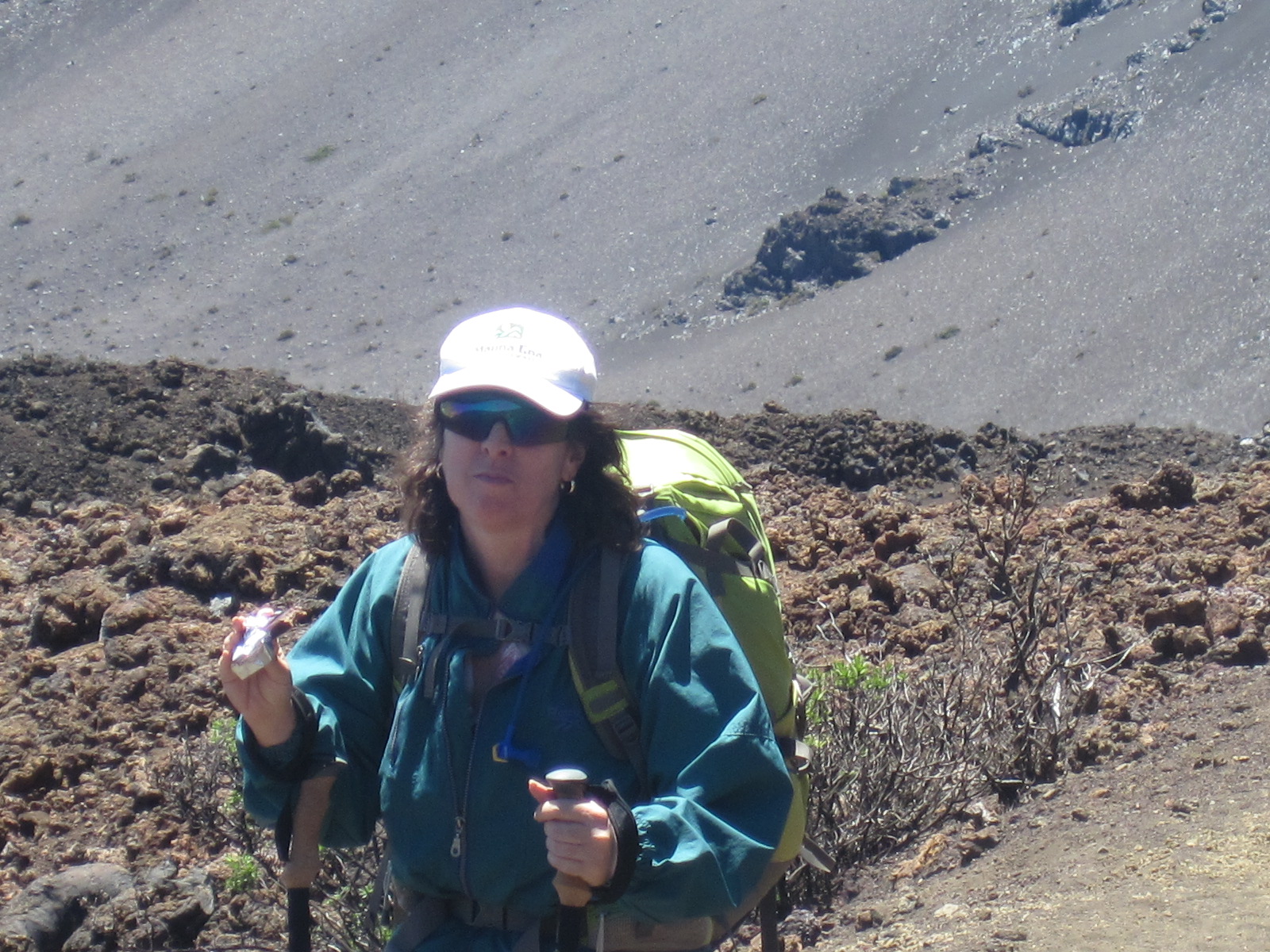
Trail food.

Including spouse & me, our party was eight adults. One is 30 years old but the rest are age 49-64. Three grew up on Maui and two of them have hiked the crater for over 50 years. One is an outdoors expert, another backpacks & hikes several months a year, and a third is an Army Vietnam vet who hikes & skis. Spouse and I hiked & camped as kids but we have the least experience. Our group rotated breakfast & dinner duties among pairs of cooks & dishwashers. We generally started each hike around midmorning and finished in the early afternoons. We’d snack on the trail (protein bars and dried fruit) and make our own late lunches at the cabins.

The first cabin, Kapalaoa, is “only” 5.9 miles down from the summit– but the altitude changes from nearly 10,000 feet to 7000 feet through 15 switchbacks. (Yes, this time I counted all of them.) Sliding Sands trail is aptly named. Last year we lunched briefly at Kapalaoa before pressing on another 3.3 miles to Paliku cabin, and that was a nightmare marathon. This year we “took it easy”. We ate a late breakfast in Kula, arrived at the park ranger’s briefing after the morning rush, and didn’t hike in until after 9:30 AM– yet we still arrived at Kapalaoa four hours later.

"Watch your step"...

Our training paid off. About halfway down the crater’s rim a rock broke out from under my foot and I lost my balance. Thanks to my taekwondo skills I managed to twist and roll the impact. I still landed on my right humerus, gouged out a square inch of tissue, and had a walnut-sized swelling on the point of my elbow for the next three days. I couldn’t control the bleeding with gauze & band aids, so we finally had to stop for 20 minutes to clean up the wound’s ragged edges and apply a compression bandage of toilet paper & duct tape. Next morning I realized I’d also slammed my right hip on a rock for a 6″-diameter rainbow bruise. Thankfully I didn’t sprain ankles or knees– crater rescues use pack horses and take at least a day, sometimes two.  The crater’s altitude and weather are not friendly to helicopters.

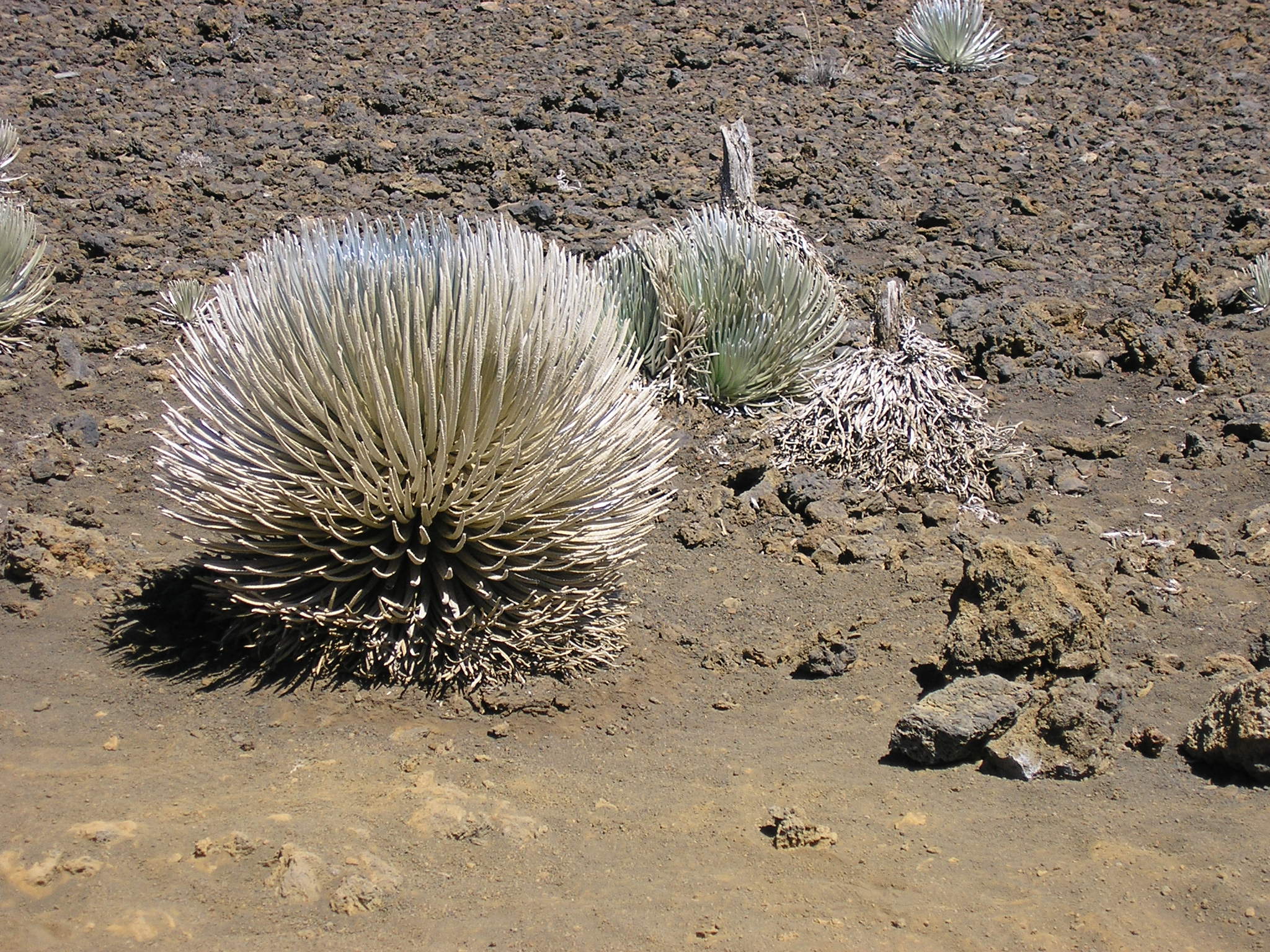
Silverswords in bloom

The silverswords are still beautiful and seemed more plentiful than last year. But Kapalaoa has the crater’s clearest weather and this year the stars were awesome– thousands of them instead of just the usual few dozen. Hawaii has very bad light pollution so it was a real treat to see five planets, a dozen constellations, and the Milky Way. (The summit of Haleakala Crater houses some of the world’s best telescopes.)  Of course we had star maps for both the Greek/Roman constellations and the ancient Hawaiian ones. Sorting out all the patterns took nearly an hour, during which we saw several shooting stars. The full moon rose over the crater rim an hour later and wiped out most of the view, but by then we were freezing anyway.

The first glimpse of Paliku cabin through the rain... again.

Next morning it took nearly three hours to hike “only” 3.3 miles to the next cabin. The Paliku cabin (at the eastern edge of the crater) is surrounded by tropical rainforest but the trail drops 600 feet of elevation down winding, treacherous, knee-wracking stairsteps over slick ledges and crumbling lava flows. Trekking poles usually just get in my way but I should’ve had a pair here to help with my footing & stability. Last year people lost toenails because we pushed to Paliku on the first day, but this year it was only minor blisters & bruises. However, the winds were still gusting to 30 knots and the clouds enveloped us in a cold mist that turned into an overnight rainshower. The weather was too nasty for more hiking around the cabin, which is a shame. Paliku is surrounded by lush vegetation and nearby cinder cones with awesome views of Maui’s Kaupo Gap and the Big Island.

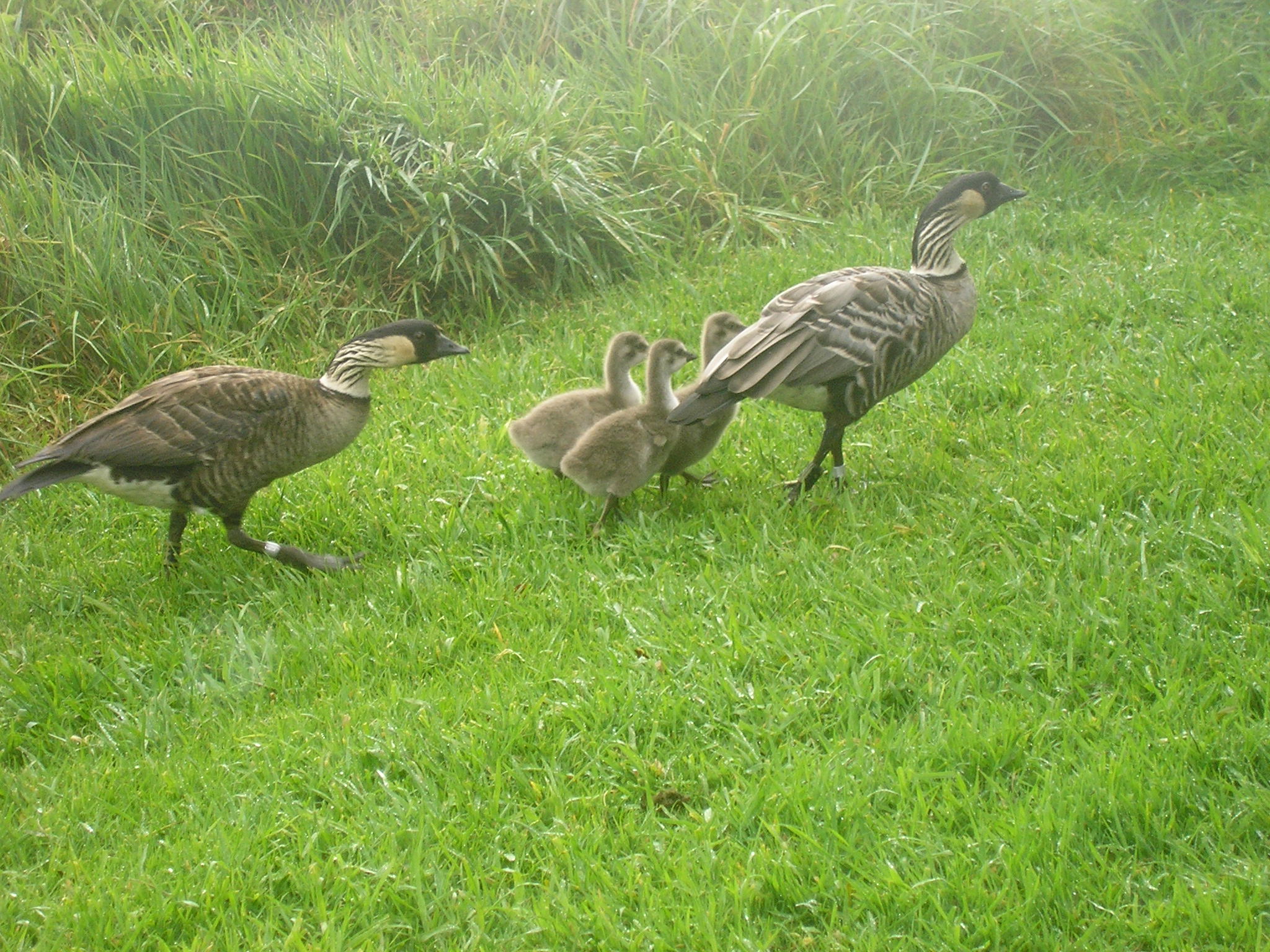
A mated pair of nene consider Paliku their home, especially the thicket of raspberry bushes behind the cabin. They’re too comfortable around humans and hikers have probably been feeding them. The nene didn’t have any chicks this year but the area was still filled with minefields of nene droppings. I flushed a bright red i’iwi  that was way too fast on the wing for my camera. Otherwise we holed up for the rest of the day drying our gear, napping, playing cribbage, reading, and talking story.
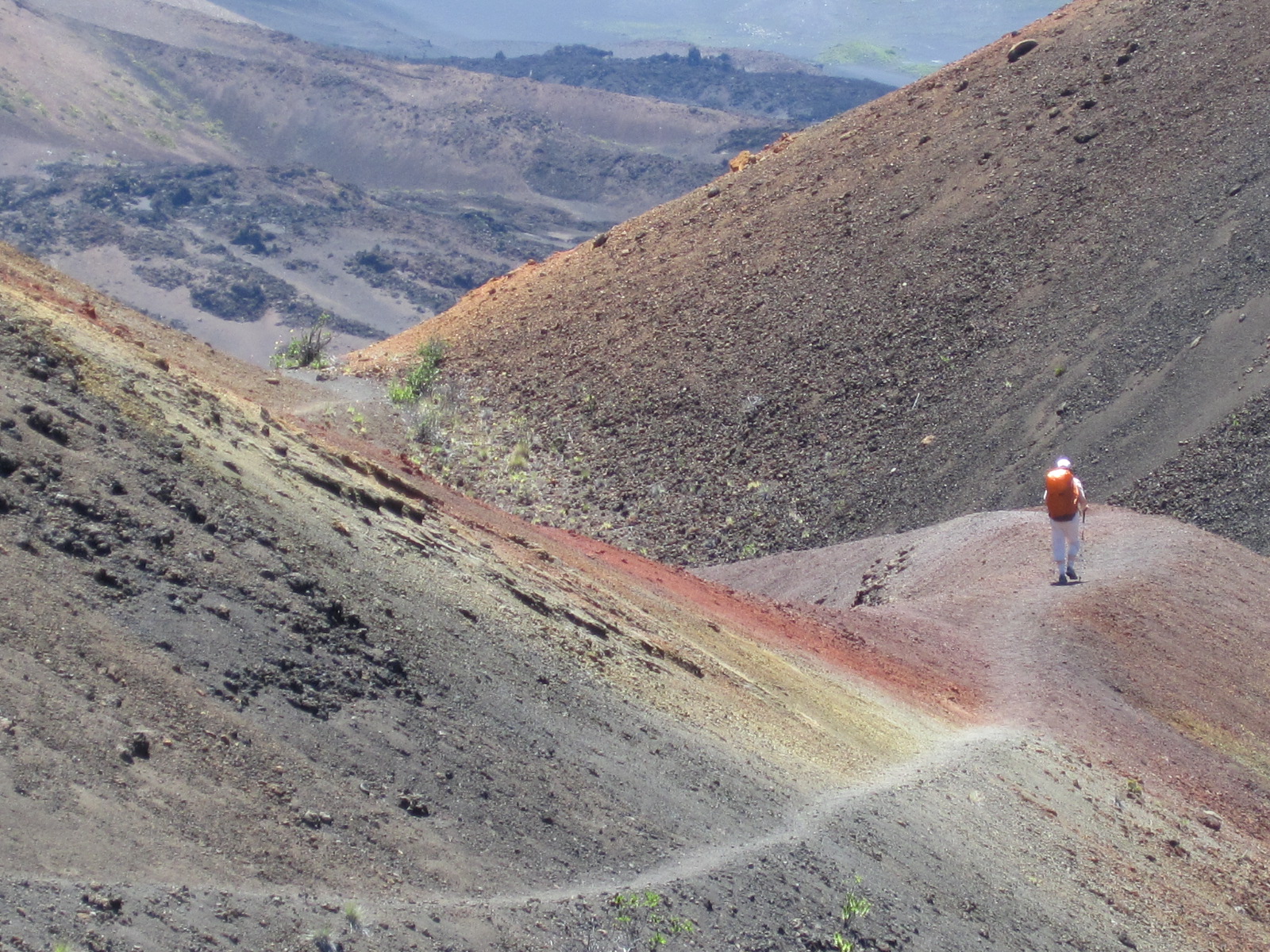
Pele's Paint Pot

The third morning dawned cold, windy, & rainy. (Just like last year.) We hunkered down until 11 AM when it finally began to ease, but by then the first mile of the trail was under water. We sloshed through and finally broke out above the clouds at 7000 feet to hike a total of 6.2 miles to Holua cabin. This trail winds through several different sandy & rocky lava fields– including a spectacular cinder cone of reds, yellows, oranges, and purples known as “Pele’s Paint Pot”. Last year it stormed constantly on this part of the trail and visibility was under 100 feet, but this year it was sunny with great views. The last mile of the hike changes from lava fields to alpine meadows. Pheasants were very shy but chukar partridges were practically underfoot.
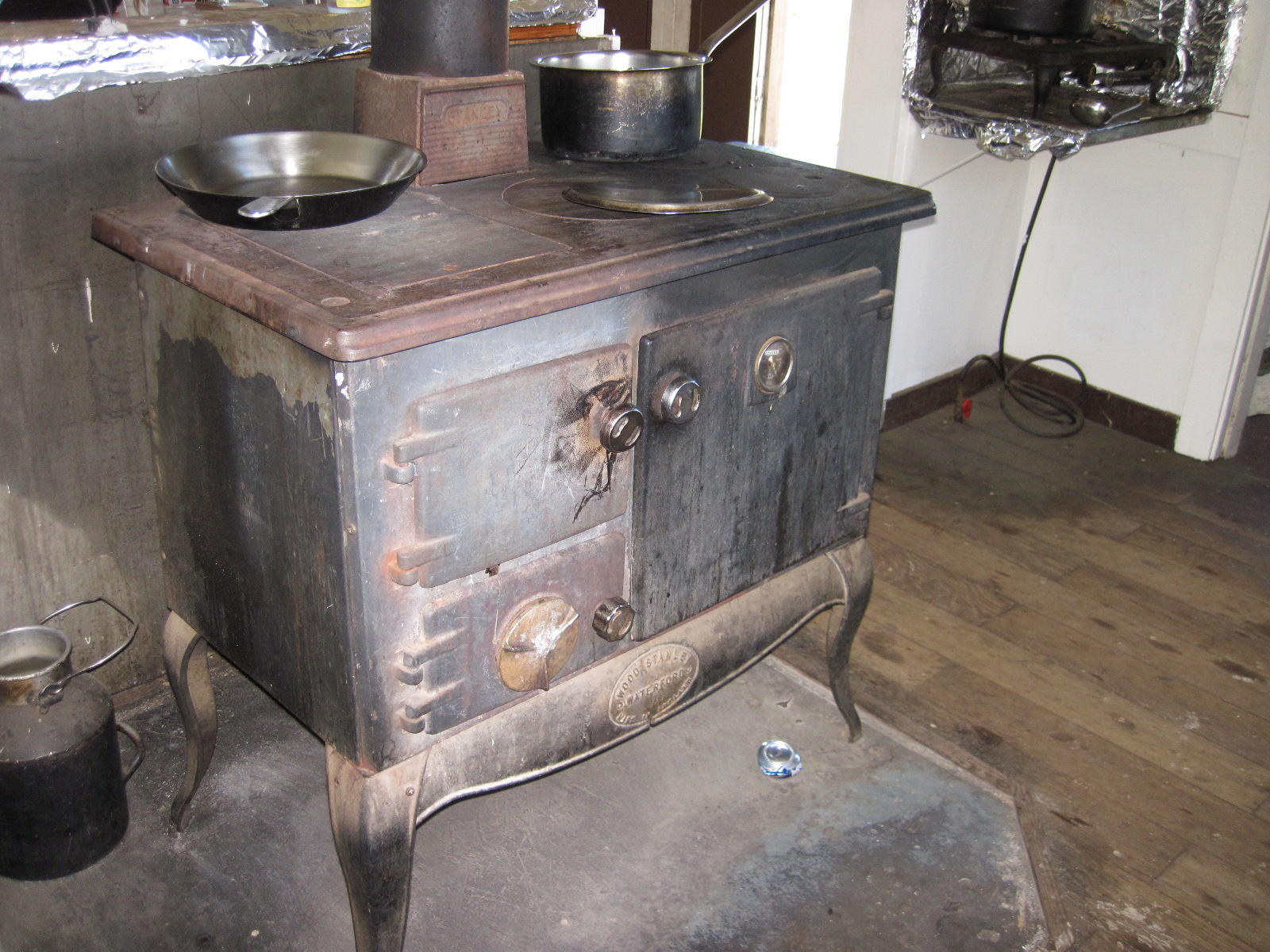
The cabin woodstove with (instant) coffeepots

Holua cabin was dryer than Paliku but a lot colder than the first two nights. Our late start from Paliku meant that we missed our friends waiting for us at Holua, but their cookies were yummy! Stargazing was good again that night but three days of hiking were beginning to exact their toll on our alertness. We filled the woodstove at bedtime but its door latch didn’t catch, so around 11 PM a burning log nudged the door open and started to fill the cabin with smoke. The smoke alarm blasted us awake, and it took us a while to clean up the coals and air out the cabin. Between the smoke and the chilly air nobody slept very well that night.

Switchbacks up the trail out of the crater

The Halemau’u trail from Holua ends at a lower edge of the crater rim at “just” 8000 feet of elevation. That trailhead is still six miles away from the summit but most hikers leave a car here instead of slogging back up Sliding Sands. The first mile of the Halemau’u trail slopes down from Holua to the crater’s inner edge, so the subsequent 29 switchbacks up to the rim actually rise 1700 feet. Last year the views were spectacular but this year the mist closed in as soon as we hit the switchbacks. The humidity was unbelievable and we were soaked within minutes. At one point visibility was less than 50 feet and the temperature dropped into the low 60s. By the time we finally broke out of the clouds we were dripping & chilling.

Crossing the finish line felt great!  We lunched in the parking lot while drying off and getting the cars, and then drove to Kula for showers & a change of clothes. We enjoyed dinner at Milagro’s  in Paia (no wood stoves, cooking, or cleanup!) and then headed back to Kula Lodge.  We zonked out by 7:30 PM and I actually slept for 11 hours. I haven’t done that in nearly two decades.

On the drive back to Kula we saw a short-eared brown owl hovering over one of the meadows. It looked like it had a six-foot wingspan. Beautiful. I’ve lived in Hawaii for over 20 years but I’ve only seen three of our owls.

The military lifestyle might make us suckers for an irresistible challenge, even long after we’ve retired. Last year we hiked Haleakala Crater because we didn’t want to spend the rest of our lives wondering “What if?” and because it’s very hard to get reservations.  (Thanks, Peter & Tracey!)  This year we made the hike because we wanted to improve our performance, and we certainly achieved that goal. We also really enjoy the company and the crater’s beauty.

Next year? Well, first we’ll spend the next nine months wondering why we would want to hike the crater again. Maybe someday we’ll see Paliku without windy rain, but I’d hate to have to make the trip 10 more times before I enjoy that spectacle. Maybe we’ll turn this into an annual “off the grid” retreat, but I don’t know if that’s worth the effort and the very real risks. (Early retirement means that you don’t need retreats to get away from it all!) Maybe our daughter will want to go with us next year (another sucker for an irresistible challenge) but maybe she could just enjoy our pictures without having to grow her own blisters. Maybe next year I’ll actually win a game of cribbage?

We’ll have to think about it. North Shore winter surf is certainly enough challenge for the rest of my life.

I’ve skipped over the details of how the park is set up, where we stayed before & after, and other Maui amenities.  If you want more Haleakala Crater or Maui information, please e-mail me or fill out the “Contact me” form!

Related articles:

Lifestyles in military retirement: Haleakala Crater

Does this post help? Sign up for more free military retirement tips via e-mail, Facebook, or Twitter!
Posted in Military Retirement, Travel | Leave a comment

Retiring Early — with Kids?


Let me start by saying that kids are totally worth it. (There, now my daughter can relax.) If you’re the kind of person who wants to have kids someday, then feel free to start a family when you’re able to support that.

Off-topic for a second, if you just can’t see yourself having kids then don’t worry about it. It’s possible that someday you’ll want to raise a family, but don’t go through the experience if you’re not interested. Family tends to shove aside other priorities, and it certainly reduces one’s range of choices for a couple of decades. If raising a family is not on your list then there are plenty of other people in the world who can benefit from your love.

Back on topic, let’s move on to whether kids are compatible with being able to retire early. Again, as my daughter already knows, the answer is “Yes!” Once again there will need to be priorities, choices, and compromises.

I may be going out on a limb here, but it’s possible that raising a family can motivate you even more strongly for early retirement. If you’re planning to ER then you’re probably not interested in spending the rest of your life in the office pursuing a paycheck. Your family may have convinced you that you don’t want to spend all your years climbing the corporate ladder, either.

You’re already focused on saving and investing, and you’re capable of carrying out a plan. These interests & skills overlap the same ones needed to raise a family. Add in the desire to spend more time with family and wanting to watch your kids grow up. Maybe you’re a little concerned about them being home alone after school during the teen “danger zone” afternoons. (No, honey, not you. Of course we always trusted you.)

Or maybe you’ve done the spreadsheet analysis to realize that you’re just not paid enough to afford childcare, summer programs, and after-school programs. However, you arrive at your conclusion, you’ve decided that your family has top priority and you’re willing to work to make it happen. Your quest for your family’s financial independence will lead you right to ER.

We human beings are sensitive to the norms imposed upon us by our culture, and one of those norms is the imperative of “setting a good example for my kid”. As we approach ER we may wonder “What will my kids think if I’m not working? How can I show that I’m still a productive member of society? How will my ER lifestyle prepare them for their working years?”

Parents, brace yourself for a bit of news: it’s not about you. Oh, your kids still care about you and your behavior– especially if it embarrasses them– but they’re largely oblivious to your social standing.

They assess your value in terms of how much time and attention you devote to them, not by how many reportables you have at your MegaCorp division or by how much you cut last quarter’s operating expenses. In a kid’s view, if your job responsibilities take you away from them too much then they may actually think less of you. And when they go out into the world to seek their own careers, the last thing a young adult wants to do is get stuck in their parent’s footsteps.  They’ll blaze their own trails.

One early retiree pioneer learned about “setting an example” the hard way. He felt obligated to appear employed for his daughter, so while she was finishing high school he kept up the fiction. He’d show up at the breakfast table each weekday in work attire and then leave in the car before she left in the school bus. After a few errands (or a cup of coffee at the doughnut shop) he’d return home to resume his “secret” ER lifestyle. Years later he confessed this subterfuge to his adult daughter, who thought it was pretty funny. She told him that she was so busy struggling through her teenage years that she never noticed what he was doing. Even if she’d noticed, she wouldn’t have cared.

What about another problem– can you afford to ER if you have kids?

The answer is still yes, although it’s difficult to forecast the economies of scale.

I’m not going to recite the media’s sound-bite statistics on how many hundreds of thousands of dollars it costs to keep the little darlings happy and thriving. You’ll figure out your own budget for your own family. You can certainly save enough money to become financially independent if you have a high-paying career.

You can save enough from most paychecks to afford ER with one or two kids. If your pay drops and the number of children rises, eventually the two lines will cross and it’ll take a lot longer to reach financial independence. I can’t tell you where that line is, but it can be greatly influenced by how frugally you raise your family. Amy Dacyczyn, one of the world’s most famous frugalistas, managed to raise six kids and still retired early.

An important aspect of raising kids with early retirement is consistency. If children’s budget rules are always changing then they’ll feel insecure about money and might even resist your attempts to save. The key is to set the rules early, live by them, and try to help your kids figure out their own solutions to their money problems. ER is not the time to impose new fiscal austerity or even deprivation.

Budget the money to teach your kids how to manage their own money, and make sure your spending reflects your values. Young kids can learn to manage a small amount of money with their own allowance, and they can just be told that there’s enough in the family budget to pay for the things the family needs. Older kids need to learn how to manage larger amounts of money (especially the deferred gratification of saving for bigger purchases) and can be shown what goes into making a budget.

Teens are old enough to manage bigger chunks of money (like a monthly allowance instead of weekly) and to find their own ways to earn money for their desires– get a job! As they approach the end of high school, they’ll be keenly interested in all details of budgeting. (Right, honey?) One of the best resources for teaching kids of all ages about saving money is David Owen’s “First National Bank of Dad”.

You can figure out how to feed an extra mouth or two and keep them in acceptable clothing. You’ll also be able to figure out how to pay for their orthodontia other expenses as they grow. Whether your ER solution involves extreme savings, a bridge career, or part-time work: you’ll continue to make family your top priority, and you’ll succeed.

Some of you are already thinking about the next question: “How can I ER and still save enough money for my kid to go to a good college?”  That’s another post. I’ll also explain how our daughter answered the question all by herself.

Related articles:
Retired at 40 (with three kids): The Neilsens
The Wandering Wahls
Thanks to Billy & Akaisha Kaderli for these next two interviews!:
The Swansons
The Greenhalghs

Does this post help? Sign up for more free military retirement tips via e-mail, Facebook, or Twitter!
Posted in Financial Independence, Military Life & Family | Leave a comment

Building the Ultimate Investment Portfolio


I’ve been reading financial discussion boards for over a decade, and they tend to converge on a few perpetual topics.

One of them is “How’s my portfolio?”  Here’s a typical example:

“Hi guys glad I found this board great to be here. So dudes im reading alot of financial books this month and heres my portfolio check it out: 10% VFINX 34.2% FMAGX 12% MO 22% XOM 4% GLD 10% cash and the rest in a newzealand timber farm my uncle got for me. But financial manager says I might need to diversify?  Wassup wit dat?!”
sent from my iPhone

Or at the other end of the bell curve:

“*Ahem*.  I’ve concluded my rigorous four-year analysis of the world’s stock market’s performance and trends, and I’m just about ready to implement my portfolio. Before I do that I’d like to run it by you to see if just possibly I might have missed anything (heh heh). Lest you go astray too quickly into the minutia, note that the Treasury yield curve just turned from its normal concave configuration to a much shallower slope which could soon precipitate inversion. I should also point out that I’m quite concerned over the direction that Congress and the American People are taking with respect to the budget deficit and the dollar’s weakness vis-a-vis the renminbi, so I think it’s quite appropriate to designate a significant portion of my portfolio to an actively-managed inverse foreign-currency leveraged trading fund. In addition, I predict that next month’s annual Indian and Chinese purchases of gold for their daughters’ wedding dowries will cause the exchange-traded spot prices to…”

And right in the middle:

“50% total stock market, 50% total bond market, rebalance every January, then go surfing. What could be simpler?”

What’s wrong with these three portfolios?

Well, if their owners are happy with their asset allocations, then there’s nothing wrong!

The underlying questions being asked by these posters include:
“If I buy these, will anything bad happen?”
“Where’s the market headed?”
“Man this stuff is boring.”

Yet all three are trying to solve the same problem: having enough money to do what they want, while not working on it any harder than they want to.

It turns out that part of the problems is: we’re humans, not just logical Vulcans.  After two nasty economic recessions in one decade, the field of investor psychology is regaining popularity at explaining why we behave this way. Although much of the research is still being debated, it’s becoming clear that humans are very good at finding patterns in data (even when no patterns exist) and very persistent at projecting our perceived “trends”. We also tend to be emotionally involved with our choices and affected by what we think are the consequences of our actions. If we like eating hamburgers, then McDonald’s is a great stock! If the markets go up, then we’re brilliant! If the markets go down, then we need a better portfolio.

Unfortunately the financial advisers and mutual-fund industry can read about this research too, but they’ve applied it to their marketing and sales techniques. We’ve been led to believe that investing has to be exciting (but only if it makes us rich) and we have to seize control over our futures (aided, of course, by the seasoned advice of our friendly investing professionals). If we’re doing something boring by ourselves then it can’t possibly work.

Notice that none of this has any effect on the stock markets. They continue to be a huge random collection of financial transactions occasionally driven in the same direction by profits, governments, fear, and greed.

One of the more popular books on investor psychology is Charles Ellis’ “Winning the Loser’s Game”.  He’s not saying that we’re a bunch of losers playing a game. Instead he uses the analogy of tennis as “not losing”.

The world is full of tennis players (and golfers, and runners, and other sports enthusiasts). Only 10 or 20 of them are truly able to win their game through their technique. After years of obsessive practice and tremendous personal sacrifice, they’re finally capable of consistently serving an ace or hitting a kill shot. They have intense sustained focus and the mental toughness to keep their emotions from interfering with their technique, and they’re capable of performing under tremendous pressure. However, they also might not be capable of doing much else besides those highly specialized skills, and (as the tabloids show) they can display amazingly poor judgment & behavior when they’re off the courts.

The rest of us amateurs haven’t put in the time or paid our dues, but we still enjoy tennis. We might have some natural talent. Our technique might be lacking, and we’re unlikely to improve because we also lack the time or the motivation to make the improvement. We might not bring a laser-keen focus to the sport, and we can have more than our share of bad days. A “friendly wager” may be more pressure than we can handle. Yet somehow, most of the time, we’re able to keep the ball in play. We might not be able to hit a kill shot every time we swing the racket, but we can usually get the ball back over the net and live for another round of the volley. Eventually our opponent will make a mistake and we’ll win– because we didn’t lose.

Ellis transfers the analogy to investing: If you’re not hard-wired like Warren Buffett, and if you’re not willing to put in the time and effort and sacrifices* to be like Warren Buffett, then don’t try to invest like Warren Buffett. If you’re going to play the game as an amateur then you should focus on “not losing”.

How do investors “not lose”? Believe it or not, it’s pretty straightforward: (1) Diversify among a few asset classes of index funds.  (2) Minimize your investment expenses.  (3) Automate as many of your decisions as possible so that you don’t have to keep making choices (or keep “not making choices”).

How do military investors “not lose”? Start with the TSP. They’re all index funds, and it’s hard to make a diversification mistake among this handful of choices. They’re all among the world’s lowest expenses. You can pick your asset allocation and your percentage of paycheck contribution the day you get your ID card, and all you need to do is keep maxing your TSP contribution. If that’s still too many choices then pick an “L” fund near your desired retirement date and let the TSP handle the rest.

You can carry the TSP’s philosophy over to your IRAs and taxable accounts, too. The index-fund equivalents of the TSP’s choices are plentiful at Fidelity, Vanguard, or Schwab.

If we were all this logical then nobody would need to read this blog post. So how do we handle our emotions when we design our asset allocation?

The first step is to do the reading to understand the issues. (Congratulations, if you’ve never done this before then you’re almost finished with that first step.) The next step is to choose an allocation that makes you feel emotionally comfortable as well as logically superior. For most investors (and their spouses!) this means an asset allocation that’s not too volatile, so that they can “sleep at night” and don’t have to constantly keep an eye on its performance.

A final step is to give yourself an outlet to express your “brilliant investor” emotions. One of my favorite posters cheerfully admits that he used to be a much more active investor, with a file cabinet full of real no-foolin’ paper stock certificates. Lately he’s been cashing in the certificates for index funds. He’s content to let Vanguard do the (non-) work for him, but he still has a small portion of his file cabinet portfolio devoted to what he calls “hormone” investing. It doesn’t have a significant effect on his net worth but it makes him happy and keeps him from getting into bigger trouble.

You can do the same with 10-20% of your portfolio– invest it in something that makes you feel good about your efforts without making it too much work. Again, you don’t have to be an investment guru unless you want to be.

So next time you see one of those “How’s my portfolio?” questions, you can respond with one of your own: “What’s your asset allocation?”

* Warren Buffett’s life looks pretty good today, but he’s made a tremendous number of personal sacrifices along the way– both intentionally and accidentally. Personally I wonder if his wealth was worth the price. Read Alice Schroeder’s biography “The Snowball”.

Related articles:
Market volatility during retirement
So where should I invest my money now?!?
Asset allocation considerations for a military pension
“Present value” estimate of a military pension
Tailor your investments to your military pay and your pension
Where to put your savings while you’re in the military

Does this post help? Sign up for more free military retirement tips via e-mail, Facebook, or Twitter!
Posted in Investing & TSP | 2 Comments

Lifestyles in military retirement: Haleakala Crater


My friend Jay asked me to post this before we go to Maui.  He either wants to check our morale or get our final thoughts on record…

A year ago we got a call from a good friend. He grew up on Maui and had hiked Haleakala Crater for over 50 years. He and his spouse had formed a 12-person group for their next trip but two had just dropped out. Could we fill in? Sure, we thought. A four-day hike with sleeping cabins? No problem!

Spouse and I hadn’t been hiking for a while, but we know what to expect at altitude. We no longer had hiking shoes or gear but we’re both in good shape, and we are extraordinarily stubborn persistent. We’ve endured plenty of environmental misery during our Navy years and we were confident that we could do this. We knew that the National Park Service severely restricts access to Haleakala’s fragile environment, and joining such an experienced group is the chance of a lifetime. The challenge was that we had just five days to prepare. Above all, we didn’t want to miss out and spend years wondering “What if?” So we scrambled to the military base to rent backpacks & sleeping bags, stocked up on food & ibuprofen, and found our most comfy sneakers. No chance to buy, let alone break in, proper hiking shoes.

We survived, but it wasn’t pretty. I haven’t been so physically challenged since my taekwondo black belt test. Four days of Haleakala felt like three weeks of Army Airborne parachute training or Navy diver school, although I’m a bit older since those days.  Spouse felt hammered down into pain levels somewhere between “plebe summer” and “giving birth”. Our critical asset was obstinacy perseverance, and it’s not hard to find when the alternative is dying of exposure. If you sprain an ankle in the crater it may literally take a day to get you out. There’s no cell-phone service, no cabin phones or electricity, and no standby rescue helicopter. If the weather closes in then the rangers use pack horses.

Summit view

Haleakala’s altitude is from 6500-10,000 feet.  It’s mostly desert and lava fields with some alpine meadows. The night before we hiked in, a cold front passed through with gusts over 75 mph. Summit winds are 20-30 mph and temperatures are 40-70 degrees even without the wind chill. The sun is intense and the altitude inhibits conversation, let alone exertion. The trails are unpredictably treacherous– ankle-deep sand, slippery rocks, sharp lava, narrow deep-cut trails, and crumbly switchbacks.  The Apollo astronauts used the crater for lunar environmental training.

Field of silverswords

NPS is fighting a conservation battle. They’ve closed off nearly 40% of the terrain for research but the land is so dry and the vegetation so fragile that it can take decades to recover. Ancient Hawaiians have left clear trails from the 1700s and traffic has risen steadily since the 1930s. Silverswords put out surface roots that can be killed by walking too close. Invasive species (rats, mongoose, goats, pigs) have cut back the bird population while reducing plant seeding & pollination. Some of the trails are worn 18″ deep and have to be re-routed when it rains. The silverswords are much reduced even in the last 50 years– we saw groups but none of them were as big as the 19th-century photos. Even 40 people staying overnight (plus hundreds of day hikers) can overwhelm the area.

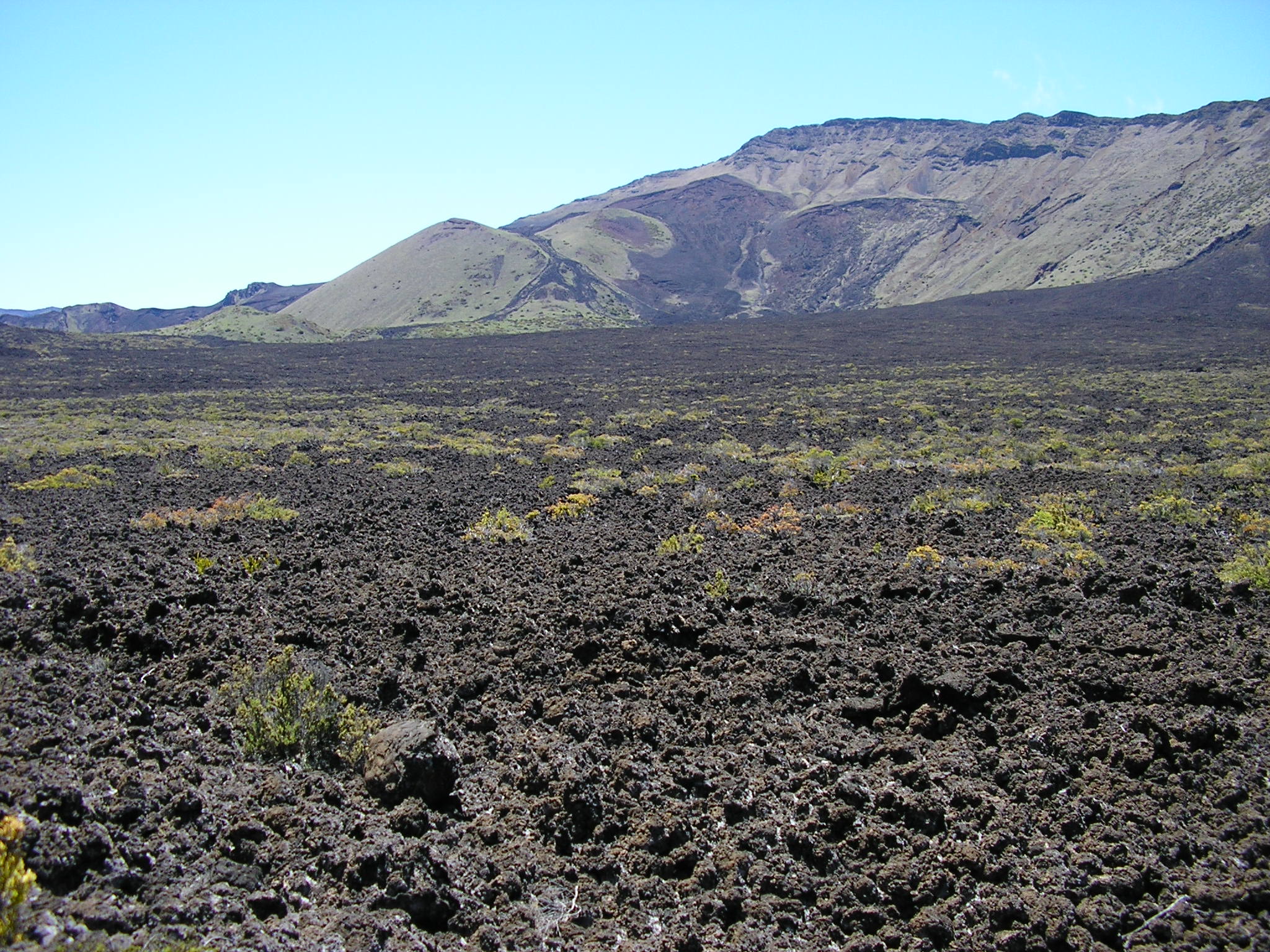
In the crater's lava fields

The first day we hiked nearly 10 miles east from the Visitor’s Center to Paliku, the crater’s “best” cabin. The first five miles slogged off the summit through Sliding Sands trail, raising clouds of lava dust with every step. Our sneakers filled with cinders. Our rental gear chafed, our sleeping bags flopped around, and spouse’s pack was too big for her torso. We started with 30 mph winds (gusting to 50) and 50 degrees but the wind soon died and the sun began to bake. The terrain descended over 3000 feet in a few miles through switchbacks into sun-blasted & eroded landscape punctured by occasional thousand-foot cinder cones and sporadic groups of silverswords. We saw no critters above 7000 feet– they’re not stupid.

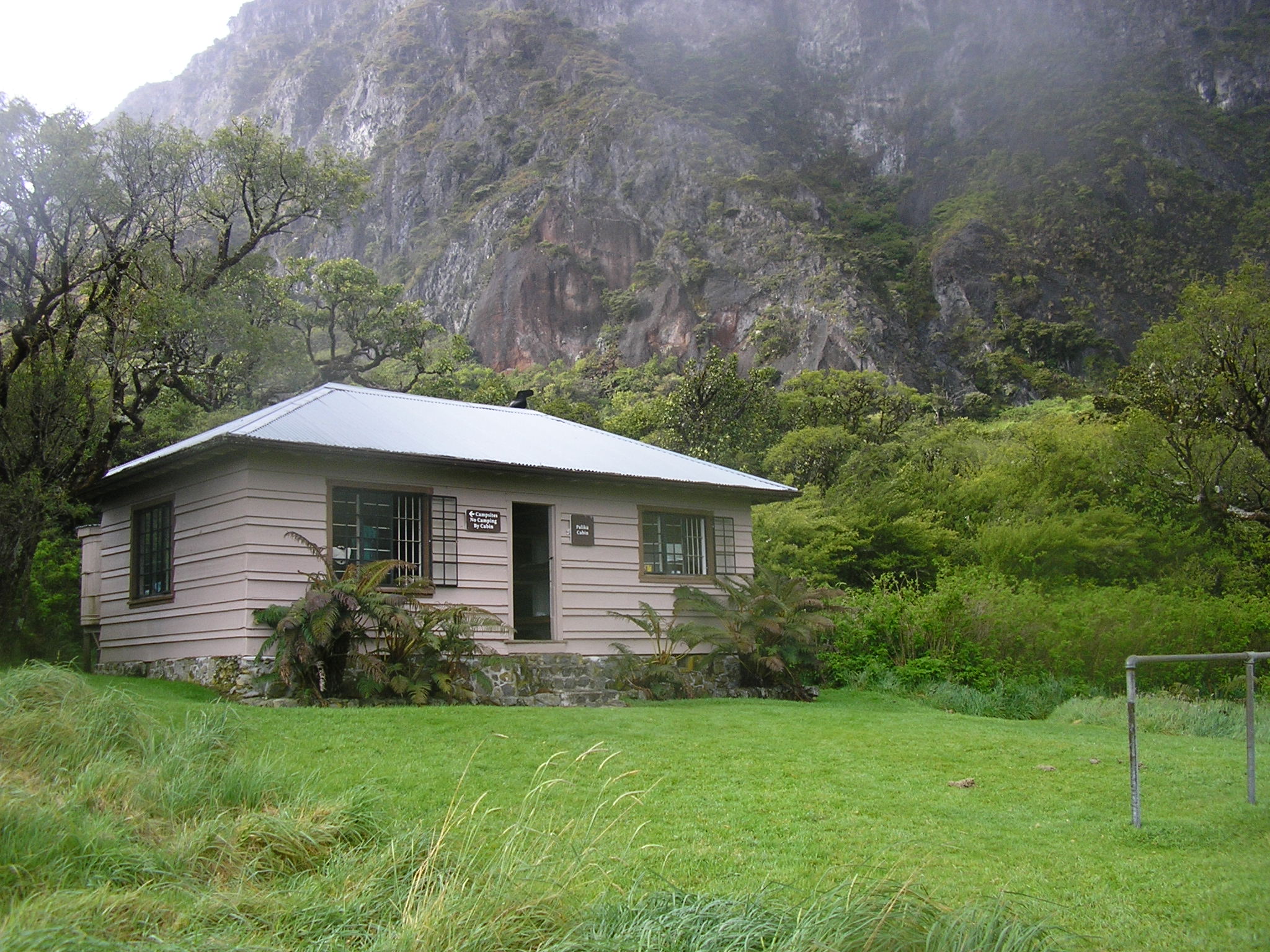
Paliku Cabin, established 1930

The cabins are 20’x40′, built by the CCC. The main room flows into a two-person kitchen next to a small firewood closet that doubles as a changing room. 12 bunks are stacked three high around a large table with benches. Water flows from the catchment tank and the pit toilet is behind the cabin. NPS provides firewood, toilet paper, kitchen gear, and bedpads. No open fires, we boiled our drinking water, and we had to burn or pack out our trash (including food waste). Evenings were spent boiling water for the next day’s drinking. Hygiene was solar shower bags or baby wipes.

Proud nene parents

The Paliku cabin was favored by a nene family putting in regular photo appearances. We also saw partridges & pheasants and heard lots of smaller birds. Clouds & mist rose up from below us at sundown but cleared by 9 PM to an absolutely stunning starscape– the first time I’ve seen the Milky Way in Hawaii. We were all exhausted that night, so most of us saw it only during a midwatch trip to the lua.

The second day we rested at Paliku with local hikes and worked on our gear. Morning was misty and rainy but by afternoon the clouds had cleared away for a ridge hike, just enough to work out the kinks. The eastern edge of the crater is eroded away to offer stunning views down to Kipahulu & Hana, lots of coastline/ocean and the Big Island’s peaks of Mauna Kea & Mauna Loa.

Even the experienced hikers rated our third day the worst ever. The windy rain started at 2 AM and continued steadily until dinner. We hiked 6.3 miles uphill/northwest to the Holua cabin, wearing rain ponchos that merely divided the soaking between rainfall & sweat. The first mile of the trail was ankle-deep in rainwater and the entire day exercised our survival skills. Of course the rain stopped as soon as the last hiker made the cabin. Holua cabin is by a quarter-mile lava tube, and a cave in the surrounding hills was the first Haleakala shelter for the ancient Hawaiians. But we spent most of that evening drying our gear and warming up, not necessarily in that order.

The path back out of the crater

The final day we hiked out a 3.9-mile trail cut into the side of the crater. I lost count of the switchbacks and the ridgelines. We gained 1600 feet of altitude at two hiking speeds– “slow” and “stop”– and everyone’s legs/feet were sore. The trail ended at a parking lot where we’d stashed a car to ferry us the final 2000 feet back up to the summit. We showered at one of the local hiker’s homes, lunched in Makawao, and shopped or hung out for a few hours before the group split up. Spouse and I bookended our stay with nights at the rustic Kula Lodge.

Out of the crater at a local hiker's house

We’re glad that we tested our limits in this crucible, but the decision was irrevocable. A change of heart didn’t mean “quit and go home”– it meant “hang on and don’t die of exposure”.

Everyone kept asking spouse “Will you go again next year?”  Her answer: “Ask me again in six months.”

Well, we got the phone call again– and we’re goin’ back in.

We may be slow learners, but this time we’re ready. We’ve been working out. During a Mainland trip we spent a couple of hours in an REI store.  Our new packs are sized to our frames and we have featherweight compact warm-weather sleeping bags. We’ve broken in our hiking shoes and spouse has trekking poles. We’ve even replaced our water bottles with CamelBaks.

It still won’t be easy, but it’ll be a lot more fun. I think we’ll be smiling more in the pictures, too.

The blog posts will continue on schedule while we’re hiking, but if you haven’t made a comment before then yours will be held in a moderation queue until I’m back. If your timing is bad then it could be as long as six days. This post shows you how to make a comment now so that I can approve it within 24 hours and you won’t have to wait for moderation anymore.

Related articles:

How to comment on “The Military Guide” blog

Does this post help? Sign up for more free military retirement tips via e-mail, Facebook, or Twitter!
Posted in Travel | Leave a comment

Getting “the job call”


“The Military Guide” blog has reached 100 posts! 

Thanks to everyone who’s read and commented over the last eight months.  I think my military skills & discipline will keep this going for another year or five, so tell your friends!

On with today’s post:

One of my shipmates mentioned a few weeks ago that instructor duty was the best tour we’d ever had. Unfortunately, no matter how skilled or valued we were at the training command, to the assignment officer we were just a bunch of fungibles to be rotated back to sea duty and hammered down into our little round holes again. It became a retention issue. The shipmate eventually left active duty and returned to the Mainland to start his civilian career.

He said that he wouldn’t mind teaching at our training command again. It reminded me of the second chance I was offered there after I’d retired, and maybe he could do the same:

My final tour at the submarine training command was in a gigantic building which was only half-full after the 1990s drawdown. Several classrooms hosted a self-study program of nuclear junior officers preparing for their Engineer qualification exam at Naval Reactors.

One day we got an unusual request from the shipyard. They needed space for their training program to teach civilian engineers how to supervise submarine reactor overhauls. Although their focus was a little different from the officer’s studies, both programs shared the same reference materials and basic subjects. The best part about shipyard’s request was that their instructors were experts in areas that our instructors weren’t so familiar with, and vice versa. Our military instructors were relative short-timers with only 2-3 years on shore duty while their civilian instructors might stay for a decade. The students in our two programs would someday meet again during a submarine overhaul, so it seemed like a great idea for them to start working together now. Soon a half-dozen shipyard staff moved in with us to start teaching their own students.

Their supervisor and I share a common background– we’re college alumni and we’ve had similar submarine careers. He’d left active duty for the Reserves and was drilling on weekends in my spouse’s unit. We all knew the same social circle and became friends. He knew I was retiring soon but I never talked about my early-retirement plans at work.

Many military “retirees” start bridge careers as civil servants. (It’s one of the reasons we wrote the book.) Changing from one government uniform to the other is subject to a huge stack of ethics guidelines. One of the basic rules is that you can’t retire from your military billet one day and then return the next day to the same billet as a civil servant. You’re supposed to find a different job or else wait at least six months before returning to that billet, presumably allowing someone else to compete for it first.

I was eager to retire and I wasn’t looking for a job. (I didn’t even write a résumé.) I left our building about a year after the shipyard school moved in and I didn’t keep in touch with coworkers. Retired life was better than I’d ever believed possible, our finances were recovering from the 2002 bear market, and I couldn’t understand why anyone would want to start a bridge career.

Six months and one day after I’d formally retired, the phone rang. My friend said he was short-handed at the shipyard school, and would I like to teach there?

I was flattered that he’d kept me in mind all these months for the proverbial dream job. I’d teach 3-4 hours/day and then spend another 3-4 hours at a desk helping the students with their studies. No other duties. Low stress, great coworkers & students, shared camaraderie, plenty of time for lunches & workouts. In a few years I’d be earning $90K/year. I could start as soon as I’d picked up a few more aloha shirts and some comfy teaching sneakers at Goodwill.

Confusion immediately set in as my internal dialogue lurched back & forth:
“I could SO do that job.” “What’s wrong with retired life? Why would you want a job?”
“$90K/year to enjoy teaching again?” “What would you do with more money?”
“Only eight hours, no weekend duty!” “What if the surf’s up on a Tuesday morning?”
“I can’t let this chance slip away!!” “Dude, you’ve only been retired for six months.”

The vision of being a nuclear expert (again) was doing impressive things for my ego. But two years ago at the retirement seminar, I thought I’d had enough of that. One of the shipyard instructors mentioned a submarine drydock midwatch a few times a year to help out with testing. So I’d get paid to hang out with submariners again, drinking engineroom coffee and telling sea stories? Cool.  However, I’d be at work after dark and chatting with grumpy watchstanders to stay awake while swilling day-old coffee.

Of course I’d have to punch a clock at the same times every weekday.  I’d be doing rush hour again twice a day, sweating out the traffic jams and possibly even trapped at work by accidents every few months. Ugh.

My 10-year-old daughter wasn’t much help. She’d be sorry that I couldn’t be home to greet her after school. However, she felt she was getting a little old for that and she wanted to spend more time with her friends. But would my new salary mean that we could buy a horse?

My spouse finally nailed me:
Would I want to keep improving at my instructor job? Well, sure.
Would I want to go through the entire shipyard training course? You bet.
How about advanced qualifications for more classroom credibility? Absolutely.
Would I want to be the lead instructor? Hey, I’m good at that.
Would I spend more time on submarines to learn how our classroom training was applied at shipyard? Uh, OK.
Would I want to fill in for my boss while he was on travel or vacation? Um, possibly.
Would I start climbing the career ladder all over again for no particular reason other than the sheer joy of self-imposed hyperactive testosterone-fueled competition? Busted.

The work would be complex, somewhat autonomous, and quite fulfilling– but I wouldn’t have complete control over my schedule. It was 50 weeks/year of work. I didn’t want to get swept up in the career climb again. As I mulled over the possibilities, I realized that I didn’t really have an exit strategy. This was not a temp job. If I chafed at the schedule and the career issues (let alone the commute), then there was no easy way to resolve them other than by quitting. Yet my friend truly needed help, and he wasn’t running a sociology lab for me to figure out what I wanted to do with my life. I was supposed to help him solve his problems, not the other way around. It just didn’t feel right.

A couple days later I turned down the offer. I eventually found a creative outlet to suit my flexible hours, and I’ve never regretted “missing” the job opportunity. In fact I hadn’t thought of it in years… until my shipmate mentioned how much we’d enjoyed teaching. Ironically that seems to be exactly what I’m doing right now!

Related articles:
During retirement: The inevitable job offers
Retirement: don’t recreate your old environment
During retirement: Back to school?
RetiredSyd: The Perfect Time in Hawaii

Does this post help? Sign up for more free military retirement tips via e-mail, Facebook, or Twitter!
Posted in Career | Leave a comment