What Questions Should I Ask USAA At Digital MilEx?


[Nords note:  if you’re finding this post via a search engine, here’s the followup post with USAA’s responses:
USAA Answers Your Insurance And Financial Questions]

It’s almost that time of year again! The San Antonio summer is cooling off (a little) and on 19-20 September I’ll be USAA’s guest at Digital Military Experience 2017.

But first, let’s get the blogger disclaimer out of the way.

For those who haven’t read about this before, the Federal Trade Commission wants you to know (“first, foremost, and at the front of the post”) that I’m USAA’s sponsored guest. The FTC worries that you won’t be able to figure it out if they didn’t make us explain it.

In financial terms, that means 2-3 nights at a hotel with a handful of free meals. There will probably be an awesome swag bag of interesting USAA information and social-media tools. It also means that (once again) I’ll be testing the capacity of their bottomless coffee pot.

The owner of The-Military-Guide also earns revenue from the USAA advertising and special offers that you see on the site. Those ads keep the lights on and give me a place to publish answers to reader questions.

Image of Doug Nordman and J J Montanaro with Colleen McAdams at USAA's DigitalMilEx.

Doug, JJ, and Colleen talking finances last year

In practical terms, it means that I’ll spend two days in real life among a few dozen people with whom I spend the rest of the year chatting over the Internet. At Digital MilEx, USAA’s Communications team also gives the USAA executives some real-world interview experience by throwing them into a roomful of hypercaffeinated bloggers (with bandwidth) for brutally honest Q&A.

Image of Doug Nordman testing a virtual-reality smartphone app on a headset at USAA's Digital MilEx conference in 2016. | The-Military-Guide.com

USAA’s next virtual-reality app?

We might also get to test-drive a few cool products.  But I digress.

The Q&A is where you guys come in.

Questions we’ve asked USAA before

Over the last year, I’ve posted about a number of USAA initiatives and issues. If you haven’t read them yet, then here’s the links to the latest on auto insurance, life insurance, and other programs:

What questions should we ask USAA next?

Now I’d like to ask USAA about your questions and issues. Here’s an example from last year’s Digital MilEx.

If you were sitting in USAA’s conference room all day with their Communications staff and a rotating agenda of program managers and other execs… then what would you ask them?

What issues or problems have you had with insurance, investments, banking, or real estate?

What would you like to see them do differently?

USAA members are already considered “members for life”, but what would cause you to change your mind about that?

What new services or products are you seeking?

Feel free to post your commentary below, but you can also send me a private message via the site’s “Contact me” box or e-mail NordsNords at Gmail.

I’ll add your question to my (growing) list and ask the right people at USAA. I’ll keep your name out of it, and I’ll let you know who you can follow up with at USAA.

How’s your online security?

Image of a smartphone displaying the USAA logo. | The-Military-Guide.com

Check your mobile device’s security.

By the way, are you logging in to your USAA mobile app with “just” your four-digit PIN and your smartphone? You might want to change that practice, and I’m pretty sure USAA’s security division is already taking a hard look at it.

Last month Christine at Her Money Moves shared her experience with a hacked cell phone (which happened to also have the USAA app on it). The crooks persuaded her cell phone service provider to port her phone number over to their SIM, and then they had the opportunity to guess her PIN for her USAA app. Once they were into the app, they drained her checking & savings accounts and tried to use her credit cards. They never actually had her phone, her checkbook, or her credit cards– but they certainly did a lot of damage without them.

USAA stopped the credit-card transactions and restored her funds, of course, but let’s just say that it was a very long evening at the end of a weekend.

Let me be clear: her USAA app was not cracked by a hacker. Instead the crooks finessed the whole theft with smooth social engineering and a smart guess.

She’s boosting the security of her cell phone and changing some of the ways that she does business online. She’s still finishing the casualty procedures for dealing with ID theft, too.

I’ve taken a look at my phone & tablet. I use the regular login for the USAA app (not the “Quick Login” feature) and I have touch ID enabled as well. I’m also going to have a chat with our cell-phone service provider.

Your call to action:

After you’ve checked your mobile devices, what questions would you like me to ask USAA?

Posted in Insurance, USAA | 4 Comments

“Hey, Nords: How’s Your Net Worth?!?”


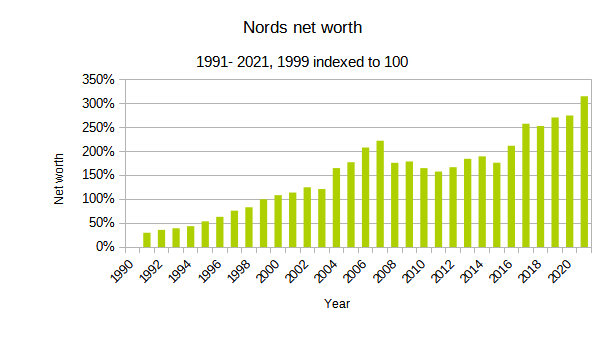
[Note:  this post has been updated for 2017 2018 2021 data.  I plan to continue updating it every year or few.]

A long while back, a reader wrote:

“Hey, Nords, any chance you’ll do a summary post about your FIRE history? I’m really interested to hear how your net worth and income have gone up.”

Life is good: my spouse and I recently pulled off an epic seven-week “slow travel” Mainland trip on military flights. (I’ll post more about Space-A travel another time.)  Now that we’re caught up on household chores, I’m ready to catch up on financial topics.

I’m surprised to realize that we now have 15 19 years of experience at being military retirees. (Where did the time go?!?) We spend most of our year at home (or at the beach) enjoying our Hawaii lifestyle. When we’re off the island, we prefer to spend weeks at a location with more time for strolling, thinking, discussing, and (in my case) writing. No worries: on this trip our entire Nords ohana got in lots of surfing too.

During our travel, I wondered whether I should even write this post. A few months back I asked the opinions of a bunch of other personal-finance bloggers who share their finances with their readers. I ruminated over the pros & cons of sharing more personal details. For example, I’ve been tracking our income since the 1970s(!) and I could publish frequent updates on Rockstar Finance’s net worth list along with hundreds of other bloggers.


Good reasons to share our numbers

I think our track record can inspire people who are striving for their own financial independence. We’ve been FI since 1999 and I retired from active duty in 2002. Our first decade of retirement slammed into not one but two of the nastier recessions of the last century. Yet today, our finances have bounced back to new highs and life is better than ever.

For starters, we’re living proof that the 4% Safe Withdrawal Rate works. It survives bear markets. The research has been validated by peer review and replication, yet the computer simulations have a number of gaps which will always worry people about its failure rates. (Pro tip: Humans are smart enough to use variable spending.) The biggest danger to a FI portfolio is “sequence of returns” risk: a recession at the beginning of a retirement could wipe out so much of the portfolio’s value that it can’t recover from its first decade of withdrawals. This issue is easily avoided (Hint: buy an annuity or start with an asset allocation of two years’ expenses in cash) yet everyone worries. You’d hate to walk face-first into the World’s Worst Recession and get shoved right back into the workforce.

Our investments survived recessions not just once, but twice. The 4% SWR math worked great, although we investors were freaking out a little.

We could share our financial numbers to help inspire other military families. Behavioral financial psychology is always more powerful than math or logic, and it helps to know that other people have been through it too. Whenever your FI math displays a 95% success rate to your highly logical cerebral cortex, then just behind that forebrain your emotional amygdala is whining about a 5% failure rate and hijacking all of your self-confidence. Even worse, when you try to explain the logic of the 4% SWR to your family & friends you’ll encounter a bunch of “But what if… ?!?” questions which could scare even Warren Buffett. It’s no surprise that many people reach their FI numbers yet keep on working for “Just One More Year” Syndrome.

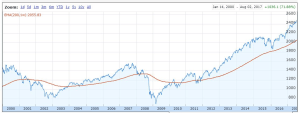
Image of the stock market average of the Standard & Poors 500 index between 2000-20017 showing two recessions followed by a strong upward trend. | The-Military-Guide.com

S&P500 index history 2000-2017.

Well, my spouse and I felt our amygdalas twitch a few times, especially in October 2002 and March 2009. Maybe we can help reassure people by sharing our numbers.


Reasons to not share our numbers

Once I hit “Publish!” on our net-worth numbers I can’t just erase it, and I don’t want to screw this up. I want to help people without irrevocably crossing a #humblebrag line.

Ms. Our Next Life put my concerns very succinctly: “Comparison is the thief of joy.”

We already know that it’s a bad idea to keep up with the Joneses. Yet if we post our net worth then we’re tempting you to keep up with the Nordses. Humans all have different costs of living (and different spending choices), yet we’re competitive animals. (We even try to out-frugal each other on Internet forums.)  I’m trying to NOT be so competitive. I just want to reassure military families that financial independence is within your reach, and I don’t want our numbers to discourage anyone.

Comparison might make you feel pretty good if your net worth number is longer bigger than mine, but what if you’re just starting your FI journey? It’s hard enough to track your spending and cut out the waste and maximize your Thrift Savings Plan contributions for a goal that you believe in. When you see the results of someone else’s trek– 15 years after they cross the finish line and maybe 30+ years ahead of you– it’s very difficult to believe that your numbers could grow so big. Our success might be more discouraging than inspiring, despite all of the mistakes we made along the way.

Our numbers aren’t relevant to yours. You just want to know that you can go from “enough for the 4% SWR” to “more than enough for the rest of your lives” without having to worry about portfolio failure.


Nobody mentions those failures

Everyone talks about the failure rate of the 4% SWR, but have you ever met someone who’s been forced back into the workforce because of it?

I know a few people. They had their numbers, but one couple freaked out over stock-market volatility. Another person was bored and unfulfilled by all of their free time. (FI means that you have to be responsible for your own entertainment.) Another reached FI on a very undiversifed asset allocation plan which failed after their favorite stock’s first dividend cut of the Great Recession. They went back into the workforce, worked out a diversified asset allocation, and achieved FI again a few years later.

We don’t hear about those failures. Nobody wants to talk about them.

Instead, we focus on the winners. It’s easy to watch the credits roll at the end of a movie and say “Yeah, that was a good flick.” You liked it because everybody loves a winner. But when you reach FI and declare your freedom, you’re still in the first act of your FI movie. How will the next couple of acts turn out? Will it be a heroic saga or a tragedy?

Let me set the stage for the potential failure of our financial independence, back when we didn’t know how the movie would turn out.

In late 1999 we crunched the numbers and realized that our portfolio was big enough for the 4% SWR. We wouldn’t even need a military pension. We could spend the rest of our lives from our investment portfolio.

If you’re familiar with the 1990s Internet stock-market bubble, you can imagine that a lot of people had our epiphany. No worries, it was the “new normal”. This time everything was different, and this time we really meant it.

Barely two years later, as I was signing my active-duty retirement worksheet, the situation was a quite a bit different.


Life still happens to you during financial independence

Let’s break down the bullet points:

  • We knew that my pension would cover our mortgage, but what about hyperinflation during a recession?
  • My spouse left active duty for the Reserves. Her pension would be delayed for 20 years… if she even qualified for one.
  • The stock markets were closed after the 9/11 attack, then lost over 10% in one day.
  • Never mind retirement. Would my spouse and I mobilize for the war?!?
  • The price of college was rising faster than our nine-year-old daughter’s college fund.
  • Hawaii was in a decade-long real-estate recession, and our rental property was worth less than we’d paid for it.
  • We had no cash flow from our rental property… and no rent increases, either.

In 1999 we were FI on just our investments. Two years later, however, the value of that portfolio was melting down faster than an ice cube on a Hawaii beach. Nobody knew how long the bear market would last.

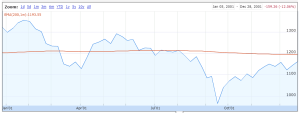
Image of the Standard & Poors 500 stock market average during September 2001. It shows a large drop after the 9/11 attacks. | The-Military-Guide.com

S&P500 index value during September 2001.

At least I’d been approved for my military retirement. My pension covered a little of the spending and we still had (barely) enough portfolio value to make the math work for our expenses. The 4% SWR is never pretty during a recession, but it would work during this one.

The good news? We had the basics covered and I could always get a job through my submarine veterans network. (Hey, back then Linkedin was just this goofy startup going up against the Monster juggernaut.)  I could run a power plant or teach a class.

I retired in June 2002 and the stock market kept dropping.  Not what we had in mind.  Let’s just say that in October 2002 the Nords household had a tense financial discussion… and we decided to stay the course. It’s a really good thing that the markets bottomed out that month, because my cerebral cortex was running out of cheery optimism about the statistical success rate of the 4% SWR.

With that experience behind us, you can predict that Act II of our FI movie would be more cheerful, right? Um, not quite.

I’ll spare you the gory bullet points on the Great Recession, but I’ll mention that our investment portfolio dropped 58% from the 2007 peak to the 2009 trough. We were cool with the first 25%, but the rest was ugly. We endured over 600 days of pain in the assets, made even worse when it was punctuated by multiple head fakes from the stock market. By 2009 nobody believed anymore that we’d really reached the bottom.

Image of the value of the Standard and Poors 500 Index value between 2007 and 2009 showing the sharp dip of the Great Recession. | The-Military-Guide.com

S&P500 index value 2007-09.

During the next three years of the recovery, most investors were still waiting for the economy to pitch over again and dive for an even deeper bottom. There was plenty of gloomy data to support the markets losing 90%, just like they did during the 1930s.

Believe it or not, we stayed the course during the whole thing. I re-read my favorite investing books (“financial comfort food”) and we all vented our concerns on Internet forums. Our family focused on getting our daughter ready for college and we did a lot of surfing. Ironically I was finishing the draft of a book about military financial independence, and I worried that I’d have to rewrite its ending.

Have I beaten this point into the ground yet?

Emotions can derail the best of FI plans, even when the 4% SWR is working.

Let me finish on a cheery note. Act III of our financial independence puts this investment angst in perspective.

In 2015 I had an emergency appendectomy. I went from “Ow!” to the OR in less than 24 hours, and the surgeon still worried that I’d waited too long. Everything came out all right (so to speak), but as the morphine kicked in I had a much different epiphany than 1999. While the medical staff cleared a table for one and my spouse tried to keep a smile on her face, I reflected that those years of financial independence had been the best of my life. I was very happy that I hadn’t spent them working for a paycheck, let alone doing submarine patrols.

Yeah, I’d never had morphine before. It was a big dose. Wow.

Today I know that it’s much better to worry about your portfolio survival than to worry about your own survival.

Better yet, it looks like we’re finished worrying about our portfolio survival.

Now for the numbers.


The net worth numbers… in percentages.

After weighing the feedback of my financial blogger friends, I hedged and decided to put our numbers out there in percentages.

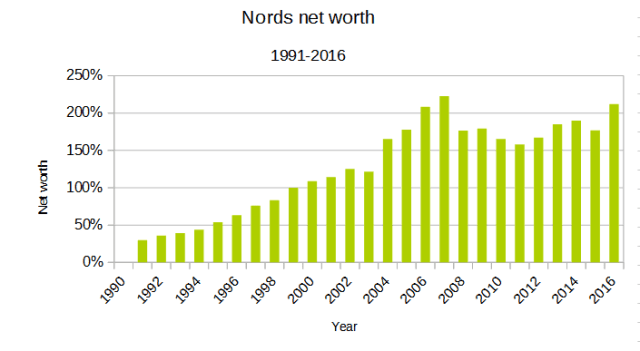
Here’s the excerpt from our net worth spreadsheet.  Its cells cover from 1977 to 2016 (yes, I’m a Navy nuke and a money nerd), but for clarity I’ve focused on the relevant years. I set 1999 as 100% and indexed all the other numbers to that FI starting point.

Ironically, we didn’t start tracking our net worth until 1993 when we read “Your Money Or Your Life”. (Hunh– 22 years before my appendectomy.) I’ve logged 40 years of income and 30 years of spending data, but we only reconstructed our net worth back to 1991.

The graph tracks the typical exponential compound-growth curve up to 1999, and while we were building it I can assure you that curve seemed awfully flat for a very long time before 1991. (Humans suck at perceiving exponential growth, and the early years of saving for FI can be discouraging.) 1999 was the first time we reached the 4% SWR tripwire.

After 1999 you can tell that the curve flattened out around 2001, but it made up for lost time in 2004-07. And how ’bout that drop in 2008? We cut back our spending a little in 2009 but after that, we could see the asset recovery. I didn’t even notice the 2015 air pocket until I was drafting this post, and 2017 could end on an even higher note than 2007.

As long as those percentages stay in triple digits, it doesn’t matter how high they go. Our annual spending has been flat for most of the last 15 years. Our daughter launched from the nest in 2014, and our spending could drop even further during the next decade.

Now that our assets are twice as big as the 4% SWR, our spending is effectively a 2% SWR. We’re spending less than the long-term dividend rate of the stock market, which means that we could hypothetically live off the S&P500’s dividends without touching the growth (let alone the principal).

The other good news is that we’re immune from the sequence-of-returns risk which can savage a portfolio during the first decade after FI. Beyond that, trying to predict the financial future is an exercise in frustration.

Maybe someday I’ll talk about the dollar figures with a few more beta-testers while we’re sitting on the beach after a surf session. (I’m lookin’ at you, dual-military retirees.) Maybe someday we’ll talk about the details at a financial conference, or if you’re thinking about angel investing. (Pro tip: limit alternative investing to no more than 10% of your assets.) But at this stage of our lives, I think you want reassurance without getting mired in the significant digits.

[Update:  here’s the 2017-18 2017-2021 data at >300%.]

Your turn:  what do you want to share about your numbers?  If you’re already financially independent, how’s that workin’ for ya?

If you’re not FI (yet!), then what are you doing to get there and how much longer do you think it’ll take?

Related articles:
REVEALED: Our Asset Allocation During Financial Independence
How Should I Invest During Retirement?
How Much Cash In A Retirement Portfolio?
How Do You Survive A Stock Market Crash?

Posted in Financial Independence, Investing & TSP, Military Retirement, What Do You DO All Day?!? | 19 Comments

Camp Mustache 4 Encore (And A Free Book!)


[Nords note: My spouse and I are still on Mainland slow travel, and we’ll head back to Oahu in mid-July. Maybe we’ll see you at a military Space A passenger terminal!]


We spent another Memorial Day weekend at the Rainbow Lodge in the bustling megalopolis of North Bend, WA. (Snarkasm! It’s a lovely little town.) This was my second Camp Mustache, and they just keep getting better. Unlike last year’s chilly rainy mosh pit, this year’s Seattle-area weather was sunny, cloudless, and warm.

Image of Doug Nordman at Camp Mustache 4 talking about "How I Wish I'd Invested Back Then" to other attendees | The-Military-Guide.com

The usual aloha shirt!

Camp Mustaches are nonprofit events which are crowdsourced by readers of the Mr. Money Mustache blog and the members of its forum. Instead of a formal licensed franchise with rules and “brands” and other guidelines, it’s an extended meetup of like-minded people with food & lodging. It’s limited to 50 attendees and this year it sold out via a lottery. It’s nearly unstructured free time: we spent the weekend with a few breakout sessions on specific topics, but most of it was random personal-finance conversations around warm fires and frosty beverages. This time, however, those conversations were about accelerating your financial independence and living your best life

Image of Doug & Marge Nordman with Keith The Tax Guy and spouse plus other Camp Mustache 4 around the fire on the deck | The-Military-Guide.com

FIRE watch, Navy veteran style

You know we talked about real estate, investing, and travel hacking. (I gave a presentation on investing in the 1980s-’90s, and how a high savings rate can overcome even high expenses and mistakes.) Most of the group already knows the basics, and our questions went into even more advanced details.

This year we added a seminar about Mustachianism for couples, especially on ways to approach the lifestyle question when one of them is skeptical about their prospects. Another presentation looked at anti-Mustachianism, especially for those who enjoy their paid employment. When you’re feeling challenged and fulfilled from your work, then financial independence simply gives you more choices about that avocation.

Otherwise, the holiday weekend was filled with offline discussions— perhaps while strolling or sportsing or just reclining around the fire with adult beverages. It also included atypical conference events like: practicing mindful meditation techniques, enjoying amateur yoga, and tackling the traditional hike up Mt. Si.

Most of all, I enjoyed my second Camp Mustache because my spouse came too! She picked up tips (which I’d overlooked) on Costco memberships and their loss-leader rotisserie chickens. But most of the time we were swapping advice with people who had questions about life after financial independence. We know what we like to do all day.

At this CM, a year older and a lot wiser, I skipped the four-mile summit hike up the Mt. Si trail. (It’s a great hike for everyone but my 20% disabled knee cartilage.) My spouse and I climbed a 45-minute hike without the marathon or its aftermath, and then we enjoyed the rest of the sunny afternoon at the Lodge.

We’re goin’ back next year (if we can snag lottery tickets). Better yet, we’re setting our sights on other Camp Mustache events around the country. They’re organized by local Mustachians who have the desire to spend 2-3 days with people who share their common goals and knowledge.


Free book offer!

Image of the book "Your Playbook For Tough Times, Volume 2: Neds And Wants Edition" written by Donna Freedman | The-Military-Guide.com

(Click the image to order.)

Which brings me to my next subject: Donna Freedman has just published her second volume in her series “Your Playbook For Tough Times“.

This is the “Needs And Wants” edition, which shows you how to live your best life while struggling with your finances. If you feel that you’re stuck in Thoreau’s “life of quiet desperation”, then this book is the troubleshooting guide. It’ll give you specific agencies to call (with their phone numbers), negotiating techniques (with scripts), and websites to consult.

“Playbook” will get you through the rest of the month with practically no money, and it’ll help you prepare for the next (unpredictable) financial catastrophe. If you’re living in deprivation (military or otherwise) then this book will help you upgrade to frugality. Believe it or not, you’ll even find the path to financial independence.

Military families will appreciate its detailed advice on how to care for a pet who eats as much as a small child. You’ll learn how to survive the gifting seasons of holidays, graduations, and weddings without going broke. You’ll browse frugal hacks for transportation and travel expenses (during your transfer to a new duty station). Best of all, the book guides you through a complete insurance review to help you figure out what to cover and what’s not worth covering.

If you’ve read Donna Freedman’s previous “Tough Times” volume then you know how the “Needs And Wants” edition can boost your efforts into a sustainable lifestyle. (If you don’t know yet, then read the review at that link.)  You know that deprivation is unsustainable, and this book shows you how to turn that into sustainable frugality.

Better yet, Ms. Freedman is giving away a free copy to The Military Guide readers! Leave a comment below by 24 June on how you’ll use the book (or for whom & why!), and we’ll randomly pick a winner.

If you don’t want to wait that long then feel free to buy it now for just $5 with this special Military Guide link and use the discount code MILGUIDE at checkout. Please note that this code is only good through 4 July.

Why pay $5 for a book about surviving with little or no money? I promise you that neither Donna nor I will get rich off the royalties or any affiliate income. The reason that you’re willing to pay $5 is because that financial sacrifice forces your commitment to get through the tough times and fix your finances. You’ll earn more than $5 just from implementing your first tip (out of her hundreds of hacks) and you’ll refer to the book many times. You’ll make better decisions about the big financial choices, and that’s an outstanding return on the price of a daily latte.

Remember:
Comment below (before 24 June) on how you’ll use the book, or to whom you’re giving it (and why).


Posted in Entrepreneurship, Financial Independence, Reviews, What Do You DO All Day?!? | 3 Comments

Your Auto Insurance Premiums Are Rising, But It’s Not Just You


My social media has lit up this year with complaints about vehicle insurance.

It seems as if every military family who’s transferred to a new duty station has paid more money to insure the same autos and the same drivers. Even families who haven’t moved (yet) are unhappy when they renew their policies: more money for the same coverage. It’s not just geckos or good hands or eagles or good neighbors or mouthy mascots. Insurance seems to cost more no matter who’s selling it.

The trend is clear: everyone’s auto insurance premiums are rising across the industry. Many insurers are paying out more than they’re earning. They’re all trying to cut costs, but we’re going to see rising rates for a few more years.

You could shop around for the cheapest deals (again!), but this time it’s not going to be easy or happy. There are a few tactics you can apply to your insurance choices, and we’ll talk about those after diving into the problems.

First, let me establish some credibility. I’m not just re-writing press releases here, and this discussion came from months of patient persistence.


FTC disclosure: how bloggers get interviews

Last week I interviewed one of America’s top insurance execs. This is unusual.

I can hear the question now: “Hey, Nords, what do you get from USAA for these interviews?”

Nothing. I enjoy researching these topics, and USAA execs seem to enjoy discussing the questions.

How does one score an interview with a USAA senior exec?

  • – Go to USAA conferences like Digital MilEx
  • – Network with other attendees and USAA staff and ask a lot of insurance questions
  • – Write a bunch of posts about insurance (and draft a book)
  • – Earn a reputation for explaining complicated insurance topics with two-syllable words
  • – Do social media with the USAA team at their Salute To Service sports events
  • – Get an unexpected invitation to the Army-Navy game.

In other words, five years of showing up followed by an opportunity.

You may have noticed by now that I’m an insurance nerd. Despite this I’m usually able to hide it and engage in polite pop-culture discussions, but if someone brings up risks or probabilities then… there I go again.

Anyway last December I was at USAA’s brunch for the Army-Navy game in a very large room with a gigantic crowd of convivial military football fans. My daughter was with me, her spouse was joining us later, and we were talking interservice-rivalry trash hanging out with other blogger buddies. I was pretty sure nobody would want to discuss claim reserves or crash-avoidance tech. I just nodded politely at the chatter and tried not to shiver in the Baltimore winter.

Much to my surprise, Wayne Peacock approached me. I’ve talked with him at several USAA conferences over the last five years, and now he’s the President of their Property and Casualty Insurance Group. As we chatted, he said he wanted to analyze the industry’s recent challenges. Why, thank goodness!, er, I mean, sure, I could do that.

Unfortunately we were expected to participate in football-related socializing, and we had to shelve the insurance discussion for later. He’s been busier than usual over the last few months (grappling with rising costs) while I talked with other experts on the P&C team. I did my homework on the rest of the industry and their trends, and then last week Wayne and I nerded out on the topic.

The FTC wants me to let you know that no money changed hands and I was encouraged to ask Wayne anything. I’ve insured our cars with USAA for over 35 years, but we have no other USAA insurance or financial products. I own Berkshire Hathaway stock (the parent corporation of GEICO) but even their gecko discount didn’t beat USAA’s rates.

If you want to learn how to network with USAA, please contact me and I’ll help you get started.

Enough disclaimers. Let’s nerd out on insurance.


Vehicle insurance problems

Auto insurance has been heading into trouble for decades, but the trends just accelerated during the last few years.

Wayne said that it started in late 2014, yet it took a while for the insurers to compare notes and realize that this is an industry-wide problem. This is one of the worst P&C years that the industry has ever experienced. Vehicle insurance claims were so bad in 2015 that USAA paid out $103 for every $100 that they received in premiums— and they have some of the lowest operating expenses in the business. In 2016, net losses rose almost 18% and members’ auto policy dividends dropped over 46%.

Ironically, the biggest insurance “problem” is that injury rates are rising faster than deaths. Both are getting worse, but vehicles (and trauma centers) are keeping more people alive after the accident.  That costs more in medical treatment, rehabilitation, and disability.

Legislation has improved vehicle safety for decades, and that’s boosting our human survival rates. Unfortunately we’re footing the safety bill by paying more for the auto. If there’s an accident then the insurance companies are paying a lot more for the repairs, and that expense is gradually circling back to the drivers as higher premiums.

The best example is “crumple zones”. This Insurance Institute crash-test video is a stark demonstration of how today’s vehicles absorb more of the collision energy up front instead of transferring it to the passenger compartment. The 1959 Bel-Air would simply be hauled off to the shredder while the 2009 Malibu would still have some parts to contribute to the junkyard. At lower speeds, however, crumple zones still enthusiastically do their job (even at 5 MPH in the parking lot). That’s a lot of internal damage, and it’s much more likely that your vehicle will need extensive repairs or even be declared a total loss.

Fuel-economy legislation and auto manufacturers are hurting insurers, too, because today’s frames and bodies use exotic mixes of aluminum, carbon fiber, and lots of plastic. The result is lightweight transportation and higher average gas mileage— until something goes wrong.

Wayne mentioned a recent USAA claim on a Ford F150, one of America’s most widely sold pickup trucks. Older models have steel wheel wells and beds, so if a tire blows out then the damage is limited to the tire and the wheel. Modern F150s have aluminum wheel wells and beds where a steel-belted radial tire can hurt a lot more. Wayne said that a newer F150’s blown rear tire sent spinning steel belts of shredding destruction through the entire wheel well, and then chewed up the truck bed all the way to the back bumper. Who wants to pay thousands of dollars to repair a tire blowout?!?

Labor costs are rising almost as fast as materials. Today’s bumpers and fenders are filled with electronics for backup cameras, proximity sensors, and computer controls. Vehicle repairs now involve more college-educated technicians than wrench-turning mechanics, and the diagnosis alone can be hundreds of dollars.

Enough about the vehicles; you get the idea. Now let’s talk about the drivers.


Driver insurance problems

The Great Recession was a good time for vehicle insurers, although admittedly only for those insurance employees who kept their jobs.

The national Cash For Clunkers program cleared a lot of junk off the highways, and unemployment “excused” more drivers from the rush-hour commutes. Oil prices were screaming over $140/barrel and seemed sure to hit $200 any day, which caused even more employed drivers to opt for public transport, carpools, and bicycles. Sure, unemployed drivers were canceling their policies, but claims expenses were dropping a lot faster than premium income.

Compare that era to the current booming economy and collapsing oil prices. The result is more cars on the road driving even more miles. It’s risen steadily for more than two years. Today more people are having still more accidents while driving yet still even more miles.

There’s a new and very disturbing trend among these rising numbers: distracted driving. More drivers are “visibly manipulating handheld devices” than ever before and the numbers are still rising. Wayne says that USAA’s fastest-growing category of accidents involves a vehicle drifting across the centerline and causing a collision without the brakes even being applied. Too many drivers are tweaking dashboard menus and videos, squinting at maps on their smartphones, or ambushed by texts making urgent noises while displaying their content in small fonts.

Just taking your eyes off the road for five seconds at 55 MPH is the equivalent of driving down a football field with your eyes closed. And I’m pretty sure you Mainland drivers are all moving faster than 55 MPH.


The cost of the problem (and the price we pay)

Adding up all of these issues during the last 800 words:

The National Safety Council estimates that the cost of deaths, injuries and property damage attributed to crashes in 2016 totaled $432.5 billion, up 12 percent from 2015.

That’s nearly $1350 per year for every person in America, licensed or not. I don’t know about your vehicle insurance rates, but I’m paying less than $150 per year for mine. The crash expenses are not affordable, let alone sustainable.


All right, expenses are rising. Now what?

As grim as the situation may seem, you can change your behavior to control your insurance expenses. Wayne has a number of constructive suggestions with USAA initiatives, but first let me jump on my podium for a personal polemic.

Millennials are now America’s largest age group, and they’ve already found the solution: drive less, and maybe don’t drive at all. Even though Millennials put themselves on report for the worst driver behavior, the Millennials and Gen Z have the lowest percentage of drivers.

Every reader of the Mr. Money Mustache blog & forum just coughed out a “Well, duh.”

Boomers and GenXers will be the drivers who bear the brunt of auto insurance costs. Better download that Uber app.

I’m not simply suggesting that you should drag your beach cruiser out of the garage and… well… actually I am suggesting exactly that. (Perhaps a modern mountain bike, bought used via Craigslist.) We could all stand to walk a little more, too, and live closer to things instead of expanding our suburban sprawl. Maybe we should plan our errands better for shorter trips, and do more online shopping. Or maybe just buy less stuff altogether.

Yeah, I know. “Nice try, Nords.” Hills. Weather. Sweat. Blisters. Aching knees. Work schedules. Shower facilities. Kid safety. Busy families. Too many errands, not enough time.

Commuting expenses are among the largest obstacles to financial independence. (It’s not the $5 latté.) The sooner you optimize those solutions then the faster you’ll boost your savings rate and reach your financial freedom.

All right, I’m done preaching. Let’s bring Wayne back in for more “practical” solutions. But remember, the less you drive then the less you pay… and not just for insurance.


Insurance solutions

The first answer is fixing the insurance system. Wayne says that U.S. insurers have to deal with 54 different state & territorial jurisdictions just to set up the rulebook. (USAA also covers military drivers in dozens of foreign countries.) Some states allow setting premiums by demographics (especially age) and experience while a few insist on charging only by driving record. The minimum requirements vary by state, not by the local cost of living or population density (or the number of Ferraris per square mile).

The biggest barrier to running an insurance business is figuring out the rules. The biggest administrative impact on reducing rates would be a national standard based on the driver’s record, their type of vehicle, and the number of miles they drive.

I’m not holding my breath for a national standard, but Wayne is now in a position of considerable influence to help the industry update the government rules. USAA has already helped do this with life insurance, and the vehicle insurance problems are even worse.

Next, USAA is working on repairing the repairs. Wayne admits that this is the hardest piece of the puzzle but it has the greatest potential for savings. One of the most vocal customer insurance complaints (even at USAA) is the lengthy, frustrating, and expensive repair process. Wayne says that USAA has to keep insisting on exceptional quality service and “get it right”. They’re constantly working with different repair businesses on better ways to restore vehicles to their original resale value.

USAA (and the entire insurance industry) is very interested in repair tech. Ford is experimenting with 3D printed parts, but I’m even more interested in DIY repairs. Imagine if you could print out those annoying plastic trim pieces in exactly the original shape and color instead of searching all over the Internet for a supplier with the right stock.

The industry’s other solution to repairs is: no repairs. In more cases than ever, it’s cheaper to declare the vehicle a total loss and reimburse the owner.

Image of mobile device with USAA logo on it for filing mobile insurance claims | The-Military-Guide.com

Easiest claim filing ever. Click on the image.

Totaling is a controversial and emotional practice for many owners who insist that they’re not getting the full resale value. If you’re in that situation then I’d encourage you to hire your own claims adjuster to negotiate with your insurer, and see whether it’s worth the expense. Personally, I’d recommend accepting the insurer’s valuation and taking the money (with minimal hassle). You didn’t have to negotiate with a dealer, or list the vehicle for sale, or handle all the sketchy wannabe buyers and their dubious offers.

Speaking of the claims process, USAA is still streamlining it. Today after an accident you can take smartphone photos of your vehicle damage, upload them when you file a claim on the app, and maybe even have payment by the time you get home. Our Ohana Nords hit & run was nearly two years ago, and filing an accident report with the USAA app took less than 10 minutes. It took an hour for our local police to do the same paperwork, and I mean literal paperwork. I had to scan the police report to upload it to USAA’s website.

Wayne says that USAA is also pushing other hardware solutions. They’re heavily promoting crash-avoidance technology to reduce accident rates and deaths (and incidentally avoid the entire repair process). Auto manufacturers are implementing these new systems faster than they rolled out airbags: it’s the biggest improvement in 20 years for the biggest potential impact.

While crash avoidance is becoming mainstream, USAA is also working on telematics and a smartphone pilot for assessing your driver behavior. Everyone thinks they’re an above-average driver, but collecting your own data will reduce your delusions.

Finally, Wayne pointed out that insurance is just one aspect of the total expense of ownership. The less you spend on the car (let alone the insurance), then the lower the financial burden of driving. For starters, USAA’s Auto Circle is now three years better than ever. It begins with their new-car buying service, where over a million USAA members have saved more than $2 billion over retail price. It has a powerful search engine to help you find the vehicle you need (not just your fantasy ride) and it can quote your insurance expenses before you buy.

They’ve greatly expanded their used-car buying service. You can let USAA work out the price with one of their certified dealers, or you can sell your own vehicle to the dealer with minimal haggling. I’m not a fan of financing new cars when you can save up the cash for a used one, but USAA is also happy to lend you the money. They’re a tad more understanding when their military members take their cars overseas, even if the loan isn’t paid off.

Finally, Wayne pointed out that most drivers choose their insurance by price– but they can’t tell whether that’s worth the cost savings until they need customer service. Before you go for the cheap policy, check customer satisfaction ratings and consider how USAA can support the unique aspects of military service.


But what can I do now?

Maybe that last section was good news for car buyers, but how else can you control your rising insurance rates? What if your premiums are going up despite having no accidents or tickets?

The most important action you can take is talking with a member service rep. Make sure they have the right info on your vehicle, and then check your policy details. Safety features? Anti-theft gear? Collision avoidance systems?

How much vehicle do you need? Are you really willing to work that many additional years of your life energy to have the biggest and most powerful pickup in the parking lot? Or could you stop competing with the Joneses and use an old minivan or sedan as merely safe family transport?

If you’re stationed in a new location, do you still need all of your old coverage? Roadside assistance? Towing? Rental car replacement?

How’s your neighborhood? Do you still need maximum coverage for property damage if you’re among cornfields instead of downtown? Is your vehicle parked indoors or on the street? How’s the winter weather?

Can you consolidate all of your policies with the same company for a bulk discount on home, personal property, auto, liability, and life insurance?

What about collision and comprehensive insurance? One thumbrule claims that when the premium is 10% of the vehicle’s resale value then you should drop them both. My spouse and I only buy used vehicles over five years old– and preferably with a few dings & scratches. We like lower prices instead of the cosmetics and we haven’t carried collision or comprehensive for over three decades. The compounded savings add up to a small fleet of good used cars– and the investments accelerated our financial independence.

If you must carry those two types of insurance, then what about your deductibles? How much could you save by raising them, and (here’s the important part) how long would that savings take to rebuild your vehicle replacement fund?

Do you still need a vehicle for every single driver in your household? This is especially important for families with teen drivers. If you have more drivers than cars then you may get an “occasional driver” discount. By the way, those young adults can enjoy lower insurance rates if they take driver education training and maintain good grades.

Now that our daughter has left the nest, I’m still trying to level up to the status of one-car family. These days we only need 1.1 vehicles (with a roof rack for longboards), so our second car does most of its duty as a spare-parts locker and a laundry rack. Ride-sharing is widespread on our little island, and maybe we can spend less on chauffeurs than we spend on insurance premiums.
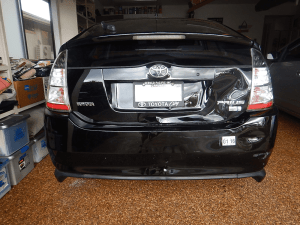
Image of black 2005 Prius vehicle damaged in a hit and run and repaired with cosmetic damage still present. | The-Military-Guide.com

After the hit&run, we didn’t fix the dings.

What’s your claim history? If you have a record of claiming fender-benders then your rates will magically elevate. Insurers share a national database of claims history, too, so you can’t avoid this expense by jumping to a different company. You’ll enjoy a brief fling with them before they update your history and boost your premiums at renewal time.

In fact, if insurers are prone to totaling a vehicle after an accident then maybe you don’t want to file a claim at all. You’d have to report the accident to your insurer (especially if you’re not at fault) but you don’t have to repair the vehicle to showroom condition. Once you’ve had the vehicle checked for safe operation then you could pay out of pocket for essential repairs (especially if you have a high deductible) or do your own cosmetic repair.

Finally, focus on the total cost of ownership. If you’re buying quality used cars and driving them for 15-20 years then your insurance premiums will flatten out. Stop paying for the latest & greatest, and put your values in your investments instead of in your transport.

Have your premiums jumped up this year? How are you controlling them?

Posted in Insurance, USAA | 2 Comments

How To Turn Your Next PCS Into A 20% Raise


This is a guest post by Justin Taylor, from Saving Sherpa.

How to Choose Your Next Duty Station

Choosing your next duty station or even creating a list of potential new homes is possibly the most stressful part of being a military member. For me, on the officer side, I know that I will move every 3-4 years like clockwork and that’s at a junior CGO level. This rate will likely increase towards the end of my career.

So how do you know where you should move or PCS to? My argument here will be that your next duty station could hold the key to upping your Effective Income by over $15,000 per year. This is due to the difference in locality pay also known as Basic Allowance for Housing (BAH).

Why is BAH so Important?

Every zip code has an associated value for your BAH. It’s important to remember that you don’t use the zip code your house will be in but instead use the zip code that your office will be at and in some cases where the nearest base is. BAH is such a beautiful thing because not only is it huge in some areas, it’s also tax-free.

This is part of the reason military members have such low effective tax rates. Currently, 40% of my income is non-taxable because I live in a high BAH city. So instead of paying taxes on my true $91,200 salary, I only pay taxes on $55,000.

The tax difference comes out to be $7k vs $16k owed to the IRS. Another way to look at this is that for every $1 of BAH, you are getting the same worth as about $1.25 of normal income, depending on your tax bracket of course.

Ok, So How Do I Pick My Next Base?

First, I would narrow my list down to areas that are even potential spots for yourself. For some career fields, you may be able to go just about anywhere and for others, you may only have a handful of bases to choose from. Once you have a list, you can go check all the BAH rates over at militaryrates.com. You will probably begin to notice some wide-ranging figures.

For instance, an 0-3 would receive $1083 per month without dependents if you were stationed at Malmstrom AFB in Montana. The same 0-3 stationed at Hanscom AFB in Massachusetts would receive $3063 per month. Your first thought might be that they’re so different because Hanscom is near Boston which is vastly more expensive than Montana.

This is potentially true in some situations but certainly not mine. To make this simpler I want to introduce a term I call Effective Income. Effective Income is the amount of money I receive each month once you take away any location-based costs. This allows you to compare apples to apples.

How Does a Bigger City Affect Your Spending?

Start to nail down which expenses will see increases directly related to the new location. For you, these factors might include childcare, music lessons, or gym memberships and certainly housing. After living in the Boston area for two months, the only area that has increased for me is my rent which increased $225 per month vs. Colorado Springs.

To be fair, I will also estimate another $100 a month towards eating out because Boston doesn’t allow happy hours and dining out is more expensive in general. So if you use me as an example as an 0-2 in both cities, my after-tax income increased from $4994 to $6335 per month after taxes. That’s a difference of $1341.

Now I deduct the $325 increase incurred from additional location-specific costs and I’m left with an Effective Income Increase of $1016 per month or $12,192 per year after taxes while certain ranks and locations could drive a change of over $15k per year.

So just by changing locations, I make over 20% more even though I have the same rank and time in service. Once you’ve identified all expense areas you believe are greatly dependent upon location you can simply subtract those from your total pay at both locations and quickly see which one is the best option for your situation.

You may not get the 20% increase that I did but you may be surprised.

You Can’t Save $1100 out of $1083

My other argument for focusing on BAH when considering your next duty station is that it at least gives you an opportunity. In my personal example, coming from Colorado Springs, the absolute cheapest I could rent a place for was $400.

That was with an old house and roommates but was actually $550 for most of my time there. Even at the best-case scenario my BAH to Rent difference was about $1000. Now in Boston, my BAH to Rent difference is actually $1900.

It’s like the 0-3 in Montana example. Even if you lived under a bridge for free, you’d only be able to save $1083, but at Hanscom, you could spend $1963 a month and still save $1100.

You don’t need to be a mathematician to understand that you would have never been able to save $1100 if you were only getting the $1083 in Montana. So while things may be slightly more expensive in certain cities, those cities at least give you the potential to have a lot of excess money from housing.

How to Go From Theory to Reality

This may seem like one of those topics that are great in theory but aren’t as easy as looking up a city and moving there. I would agree that with the military there are certainly no guarantees on location. However, I strongly believe that most members don’t do everything they could to push themselves towards their base of choice. In the Air Force, we have development plans and access to job openings through the various cycles.

First, locate the type of job you want at a specific location in one of the move cycles before you. Then write your development plan to make it seem like you were made for that job. You may also see some required certifications that will make you competitive for that position. Then reach out through your contacts and leadership to have them try and request you. If you are working it from both ends, you actually have a really high success rate.

Another option is through Special Access jobs that hire on a by name basis. It may take a lot of phone calls but trust me it can be done. If you land one of these jobs you actually can guarantee a job location way before your buddies on the same cycle even have a clue where they’re going. Even if you get the location approved, you may still be skeptical that a large city isn’t that much more expensive than a tiny one.

A Big City Can Actually Be Cheaper

My rent did go up some but my gas usage is actually cut in half due to public transportation, which is free in Boston for military. There are so many free or discounted activities. I’ve already been snowmobiling for $10 through the base, Red Sox games for $10, and free Celtics tickets in my first three months here, and I know they have a lot of great programs throughout the year. There are also plenty of free events that don’t require you to be a military member in these larger cities.  These are the type of opportunities that exist when being near a larger city.

Keeping entertained and navigating into the city has actually been easier here than any city I’ve ever lived in and at a lower cost. My groceries haven’t risen either thanks to the Commissary and shopping around for discount grocery stores. USAA didn’t have to raise my insurance being in a high tax state like Massachusetts because my home of residence is still Mississippi. I was once guilty of believing that living in a bigger city would be detrimental to my goals. Now, I understand that I’m making over $12k additional tax-free dollars and these high BAH assignments may be the biggest accelerant to financial freedom. Cities such as this will certainly be at the top of my list going forward.

If you enjoyed this post please check out some of my other work at saving-sherpa.com

Posted in Career, Money Management & Personal Finance | 2 Comments