Thank you, New Yorker magazine.
This post doesn’t have a financial independence theme, but it certainly helped me develop attitudes of gratitude and abundance. I’m also sharing it to help others.
June 15th is the anniversary of the 1991 eruption of Mount Pinatubo in the Philippines, about 20 miles north of Subic Bay.
I spent that 36-hour day mostly as the inport Ship’s Duty Officer on the submarine USS NEW YORK CITY (SSN 696), where I was serving a department-head tour as the Weapons Officer.
If you’re a Pinatubo vet too, check the “Related Articles” links at the bottom of this post about potential respiratory damage from toxic particles as part of the PACT Act. You might want to update your VA disability claim as well, and add your name to an exposure database.
Earlier in 2023, one of my friends wrote me:
“… you likely had many scary times during your service. If you’d be willing to share them (either just with me or with the forums), I know I’d love to hear them.
Most people generally don’t think of things like this when considering what our military members have to go through in serving our country, so telling them to a broader audience will hopefully give many a better appreciation for our service members.”
My cheerful reaction was “Sure, I haven’t written about Mount Pinatubo in a while!”
Then I tried to write about it. That wasn’t so cheerful.
It turned out that all I’d written before was a short social-media post asking Pinatubo vets to get in touch. (I wanted to learn if we survivors could have a VA disability rating for lung damage from volcanic ash.) Even now, during the weeks months that I’ve displayed this post on my monitor, my brain keeps skittering away to find anything else to write about. And oh look, my coffeepot needs cleaning!
Four months and 7000 words later, this is now the blog’s longest post. With photos.
This is the hardest post I’ve ever written (out of more than 2000) over the last two decades. Maybe my aversion is a mental-healthy defense mechanism, but I’ll tackle the keyboard-therapy challenge. If this helps me, I hope it helps a few of you too.
SPOILERS:
Over 800 Filipino residents died during the eruption and thousands more were injured, but our submarine crew survived.
A few crewmembers were on liberty in Olongapo and were injured during the eruption. Several spent the night trapped under wreckage of buildings that collapsed from the ashfall and the earthquakes, and for hours we had no idea if they were alive or dead. They were rescued the next morning and came aboard before we got underway.
Our submarine initially seemed to be undamaged, but over the next year we had to replace a surprising amount of ash-damaged equipment. As the Weapons Officer, I’m surprised that our torpedo launching systems were unscathed. All we lost in our department was some topside hull paint.
For more background on the environment, you can read the Wikipedia article about the interaction of the Mt. Pinatubo eruption with Typhoon Yunya. Yeah, I know, that sentence reads like the plot for a bad 1970s disaster movie. I wish I’d never bought that particular ticket.
I’ve researched the event from open sources, but I’ll admit up front that my memories are flawed by the stress and fatigue of 36 hours without sleep. I’ve also gone through three decades of involuntary leveling and sharpening of those memories, along with apparently suppressing the entire experience. My subconscious has done an incredible job of fighting protecting me for nearly half of my life now.
This is a personal story with my perceptions of our experiences. I’ll gloss over some of my more… intense… interactions with the chain of command above my billet. As far as I’m concerned, the rest of the crew did an outstanding job. If you were there with me, feel free to improve my memory in the comments. I’ll leave it to an experienced researcher to build a better chronology from our boat’s deck log in the Navy’s archives.
If you’re a veteran searching for more information about disability ratings from breathing volcanic ash, as far as I’m aware the VA has no presumptive conditions for Pinatubo. You’ll have to document silicosis or other respiratory symptoms and check a lung scan for lesions. You’re welcome to read the rest of this blog post and contact me with questions, and I’ll update this post if there’s new information.
If you’re an accredited historian, I’m happy to share more memories with you. Post a comment or contact me through this site.
Finally, this post has little to do with financial independence. (Sorry, hardcore FI fans.) This is more in the category of “You never know when you’re living your last day.”
Setup

The obligatory submarine emergency blow photo.
During NYC’s Westpac ‘91 deployment, we succeeded in one of the scariest missions I’ve ever experienced. (I’ll write about that another day, but some of you will recognize why a submarine crew was awarded the Coast Guard Special Operations Service ribbon.) We proved that 360-foot long submarines with 32-foot drafts could operate submerged in (very) shallow water. We opened up a whole new mission area (thanks, INDO-PACOM) at a time when our traditional Cold War operations were rapidly dwindling.
At the end of that mission we were much, much further north and east of our scheduled liberty portcall in Singapore.
At the same time, we’d read many media headlines about the U.S.-Philippines diplomatic efforts to continue leasing Subic Bay’s naval station maintenance facilities and Clark Air Base. The Philippine government wanted a lot more money, and negotiations had broken down.
Subic Bay has been one of the U.S. Navy’s most legendary ports for several generations, where you could get just about anything you wanted for your submarine. The liberty in adjacent Olongapo City was even more notorious, where you could get just about anything you wanted– period. Certain… experienced… members of our crew were agonizing that we’d never be able to have another Subic portcall, and these concerns were shared with the boat’s chief petty officers. The consensus was that we’d rather go to Subic than Singapore.
Submarine crews do not simply vote for their next liberty port. However our commanding officer appreciated that Subic was a lot closer to our current location than Singapore, and he might have had a few Subic fantasies memories of his own younger days to recreate. Our XO was smirking a little, too.
After several protracted exchanges of message traffic, our Westpac boss (the commodore at Submarine Group SEVEN in Yokosuka, Japan) agreed to arrange our liberty port in Subic instead of Singapore. CSG7’s staff location, nearly 2000 miles away from Mt. Pinatubo, had apparently left them blissfully ignorant of its emergent volcanic activity.
Arrival
When we tied up at the pier, I immediately scampered across the brow to a nearby pay telephone to check in with my spouse. (1991’s Philippine landline calls to Hawaii = $6/minute.) She was a Navy meteorology/oceanography officer stationed at the Pearl Harbor METOC center, responsible for forecasting the weather all over the Pacific. We hadn’t talked in over a month, but she had the security clearances to know when & where we’d been doing our last mission.
I’d been married long enough to know that I should phone home before all of the boat’s other spouses found out that we were inport. You don’t want to be the last spouse to check in after all the other families have had their calls.
In those days submarines only had about 2400 bps of bandwidth for radio broadcasts (with headline news), and the mail was always weeks behind. I hadn’t seen a newspaper(!) yet and wasn’t up on current events, so our spouse conversation was an unpleasant surprise.
Her: “What the #$%* is your boat doing in Subic?!? Did anyone tell you there’s an active volcano just 20 miles north of you?!? There’s also a tropical storm a few days away that’s going to turn into a typhoon.”
Me: “Um. I hope CSG7 checked with their weather center. Gosh, 20 miles away, I’m sure it’ll be fine.”
Her: “Listen to your meteorologists: you need to get out of there.”
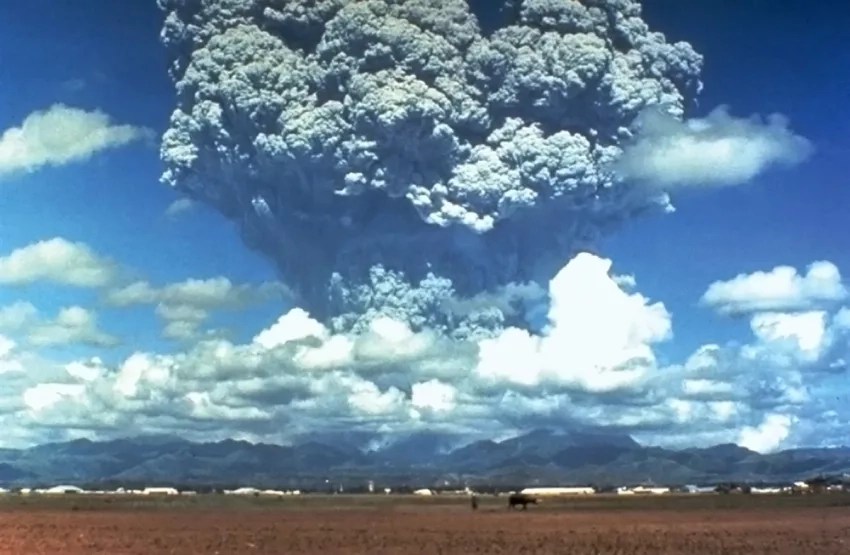
A few days later on 12 June, Mt. Pinatubo had a brief eruption.

This was the “minor” eruption on 12 June 1991. Courtesy NASA meteorological photo.
All day we could see a gigantic mushroom cloud of the eruption to the north, and a “light sprinkling” of volcanic ash fell on Subic Bay. (The port’s base guards hosed the ash off your taxi’s windshield as it went through the gate.) The eruption was an immense distraction, let alone a threatening omen. Understandably, many of the crew spent the morning topside to gawk and take photos as they worked on other tasks. As the boat’s Weapons Officer, during that workday I found myself going topside to announce to the troops “All right, I haven’t seen a live volcanic eruption since we left Hawaii either, but right now we’re supposed to be on the mess decks doing department training.” Yeah, I could still snark at a time like that.
By that evening, the Olongapo entrepreneurs were selling t-shirts: “I survived the eruption of Mount Pinatubo, 12 June 1991!” I wish I’d bought one for the irony.
Apparently the eruption didn’t cause any concerns among the Filipino authorities, let alone the U.S. Navy’s Seventh Fleet or our submarine group staff. In retrospect, we should have gotten underway that day– but we were busy with essential maintenance and even more essential liberty.
Three days later the eruption really began.
“Worst Duty Day Ever”
Every military veteran jokes about their worst duty day, and this one certainly recalibrated my definition.
Back then I’d usually show up on the boat around 4:30 AM to tour all of the spaces and chat with the offgoing watchstanders. I always learned a lot from the midwatch duty section about what was really happening… instead of what we supervisors wish had happened.
On the morning of 15 June 1991, though, the volcano’s ash was already falling. It was soft, like the first few hours of a gentle snow– but there was a lot of it and it was already forming a heavy slush.
I checked with the Weapons Department crew on our torpedo room, sonar, and fire control gear. All of those systems had been shut down when we entered port. We’d caught up on repairs and maintenance and we’d had no problems so far.
The engineroom was a different situation.
Inport submarines have four ways to maintain power (and air conditioning): shore power, the boat’s diesel generator, the boat’s emergency battery, and… the nuclear reactor. Starting up the reactor (and generating steam for the engineroom) takes a full watch section (and consumes uranium), so when we tied up we’d usually shut down the reactor as soon as we connected to shore power. We’d post a skeleton duty section and everyone else would go on liberty.
If you lose shore power (for whatever reason) then the duty section uses a few kilowatt-hours from the battery while they’re starting the diesel to snorkel (and generate electricity) until shore power’s fixed.
If you suddenly had problems with the diesel then you could hypothetically start up the reactor. For various safety & maintenance reasons, though, the startup checklist takes several hours to make sure all of the reactor protection systems are working correctly. Starting up the reactor also takes a lot more watchstanders.
By the time I got to the boat, I learned that the midwatch team was having a Really Bad Night.
As Mt. Pinatubo exploded, the combination of falling ash and lava-boosted mudslides had damaged the local electric grid. Shore power had been down & up all night, and the boat’s electricians were very unhappy about our battery discharge.
At the same time, the diesel mechanics were equally unhappy about the volcanic ashfall. Diesels suck down a tremendous volume of air for combustion, and the ash-fouled air was quickly creating an ash-fouled diesel. We joked that the diesel sounded like a rock crusher, but it wasn’t designed to crush lava.
Our Engineer Officer had been getting phone calls all night about the shore power problems, and he was even more concerned about the diesel. By the time I wandered into the engineroom for my pre-duty tour, he was stationing the full watch section. With the CO’s concurrence, the Engineer had already ordered an emergency reactor startup.
30 years ago, submarine engineering departments trained on emergency startups and even occasionally did one for practice. Compared to the full-blown precritical checklist, an emergency reactor startup is just a cursory look that all the important switches are in the right positions, and that the core’s power-monitoring instruments seem to be working. Full switch lineups? Calibration checks? Yeah, those could be done after the boat had power & light.
The emergency startup section of the Reactor Plant Manual had a couple paragraphs about not hurting anyone or breaking anything– and try not to accidentally scram the reactor while you’re withdrawing the control rods. To us nukes, that was a welcome freedom from the hundreds of pages of detailed guidance for a normal reactor startup.
After the full team had assumed the watch, the Engineering Officer Of the Watch ordered the Reactor Operator to commence an emergency reactor startup. The RO latched the reactor’s drive motors onto the core’s control rods and pulled them out just short of the point where they expected the reactor to reach criticality. Right after that, keeping a close eye on their instruments, they withdrew them a bit more until the reactor was indeed critical.
It was going well, but most of the duty section had been up all night and the situation was getting tense. Out in the engineroom someone might have muttered “Latch ‘em and snatch ‘em, and let’s get the steam in here.”
The RO kept bumping out the rods (a little at a time) to heat up the reactor as quickly as they deemed safe, while making sure that reactor power stayed below the scram setpoint. The EOOW coordinated the rest of the watch team. As soon as the plant was hot enough, the mechanics opened the steam valves and began rolling both turbine generators to produce electricity.
Compared to a normal reactor startup and heatup of several hours, the emergency procedure had our engineroom generating our own electricity within minutes. You could almost feel the entire crew (especially me and the rest of the oncoming duty section) heaving a sigh of relief as everyone scurried around to restart air conditioning and ventilation fans.
Topside and on the pier, however, was a different situation.
“LCDR Nordman is the Ship’s Duty Officer.”
I’d seen enough in the engineroom to know that we were back on track back aft. The oncoming duty section had taken over, and I relieved the offgoing Ship’s Duty Officer around 7 AM. That was announced throughout the boat.
Belowdecks our ventilation system was blowing cool dry air, breakfast was served, and the coffee was hot. We were doing great and we were going to get through this little natural disaster.
I went up the ladder to see how we were doing topside and stepped out of the hatch. The storm immediately blew me off balance– and almost into the harbor. An hour after dawn, the sky was still black and the air was full of ash. This duty day might not be as easy as I thought.
While Mt. Pinatubo explosively erupted its megatons of volcanic debris, Yunya had intensified into a typhoon and made landfall. That torrential downpour and the high winds spread the volcanic ash and hazardous sulfide gases to form lethal conditions.
Months later I learned that satellite imagery showed the volcanic mushroom cloud erupting straight up through the eye of the typhoon. Scientists later determined that Pintubo’s explosion pumped so much ash into the upper atmosphere (to be spread by the typhoon) that the entire earth’s climate cooled by nearly a degree. The following winter (around the globe) was the coldest in decades. The ash also led to months of spectacular sunrises and sunsets in Hawaii, but that might be my survivor bias evoking my gratitude for the little things in life.
As the ash soared, the heaviest particles spread across the peninsula and rained down with the typhoon like a shower of pebbles. Lava cascading down the side of Pinatubo had already caused galloping lahar mudslides which wiped out entire villages. The typhoon rain sent even more mud and debris rocketing down the southern slopes to flood the entire peninsula and Subic Bay. Storm surge in the channel and the harbor created waves across the moorings and flooded over the piers. Fortunately our lines and fenders kept our boat from moving– and from beating its ballast tanks on the concrete.
Although the morning was long past dawn, the sky was still black with a mixture of typhoon clouds and falling ash. Back then I wasn’t aware of the silicosis hazards of breathing the ash, but we were all uncomfortable topside with ash clogging our nostrils and our mouths. (Especially the security watches.) We broke out our 1960s MkV gas masks for the two topside watchstanders, who also sheltered from the ashfall under the sail’s fairwater planes or on the pier kiosk. Those masks were hot, heavy, and foggy– but they worked just as well with ash as they did at their main use for airborne radioactive particulates. Besides, visibility was only about a hundred feet and nobody else was wandering around on the pier.
After another hour it became clear that the ashfall was not only building up on the hull, but was heavy enough to deepen our draft. By the time we sent more crew topside with brooms (also wearing gas masks), we’d already lost a couple of inches. We shifted to shovels (found somewhere on the pier) and eventually rigged our 2” 250 PSI fire hoses to blast the sludge off the hull. Although we were using lots of seawater from our trim tanks, we were also lightening our draft and reducing the effect of the ash. We kept this up for over 18 hours, both with the fire hoses and the shovels, rotating teams every hour. The crew got years of firehose tactical training in one day, and we nearly emptied our trim tanks. Some of us inhaled way too much ash, too.
While the duty section was struggling with ashfall, suddenly more crewmembers scurried across the base up to our flooded, ash-covered pier from the barracks (several blocks away). We asked them why they wanted to come back to the boat instead of sheltering in the barracks, and they said “Don’t you feel the earthquakes?!?”
Well, no we couldn’t, not on a floating submarine. Yet the temblors were so severe that the barracks walls on several floors had started to crack, and even the boat seemed safer than being inside that building. As the day wore on we finally verified that our crew had left the barracks, but another 20 people (on authorized liberty) were still unaccounted for.
A few minutes after the crew showed up we were very happy to have the extra help– especially from the nukes.
Running Critical
By late morning the ashfall was pelting down like a concrete monsoon, when suddenly back aft the EOOW announced on the loudspeakers: “Lowering vacuum, port main condenser.”
The volcanic ash in the harbor water was clogging the suctions of our seawater pumps, and that loss of cooling water almost cascaded into a loss of electricity followed by a (controlled) reactor shutdown.
(You can scroll to the end of this post for the detailed engineering thermodynamics of why this was a serious fast-moving casualty. I’m going to continue with the main story.)
The rest of the Engineering Department had to help the mechanics clear the ash from the seawater suctions. This happened every 20-30 minutes for the next 18 hours. We barely kept the steam plant going, but the nukes were exhausted from fighting the nonstop crisis.
On my next visit topside, the ash on the hull was over a foot thick. Our draft had already deepened by a few more inches, and we were barely keeping up. Engineering had their hands full with ash problems down below, but most of the rest of the crew was doing their best to remove the topside ash under surreal conditions.
The hot ash mixed with the typhoon’s rain created weather of over 90 degrees with 100% humidity. In the early afternoon the sky was totally black with clouds and the winds were gusting to 80 knots. The ash created lightning discharges in bolts and sheets across the entire sky, but for some reason the lightning was bright red.
The constant red streaks across a black sky– along with the thunder, the howling winds, the heat, and the blowing ash– were as close to hell on earth as I ever want to see.
It wasn’t just straight out of the Old Testament or Dante’s Inferno. Some of the crew might have been regretting their liberty sins in Olongapo, but everyone else was rethinking our life choices and wishing we’d spent more time with our families.
A week ago when we’d given up our Singapore portcall, we’d had no idea that a volcano or a typhoon was threatening Subic Bay. Now we wished we’d had more warning from our military chain of command so that we could have left port before the eruption. Unfortunately a couple of other Navy ships were also trapped at different piers.
Technically, we could have cast off our mooring lines and gotten underway for open sea. (You Navy vets are already alarmed at the thought.) However we were already having enough trouble pierside just generating electricity (let alone air conditioning) and the ash in the water meant that we might not even be able to maintain reliable propulsion in a narrow channel.
By mid-afternoon, visibility in the ashfall was nearly zero. If we’d gotten underway then the winds would have been extremely hazardous to topside linehandlers, and anyone who was blown off the hull would have been lost without our ability to rescue them.
With visibility dropping to only a few yards, the black skies and the red lightning were tremendously disorienting. Our navigation team wouldn’t have been able to see enough out of the periscopes to get visual fixes to keep us on track. The stormy electronic discharges had overwhelmed our GPS receivers from using any of the satellites to track our position. Even our bridge team wouldn’t have been able to see enough of the channel to avoid collisions or grounding. After hours of ashfall we had no idea whether the channel was still deep enough for our draft. The channel might even have been blocked with debris or other vessels.
As I write this, it seems impossible that we contemplated getting underway– yet our conditions pierside were so life-threatening that we seriously considered it. Our wardroom had a contentious debate about overcoming the propulsion and navigation obstacles, and we even contacted the commodore to discuss a plan. (By now we were using HF radio to talk to the submarine group staff in Yokosuka. Telephone lines had been dead since last night and even satellite radio signals were intermittent.) There were some raised voices and forceful arguments, but we couldn’t find a way around the dangers of grounding or collisions.
Meteorologists thought the storm and the eruption would subside during the next 24 hours.
We thought we’d be lucky to live through 24 more hours.
We had to stay inport and fight through the rest of the disaster. As far as we could tell, we’d slowly lose the struggle for cooling water and we’d have to shut down the reactor. The entire boat would be dark and hot (slowly sinking under the ash) while we conserved battery power until the ashfall stopped and we could restore seawater cooling.
Nobody got any rest that day, let alone sleep.
“There’s Got To Be A Morning After”
By midnight the skies had been black all day, but the ash fall slowed down a little. Around 2 AM it finally subsided to almost a gentle snow flurry. The topside team gradually caught up with cleaning the sludge off the hull, and our draft returned to normal. By 4 AM the winds had died down.
Although most of the crew had spent the night onboard, our muster was still short by a dozen men. Shipmates knew where they’d planned to spend their liberty, but we didn’t know where we’d find them. If we were able to get underway that morning, we needed to bring the entire crew with us.
I talked it over with the Duty Chief Petty Officer, and as dawn began to appear he sent people on the pier in search of a bus or a truck. The base seemed abandoned but we finally found a stake-bed truck near our pier with keys still in the ignition. Its engine started! The team cleaned the ash off the truck and drove back to the boat.
We mustered a small search party to find whoever might still be in the barracks or in Olongapo. After some debate, I (as the Weapons Officer) agreed not to arm the searchers. Most of our crew was poorly trained to handle firearms (due to a lack of ammunition funds), while our stress and fatigue would make us even less safe. We expected that we’d have several hours to find our crewmembers before any first responders or locals were ready to worry about looters or militia.

Driving into Olongapo.
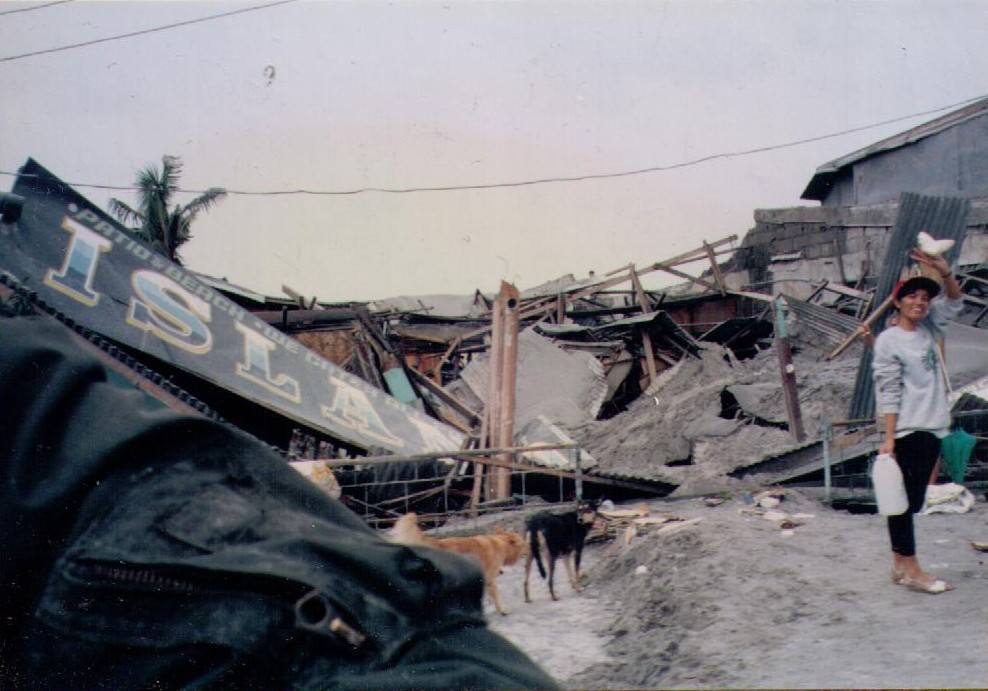
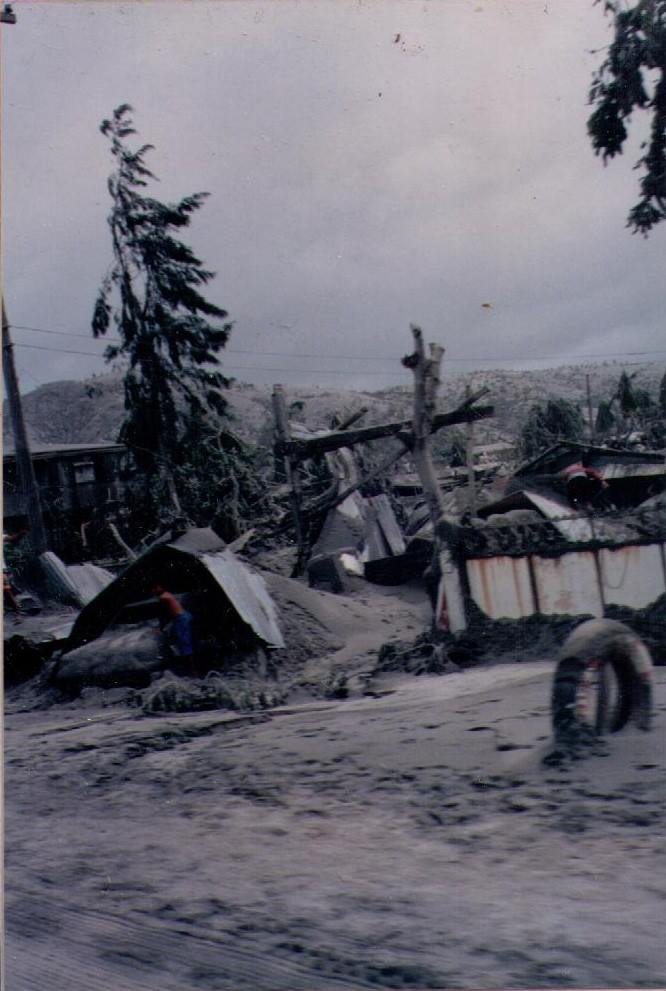
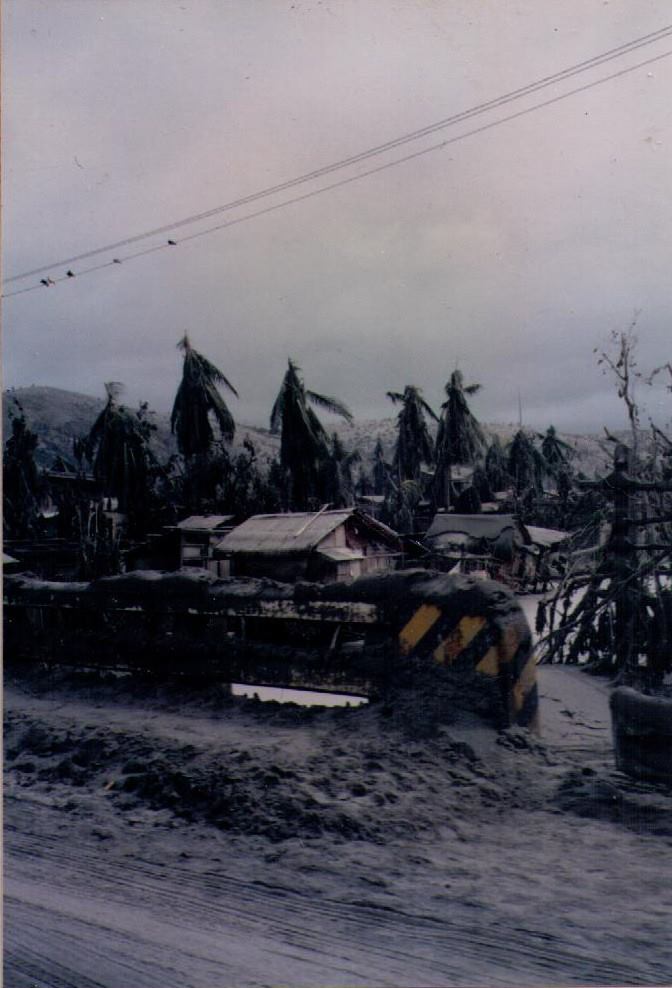
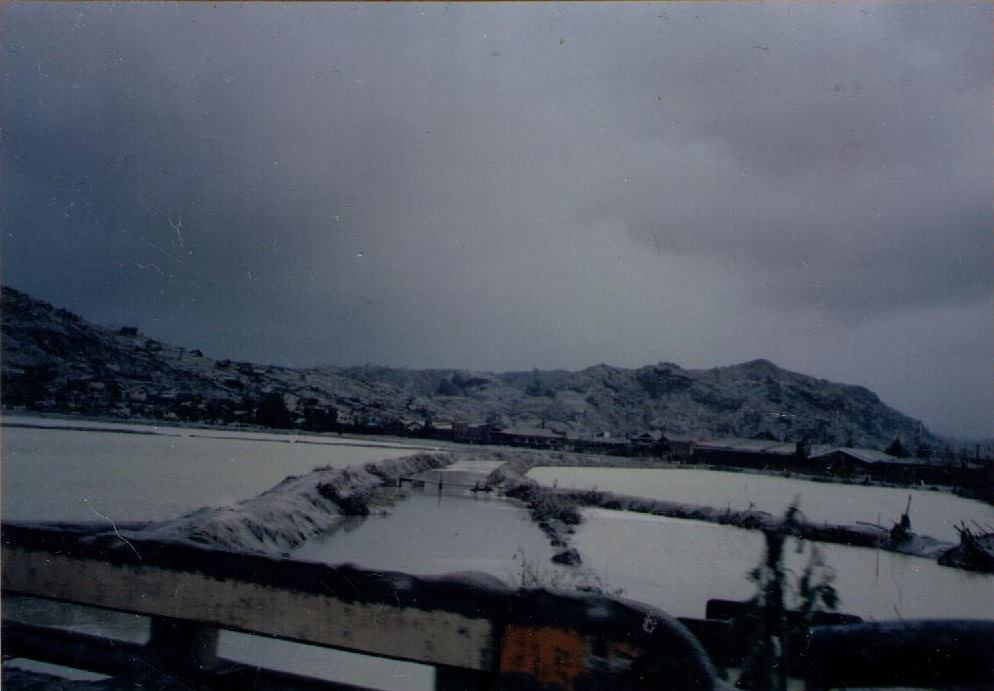
As soon as it was light enough, we sent the truck out to Olongapo. (All of these photos were taken on a film camera by one of the crew in the truck.) We learned later that the town was buried in several feet of ash but the main roads were navigable. The larger buildings (apartments and hotels) had minor earthquake damage but many of the smaller ones (mostly bars and restaurants) had collapsed roofs. People were wandering about, checking on each other and assessing the damage.

One of many collapsed buildings in Olongapo.
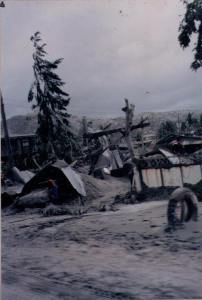
Heavy ash and high winds = collapsed buildings and bare trees.
Happily we found our missing crew, although most of them had minor cuts and bruises. One of them had been trapped all night under a bar with a collapsed roof and had a long wound on his forearm from metal debris. (He said he felt fortunate to be alive, because he’d listened to the screams of one of the bar’s employees as they died in the wreckage.) The truck hustled the crew back to the boat without incident, where our corpsman cleaned & stitched our injured man’s arm.
“We Gotta Get Out Of This Place”

The municipal bus was on time.

Downed trees were everywhere.
Back on the boat, we quickly finished our underway checklists. The typhoon had dumped its rain and was breaking down into a tropical storm, but we didn’t know whether Mt. Pinatubo would erupt for a third time. As the skies cleared, we’d regained satcom radio contact with the submarine group. They agreed with our voyage plans and assigned us the submerged operating areas to head for our maintenance port in Guam.
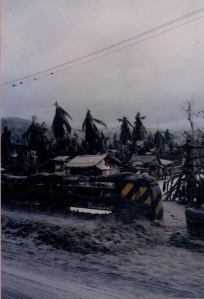
Stripped palm trees.
Aside from the ash, the boat appeared to be in surprisingly good shape. Once the Engineering Department finished cleaning the ash out of their seawater suctions, the steam plant was much more stable. With reliable air conditioning (and chill water to our computers) our sonar and fire control systems started with minimal glitches. (We could technically get underway without them, but nobody wanted to submerge without a reliable sonar system.) Our Weapons Department gear was as good as it gets but all of us were exhausted physically, mentally, and emotionally. We still had to get through today.

Ash-covered hills, and ash in the water too.
As the offgoing (finally!) Ship’s Duty Officer, I was also the Surfaced Officer Of the Deck for the underway. To our surprise, a few port employees showed up on the pier to check on us. (The phone systems were still down, and the shore electric grid was still dead.) We could cast off the mooring lines without assistance, and they used our borrowed truck to pull the brows off the boat. It was the ugliest underway I’ve ever conducted, and my happiest.
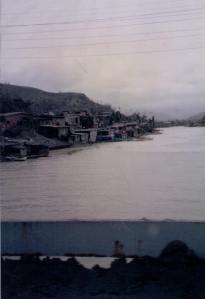
Storm surge and ash-filled rivers.
Our sortie was surprisingly uneventful. The channel was filled with floating debris but we were the only vessel going through it. We straddled both the inbound & outbound lanes and gave ourselves as much evasion room as possible. Both sides of the shore were blasted by the winds and the ashfall, and the surviving palm trees were mostly ragged sticks. As we passed the airfield at Cubi Point I remember seeing one plane resting on its tail, its nose in the air. It was covered with two feet of ash.
Once we reached open ocean, our speed scrubbed the last of the ash from the hull. Now in clean water, we could restart our evaporator and top off our drinking water tanks. We also had to refill our trim tanks to replace the thousands of gallons of seawater that we’d used to hose off the ash during the worst of the eruption.
The Engineering Department’s mechanics had needed so much air to blow ash out of the seawater suctions that our 4500 PSI airbanks were below 3000 PSI. These air banks would also be needed for emergency blows to reach the surface if we had an underwater casualty, and they had to be back at 4500 PSI to be effective against flooding. This meant that before we could dive, we had to run a long air charge while we were driving on the surface.
With clean air and reliable electrical power, the mechanics started all three of our high-pressure air compressors. Four hours later, we managed to get the air banks back above their minimum required pressure and we finally submerged.
After diving and getting a final neutral-buoyancy trim (happily without any surprises) we sped up and went deep. We manned our regular underway watchstations while the rest of the crew caught a few hours of sleep. That afternoon we began cleaning up the ash that had been tracked onto (or sucked into) just about every nook & cranny. I don’t remember much about that week, but I clearly remember that we even suspended our routine training & drills so that we could focus on cleaning and resting. Not necessarily in that order.
We reached Guam in several days. 30 years later, in today’s Navy, the entire crew would have been met at the next port with a team of psychologists and counselors to help us talk through our trauma. There’d be several PTSD screenings and maybe even physical exams to check for lung damage.
As near as I can remember from 1991, none of that was even discussed. While we were on watch (or cleaning), I remember many conversations that started with “Where were you when… ?” One of our crew said that they’d planned to serve for at least 20 years, but after this natural disaster they were hoping for a Monopoly game’s “Get Out Of The Navy Free” card. (That wasn’t offered to any of us either.) We got through the rest of the week mainly through crowdsourced talk therapy.
Aftermath
The Weapons Department’s gear was largely unaffected by the ash. On the way to Guam we shot a salvo of water slugs out of our torpedo tubes, and we found a small amount of ash left in the tube. There was no other damage (like the engineroom’s seawater pump seals) but… there was ash. After more inspections and discussion we decided that the ash had flowed down along the hull inport to get trapped in nooks & crannies of the ejection system. We shot a second salvo and the tubes were clear. Thankfully there was no evidence of ash damage in any seals or gaskets in the weapons launch system.
The superstructure inside our sail had probably accumulated an amazing amount of ash through the bridge openings at the top. We never made the time to remove the sail’s access plates (always good for hours of frustration) to inspect for damage, let alone cleaning. We raised and lowered our periscopes and antennae (housed in the sail) as part of the underway and undoubtedly scraped a lot of bearings through the ash. After we submerged the ash would (eventually) have washed out of the sail through various freeflood penetrations.
During the next year we replaced just about every bearing on every mast in the sail, and at least one antenna barrel. That was probably the second-worst damage to the boat, and certainly the most expensive.
The boat’s ventilation filters were clogged with fine ash that had entered the boat through the hatches. Over the next month the crew spent hours cleaning those as the ventilation system gradually cycled the ash through all of the fans and ducting. (The air filters on our sonar and fire control computers were even worse, despite daily cleanings.) The diesel generator’s snorkel air inlet plenum was coated with ash, so it’s a very good thing that we never attempted to snorkel.
I’ve already mentioned the engineroom’s seawater systems. The seawater cooling pumps managed to handle an amazing amount of ash but their seals were permanently eroded. The mechanics dealt with the leaks for the rest of the deployment (and pumped a lot of seawater out of the bilges) until the boat’s next major homeport upkeep. Let’s just say that we depleted the Pearl Harbor submarine logistics system of seals for all of our seawater pumps.
During the rest of the deployment, nearly everyone in the crew dealt with respiratory infections. Our bodies were clearing the ash out of our lungs as quickly as possible, but we all had complaints ranging from chronic coughs to full-blown pneumonia. A few days after leaving Subic Bay I woke up that morning gasping for air and unable to draw a full breath. Our corpsman listened to my lungs and pumped me full of antibiotics, which took care of the problem. And yes, I sucked it up and stayed on the watchbill. I wasn’t going to be snoozing in my rack when everyone else felt at least as crappy as I did.
As far as I’ve learned from shipmates over the years, our crew recovered from the trauma. I’ve heard from several other veterans (Air Force and Navy) who now have damaged lungs from the weeks of the evacuation and closure of Clark Air Base. Please post a comment if you were there during or after the eruption and have more information (or sea stories) to share.
Epilogue
In 1992 USS NEW YORK CITY (SSN 696) was awarded its fourth Meritorious Unit Commendation. The crew earned dozens of individual medals and other commendations. That was mostly due to our deployment’s typical Cold War submarine missions (which we do not discuss) and possibly our mission with the Coast Guard. Someday I’ll write about that USCG operation and I’ll post a link here.
At the end of my tour in July 1992, I transferred to shore duty. In 1995 the boat deployed to the Western Pacific again and the crew finally got that Singapore port call.
The boat’s inactivation ceremony was in December 1995 at only 16 years of service. That’s less than half of a submarine’s typical lifespan, and NYC was in good material condition with plenty of nuclear fuel. The decommissioning was due to the funding cuts of the U.S. military’s biggest drawdown since the Vietnam era, not from the effects of Mt. Pinatubo.
During the next decade I dealt with repeated respiratory issues: several more cases of pneumonia, at least a dozen of bronchitis, and more ear infections than I can remember. A chest X-ray in 1992 was negative. (That was only done as a routine check for nuclear-trained submariners.) Several other X-rays over the following years diagnosed pneumonia but presumably there were no lesions or other signs of silicosis. There was no respiratory damage found during my retirement physical in 2001, and in 2013 a full pulmonary function test was rated as “normal for a man in his 50s.”
In the late 1990s when I was stationed at a submarine training command, I reunited with one of the senior enlisted Sailors who’d been in the Weapons Department with me. He was the man with the injured arm who’d spent the night trapped under the wreckage of the bar. We both agreed that we’d recovered from the incident. Maybe we were right.
“Every Blog Post Should Have A Call To Action”
My spouse and I reached financial independence during active duty, and I’ve been retired from the military for over 20 years. Three decades after the eruption I still struggled to write this sea story. While I wrote it, I paused many times to gaze out of our windows and admire the tropical view. I’ve even had a few paragraphs of this post pop up in my brain during surf sessions, and surfing always leaves me with an extra-large helping of gratitude.
You never know your last day of doing anything. Work as long as you find it challenging and fulfilling, but keep saving & investing for your financial independence. If you’re dealing with a scarcity mentality, then appreciate your human capital and try to adopt a mindset of abundance. That evolution can take months.
Make sure you’re living your best life without trading more of your life energy (which you might not have) for more money (that you do not need).
Related Articles:
A U.S. Navy meteorologist remembers the Mt. Pinatubo eruption and evacuation
Updated VA disability claim and medical tests (my sinus damage… and maybe yours too.)
Want to read more about (unclassified) submarine careers and lifestyles?
Poopie Suits & Cowboy Boots “Sub Tales” book series
Explanation: “Lowering Vacuum, Port Main Condenser”
A steam plant generates electricity by turning a turbine that’s connected to an electrical generator. As the hot dry steam spins the turbine, the steam gives up its energy and exits down into a condenser. The steam has barely enough heat energy to stay vaporized. Submarine steam plants pump seawater through cooling tubes in the condensers to turn the moist steam back into hot water. Pumps move that condensate back into the feedwater system and eventually into the steam generators where the reactor supplies the heat to make more hot, dry steam.
A submarine condenser is a sealed system that normally operates at a vacuum for greater cooling efficiency. If a condenser loses its vacuum (or its seawater cooling) then it can’t turn the steam back into condensate. If vacuum is lost and pressure builds up then the turbine’s steam supply has to be shut down before the condenser blows a seal. It’s a delicate balance, but it’s sustainable as long as the condenser has cooling seawater.
If the turbine is shut down, it’s not making electricity. If both electrical turbine generators are shut down then the emergency storage battery starts discharging again. The reactor is still keeping the engineroom’s steam hot, but none of it is generating electricity. The reactor’s still (relatively) safe but this is not sustainable. The condenser has to restore its seawater cooling (and its vacuum) to bring the turbine back online and resume generating electricity before the battery runs out of amp-hours.
When vacuum started dropping during the volcanic ashfall, the engineroom’s mechanics quickly checked the condenser and realized that there was hardly any seawater flowing through the cooling tubes. The hull suctions of the seawater pumps were clogged with volcanic ash. Even worse, the seawater pumps were forcing a slurry of abrasive volcanic ash through their rotors and seals and into the condenser’s narrow tubes before trying to push the sludge back out of the hull’s discharge piping.
Under a typical loss of condenser vacuum, the Engineering Officer Of the Watch would order the Electrical Operator to unload the turbine generator. (The other turbine generator would handle all of the electrical demands.) The mechanics would shut down the steam to the unloaded generator and then shut off that condensor’s seawater cooling. They’d connect an air hose to the seawater suction piping and blow air back out of the suction’s sea chest to clear out whatever marine debris had accumulated.
But nobody ever designed a submarine cooling system to run on seawater that’s fouled with volcanic ash.
Once the cause of the problem was clear, the EOOW and the EO quickly unloaded the turbine and the mechanics blew the ash back out of the sea chest. As they restored seawater cooling to the condenser and it began doing its job again, the EOOW announced “Rising vacuum, port main condenser.”
Whew. Everyone relaxed a little as the mechanics brought steam back into the port side of the engineroom and spun up the turbine for the EO to generate more electricity.
You submarine veterans can already predict what happened next.
Suddenly the EOOW had a new announcement: “Lowering vacuum, STARBOARD main condenser.”
This caused a mad scramble from the EO and the mechanics. As the port turbine generator took over the electric loads, the starboard turbine generator was electrically unloaded and the starboard side of the engineroom was quickly shut down. The mechanics hustled the air hoses over to the starboard seawater suction, blew out that sea chest, and quickly brought steam back to the starboard turbine generator.
This continued for 18 hours. Every 20-30 minutes one side of the engineroom would have to be shut down to blow a sea chest while the other side struggled to maintain condenser vacuum long enough for the first side to be brought back online. The mechanics, normally in three-section watches, were all on continuous casualty response. The ship shut off all non-essential electrical loads, and even the air conditioning was turned off until the engineroom got too hot.
The seawater pumps continued to grind through the ash in their impellers and seals. All of the mechanics gained way too much proficiency training at shutting down and starting up a side of the engineroom. As they raced against the lowering vacuum and the seawater flow, they knew what was already happening to the pump seals– and nobody was looking forward to those repairs.