DIY home maintenance


Old toilet, discolored porcelain, and mineral stains


I was ready to wax our old toilet.

But before I explain that teaser, let me talk about a critical aspect of financial independence: DIY– doing it yourself.

When you’re working 60 hours a week (or deployed for a 168-hour workweek) then you probably don’t look forward to doing your own home maintenance. You’d rather spend time with your family, go out for entertainment, or just catch up on your sleep. You’re not the only person who feels this way, because there’s a whole industry of dogged entrepreneurs picking up pet poop for customers who are “too busy” to take care of it.

Sometimes it makes sense to hire out home maintenance. If you’re paid more at your job than you’d pay to hire out the cleaning, then hiring it out seems compelling. However, it’s easy to turn that into a false economy, especially when you want to hear a certain answer. If you’re getting paid $50/hour then hiring a $60/hour cleaning crew is a money-losing idea. But if you’re getting paid $60/hour, then what?

Do more math and make sure you’re comparing the same numbers. You’re paying the cleaning crew with after-tax dollars, so determine your after-tax wages. If you’re earning $60/hour then federal/state/local taxes could easily eat up 30%. At this point most of you are getting out the vacuum cleaner.

In defense of those who hate cleaning, you have other factors on your side. DIY needs your own tools and supplies, which can be expensive to buy & maintain. (Or you could buy them from Craigslist and garage sales.) Even if your net pay is just $42/hour, you may still value your liberty more highly than your boss values your work. The cleaning crew’s $60/hour could be worth paying from the entertainment budget.

However, the non-financial intangibles make all the difference. For example, housecleaning is an arduous exercise in flexibility, free weights, & aerobics. It might feel like a waste to pay for both a cleaning crew and a gym membership, especially if you could redirect hundreds of dollars a year from those bills to your retirement investments. Next, housecleaning is an excellent chance to do a facility home inspection. You’ll notice little warning signs (water leaks or bugs) before they grow into big problems. Most importantly of all, though, housecleaning is an outstanding opportunity to reflect on minimizing it. The less you own, the less you’ll clean. If you don’t get it dirty in the first place, then you won’t have to clean it. A little daily cleaning saves much more time and effort than “monthly cleaning marathon day”. I won’t get into the millions of cleaning books and websites, but we’ve learned a lot at Hale Nords from that timeless classic (available at your local library) “Speed Cleaning”.

Have you considered slave labor? No, not that kind, I’m talking about your kids. The earlier you can teach them to clean up after themselves and do chores, then the less you’ll suffer when they turn into teenagers. Servicemembers have hundreds of hours of experience at military cleaning and training– so make those skills pay off! Even a five-year-old can put away their clean laundry, clear the dinner table, and empty wastebaskets. Helping them their bedroom & bathroom counts as “quality family time”, as well as the chance to show your budding DIYers how to check for plumbing leaks or bugs. Cleaning their own toilets will inspire your kids to make less of a mess in the first place. Ultimately they’ll want to have their own place– and the sooner you teach them their own DIY skills then the sooner they’ll move out of your house.

DIY home maintenance is even more valuable in an emergency. If you’re already taking care of your own plumbing, then when a leak erupts at 10 PM on a Friday night you’ll know how to stop it on your own. You might even know how to fix it, eliminating hundreds of dollars of emergency-response fees and weekend service calls. You just can’t put a price on the self-confidence boost you earn by recovering from this engineering casualty.

So where do you get these skills? Start with the world’s biggest DIY training facility: the military. Even military clerks and security guards get a chance to see things being fixed. If someone else fixes your gear, then you certainly want to know how to keep it working more reliably and longer. A polite question makes people happy to show off their knowledge & skills. If you’re a supervisor then you have to ask these questions anyway!

Two other DIY resources are Family Handyman magazine and The Samurai Appliance Repair website.  I like the magazine’s tool ads repair-tech updates for $20/year, but FH’s website is free. Both are filled with procedures, checklists, videos, parts lists, and tool tips. The Samurai’s troubleshooting guides are also free, and for a small beer-fund offering he’ll answer your questions in live chat or on a discussion board. Home-improvement stores are online and in nearly every neighborhood, and parts are much more standardized & affordable. The industry still caters to contractors, but it makes a lot of money from DIYers– especially the women who have lost all fear of maintenance & repair projects.

Submarine sewage experience– the hard way

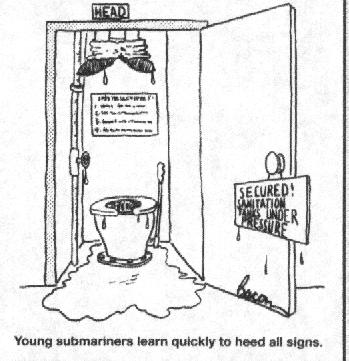
The Navy spent years of my life (and piles of your tax dollars) training me to be a nuclear engineer. How did I repay that investment? By spending an inordinate amount of time fixing sewage systems. When you’re 22 days into a 90-day submarine patrol, and thousands of miles from the nearest plumbing-supply store, then you have all sorts of time and creativity to keep your toilets flushing.

A thousand words later I’m back to the toilet. Nice segue, huh?

It was 22 years old. The bowl’s porcelain finish was eroded by years of harsh chemicals and abrasive cleaners, and it had a lot of friction impeding the “material flow”. We have a whole-house water conditioner, but minerals still built up on the porous surface to require even more chemicals & scrubbing. Its piping was slowly clogging with mineral deposits and its flush just wasn’t pushing the contents like it should. The public-bathroom toilet sees the most traffic– and it was beginning to make the wrong type of first impression. A coat of wax would have helped the bowl look cleaner & work better– but who wants to spend their valuable liberty on that chore?

Next-generation DIYer

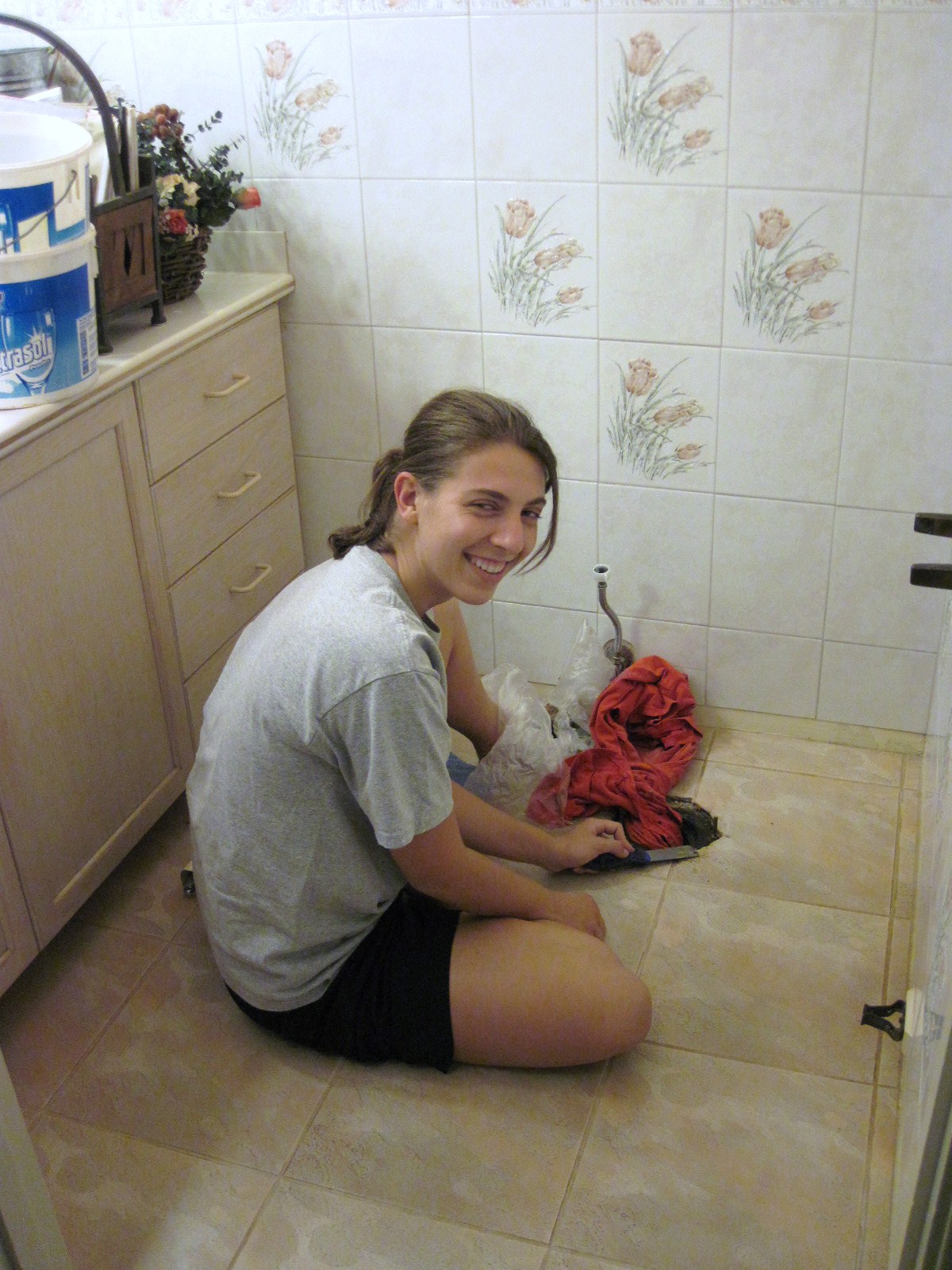
We did our research with Family Handyman’s “top toilets” article and the step-by-step procedure. We shared the links with our daughter, who volunteered to tackle the project during her college break. This would be her second toilet replacement, earning her $10/hour while offering valuable civil-engineering experience.

So for our 25th wedding anniversary, I got my spouse a different type of shiny rock-hard glittering gift: a Kohler Wellworth elongated low-flush model, $208 at Home Depot before the 10% military discount. Pricey, but worth every penny for decades of quality!

When you wait this long to replace a toilet, there’s many engineering upgrades. It’s still a gravity flush, but the hydrodynamics are much better. The bowl is designed for a straight shot down the chute instead of a swirl, so its contents depart immediately with no clog left behind. The flushing handle moves a poppet valve instead of a traditional flapper, so you can flush exactly the amount of water you want with prompt feedback. The tank holds 1.6 gallons but the usual flush is under a gallon. The flow is so smooth that you don’t even hear the traditional “whoosh” noise. The bowl’s hard-glazed surface is slicker ‘n… well… anything likely to contact it. Over the last week it’s needed zero cleaning. I’m happy to devote several additional weeks of monitoring to determine the ideal cleaning interval.

Not only is it a top-quality toilet with minimal maintenance, but during the replacement I just hovered over my daughter’s shoulder offering helpful suggestions while she did the real work. Best quality family time ever.

New Kohler Wellworth toilet

If you weren’t raised in the DIY lifestyle, start now. Subscribe to the magazines & websites, enjoy the pretty pictures, and spend a few minutes a week learning the vocabulary. Follow your interests and start small. If you hire a contractor, ask questions and learn from them. I prefer plumbing & appliances to carpentry, but I’m willing to tackle just about any maintenance or repair task. You’ll easily save $25/hour on minor projects, and as your skills improve you’ll end up saving hundreds. Better yet, your DIY maintenance will nip problems in the bud to avoid thousands of dollars in repairs. You’ll never be at the mercy of contractors again, and you’ll be one of your street’s most popular neighbors. $25/hour is a nice boost to any retiree’s discretionary income, but the work-for-food baked goods are even better!

You don’t want to know how I learned some of my plumbing skills. However, for my daughter’s gross-out service-selection benefit, someday I’ll post my sea story about the dustpan in the submarine sewage holding tank.


Related articles:
Frugal living is not deprivation
How many years does it take to become financially independent?


Does this post help? Sign up for more free military retirement tips via e-mail, Facebook, or Twitter!

Posted in Mortgage & Real Estate | 2 Comments

Financial lessons learned from caring for an elderly parent


It’s been nearly two years since my father wrote a letter to us two sons that his “slipping memory” made him stop using e-mail. Since then I’ve learned way more than I really wanted to know about managing his affairs, and I’ve included the four most important lessons at the end of this post.

Dad’s a retired engineer who’s been widowed for almost 25 years. For a number of understandable reasons, after Mom’s death he gradually disengaged from family and society. He’s accustomed to living a simple life in a small apartment and hiking his favorite mountains, coming home to spend his time with his books and his computer. Among us three men, it’s “normal” to swap only holiday e-mails and to get together just once or twice a decade. I live over 3000 miles from Dad and my brother had a five-hour drive over dicey roads.

But Dad’s letter promptly earned him a visit from both of us.

By the end of our afternoon together it was clear that Dad was showing Alzheimer’s symptoms. He knew what was happening but he’s fiercely independent. He was coping with it by using lots of calendars, engineering-style checklists, & reminder notes. We suggested various forms of “help”, and as expected he politely yet firmly declined them all.

Whatever generation you’re in, we’ve all seen the media presentations on how to have “the talk” with your parents about their affairs. We all know we need an “emergency” folder, a will, a medical directive, powers of attorney, and perhaps more complicated arrangements like a trust. We’re all supposed to sit around in a relaxed and neutral setting– ideally a local restaurant or coffee shop– to discuss how to take care of each other. We young ‘uns start the awkwardness by reassuring our parents about the arrangements we’ve made to ensure that their grandchildren will be taken care of if we’re unable to. Then we’re expected to tactfully steer the conversation to their own arrangements: how can we help them? Everyone puts together their paperwork, copies are handed out, and we all share a big Norman Rockwell family hug. Great.

Dad’s always had a current will & medical directive plus comprehensive files. No problem there. He said he’d execute powers of attorney “when the time came”, but he wasn’t ready yet. After our visit I consulted a local geriatric care manager and was advised that we couldn’t do much more than wait for Dad to ask for help. We had no legal authority. Pestering him would only alienate the entire family.

How do you urge someone who’s three time zones away to keep in touch when they can’t use e-mail and can’t hear the phone? Snail mail. I wrote a letter every few months, and I usually got a response. My local geriatric care manager (I couldn’t have handled this without her) referred a couple geriatric care managers in Dad’s town who agreed to respond to emergency phone calls. For my Dad’s insistence on independence, that was as good as “keeping in touch” was going to get.

Yet we still lacked legal permission to help with Dad’s affairs. He didn’t want to “complicate” the decision-making by delegating authority.

In retrospect, Dad’s cognition deteriorated sharply last January. He handled Alzheimer’s for at least two years before it all fell apart. When he lost the ability to care for his health, he ended up in the emergency room with a perforated duodenal ulcer. He came within an hour of dying but the surgeon figured out the conflicting symptoms and pulled off a quick miracle.

You already know what Dad wanted to do as soon as the staples came out: go home. The reality was that we had no legal authority to interfere. 24/7 home care, however, was estimated to cost over $10K/month.

I inherited Dad’s persistence, and I used it. Because Dad lacks a short-term memory, during his 10-day hospital stay we had “the talk” another couple dozen times. I repeatedly stressed the safety of a care facility where he could still have privacy while going through rehab. But he still insisted he was going to “finish his business trip, check out of the hotel, and go home”. As discharge day approached, the doctor had to bluff assert his own authority: Dad could complete his recovery in the hospital or at a skilled nursing facility. We didn’t even mention the “go home” option. We spent the next few days on frantic teamwork among my brother, two sets of care managers & lawyers, and the hospital’s discharge coordinator. I waved my credit card around with wild abandon and the team found a good skilled nursing facility. Then I drove Dad to my brother’s city (over those five hours of dicey roads) and Dad checked into the facility to begin his rehab therapy.

Was our coercion legal? Probably. Ethical? Absolutely.

Dad’s recovered from the surgery and he’s doing as well as mid-stage Alzheimer’s allows. In a surprise about-face, he’s tremendously relieved not to have to manage his own affairs any longer and he loves not having to spend all day on chores. He’s happy at the care facility and he wants to stay there.

But we still have no legal permission to help with Dad’s financial affairs.

The medical paperwork is fine. All three of us have signed a stack of medical powers of attorney, HIPAA releases, and “Do Not Resuscitate” orders. Dad’s wishes are clear, and I have years of his old letters to document his current desires. No problems there.

His finances are good. Medicare covered the first couple months (the hospital was over $50K alone) and Dad’s Medigap insurance covered the deductibles. His pension’s prescription plan (nearly unheard of today) covers all but a small copayment. With his simple lifestyle, he’s been spending less than half of his pension/Social Security for the last decade. He has a fantastic long-term care insurance policy and he’s built up his own investment portfolio.

I’ve learned all of this from his files. I just don’t have the legal authority to do anything with it.

It’s been over five months since Dad left the hospital. Since then we’ve spent over $6000 on geriatric care managers, lawyers, and psychologists to document Dad’s need for us to handle his affairs. (The care facility’s expenses, and filing the claim for long-term care insurance, is a completely different issue.) We’ve made several trips to his town to sort through his apartment, sell off his furniture, bring his personal possessions back to him, clean things up, and break the lease. Next week our lawyer will file the petitions for guardianship and conservatorship, and hopefully this will all be worked out over the next two months– plus the final couple thousand dollars of legal bills.

That’s the price of Dad’s independence.

We should have handled this differently. The legal community greatly prefers revocable living trusts because they cover both incapacity and probate. It’s a wonderful theory but in practice, many trustees neglect the paperwork. Most people balk at the legal costs of setting up the trusts, and Dad would have been suspicious of the triggering mechanisms for successor trustees. However, if your family is willing to consider a trust (and maintain it) then it should work when needed.

Adding our names to his checking/investment accounts would have solved everyone’s problems… at first. However, if an adult child is sued over their own assets, and if they’re joint owners of an elderly parent’s assets, then hypothetically the parent’s assets are also at risk. It can be difficult to maintain joint accounts through life’s changes, too. My brother’s near Dad but bro works long hours and has no interest in managing Dad’s finances. I’m too far away to help in person so I’m happy to take care of the finances, but if I was in the service then it would’ve been hard to help from the deployment. Of course joint accounts work fine between spouses. If I wake up incapacitated tomorrow, my spouse can open our “Emergency” folder and pick up where I left off with no surprises.

A durable power of attorney sounds great, but personally I think it’s an urban legend. The first thing you learn when you’re holding a durable power of attorney is that nobody has to respect it: banks use their own forms, brokerages have their own ID verification procedures, and different corporate lawyers have different definitions of “durable”. I haven’t investigated this option in over a decade, and I sure hope things have changed since then, but I’m skeptical of “one POA fits all situations”.

A power of attorney (on the financial institution’s forms) works well (as long as the grantor wants you to keep on using it), but I now know that a hospital recovery ward is a terrible place to notarize legal documents. Even if Dad was competent and willing to sign a power of attorney (and if we managed to bring a notary into his room for the occasion), he was in no condition to do so. A notary would have been quite justified to decline the transaction.

The good news is that Dad is safe, physically healthy, and as happy as he can be. He’s managed to sign some checks and letters to pay the bills. We’re cleaning up the rest and we’ll work out the reimbursements later. But with what I know now, I’d go back to that magazine article about “the talk” and add a few paragraphs:

Lessons learned?
1. We don’t learn. My grandfather did this same dementia crisis on Dad in the 1980s. (14 years in a care facility.) Yet Dad never figured out the right way to let us sons step in for his own incapacitation, and I didn’t know enough to take charge. In his case it should have been a POA in his “emergency” files for his checking & brokerage accounts, updated every year or two. For spouses it might be a joint checking/brokerage account or an alternate trustee’s springing authority in a revocable living trust. Legal technicalities aside, a stack of old POAs can be a big help in persuading a skeptical bank branch manager (and a notary) that you’re acting in your parent’s best interests.

2. Do the paperwork while you still can. When Dad declined to set up powers of attorney, I should have said “I understand. Don’t to give them to us until you’re ready, but complete them now in case you get sick and want help taking care of things while you’re getting better. I can’t bring the notary to the hospital.” I’d help him get the forms from his bank & brokerage, I’d get them completed & notarized, and then I’d make sure Dad had them on file where we could reach them– not necessarily a safe-deposit box but certainly a secure place where we’d know to look for them.

3. Make it easy for people to understand our benefits. (This is especially critical if you’re a military veteran.) I’m pretty good at finance but even I was blissfully ignorant that I was so blissfully ignorant. My father has an “If I wake up dead” letter and a medical directive, but not an “If I’m in the ICU” letter. That letter would have said “I’m covered by Medicare (you’ll need my SSN) and my Medicare co-payment is covered by my insurance (here’s the name of the company and the policy number) and my prescriptions are covered by Medco (here’s my number).” A “Basics of Medicare and Medigap Insurance” flyer would have been a bonus. My wife and I understand each other’s military benefits, of course, but now we’ve explained them to our college daughter. We’ve also included the checklists of veteran’s benefits that each service supplies in their retiree newsletters.

4. If you’re an adult child of an elderly parent, then you need an emergency fund. You may spend several thousand dollars of your own money on your parents (and their bills) before you’re able to reimburse yourself. In our case, my spouse and I have our bills on autopay from our joint checking account that receives my pension deposit. If I’m incapacitated, she doesn’t have to do anything. If I die, she just has to transfer money over to our account while she probates the will and takes over the bills.

This might be a good time for you to check your family’s papers to see if you’re ready to take care of each other. If you or a loved one is in Hawaii, I know an excellent geriatric care company that can help. I hope this post persuades at least one other reluctant elderly parent to really have “the talk” while they still can.

Related articles:
Book review: The Complete Idiot’s Guide to Social Security and Medicare

Does this post help? Sign up for more free military retirement tips via e-mail, Facebook, or Twitter!

Posted in Military Life & Family | 6 Comments

Book Review: “Get Rich Click!”


A few months ago I was offered a chance to moderate a tiny part of the Dollar Stretcher community in Military Family Finances.  I highly recommend Dollar Stretcher’s weekly e-mail, and their website is a treasure trove of personal financial tips.

One of the perks of being a Dollar Stretcher moderator is the opportunity to review new books. I’ve highly enjoyed the privilege (“Will write for chance to read free books”) and I’ve been passing on the best ones in this blog.

Today, however, I’m going to review a book that’s a bit less than the best.

Here’s the problem: People are getting rich off the Internet, but it’s not easy.  It takes time and effort to duplicate their success. The advantage of global connectivity is that we only need to earn a penny or two from each sale, and then scale it up. The cost of starting a Web business is lower than ever, there’s very little penalty for failure, and it’s easy to start over. However, the same bandwidth that’s connected us has also spawned a gigantic gold-rush industry of spam, fraud, and just plain useless advice. It all seems too good to be true: enriching yourself from the Internet still requires dedication, hard work, and a little luck.

Business advisers have multiplied a thousand-fold over the Internet, and they all have to deal with a credibility issue: “If you’re so smart, then why aren’t you rich? And if you’re so rich, then why do we have to pay you to read your advice?”

Marc Ostrofsky has already been smart enough to get rich, but I wouldn’t pay for his book. If you must read it, then ask your local library to buy it. (My review copy has been donated to our Hawaii library.) While you’re waiting for the library, go to GetRichClick.com and start learning.

The book is full of useful references for Internet profits. Ostrofsky shows that bandwidth helps a Web entrepreneur exploit the many inefficiencies in the bricks & mortar business world. Not only are these profitable opportunities, but they can scale worldwide and perpetually. He then cites the stories of people who have done precisely that.

The problem with a hardcopy book is that history doesn’t translate into reader action. We’re nearly two-thirds into 2011, and this book has been in editing and printing since mid-2010. That’s a generation at Internet speed. The gold rush in domain names ended years ago.  There’s no mention of ICANN’s newly created generic top-level domain names or their expensive registration requirements.  Even casual tech readers know that Google recently changed their search-ranking algorithm, eBay has raised their fees (again), and that Facebook is facing serious competition and backlash. Some of the advice in “Get Rich Click!” is already out of date, and most of it will be obsolete before 2012.

The author tries to compress the entire world of online sales and marketing into 240 pages. Unfortunately most of the subjects are limited to a page of introduction, a success story or two, another paragraph of advice, and then the reader is referred to the website. Why not just skip the book and start with the website?

I’m a voracious reader, and even I think that the book’s formatting is annoyingly distracting. There’s very little white space at the margins. The layout uses two ink colors and several font sizes. There’s a trademarked phrase on nearly every page. Cartoon panels are sprinkled through the text but they don’t always relate to the subject, and two of them have the same punchline. QR codes are used on many pages for websites that you’d never want to read on a smartphone. Text includes disclaimers like “I’m not an expert” or “Try consulting a friend.” Ostrofsky is a relentless name-dropper, even when names are irrelevant to the point of the story. The book is blatantly padded with five-page lists and “top 25” summaries. Maybe they’re good brainstorming tools, but mostly they’re history.

Ostrofsky will help you figure out how to get rich if you’re willing to work for it. (It’s not quick or just “Click.”) But if you want relevant advice in a readable format, start with his website.

Related articles:
Book review: Eric Tyson’s “Personal Finance in Your 20s For Dummies”
Book review: “The Complete Idiot’s Guide to Social Security and Medicare
Book Review: Liz Weston’s “The 10 Commandments of Money”
Hawaii newspaper review of “The Military Guide” (scroll to bottom)

Does this post help? Sign up for more free military retirement tips via e-mail, Facebook, or Twitter!

Posted in Entrepreneurship, Reviews | 3 Comments

Join the military to get rich and retire early?: the rest of the story


(The first part of this post is over at Jacob Lund Fisker’s Early Retirement Extreme blog.)

Now for the rest of the story…

When I was an impressionable young teen, my best friend’s older brother was attending USNA. Every time he was home on leave he wore a Navy sweatshirt and a three-day beard. He’d have a cold beer in one hand and a hot chick in the other… even at 10 AM. He drove a great car. His life looked a lot better than high school! I toured the Yard, attended a class, saw all the cool gear and uniforms, and got sucked into the irresistible challenge. Navy’s marketing is very effective. It’s so effective that when my spouse and I attended the same tour nearly three decades later with our daughter, all of us were ready to sign up.

Before graduating from college I carefully mapped out my temporary duty, initial training, and sea tour to coincide with the end of my active-duty obligation. I wasn’t going to be one of those poor suckers who owed the assignment officers years of indentured servitude on hardship duty. Well, not for a second time, anyway.

My plan succeeded and I left sea duty only five months before my obligation expired. However, my spouse and I had just married, and her next duty station was the Naval Postgraduate School. It was our best tour ever, and to this day I’m still grateful that she got me there. Of course when I graduated I had a pesky new 4.5 year commitment that would take me to 11.5 years. But we were stationed in Pearl Harbor. No complaints there!

By the time that obligation ended, spouse and I had picked up a different one: we’d started a family. I made the cut for XO but it looked like I wasn’t going to get the call, and the future seemed murky. However, I had no compelling reason to leave active duty, and if I stayed then we could be stationed together in major homeports. I looked at other warfare communities and staff corps but they all involved various degrees of “starting over”, and I wasn’t willing to make that transition either.

The subsequent 8.5 years to retirement had some incredibly miserable moments, but they all seemed better than the alternative of leaving active duty. Heck, if I’d left active duty then I might have had to get a real job.

Blissfully ignorant I was: today it’s clear that I was surrounded by unrecognized opportunities. On one shore duty I worked with literally dozens of Reserve officers who would have happily taken me under their wing and showed me how to make the transition.  At another command I could have left active duty on Friday and started a civil-service career in the same office on Monday– and drilled in the Reserves. At my training commands I regularly fended off job offers from shipmates who’d already started civilian careers and desperately needed all the team-building help we smart leaders could offer. I was worried about going without a paycheck, yet most of my transition choices involved collecting two paychecks.

Notice something else about that 20 years of angst? It was never about the retirement benefits. An inflation-fighting pension and cheap healthcare were never on my radar. All the way up to my 18th year, we never really planned for financial independence. We saved and invested, sure, but “never work again” wasn’t even a fantasy. When I considered the idea at all, it was part of a post-military career that would eventually lead to a second pension and then maybe to retirement.

Seems pretty ironic that those ERE teens want to join the military for the retirement benefits.

Another issue is the “military inferiority complex”. As part of being one of the world’s top combat outfits, we’re pretty good at beating ourselves senseless in the name of training and self-improvement. After a tour or two you may feel barely capable of functioning at your current rank, let alone meeting the requirements for promotion. A little humility can’t hurt, but too much of it will cripple your self-confidence. Coupled with obstinance perseverance and self-discipline, it can keep you on active duty far longer than necessary. It can certainly stress you out, and possibly even degrade your mental & physical health.

My conclusion? Don’t join the military for the benefits.  As a Marine friend told me, join the military for the chance to realize your potential. The chance to be part of something bigger than yourself. The chance for more authority and responsibility in your 20s than your civilian counterparts will ever have. The chance to learn skills that will last you for a lifetime, and to test yourself beyond what you would ever believe you could handle.

Stay on active duty as long as the military matches your life & family priorities. If you have a “bad” tour then consider giving it one more tour while you plan your escape to the Reserves/National Guard. If that second tour’s not working for you either, then you should be more than ready to make your own transition. If the second tour gets better, then think about whether it’s worth sticking around for 20– but take it one tour at a time.

Once you’ve been in the military then you can achieve financial independence anywhere. The active-duty pension certainly makes it easier, but a Reserve/Guard pension does it too. Even if you don’t stick around long enough for either one, you have the skills and the ability to do it on your own. “The Military Guide”  is full of stories from people who have done exactly that.

Related articles:
Dual military couples
When should you stop working?

Does this post help? Sign up for more free military retirement tips via e-mail, Facebook, or Twitter!

Posted in Career | Leave a comment

Charitable Gift Funds – How to Set Up An Account to Donate to Your Favorite Cause


Several readers have asked about this donation system.  I’m not an expert, but let me tell you what I know and you can share what you know.

Like most people, my spouse and I started our philanthropy by donating to charities somewhat randomly. We supported our military command’s drives for the Combined Federal Campaign. We spend a lot of time giving to and buying from Goodwill. We support school fundraisers, where any kid with the guts to ring our doorbell and talk with us can get a $10 donation. (Especially for Zippy’s chili or School Kine Cookies!!) We contribute to drives for the local food bank or a shelter.

Cash donations are anonymous (unless you get a receipt), but writing a check usually puts you on a non-profit’s mailing list. That generates two surges of mail:  one wave from the non-profit, and later an even stronger tsunami of appeals from all the other non-profits with access to the first one’s mailing list. Some of my Mainland friends heat their homes by fueling their wood-burning stoves with junk mail, but here in Hawaii, the slick brochures aren’t even suitable for composting.

Volunteering our time & labor with non-profits has had mixed results. Spouse (mostly) likes working with a couple, but the only long-term commitment I’ve enjoyed has been writing “The Military Guide.” Over the last decade, I’ve concluded that I’d much rather offer my money than my time.

Helping local schools was another problem. We’d be happy to contribute to a class project, but we became concerned that the teachers might treat our daughter differently. Most teachers are way too professional for that, but a few would publicly thank our family in front of the other kids and make everyone feel uncomfortable about the attention. While we liked helping out the teachers with computers or science equipment, we had no interest in getting involved with the parent’s groups or the other school organizations. Our alma mater and our daughter’s college have been particularly aggressive, and it’s taken substantial time and effort to persuade them to leave us alone.

We enjoy helping by giving, but we crave anonymity.

Charitable Gift Funds & Donor Advised Funds Make Giving Easy

[There may be some legal distinction between those two terms, but I’m going to use them interchangeably as “CGFs”.]

Then we discovered donor-advised charitable gift funds. Fidelity has done this for 20 years, and both Vanguard & Schwab have had their own versions for over a decade. Other fund companies have started their own, and a number of independent CGFs have sprung up. I’ll mention one of the independent ones later on.

Charitable Gift Funds are regulated by the IRS like any other charity. They take your donation like most other charities, and they’ll use it according to your wishes. The difference is that your contributions and grants are tracked for you and disbursed in accordance with your specifications. A CGF can send your grant to almost any U.S. charity and many international ones. The larger charities are usually electronically linked to the CGF’s systems, but even the smallest local non-profits can be approved by the CGF staff and receive a paper check in the snail mail. At a minimum, the group has to be listed with the IRS’ approved charities and have a tax ID number.

CGFs will happily accept cash, of course, but they’ll also handle stock or shares of mutual funds. Larger CGFs may accept donated real estate, works of art, or other valued possessions. Again the IRS regulates the types of donations that a CGF can accept, and the CGFs may have additional restrictions. When I was trying to figure out how to donate the book’s royalties to charity, I learned that CGFs won’t accept royalty rights.

Once you set up an account with a CGF, you direct how your grants are acknowledged. You can name your account just like any charitable foundation, although your foundation’s mailing address is usually your home address. When you choose the grants you want to distribute, you can make them in your foundation’s name (although that will reveal your mailing address to the grant recipient). Better yet, you can make the grant in honor (or in memoriam) of someone– or you can remain anonymous. The CGF itself knows who made the grant, but that information is not shared with the recipient.

The CGF offers the convenience of tracking your generosity. You can link your brokerage account to the CGF, so your shares of appreciated stocks or mutual funds can be donated directly to the CGF and you’ll know the exact amount of the deduction. After you’ve set up a non-profit in your account, you can make additional grants with just a few mouse clicks. You can analyze your grants by date, amount, or charity sector. You can search the CGF’s database for additional charities to support. You can even automate recurring grants and let the CGF take care of the details.

You can make the contribution whenever you want, and you can disburse your grants whenever you deem best. Unlike writing a check to your local charity, the two actions become separate events.

When you make a tax-deductible donation to the CGF, you’re free to use the deduction on that year’s tax return. However, you can disburse the grants at any time, even years later, as long as you comply with the CGF’s restrictions.

For example, you may be required to disburse at least an average of 5% of your account balance every year, similar to the IRS’ guidance for non-profit organizations. This convenience is especially useful for a one-time fundraising campaign (like repairing the USS ARIZONA Memorial) or a challenge drive (where your grant is matched by other donors).

A fund company’s CGF may grow your contribution by investing it in an index fund. We used to leverage ours in a mutual fund while we decided what charities would get our grants. Then in 2008, the fund lost 40% in just a few months, so now we put our contributions in the CGF’s money market. We usually do it only a week or two before we send out our grant to our chosen charities, but we still appreciate the flexibility to be able to make CGF contributions any time of the year and send out the grants at any other time.

Why Would a Charitable Gift Fund Offer These Services to You?

Well, first, they’re not free. The CGF will either deduct a fee directly from your account or will include it as an expense of operating the fund. Second, their customers have asked for it. Once Fidelity took the initiative, Vanguard and Schwab followed suit for fear of losing customers to Fidelity’s convenient donation system. Finally, it’s great marketing. The grants are chosen by the donors but the CGFs don’t hesitate to take a share of the credit for all the good work.

Another immensely popular non-profit is Donors Choose. Their job is connecting educators with donors by maintaining a huge database and certifying legitimate requests. Donors Choose adds a fee for their expenses, but you know that your donation is really going to the project you’ve selected.

Motivated Teachers Use Donors Choose to Leverage Their Grants.

They don’t have to enter contests or apply to multiple organizations or send home repeated appeals to their student’s parents. They can explain their plans in detail, supply keywords for database searches, and even include photos & video. They can form a team or apply individually. They can remain anonymous, although you can probably figure out which of your high school’s teachers is applying for that History Day video camera. Donors can sort the database by many criteria, including a specific school or subject or activity. They can fund all or part of a project. After donors have contributed, the teacher (and students!) can even post a “Thank you!” to show the donors how their money is being put to work.

If you register directly with Donors Choose then you’ll end up supplying contact information. However, your CGF can also disburse a grant by using the Donors Choose project number/name while preserving your anonymity. You won’t get a “Thank you!” in your e-mail, but you can see the project’s results on the Donor’s Choose website.

We use a Charitable Gift Fund to Donate Book Royalties

We have been donating royalty checks from “The Military Guide” from day one. The contributors have already asked me to split the donation between the Wounded Warrior Program and Fisher House. I’ll transfer the money to the CGF, set up the two military charities, and send out the grants in honor of the book. As the royalty checks roll in, all I’ll have to do is transfer the money and send more grants with a couple of mouse clicks. Unlike signing the royalties over to one charity, we have tremendous flexibility. If a military charity falls on its sword, or if the contributors decide that we’d like to donate to another organization, then it just takes me a few seconds to change the plan. (More on this below).

How to Use Your Charitable Gift Fund to Support Other Charitable Causes

You can also use your Charitable Gift Fund to support causes at any time. For example, you can use it to make regular contributions or in times of great need.

Last week I was only dimly aware that hurricane season is approaching. Instead, my spouse and I have been casting a wary eye on our retirement investment portfolio.  After nearly six years, it’s returning to new highs, and we all know how that trend ended the last time.

Our asset allocation and our rebalancing triggers are subjects for another blog post, but one part of that process is our Fidelity charitable gift fund.

So rebalancing and donations were already on my mind when a recent natural disaster struck. And this is a good time to look at a different way to give money to relief organizations while rebalancing your portfolio.

Ideally, we’d all have a philanthropic donation plan just like our investment plans. We’d choose our charity goals just like our asset allocations, and we’d regularly support our chosen organizations in ways that maximize their benefits.

However, we humans are just as emotional as we are logical, and when disaster strikes we feel a strong affinity for helping others.

Bankrate.com author Judy Martel, a CFP and an expert on family wealth, has a few suggestions on how to donate to natural disaster victims. When we impulsively give $50 to the Red Cross or one of the other organizations on her list, it makes us feel better next time the video & photos start scrolling across our screen.

But where is that $50 coming from? If you’re striving for financial independence then you’re already running a budget. It probably lacks a category for “miscellaneous charity donations.”

You might allocate part of your spending to charity, but the organizations that you normally support are still every bit as deserving of your donation as natural disaster victims.

You’re probably pulling that $50 out of some other cell in your budget spreadsheet. If you’re planning to donate more, like $500 or even $5000, then it’s a lot more than just a part of your monthly budget.

You could pull the cash out of your emergency fund. However, most people want their emergency fund to support their own personal emergencies so that they don’t need a relief organization. Cannibalizing your own emergency fund to help someone else is not in everyone’s best interests. Besides, you never want to get in the habit of frequently withdrawing “just a little bit of money” out of your emergency fund.

There’s another source of funds: your investments.

If you’re reading personal-finance blogs then you’re probably already familiar with the concept of rebalancing your investment accounts. You bring your asset allocation back to your personal comfort level by selling some assets (presumably at a gain) and using the cash to buy other assets (ideally on sale). You do it annually or whenever your chosen allocations get too far out of whack.

It’s fairly easy to sell assets from a taxable account, transfer the cash to your checking account, and then write a check to your chosen charity. However, when you sell appreciated assets in a taxable account, you pay taxes on the gains. Now you have to have a little more cash available to pay your tax bill, and your $50 donation to the Red Cross has been contaminated by another involuntary donation to the U.S. Treasury.

That’s the beauty of charitable gift funds and donor-advised funds.

[There may be some legal distinction between those two terms, but I’m going to use them interchangeably as “CGFs”.]

The Internal Revenue Service already lets taxpayers donate many types of appreciated assets to charities without (in most cases) paying taxes on the gains. Your charitable donation means that your profits on the sale are no longer subject to tax. In fact, if you meet the additional IRS limits on your other income and deductions, you may even save a little on your tax bill. I’m just a personal-finance blogger, so please seek professional advice before trying to save a little on your own tax bill.

In the past this meant obtaining actual paper share certificates, physically signing them and turning them over to the charity, and then having the charity cash them in to obtain the funds for their programs. In the 1990s, however, investment firms began acting as intermediaries. Instead of sending you a paper certificate they’d transfer the shares electronically to their own charitable funds. You, as the donor, could “advise” the fund on how you want to distribute the asset that you just donated. Three of the largest CGFs are run by Fidelity, Vanguard, and Schwab.

The fine print of a CGF agreement says that they’re only going to distribute your contributions to approved charitable organizations. For example, you can tell a CGF to send your donation to support tornado victims in Oklahoma when there’s an IRS-approved charity for that cause. Even then, you might only want your contribution to go to that charity if you feel that they’re responsible stewards of your money. However, by the time you read this post, all major CGFs will have suggestions on their websites for where your tornado relief contribution will do the most good.

Although the CGFs are sending money to charities, they’re not completely altruistic. Fidelity will deduct a fee from your account every quarter, and the other fund companies will cover their expenses either with similar direct fees or through processing costs. However, you can send appreciated shares to these funds much more efficiently via electronic transfers than by paper share certificates in the postal mail, and I think their fees are well worth the convenience. Best of all they’ll track your donations and your charitable distributions while sending you the appropriate tax forms.

Now when you want to send $50 to the Red Cross, you can sign up for an account at one of the CGFs. If you already own funds at Vanguard then it’s probably easier to set up an account at Vanguard’s CGF, but you can transfer your shares electronically among almost all major financial companies and a CGF of your choice. If you’re transferring shares from your Schwab account to your Schwab CGF, then it also happens overnight instead of over 3-4 days.

How to Use Your Charitable Gift Fund to Rebalance Your Investments

Next, you have to choose which of your investments will provide the $50. You’re probably going to pick the fund or stock that’s appreciated the most (for the largest capital gain) or the asset class that’s farthest above its desired allocation.

Instead of selling shares and transferring the cash to your checking account, you’re going to transfer the shares directly to the CGF account. Your trade will go through at the next available transaction price and $50 worth of shares will disappear from your taxable account. The CGF will let you deposit those shares into another investment fund if desired, but since you’re sending the money straight to a charity then you’ll probably direct them into the CGF’s money-market fund.

Once the shares have cleared the CGF’s processing and are credited to your account, you’ll select the Red Cross for a grant of your $50 worth of shares. Since the Red Cross is already on the CGF’s list of IRS-approved charitable organizations, your grant recommendation is immediately approved. The money-market fund shares are cashed in and $50 is transferred electronically directly to the Red Cross’ accounts. A Red Cross volunteer in Oklahoma uses the money to buy supplies for a shelter or hands a debit card directly to a tornado victim.

That’s all it takes. The Red Cross has your $50 in Oklahoma faster than you could have tossed the cash to a volunteer. You didn’t have to write a check or deplete your emergency fund. You didn’t have to pay taxes on the donation, and the CGF will send you the IRS form in time for your next tax return.

By the way, you’ve just done a little rebalancing in your investment accounts. Now you can relax a bit and enjoy the stock-market trend.

[This example was for assets in a taxable account, but if you’re older than 70½ then you can also make a charitable donation from your IRA. If you’re younger than 70 ½ then you’re going to have to wait until you’re old enough to qualify to use your IRA for charity.]

Other Charitable Gift Fund Conveniences

When you have the fund send a grant to a charity, you can tell the charity how you want them to recognize your donation. CGFs do the task for you in your name. You can use the CGF’s website to designate the grant “In honor of…” or “In memory of…”. For example, revenues from my book, “The Military Guide to Financial Independence and Retirement,” are donated to their military charities “In honor of the contributors to the book ‘The Military Guide to Financial Independence and Retirement’.”

You can distribute the grant for a specific purpose. When you send it to a large organization like the Red Cross without any conditions, they can use your “unrestricted” grant wherever they want. It’ll probably go to tornado relief but it could also go to a local Red Cross chapter in your area, or it could be used to buy laser printer toner cartridges at the Red Cross headquarters office. If you check the box labeled “Use the money where it’s needed most” then it’s spent on their top priority for their annual program plan. When you specify “For relief efforts to Oklahoma tornado victims” then that’s how they’re required to spend it.

You can send the grant in your name– or not. If the charity receives a donation letter from your CGF with your name on it, then the charity can put you on their mailing list and contact you directly. Even worse, some charities will sell their mailing lists to other organizations who will send you their own appeals. When you’re trying to help tornado victims, it’s annoying to see a tornado of unsolicited mail descend on your own house (pun intended).

However, you can tell the CGF to make your grant anonymously, and the charity won’t be able to send you monthly appeals or other invitations. Now the charity is spending contributions on relief efforts instead of sending you junk mail.

My spouse and I really appreciate distributing anonymous grants. We don’t want the charity wasting our money on direct-mail fundraising expenses. We have a philanthropy plan, and we might want to change it without the charity sending us reminders or guilting us into donating more. We know how much we’re doing, and nobody else needs to know that information. You’ll never see my name on a park bench, let alone a hospital wing.

Now that you’ve set up a CGF account, you can make donations to it at any time. You can do your tax planning separate from your charity support. Instead of waiting for a specific event at one of your philanthropic organizations you can transfer appreciated assets to a CGF now, stash the funds in a money-market account, and wait for a charitable event to recommend a grant. This means that you can carry out your philanthropic plans on your schedule (quarterly donations or whenever you rebalance) and distribute grants to your chosen charities on their schedule (emergency relief, matching donation challenges, fundraising drives, or other events). We rebalance our investments every 2-3 years, and we transfer enough of that to our CGF’s money-market fund to fund three years of annual grants.

A CGF Lets You Organize Your Philanthropy and Put it on Autopilot

If you decide to add tornado relief to the causes that you support, then you could use your CGF’s website to schedule an annual grant from your taxable investment account. It could be sent anonymously every March to the Red Cross in memory of someone (or in their honor) to be used for tornado relief efforts. Now when you see a tornado on the news, your heart still goes out to the victims. However, you also know that you’re already supporting the relief efforts with your donations and grants, and you can even impulsively log into your account to send more.

A charitable gift fund is a great way for us to use our emotional investor psychological behavior to help others.

We Use Our Charitable Gift Fund To Donate Book Royalties

I’ve sent the first royalty check of “The Military Guide” ($1136.15!) to our Fidelity charitable gift fund. From there I used their website to split it into two grants for the Wounded Warrior Project & Fisher House. The Fidelity CGF makes it easy to supply the book’s contact info to the charities without getting my personal name & snail-mail address in their databases. Fidelity’s designation letter includes my custom text: “In honor of the contributors to the book ‘The Military Guide to Financial Independence and Retirement’. Please use this contribution where it’s needed most” along with my e-mail address and the blog’s URL. This lets the charity use the money however they feel is best (even a new computer for the admin assistant or more toilet paper for the staff bathrooms) while saving them the time & expense of sending unsolicited snail-mail to my address.

I started writing the book in 2005. When you’re slogging through the details of Chapter 2 (or later sending your seventh query letter) it’s a bit difficult to envision the royalties. While I was expecting that a royalty check would eventually arrive, frankly I was surprised by its size. (Thanks for buying!)

Why Donate Book Royalties?

Let’s back up a step: Why keep giving book royalties & blog revenue to charity at all? You contributors contributed. We wrote a book. I sold it and we donated royalties to charity. You guys can pat yourselves on your backs for an average charity donation of at least $20. How much longer do we keep this up?

Well, in the first place: I don’t need the money. I’m financially independent. I’m already buying a second longboard rack, and I’m out of storage space. I already have 50 t-shirts and two pairs of cool surf shorts. My military pension covers our beach-bum lifestyle. My spouse has her own military pension barreling down the pipeline in another decade. Our daughter has displayed considerable talents for earning & saving, and she won’t need our inheritance. (Sorry, honey. You go, girl!) Even if we were planning to give it to grandchildren (or a hospital wing), our longevity planning puts that at least 50 years away.

Why not declare a “dividend” and distribute the profits to your contributors?

Well, sure, we could do that. It’d upgrade your lifestyles by roughly one Starbucks trip per month (if you’re frugal). The blog revenue might boost that hedonism to two or even three times a month. But, hey, you guys are supposed to be financially independent too– or at least striving for that distinction. Readers want to know that your stories and your advice actually work on their own and aren’t just intended to generate the revenue to make it work. If we’re so smart we still may not be rich, but we’d better be financially independent.

Donating royalties to charity also ensures that we have the right author and contributors.

If I’m trying to inflate my bank account with royalties then I might make editorial & marketing decisions that aren’t necessarily in a reader’s best interests. Paying contributors might attract the wrong sort of contributors, and their stories & advice might not be so much “pay it forward” as they’d be “pay it to me!When we donate the royalties to charity, we preserve our credibility along with our integrity. We want people who are happy to share their wealth of experience, not just grab a share of the wealth.

Which gets to the final point: if we’re donating the royalties to charity, then readers feel good about buying the book. Military support organizations can also feel good about buying it in bulk, and corporations can feel good about donating a few pallets to their own customers. (If you’re a corporation looking for a few pallets, please contact me about bulk discounts.) Everyone feels that they’re getting objective advice and practical tools while donating their money to a good cause.

So we’re gonna keep donating. All of it.

How Long Will You Donate Book Royalties?

Until we’re done.

That’s a simplistic answer, but it’s also the beginning of an exit strategy. I think we have more to say, and I’d like to put out another edition of the book. (Some Impact Publications authors are on their 13th edition!) I think we can tie future editions more tightly into website tools and maybe even mobile apps. I’d like to consider tackling a different e-book format (sorry, Amazon) or even self-publishing. (Don’t worry, Impact, at least not for the 2nd edition.) I like the writing, and I think I can get better at the rest of the process.

The book may turn out to be evergreen, but in another 10 years a binding of dead trees may be considered an archaic novelty. If When that happens, the book may be absorbed into the website (or whatever we’ll be calling it) and everything may be done online… or downloaded to your smart headset in your personal flying car.

I may write the third edition, or I may move on to something else. Frankly, I don’t have a clue. However, I think a big, robust, revenue-earning website would be the proper incentive to attract my relief author. They could keep donating the earnings to charity or take a chance with earning their own income. One of you may even someday want to be that relief, or maybe it’ll be someone who’s still wondering about joining the military. But when I exit this gig, I want to leave a smooth-running machine ready to roll out with the new driver.

Ways to Donate?

Book royalties are easy: they go on Schedule C of a tax return as self-employment income. There are all sorts of deductions to offset royalty income, and the net result is taxed as regular income. One minor annoyance with that approach is paying nearly 15% of that royalty check as self-employment income tax.

I could have just signed the royalties over to (one) charity when Impact Publications offered me the contract. That’s still an option, but it also means that we lose some flexibility. We’d have to choose one charity and we wouldn’t easily be able to switch things around. New contributors wouldn’t be able to add their votes to choosing more charities.

I’d love to just sign the royalties over to our Fidelity CGF and have them totally bypass me. Unfortunately, the last time I checked, CGFs are restricted on the types of assets they can accept as charitable donations– and they’re not allowed to accept book royalty payments. If you’re a tax expert who knows a way around this restriction, I’d love to hear it.

Blogging income is also Schedule C self-employment income. That means I’d pay the self-employment tax and then donate the leftovers to charity. While I’m happy to help rescue Social Security for the rest of America, I think we’d prefer to have the blog income go directly to a charity instead of to “me”. However, we’d also want to retain the flexibility to change up charities once in a while. WWP and Fisher House do a great job, but you contributors might have other places you’d like to send the money.

Another way to donate blog revenue would be to create a “Military Guide” charitable foundation– and have all the royalties & blog revenue go to that foundation. I’d have to set up the foundation so that the revenue could be booked as donations, not unrelated business income. I know how to do that. It’s a cumbersome IRS paper shuffle. I’d file IRS Form 990 tax returns every year. But then the foundation could dispense the income to any charity it wanted to.

Unfortunately (for me), the advertising and book sales might be raising funds in all 50 states. That could mean the foundation would also need to be registered in all 50 states. I’m watching my spouse do this now at a non-profit, and it’s a full-time job for two people for several months. As much as I love writing, I’m not going to file 50 registrations– and the expenses of doing so might be far higher than paying self-employment tax. Again, if you’re an expert who knows whether I’d have to register in 50 states, I’d love to know how to figure out the rules.

A third way would be to have advertisers donate their payments directly to the charity. I’d think that an advertiser would rather donate directly instead of buying an ad, although I don’t know. Call me cynical, but I suspect that the revenue would be a lot lower– less than just paying the self-employment tax, anyway. Google AdSense also has an issue with bloggers announcing that ad revenue goes to charity. I suspect that I’d be able to convince them (with my tax returns?) but Google is too big to care and might not pay any attention to me.

A fourth option would be to sell out. No, not that way: I mean sell out to a blogger company that would… put me on royalties or salary. Which I’d donate to charity. However, the blog would have to at least triple its current hits to attract corporate attention, and again I think we’d be spending more money than we’d be saving on avoiding self-employment taxes.

Has anyone else dealt with this “problem”? Any other ideas?

Stewardship and Philanthropy Are Important – And We’re Stil Learning

My spouse and I have a lot to learn about stewardship and philanthropy. I feel as if most of the authors & websites are either writing feel-good boilerplate like “discover your bliss” (?!?) or else telling me to send it all to the Gates Foundation where their trained professionals will know what to do with it. While we’re trying to figure out our priorities, it’s a relief to know that we can remain anonymous and experiment without worrying about long-term commitments or unwelcome attention.

How do you donate to charities? Any other advice on CGFs?

Related articles:
Volunteering for charity or neighbors
During retirement: You will change. Your plans may change too.
Retirement: don’t recreate your old environment
Book review: “Give Smart”


Posted in Entrepreneurship, Military Charities | 2 Comments