Book report: Dilemmas of Family Wealth


Judy Martel was a senior editor at BankRate (a partner of Dollar Stretcher).  She still blogs about financial news for the site.

Her book “The Dilemmas of Family Wealth”  was published by Bloomberg over five years ago. However, the stories she tells are timeless and fascinating reading.

You would not expect us military veterans to have this “dilemma”, but in the next six paragraphs I might be able to change your mind.

When people gain financial independence, they may not be planning to leave a huge legacy to their heirs or to charity. This is especially true if you’re a military retiree with a pension that stops when you do (plus perhaps some survivor benefits). You make sure that your retirement portfolio’s projected survival rate is high enough to handle a prolonged bear market, and then you retire with the intent of spending every last dollar.

However, there’s a seldom-discussed side effect of that approach. If you want your portfolio to survive 95% (or even 100%) of the worst-case investment scenarios, it means that you’re practically guaranteed to have money left over when you die. You’ve already set your lower limit at “0” for the worst-case situation, and that usually has only a 1-5% probability of happening. Most retirees are quite conservative in their planning, so the “worst case” hopefully never has a chance.

But wait, even that might be overkill. Retirement planner Ty Bernicke has noted that retirees spend less as they age– a phenomenon both discussed anecdotally among hundreds of financial advisers and also recorded by the U.S. Department of Labor.  William Sharpe, Nobel-prize-winning founder of FinancialEngines.com, has also concluded that most retirees “save too much” for their retirements.

Don’t get me wrong: you should plan for the worst in retirement while hoping for the best. But follow that logic to its conclusion, where you expect your money to last longer than you do. You might annuitize all of your assets for 100% of your income (so that you have nothing left when you die), but almost all of us will leave an estate. In fact, if you’re a dual-income family or if you start your retirement with substantial income-producing assets (like rental property or dividend stocks) then the estate might be an impressive one.

Like other retirees, my spouse and I plan to try to spend most of our wealth. If we fail in that goal then we hope our daughter inherits when she’s in her 80s. Even if we fail in that goal, too, it’s still actuarially likely that she’ll inherit in her 60s.  By then I sure hope she’s working for love, not for money, and no longer needs our estate for her financial independence.

If that’s how our plan works out, then she’s quite likely to disclaim our inheritance and pass it on to our grandchildren. But what will they do with it? More importantly, what will it do to them?

And there it is: a dilemma of family wealth.

You’re unlikely to ruin your children or grandchildren with affluenza.  You’re probably not going to cripple their work ethic or kill their sense of self-esteem. However, you may still leave more than enough assets for them to fight about, causing years of pain and estrangement. The discord comes from not understanding the deceased parent’s intentions (and possibly a resurgence of sibling rivalries or in-law envy). In the worst cases it can cause excessive spending and even addictive behavior with gambling and drugs.

Judy Martel puts her stories together from an impressive group of contributors. Nearly two dozen authors, attorneys, professors, counselors, inheritance experts, and wealthy heirs explain how a well-meaning scion’s expectations can go terribly astray if family members are left out of the process. (One of the contributors even wrote an entire book about how to pass on the legacy of the legendary family summer home.) She bolsters their advice with stories from families who have gone through the cliché of “shirtsleeves to shirtsleeves in three generations”: the inheritance was passed on to the second generation and wasted by the third.

The stories themselves are voyeuristic schadenfreude… until you consider the possibility of it happening to your family. Then it suddenly becomes important to understand what you’d like to do with your wealth (because you’ll die before it’s gone) and how you’d like your family to work together to carry out your wishes. After Judy Martel presents the problems, she lays out several pages of suggestions and chapter checklists on how to figure out a family plan, how to share it with your heirs from childhood to adulthood, and how to help the whole family agree on the execution.

It’s still your money as long as you’re alive. But if you don’t start talking about your goals and plans with your children, from their younger years up through their own parenthood, then they won’t have any idea how to carry out your legacy.

When you discuss a family mission and a wealth plan, you’re sharing your philanthropy with your family while you’re still alive… and you ensure that your vision continues after you’re gone. It’s also a wonderful family activity for passing on your accumulated wisdom while helping your descendants develop their own values.

Of course you can still continue with your fantasy to spend your last dollar on the hearse. But when (not “if”!) your money outlasts you, then it’s good to know that your philanthropy can outlive you too.

Related articles:
Raising a money-smart kid
Building the ultimate investment portfolio
Book Review: Liz Weston’s “The 10 Commandments of Money”
Book review: Eric Tyson’s “Personal Finance in Your 20s For Dummies”

Does this post help? Sign up for more free military retirement tips via e-mail, Facebook, or Twitter!


Posted in Entrepreneurship | Leave a comment

Introverts, extroverts, and retirement


A persistent claim about retiring early is that it favors a certain personality type. This rumor started over a decade ago with a survey comparing personality types with financial-management skills. It was an informal query, not a statistically significant study, and the data is self-reported by the (mostly anonymous) participants.

The Myers-Briggs Type Indicator claims that our personality types can be broken down into 16 different categories. The details of those categories are far beyond the scope of this post, but two of the types are introverts and extroverts.

Both terms have their own positive & negative connotations, but Myers-Briggs defines “introvert” as “inner-directed”. In this context an introvert tends to seek inward rather than outward. It doesn’t imply that they’re shy or antisocial, but rather that they’re comfortable with being alone. They may also be uncomfortable in large groups and could grow tired of the crowds more quickly than extroverts. Extroverts, of course, prefer the stimulation of crowds and thrive on group activities. Each personality type may have difficulty appreciating the other.

The MBTI test has been administered to millions of people over several decades but it’s still subject to controversy as a credible psychological tool. One problem is that it depends on self-reporting and its results can be skewed by a knowledgeable respondent. Another problem is that the results aren’t as highly reproducible as other tests– and people’s types tend to change over the years. A widely reported issue has been employer attempts to use the test results to classify workers into jobs. The test only explores a respondent’s preferences, not their abilities or skills, and it doesn’t predict career success.

Despite its detractors, the MBTI is enormously popular as a self-assessment tool. If the 16 different type categories were evenly distributed then each would account for about 6% of the population and no category would be considered exceptional. However, the U.S. population is unevenly distributed  and the characteristics of some personality types receive more media attention than others.

One claim of the early-retirement study  is that the world population is only 28% “I” while a survey of over six million Internet users averaged about 48% “I”. (I haven’t been able to confirm these results and the data is over a decade old, so it probably doesn’t reflect today’s Internet demographics. However, the claim is a believable stereotype!)  The early-retirement study also found that nearly 90% of the respondents were type “I”. A follow-up survey a few years later  was also heavily skewed toward “I” types.

So what can you conclude from this controversial & conjectural data? Well, if you’re one of the world’s “lucky” few who test INTJ or ISTJ then you may be hard-wired for retirement. (I’m specifically mentioning these two particular types because there can be difficulty understanding why they’ve always wanted to retire early– and often do.) You probably have no difficulty being responsible for your own entertainment. Keep in mind that the test just measures your preferences, not your abilities. As much as you might prefer to retire early, you’re still going to have to work for it.

For the other 14 personality types, pay careful attention to what you expect to get out of retirement. Even if you’re introverted, you’re still going to have to decide whether early retirement is a priority– and then save for it. If you’re extroverted in the military or corporate worlds, then you’re not going to want to retire to a life of solitary contemplation. You may find yourself more interested in volunteering or staying active in busy places with other extroverts. (You’ll know they’re extroverted because the introverts won’t go near the place…) Don’t just leap into retirement but rather try to figure out if it’s really what you want. If you enjoy your current working environment then you may even decide that you’re never going to retire.

Don’t lock yourself into a particular personality stereotype. Re-take the test every few years to see how your preferences change. In your 20s you may test strongly as one type, but by the time you’re in your 40s you’ll have developed your secondary characteristics as well. Even if you still strongly favor a specific type, you’re more experienced and able to handle unpleasant situations with less stress.

No matter what personality type you fall into, learn what pushes your buttons and how to handle your involuntary response. Read about the various types with their strengths and weaknesses.  Consider playing to your preferences and setting yourself up to develop your skills in a supportive environment.  Introverts have received a lot of media attention lately, but extroverts can also learn why they’re so different. For example, enjoy this article on 10 myths about introverts.  The book The Introvert Advantage  has sold over 100,000 copies and been translated into several language. This Atlantic article on introverts  spawned an enormously popular campaign for knowing how to stick up for yourself and how to recharge your batteries. It not only educated both introverts and extroverts but gave them a greater appreciation for each other.

No matter what personality type you may be, learn what brings value to your life– and make those values your priorities. If you design your ideal retirement to appeal to your preferences, then you’ll have no problem figuring out what you’ll do all day. Once you’ve sorted out your retirement goals, then you can use the book and this blog to make them happen!

Speaking of values & priorities, this blog is now one year old and today’s post is #150!  I certainly wasn’t expecting to count that high…

Related articles:
“But… but… but what will I DO all day?!?”

Does this post help? Sign up for more free military retirement tips via e-mail, Facebook, or Twitter!

Posted in Military Retirement | Leave a comment

More on caring for an elder’s finances


Thanks for all your feedback since my first post on my financial lessons learned from caring for an elderly parent.  Frankly, writing about it helps me make sense of the situation. I also appreciate your backup!

My Alzheimer’s research led me to a number of websites covering all aspects of the syndrome. Unfortunately no single site covers it all, but I’d highly recommend searching for local Alzheimer’s groups. Local groups can be a great help in finding a good care facility and navigating your local system. I can’t overemphasize the education & support I’ve received from geriatric care managers and elder law experts. Like investing for retirement, we’re all capable of figuring this out for ourselves. Unlike retirement planning, however, this situation is usually precipitated by an emergency that turns into a care crisis. It’s almost impossible to learn the necessary information fast enough, and during the crisis you’ll need all the help you can find.

I’ve also found two great Alzheimer’s websites with the technical details that I’ve been seeking. Don’t get me wrong– there are plenty of wonderfully supportive sites out there with information and coping advice. However, these two helped me answer specific financial questions: (1) What’s next and when should I expect it?  and (2) What tax issues should I watch out for?  The second link is seven years old, so learn the vocabulary and then update its info from IRS Publication 524 (Credit For the Elderly or the Disabled) and a tax software program like TaxAct or TurboTax.

According to the first website my father is at the end of stage 5 (of 7) and entering stage 6. Paradoxically, he managed to live independently well into stage 5– although I’d probably be horrified to learn of the inevitable near misses.

The long-term care insurance company has approved my Dad’s claim, but I’ll still be involved in the process. I pay the care facility’s bill a month in advance, and then I file a claim on that bill with the insurance company. At the end of the month (in arrears), the insurance company reimburses Dad with a check for last month’s payment. The tax advantage of this delayed payment is that the long-term care benefits are compensation and not subject to income tax. This is a cumbersome 19th-century process that I hope to turn into an electronic fund transfer, but at least the claim is being paid. This will go on for at least three years.

I’ve also changed my Dad’s mailing addresses. The first step was to eliminate as much snail mail as possible. I’ve put a lot of care and effort into moving his financial correspondence and account statements online. His mail from the IRS, Social Security/Medicare, and the state will now go to my brother (who lives a few blocks away from Dad’s care facility). All other mail (especially insurance paperwork) goes to my address. No snail mail goes to his care facility.

In no particular order, here are other suggestions:

Get the assistance of an attorney who’s been trained in elder law. This means an attorney that understands Medicare, Medicaid, long-term care insurance, estate planning, and advance directives. There are shysters who claim to be able to help “get around” the five-year look-back provision for Medicaid. Don’t buy into this. The experts at the state Department of Social Services (DSS) know exactly how and where to look for transfers of an elder’s assets to a trust, a corporation, or offshore. (Medicaid is a federal program but application and administration is done through a state agency such as DSS.) Fraudulent acts will be noted. I’ve heard about at least two families who made improper state filings and are now working it out with their state attorney. By the way, they were denied admission to a care facility.

If there are problems with the long-term care insurance claim, contact the state’s insurance department as well as an elder lawyer. The state insurance department has the power to impose sanctions and fines, but more importantly they’ll call public attention to the issue.

The most important wording in a long-term care insurance policy is where the benefit will be paid. Some policies still say “nursing home”, which may rule out an assisted living facility or at home.

Keep track of your elder’s net worth and insurance. When net worth declines to $50K, it’s time to begin the Medicaid application process with the state Department of Social Services. (This is a good time to use the services of an eldercare attorney.) The application & approval process can take up to six months.

Medicaid requires a care facility to hold the resident’s bed for fifteen days when a Medicaid recipient is hospitalized. Generally, this is more than sufficient as hospitals rarely keep people more than a few days. This is the standard although some states permit an extra five days on appeal.

If your elder has a conventional IRA then make sure their required minimum distribution is made on time each year. IRS Publication 590 can help with the basics but if there’s confusion then seek a tax expert’s help immediately.  Your elder may not have been taking care of their finances for a while, and the IRS imposes significant penalties on missed RMDs.

An elder with dementia shouldn’t get snail mail directly— only from a visiting family member. Dementia leaves elders prone to mail fraud and they may pay anything that looks like a bill.

A progressive care facility is a great solution to the transition from independent living to full care. Unless an elder is desperately unhappy in their current facility, a change of location can be very disturbing. A care facility that includes skilled nursing will greatly ease the transition back from a hospital stay.

Don’t plan for dementia to progress to death in five years. Some dementia patients (and even a rare Alzheimer’s patient) may survive for up to two decades. There are many forms of dementia with greatly different survival rates. Although several promising Alzheimer’s diagnostic tools are being tested, currently the syndrome can only be confirmed after death.

(A big thanks to the posters on Early-Retirement.org and other readers who contributed to this post’s suggestions!)

Related articles:
Financial lessons learned from caring for an elderly parent

Does this post help? Sign up for more free military retirement tips via e-mail, Facebook, or Twitter!

Posted in Military Life & Family | Leave a comment

Pension pitfalls


A friend’s active-duty retirement reminded us of the potential surprises & pitfalls of the first pension payment.

The first surprise you may encounter is the date of your pension deposit. When you’re on active duty you’re getting paid on the 1st and the 15th — although the exact date that the money’s in your account will vary with the business day and your bank’s deposit policies. After years of active duty, you’re reflexively looking forward to those paydays!

When you retire, that’s going to change. You’ll look forward to the beginning of the month, and it’ll be just once a month.

The first “pay change” in retirement is that your pension shifts to arrears. The second change is that it’s only paid once a month on the first of the month. If you retire on 1 October, then your first retirement deposit will arrive on 1 November.  Not only that, but if it’s been a very busy retirement month (for example, June) or around the end of a fiscal year (September, October) then the Defense Finance and Accounting Service may need a few extra days to process your retirement package and that first payment. It’s not unheard of for the very first pension deposit to be a week late.

When this surprise was revealed at my transition assistance seminar, an unpleasant murmur rippled through the room. These people were all retiring from active duty, but many of them weren’t ready to go five or six weeks without a “paycheck”!

When you retire, make sure you’re ready to handle six weeks without a pension deposit. The system should settle down in a month or two, but the first month isn’t always predictable. If you’re on the highway en route a new retirement destination then Murphy’s Law will almost guarantee that there will be pension problems before you have a chance to discuss it with DFAS.

Here’s another potential pitfall. Usually your required periodic federal/state tax payments are withheld from your paycheck. You may also elect to have that happen with your pension deposit. However, when you receive a lump sum of income, withholding doesn’t always happen.

If you sell back leave as part of your retirement package, you’ll get a lump sum of money along with your first pension deposit. (That’s all good. No pitfall there.) When you receive that lump sum of income (the base pay of the leave you sold back), it’s considered taxable. Unless you ask DFAS to withhold estimated taxes from that lump sum, you’ll get the entire amount of the money you’re entitled to. If it’s a big lump sum (for example, 30 days of leave) then you may be required to pay estimated taxes on that amount at the next quarterly payment date (roughly 15 January, April, June, and September). That’s the pitfall: if you owe estimated taxes but don’t pay them, then interest & penalties will be assessed on your next tax return.

If you’re the kind of person who has lumpy income during the tax year, then you’re probably already all too familiar with estimated tax payments. But if your income has been fairly steady over the years and taxes have been handled by paycheck withholding, then interest & penalties on estimated taxes will be a very unpleasant surprise.

The best financial solution would be to avoid selling back leave, but you may have a better reason for not wanting to take duty recall leave before retirement. An easy solution is to have estimated taxes withheld by DFAS when you sell back your leave for a lump sum. A more complicated solution would be to learn how to calculate your estimated taxes and pay them when they’re due.

Here’s another pension pitfall: state residency. Are you going to owe any income taxes to that state, possibly requiring estimated payments? If you’ve already been living in that state for a number of years (on military orders) and now you’re planning to retire there to become a resident, then you may need to start paying state taxes. (Your military pension may not be taxed, but you’ll still have other employment or investment income.) Worse, you may need to get a driver’s license for that state (possibly requiring a written exam or even a road test) and re-register your cars. You may be required to do so within 30 days of retirement, especially if your old state of residence learns that you’re retired and cancels your driver’s license.

And remember to register to vote in your new state of residence!

If you’re like me then you need to be ready for one final pension pitfall. When you’re on active duty, you probably log into DFAS’ MyPay website frequently enough to remember your password. When you retire, you’ll only log in once a year to download your pension tax statement. Not only will you have trouble remembering your password, but you might not even remember your user name! So give yourself plenty of time to recover from that loss of proficiency, and make sure you’re not trying to retrieve your login/password at the last minute before your taxes are due. No, I don’t want to get into how I learned that…

Kimo, congratulations on your retirement!

Related articles:
Kate’s “Paycheck Chronicles”  (Excellent resource for all pay questions, no matter how obscure or complex)
Retirement and discharge paperwork
Six months before retirement…

Does this post help? Sign up for more free military retirement tips via e-mail, Facebook, or Twitter!

Posted in Military Retirement | 4 Comments

Lifestyles in military retirement: surfing photos


Sometimes putting up three posts a week is a problem. However, my blogging problem isn’t deciding what subject to write about. My blogging problem is deciding which subject to write about first!

Since I’m still incubating a half-dozen unfinished posts, I’ll take the easy Monday-morning approach and talk about my favorite subject: surfing. The day after this post goes up, the Oahu south shore forecast predicts at least six feet– and even bigger over the rest of the week. You can find me a hundred yards to seaward of the fenceline at the eastern edge of White Plains Beach on Kalealoa (formerly Naval Air Station Barbers Point). Once again when Friday rolls around I’ll have spaghetti arms, sore quads & hamstrings, a handful of ibuprofen, and a big smile.

This month our daughter was home from college for 18 days, and we managed to go surfing for eight of them. She’s been working out for an entire year with her NROTC unit’s Marine gunny sergeant, so she’s in excellent surfing shape. I was doing fine for the first six or seven sessions, too, but it turns out that my muscles no longer recover as quickly at age 50 as they did at age 18. Two words of advice for you more experienced surfers: afternoon naps.

By the end of the first week I knew I was in an endurance contest against my own muscles. To quell my incipient attitude of “Oh, gosh, surfing again?!?” I decided to give myself a new goal. For the last five years my daughter and I have tried to get good pictures of each other on the waves, but it’s not easy to sit out there in the waves and take care of you, the board, and the camera all at once. So after years of reader requests (and growing skepticism), I finally went and did it: professional surfing pictures. “Professional” refers to the photographer, not the surfer. More about the photographer in a few paragraphs, but first let’s look at the pictures.

Here we go:

Flea Virostko free fall during 2004 Eddie Aikau big-wave competition

Oops, sorry, that’s not me. That’s world-class big-wave rider Flea Virostko winning “Best Wipeout” at the 2004 Eddie Aikau competition in Waimea Bay. (Flea’s a trained professional surrounded by rescue crews on jet skis. Kids, don’t try this at home.) Yes, that’s at least a 30-foot face. Don’t worry, he made a full recovery. Eventually.

Here’s our photos:

No, wait, that’s Ringo the stand-up pup wearing his Doggles and his Outward Hound personal flotation device. He regularly brings his owner down to White Plains Beach, too, and he’s a chick magnet (Ringo, not his owner) with his cool surf-dog gear. (Kids, check with your parents before trying this on your pets!) I’m jealous that Ringo can hang 20 anytime he wants. You can see more Ringo photos here.

Let me try this again:

White Plains 2-4 near the shore

Left the bottom turn a little late...

Father-daughter surfing!

High-five...

Lost the wave!

These were shot from the beach by professional surf photographer Terry Reis of SurfShooterHawaii.com.  Terry works from the beach or from the water, but these were taken from shore through a lens that looks like a bazooka. He was kind enough to come out for dawn patrol at very short notice (like 7 PM the evening before) and he spent a couple of hours catching everyone on the break. You can see his other work at White Plains here  and the rest of his beaches here.

Speaking as a parent, the key to this photo session was that my daughter was totally back in her Hawaii surfer-grrrl groove and completely comfortable with the waves. We were too far out for Terry to get crisp shots of our bottom turns off those 4-6 footers, but we did just fine playing with the 2-4 near the shore. Normally I’d never get my beat-up 9’0″ fiberglass within two lengths of my daughter’s 7’9″ epoxy custom high-school graduation present, but by this time we were both in control and having fun.

Terry’s website offers a variety of sizes and prints, but we went with traditional 5″x7″s. We made a significant bulk purchase (heck, it took us nine years to get around to this photo session) so Terry threw in the free JPEGs. Of course now I have to get around to framing a few shots on my “I Love Me” wall and adding the rest to our photo albums. Send me an e-mail (or use the “Contact me” box) if you want more information on Terry’s rates, or contact him directly to set up your own personal shooting session. You won’t find anyone else on Oahu with this combination of skill, experience, and price.

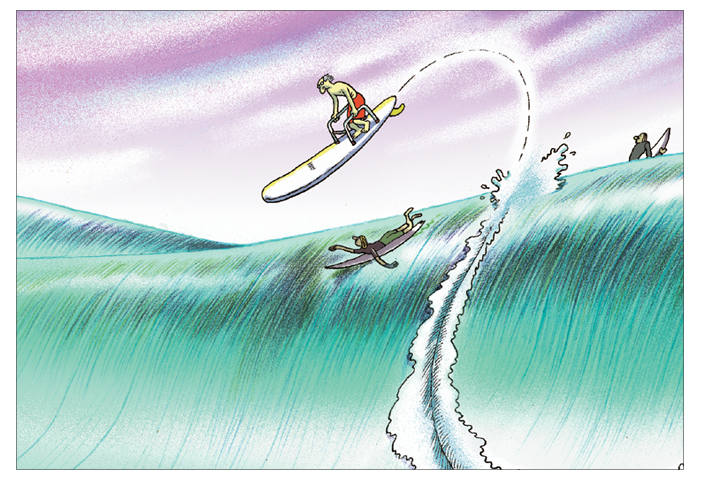
I’m going to keep an eye out for Terry whenever I’m on the waves, and I think I’ll buy more shots every few years. It’ll be interesting to see how my style improves over the rest of the 21st century, and to see how long I can keep this up:

Geezer longboard air

Besides, now that my daughter’s back in college, someone has to keep her board from drying out in the garage rack. (Sorry you can’t be there, honey, but I’ll take care of it for you.)

Back to work on the rest of these posts. (Tomorrow is going to be one busy surfing day.) I’m buffing up topics like Medicare & Tricare For Life insurance, DIY home renovations, more financial management issues for aging elders, the difference between “frugal useful” and “functional hoarding”, the personality types of retirees, and the retirement surprises that come with the first pension check. And of course starting on 12 September I’ll be blogging about “What I Did at the USAA Military Blogger Conference”.

Related articles:
Lifestyles in military retirement: surfing
Lifestyles in military retirement: learning to surf in Hawaii

Does this post help? Sign up for more free military retirement tips via e-mail, Facebook, or Twitter!

Posted in Military Retirement | Leave a comment