Extreme home improvement: DIY photovoltaic array


[Note:  Hover your cursor over the images for the metatext.]

Photovoltaic panels on a Hawaii grass shack

Local solar?

Last week’s post on photovoltaic systems presented the finances without much engineering. We had a guest post this week on more photovoltaic “rent vs own” decisions, but this post will focus on the construction. When I describe the system that we built, our choices were mostly driven by finances. Back in 2004, the goal was boosting our financial independence by spending over $16K to eliminate a $100/month electric bill. When we recouped almost 60% of that expense as state/federal tax credits, the payback became even more compelling.

Photovoltaic hardware prices have dropped by nearly an order of magnitude over the last decade. These days you can hire a solar company to achieve your energy independence at the same expense as we did in 2004: no DIY labor required. If you’re in the military then you’ll want to wait until you own your home for at least the length of the payback, but even if you’re living in base housing you may have solar. If you’re stationed on Oahu then you’ll almost certainly have sunshine powering your base home.

WARNING: A photovoltaic array operates at up to 600 volts DC, 240 volts AC, and several thousand milliamps of current. Exposed wiring can kill you before you realize you’ve made a mistake. Unless you have personal experience with electrical work, please hire an electrician.

DISCLAIMER: PV systems have to comply with municipal code and permit requirements. You’ll want to hire an electrician to help with buying the right parts and signing the right paperwork.

Another disclaimer: In most installations, you’re going to be drilling holes into (what used to be) a perfectly good roof.

So why in the world would you care about this post? (If you’re a solar engineering geek like me then read on!) If you’re a normal person with more conventional interests then you’ll learn more about why the installer wants to build your photovoltaic array a certain way.  By the end of this post you’ll either feel more confident about DIY, or else you’ll know it’s not for you.  I’ve included two more links at the end of this post on how to shop for solar panels and how to choose an installation contractor.

For the rest of this post, I’m going to assume that you’ve chosen the simplest and cheapest configuration: grid-tied photovoltaic panels that will supply your home’s energy first and then dump their excess power into your local electric utility grid. Your system also includes an electric inverter that converts the electricity produced by a panel (a couple dozen volts of direct current or DC power) into the electricity used by your local electric utility (240 volts of alternating current or AC power).

Your panels will either have microinverters (one inverter per panel) or a string inverter (one inverter for a dozen panels). Both types of inverters have their relative advantages and are extremely reliable, but you only care about the different inverters if you’re planning to expand your system for future needs.

I’m not going to clog this post with dozens of photos because it’ll really slow down the page load times. If you’re building your own system and you’re curious about a configuration, try Google Images first and then contact me for more details. I’m happy to show you what we did, but your local code may require a different configuration

Our First 1100 Watts of Photovoltaic Panels

We bought our first 20 photovoltaic panels in late 2004. (My spouse actually spotted a “classified ad” in our local “newspaper”.) The seller had owned the panels for nearly 10 years. Each panel is only rated at 55 watts (a fraction of today’s panel power), and they were mounted on heavy-duty stainless-steel angle-iron racks. He was desperate to sell and we were willing to unbolt them from his roof. We paid $2.25/watt at a time when most panels were selling for $6-$8/watt from the factory (and over $10/watt installed).

When we saw the ad, Hawaii Electric Company had just started a residential electric net-metering program. We knew that we’d need a construction permit and an electric contractor’s signature (with his license number) to obtain HECO’s approval of our net-metering application. We were about the 25th net-metering permit on the island, and today Oahu has thousands of homes with PV arrays.

We found our electrician at a small solar installation company. He was willing to check the seller’s panels with us before we bought them (for a consultant’s fee) and he agreed to show us what parts met the code to re-install them on our roof. We knew we were getting a great price on the panels, so we didn’t mind spending a few hundred extra dollars for his consulting fee and a rented U-Haul “panel” truck to haul the panels home.

The solar contractor gave us a parts list (with specifications) and we started our scavenger hunt. We found lag bolts & roof sealant in home improvement stores, and we found the wiring & connectors at an electric supply store. Our south roof is a cathedral ceiling so we were able to see the beams at the eaves and follow them up to the ridge. A careful layout with chalk lines (and banging on the shingles with a rubber mallet) helped reassure us that we kept the racks centered and parallel on the beams. Even so, I still managed to drill one hole down the side of a beam (I swear it’s warped!) so the roof sealant was essential to repairs as well as construction. We added small angle brackets to the roof bolts so that we could raise & lower the PV panel racks by pivoting them on the lower angle brackets. This made it a lot easier to wire the panels together after the racks were mounted on the roof.
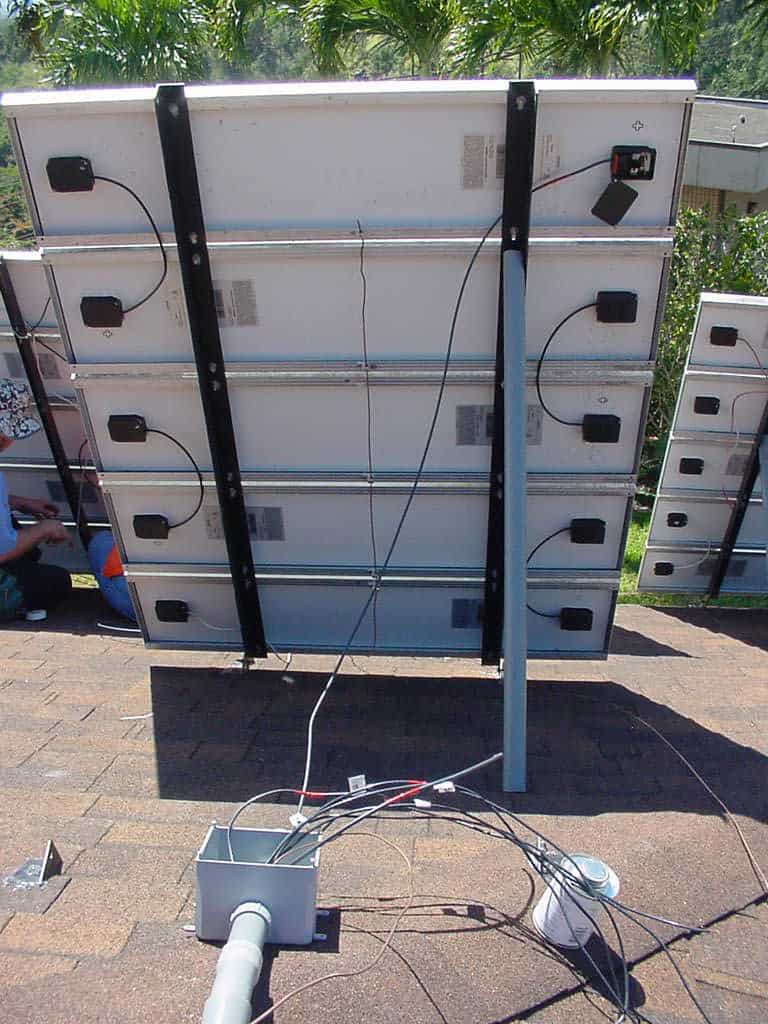
Photovoltaic panel wiring to electric junction box

Panel wiring to junction box

Wiring was a challenge. We planned to mount our inverter on the side of the house by the electric meter. (Microinverters weren’t available in 2004!) That’s 75 feet away from the panels and it goes through our garage attic. The code requires that the wires be protected from weather (and critters) by running them through PVC conduit (UV-resistant gray instead of white).

Because we planned to have the inverter control two separate strings of panels, we routed four separate wires (plus a spare wire and a ground wire) through the conduit. (Luckily we’ve never needed the spare.) We mounted a small junction box on the roof (to connect the panel wires to the conduit wires) and bolted the conduit to the roof with metal straps (hurricane defense). There’s no easy way to snake wires through 10-foot lengths of conduit inside an attic that’s only four feet high, but my labor is a lot cheaper than the electricians. They would have wanted to route conduit all the way across the roof (instead of through the attic) which would have just given a hurricane more exposed PVC to work on.

We leisurely mounted the racks and wiring for an hour or two during the cool mornings. (Financial independence made this project more enjoyable than if we’d had to take leave from work and hustle it 16 hours/day.) The electric contractor visited us a couple of times to make sure that we were on track. (He was charging by the hour for his education as well as his inspections.) By early 2005 we had the panels mounted & wired together, the wiring strung through the conduit, and we’d fixed our (minor) mistakes.

The electrician hung the inverter and connected its cables to the house’s electric distribution panel. He made it look easy but his code knowledge and experience was essential. Today I can replicate his layout (like a trained monkey) but I don’t know all the code options and I wouldn’t have been able to solve the design challenges that he met.

After the inverter was connected to the service panel, the electrician finished wiring the panels in series (up to 600 volts DC) and connected the panel string at the junction box. After a multimeter check confirmed that the panels were making voltage, he connected the last two wires to the inverter.
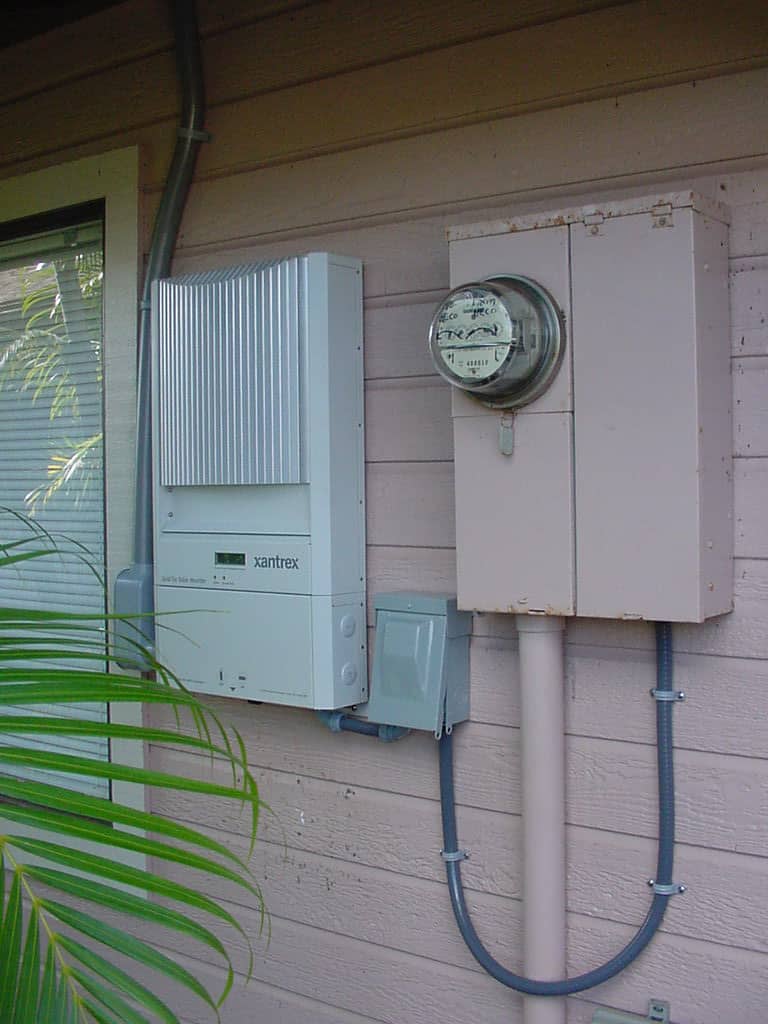
New inverter next to old analog electric meter

New inverter next to old analog electric meter

[Pro tip: if you must wire a photovoltaic panel, do the work away from sunlight or cover the panel with cardboard and duct tape. Electricians do this safely (“survivor bias”?) but it’s beyond the skill level of the average homeowner. One panel might not hurt you too badly if it turns sunshine into DC voltage, but a string of panels will endanger your life.]

The electrician flipped the switch, the inverter booted up, the sun came out from behind the clouds, our electric meter slowed down and… started spinning backwards! We were making more power than we were using, and our grid-tied system was dumping the excess power into HECO’s grid.

After a few engineering high-fives, the electrician shut off the inverter again. We paid him and he went home.

Why did he shut off the system? Because HECO still had to do their own inspection and sign our net-metering agreement.

Guerrilla solar” is technically illegal, and I wrestled with my ethics. I’ve been there before: nuclear engineers are not supposed to make our own rules, but submariners have to use their own judgment & initiative. What if the electrician made a mistake? What if the design wasn’t safe after all? What if HECO wanted something changed or re-worked?

A five-minute phone chat with the electrician reinforced my confirmation bias. He said that HECO wouldn’t inspect the entire array– they’d only check the connection to the service panel. Everything else was up to the electrician, and he’d used a standard design that was already operating in hundreds of Mainland homes.

We turned the inverter back on. I’m glad we did because it took HECO two weeks to get around to their inspection. First they actually sent a fraud/theft inspector because our electrical use had dropped so precipitously that they thought we’d sneaked an extension cord over to the neighbors or tapped into a street lamp. The electric inspector had never seen a residential grid-tied photovoltaic array before. HECO finally approved the net-metering agreement several months later.

Speaking of inspections & permits, we paid the electrician to handle the construction permit. He actually subcontracted a “runner” to stand in line at our city Department of Permits & Planning. He had already filed a standard set of pre-approved plans with the DPP staff, but it still took the runner all day to finish the paperwork. We paid a $411 permit fee (on top of the $150 runner fee). The electrician charged nearly $900 to tutor us through the mechanical & electrical code, to install the inverter, and to make the connections. He also signed the net-metering agreement (with his license number) for HECO’s approval.

Flush with success, we took our maximum state/federal tax credits in 2005.

20 55-watt photovoltaic panels mounted on a roof

20 55-watt panels

Our Second 1960 Watts

In late 2005 we found four decade-old 50-watt panels on Craigslist at $4/watt. Even better, we discovered that Evergreen Solar was selling blemished panels through eBay. The panels had broken junction wires and discolored solar cells but they had been over-engineered to still deliver rated voltage & power. I put an eBay “Buy it now” $7000 PayPal transaction (*gulp*) on a credit card to buy 16 110-watt panels. (Today’s panels are nearly three times more powerful.) It even included shipping & handling from Florida to Oahu. At less than $4/watt, the panels compared favorably to the local market’s $6-$8/watt. (Today they’d cost about 75 cents/watt.) We made more rails and brackets using scrap aluminum and mounted the panels on our roof. Following the procedure that we learned from the electrician, we wired them in series and connected them at the junction box as a second string for a total of just over three kilowatts.

DIY Solar Water Heating

Two people on the roof of a house installing a solar water heating panel

Father-daughter DIY

In early 2006 we also added a solar water heating system. We started with two 4’x8′ panels through Craigslist for $150. Their copper tubing was worth more than $75 each, but they’d been sitting in a storage for over a decade. (I was even able to trace the panel’s label plates to the California company that made them in 1976.)

As a submariner I’ve done plenty of piping flushes, fills, and hydrostatic tests so we hauled them home, flushed them, and connected them to our garden hose. I was thrilled to see them hold pressure so we hauled them up to our second-story roof and mounted them on more angle brackets. Craigslist yielded a used solar water heater & pump for $150 and we spent another $600 on materials like copper pipe, valves, a controller, the connectors, and insulation. Our 13-year-old daughter helped us plan & lay out the design and I taught her how to solder copper pipe. (Today she’s finishing her senior year of a civil engineering degree.) Our system immediately started making more hot water than we ever use.

In 2006 we took more state/federal tax credits, and in 2007 we took our final credits. Between the state/federal tax credits and Oahu’s electric rates of 30-35 cents/KWHr, the PV array and the solar water heater paid for themselves by late 2010. Sweat equity led to less than a six-year payback.

We’re frequently asked about breakdowns, repairs, and maintenance. Our solar systems have survived many hours of high winds, rainstorms and even a house-rattling 5.5 earthquake.  They were just tested two days ago by Tropical Storm “Flossie”.  The panel mounts & racks actually help strengthen the roof against hurricanes. We’ve never had a breakdown or a service interruption. If HECO goes down then our inverter (and our array) goes down too, but when HECO comes back up then the inverter reboots right away. We don’t even bother to clean the panels. If I’m on the roof for another reason then I’ll look them over, but no maintenance has been necessary. We don’t carry insurance on any of our solar hardware– just the usual homeowner’s policy with a high hurricane deductible.
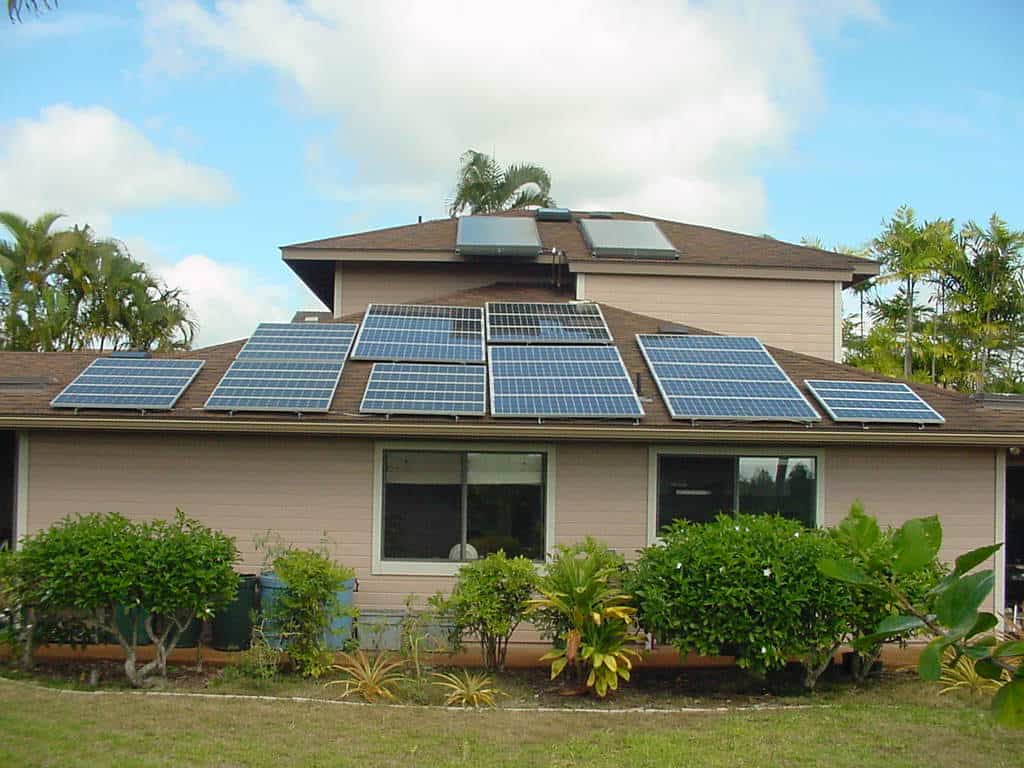
Picture of photovoltaic and solar water panels on top of a home's roof.

Photovoltaic with solar water heating

Technology has come a long way in the last few years. Worldwide subsidies (and overseas mass production) have crashed the wholesale price of photovoltaic panels to about $1/watt. The industry has also developed better roof mounts (with aluminum flashing in a choice of colors!), better rack mounts & clips, and cheaper grounding systems. Microinverters greatly simplify assembly and expansion. There are thousands of solar websites to guide you through the code requirements in your area, the permit paperwork, the tax credits and rebates, the designs & hardware, and even to share reviews of the installation companies.

The Next Step: DIY Electric Vehicle Recharging

My spouse and I are very happy with our used Priuses, and we’ll drive them into the ground. (That may take another 20 years.) We drive less than 7000 miles per year and we spend under $800/year for gas. Electric vehicles (and next-generation hybrids like the Chevy Volt) have controversial paybacks due to their higher prices. Their payback is a little faster with Hawaii’s gas prices of >$4/gallon and by finding a good used EV through Craigslist. However, the payback will be even faster when we add a few more photovoltaic panels to our array. We might have to buy a bigger string inverter or set up a separate batch of panels on microinverters, but the charging circuit and hardware are already standard. Maybe we’ll hire an electrician to help us wire them into the garage, but it might not be necessary.

Is this feasible? Yes, our neighbor has been recharging her Nissan Leaf from her house’s net-metered photovoltaic array and commuting up to 80 miles per day. Her PV array makes extra power during the day and dumps it into HECO’s grid, then draws power from the grid at night to recharge her Leaf’s batteries. Not only does she have a $17/month electric bill, but she drives nearly 8000 miles/year and never buys gasoline!

Are you considering your own photovoltaic array or solar water heating system?  If DIY is not for you, then read this article from Scientific American on choosing an installation company and this article from Business Week about shopping for solar panels.

Related articles:
Extreme home improvement: the finances of your residential photovoltaic array
Guest Post Wednesday: The bright side of solar power purchase agreements
DIY home maintenance
DIY home improvement
Lessons learned from DIY home improvement
Scientific American: “How to shop for solar array installers”

Posted in Money Management & Personal Finance, Mortgage & Real Estate | 4 Comments

I’m Still a Tricare Delinquent


[As this post goes live, Tropical Storm Flossie is approaching the Hawaii islands.  It’s borderline hurricane strength, and despite that wussy dental name it’s still going to dump 6-10 inches of rain on us. It’s quite possible that Oahu electricity & Internet will go out. My tiny little share of a Bluehost server is on the Mainland and I have the blog loaded up through Monday 5 August, so the posts should keep on coming in autopilot. I may not be able to respond to comments and e-mails, or moderate the spam, but I’ll get back online when I have power and bandwidth.

No worries. My spouse is a meteorologist and a (retired) military emergency preparedness officer. We’ve been through Hurricane Iniki and several near misses over the last two decades, and we have a good hurricane readiness checklist. We’ll be hunkered down inspecting the waterproof integrity of Hale Nords and– when the power goes out– partying like it’s 1799.]

A couple of months ago I posted a rant about the fumbling transition of the Tricare Western Region contract from TriWest to UnitedHealthcare. I never expected that anyone could make TriWest look good, but UHC is compelling me to reconsider my opinion. Since that post went up, other unhappy readers have shared their stories in the comments.

When we wrapped up my last cliffhanger episode post, UHC had admitted that they’d messed up my March request (and my April followup inquiry) to deduct their monthly fees from my checking account. They couldn’t catch up on the deductions for April, May, or June, so we decided that I’d charge those to my credit card. In return, they agreed to process my original electronic funds transfer request to start in July. They read back my credit union’s routing transaction number and my checking account number and confirmed that they were all set.

By the middle of July, UHC had still not managed to deduct my premium payment from my checking account.

A week later, I received the following UHC form letter in the postal mail:

“Dear Tricare Beneficiary:

Thank you for entrusting your healthcare needs to UnitedHealthcare Military & Veterans. Due to your Electronic Funds Transfer or Reoccuring [sic] Credit Card payment method being returned or rejected, a balance of $134.64 is now due on your account. This balance includes a $20 administrative fee for your returned payment.

[…payment instructions and enclosed forms…]

If payment is not received by the end of the calendar month, unfortunatley [sic] you will be disenrolled from your Tricare coverage.

We are grateful for the opportunity to serve you.”

This was my first notice of that problem. Navy Federal Credit Union had not complained about my EFT. It took UHC nearly two weeks to generate that letter (and another week to snail-mail it to Hawaii). Their website has my account information, including my e-mail address and phone number, but apparently, they couldn’t figure out a faster way to let me know about the problem.

I called UHC’s toll-free number and slogged through the computer menu. When a human came on the line, I asked her to review my file to get up to speed on the problems stretching back to April. When she agreed that I was still delinquent (and about to have my coverage cut off), I asked her to transfer me to a supervisor so that we could have more power to fix their problem. She told me she wasn’t sure that she had a supervisor available, but one might be able to call me back within 24 hours. I asked her to inform a supervisor that I was wondering if I should file a second grievance with Tricare. Maybe my request wasn’t strictly necessary, let alone appropriate, but a supervisor was on the line within five minutes.

Once we confirmed that the supervisor could see all the problems in my file, I asked her what caused my credit union to reject the EFT request. She said that the error was “Account number does not match“. I asked her to read back the RTN and account number.  Yep, UHC’s staff had somehow entered one digit incorrectly.

Further research confirmed that I’d given UHC the correct numbers, so they obligingly removed the $20 fee. I gave them another credit-card charge for $134.64 to cover the premiums for July, August, and September. The supervisor agreed to set up the EFT to start in October (nearly seven months after my original request). We once again “verified” that UHC had the correct checking account number (and this time they really mean it).

The good news is that the supervisor has promised to personally check on the EFT in October, and she’s given me her direct phone line to call if there’s a problem.

The not-so-good news is that UHC has screwed up this seemingly simple transaction at three separate times with three separate teams. It’s cost them far more in corrective labor than they’d ever be able to earn from my premiums. I’ve been required to enter 21st-century data on their IT systems, yet they’re still communicating with me via 19th-century paperwork.

Maybe the third fourth try will be the charm. I’ve added “UHC Tricare” on my blog’s October editorial calendar. Stay tuned for the exciting conclusion to this suspense!

Let me be clear that these complaints are not about Tricare. I’m quite satisfied with the quality of the medical care. I’m certainly happy that I’m paying such a low fee compared to civilian retiree healthcare costs. However, it’s frustrating to see Congress and SECDEF complain that military personnel expenses are out of control when there’s so much inefficiency in a simple turnover between contractors.

I hope that those of you who commented on the last Tricare post have been satisfied with UHC’s corrective action. If not, consider downloading the Tricare grievance form— and please let us know how it works out!

Related articles:
TRICARE Prime premiums and United Healthcare

Posted in Insurance | Leave a comment

Extreme Home Improvement: The Finances of Your Residential Photovoltaic Array


A reader writes:

I remember reading somewhere that you had installed solar panels onto your house yourself. You mentioned that you were able to do it in cheap enough that the initial outlay of cash was completely covered by tax rebates.

My husband and I just moved to California. Out here it is really popular to “rent” solar panels. We would much rather “own” them. I was hoping you could walk me through the process you used. I know times have probably changed a little with costs. Hoping your experience could be a starting point.

Most people think our money-saving methods, are crazy (why go to the extra work when you can rent them :)). Therefore we can’t really pull from our friends experiences for this questions :)

A photovoltaic array will accelerate your goal of financial independence, but it’s a challenge to install. I’ve written about this on several different forums over the years, so let me summarize it here. I’m going to do this in two posts: one for the finances and another on the mechanical/electrical construction.

By the way, even military base housing neighborhoods are adding photovoltaic arrays. Many bases in the southwest and Hawaii have installed solar water-heating and electricity-producing systems. Schofield Barracks on Oahu has one of the nation’s largest photovoltaic neighborhoods, with over a thousand homes on solar power and more on the way.

Reduce your consumption (and your electric bill)

The first step in going solar is an energy audit of your home’s power consumption. It’s always easier to reduce your electric consumption than to raise your production. Before you go photovoltaic it’s far more cost-effective to install solar water heating, wall insulation, rooftop reflective foil insulation, multi-pane low-e tinted insulated windows, and EnergyStar appliances. Maybe in some climates you can reduce air conditioning in favor of passive cooling. Rebates and tax credits may be available for these residential home efficiency improvements from your local utility, your city, your state, and the federal government.

Picture of photovoltaic and solar water panels on top of a home's roof.

Photovoltaic with solar water heating.

Grid-tied, not off the grid

Most residents dream of having unlimited power and no electric bill. A few fantasize of “firing” their utility company and maybe even having electric power after an earthquake or a hurricane. However, there’s a price to pay for going “off the grid”, and the engineering is expensive.

The resulting lifestyle is also not quite what most homeowners expect. When you’re off the grid, there are limits to the size of the household appliances that can be run on the system as well as the total electric load. You don’t want your family to start up a vacuum cleaner while your DVR is recording a show or your computer is trying to save the text of your next blog post– the transient voltage fluctuations can kill your sensitive electronics.

Residential photovoltaic companies offer a slightly scaled-back version of the dream: a “grid-tied” system. You still produce your own power, but you still have to work with the local electric utility. You have a (very small) electric bill but you enjoy the electric company’s backup power (at night or on rainy days) and rock-steady voltage. Your lifestyle doesn’t have to change, either, except for the part where you pay almost nothing for your monthly electric bill. Unfortunately a grid-tied array design still means that if your electric company goes down then your PV array shuts down too, but the system is much simpler and (here’s the good part) much cheaper.

The vast majority of residential photovoltaic solar systems are grid-tied, not off the grid, and the designs are very different. A grid-tied system is essentially connected to your local electric utility through your meter, and it only produces energy when your local utility is working. (Your PV voltage inverter needs the grid power to turn on and to convert the panel’s DC voltage to your house’s AC voltage.) An off-the-grid system is completely disconnected from the local electric utility, so it uses a bank of storage batteries and a charging system for those times when there’s not enough sunlight to power your house.

You want a grid-tied system because it’s a lot cheaper, it’s simpler to install, and there’s no maintenance. You’ll still have an electric bill but it will be close to zero.

Your financial challenge is buying a PV array of just the right size: enough to generate all the electricity you’ll need throughout the entire year. You want to generate just as much as you use. (You don’t want to generate too much extra because you won’t be compensated for it, as I’ll explain in a few paragraphs.) You figure out your array size by reviewing your electric bills and then using a photovoltaic calculator website to decide how many panels you’ll need. A typical residential PV system is between three and eight kilowatts, or (with today’s technology) roughly 10-25 panels.

Net metering, not wholesale

Your local electric utility may also credit your PV production at the retail rate. Some utilities offer residential customers a “net metering” program: you’re only charged when you use more electricity than you produce. During the day you’ll generate dozens of kilowatts from your PV system, use a few of them to power your house, and dump the remaining energy straight into the utility’s grid through your electric service panel (and your electric meter).

At night your PV system goes offline, or on cloudy days you might use more electricity than you produce. When that happens your house simply sucks energy from the electric utility’s grid to supply your needs. (It seems like magic, but electrical engineers design the system to let power move to wherever the voltage is lower.) Your electric meter keeps track of which direction the kilowatts are moving: either out to the grid or from the grid.

At the end of the month the utility reads the meter and sends you a bill. If you used more power than you produced then you pay the electric company. If you generated more power than you consumed then they credit your account. The price is the same whether you’re producing or consuming, and you’re only charged for the “net on the meter”.

Oahu’s electric utility charges ~$16/month just for the privilege of staying connected to their grid. Hawaii’s islands make undersea electric cables too expensive, so each island is its own isolated electric grid and we’re stuck with the benevolent dictator monopoly. Oahu electricity costs 30-35 cents per kilowatt-hour and people have $150 electric bills even without air conditioning.

The “good” news is that HECO credits residents the same retail price for production as we’d pay for consumption, which is a much better deal than being a commercial electricity wholesaler. They’ll also credit our excess power production on our account for up to a year, so we can generate extra power in the long summer days to make up for our lower production during the shorter winter days.

Some electric utilities use different rates for consumption and for production. They’ll sell you electricity for a dime per kilowatt-hour but they’ll only buy your excess for a nickel per kilowatt-hour. This power purchase agreement is not as sweet as net metering, but it’s better than no PV array at all.

Electric utilities are generally required to buy power from wholesale electricity producers, but they’ll negotiate the PPA rate. Most residents could hypothetically cover their roof with PV panels and generate far more power than they consume (during the day, anyway).

Unfortunately, if you have more panels than a typical residential system (~10 kilowatts) then the electric company may decide that you’re a commercial wholesaler instead of a retail customer. You’ll not only get paid a lot less for wholesale production than you’re charged for residential consumption, but you’ll be subject to additional “feed-in tariffs” and power producer fees. In effect, you’ll sign a wholesale PPA with the electric utility, and they’ll treat you like just another wholesaler.  It’s better to stick with a residential net-metering agreement.

Expenses and tax credits

I may have given the reader the wrong impression about tax credits. We built our PV array very cheaply from a combination of used & blemished panels and do-it-yourself labor, but the tax credits are based on a percentage of the price. You can look up your state, local, and utility credits on the Dept of Energy’s Database of State Incentives for Renewables & Efficiency. Hawaii’s state residential PV tax credit is limited to 35% of the total price or $5000, whichever is less. The federal personal PV tax credit is limited to 30% of the total price.

We built our PV system in three stages (three separate years of tax credits). Between 2004-2007 we spent a total of $15,682 for 3350 watts of panels on a single inverter. (We also installed a solar water heating system for an additional $920 of used parts and DIY labor.) We managed to take a total of $9376 in tax credits, and by late 2010 we’d generated enough power to repay the remaining $7226. We’ve enjoyed free electricity since then, and our elderly panels will probably last until at least 2030.

We produce about 250-350 KWHrs per month (lower in winter, higher in summer) at a net-metering rate of about 30-35 cents/KWHr. That saves us $75-$120 per month, which is a great annual dividend on the cost of the array.

As you can tell, our consumption is much lower than the average American home. Solar water heating eliminates about a third of the average family’s electric bill. Our south roof is insulated with foam and reflective foil (to keep the heat out) and our south/east walls are insulated with reflective foil and recycled shredded denim batting. Our windows are either shaded from the sun or double-pane tinted low-e glass.

We own EnergyStar appliances (bought used from Craigslist) and our main ceiling fans are EnergyStar special oversized DC-drive models. We do not have heating or air conditioning (e komo mai Hawaii!), and we only use our clothes dryer for about half of our laundry. (The biggest electric load in our house used to be our teenager, and now she’s away at college.) The energy-efficiency improvements made a huge difference. The house is comfortable all year long, even in September heat when the tradewinds die down. Frankly, in the winter it’s a little chilly: we have to close the windows at night and wear pants & long-sleeved t-shirts for a few hours in the morning.

Today’s PV arrays are much cheaper than when we started building our system in 2004. Worldwide subsidies and mass production have crashed the manufacturing costs and the industry is consolidating. Most panels are about $1/watt wholesale and their efficiency is maximized with microinverters (one DC–>AC inverter per panel). The designs and equipment are standardized across the industry and PV companies are familiar with residential electric & construction codes. Installation workers are equipped with special-purpose tools and trained to quickly & efficiently mount racks and panels. Today’s PV business is a commodity with thin margins, and a company’s revenues depend on installing as many systems as possible as quickly as possible. Sales teams have to give up some profit to reach a higher sales volume and undercut the competition.

However, the finances are still a problem. A low-end 3000-watt system can cost $15,000-$20,000. Only about half of Americans own their homes, and landlords aren’t eligible for residential tax credits. The average American family moves every seven years, so very few homeowners are willing to invest in solar power because they don’t know how long they’ll live there. Home sellers don’t get full value for their systems if they move after installing them because solar power is still an exotic product and home buyers aren’t willing to pay the extra money.

“Free Solar”?!?

Americans may be happy to finance a $30,000 pickup truck– but they aren’t willing to buy a PV system. Because of this marketing challenge, PV installers are becoming finance companies. They’ll offer cheap loans and extended payments to homeowners, but that’s still not as attractive as remodeling a kitchen or adding a spare bedroom. Their most effective sales tactic has been “Free solar!”

The “free” PV system isn’t really free: the homeowner is just renting it from the installer. The installer is buying larger volumes of panels and equipment, so they can negotiate wholesale discounts with the solar suppliers. Their installation crews stay busy so their margins improve. The installer gets the residential tax credits or writes off the equipment as a business expense, and they can even negotiate lower permit fees with the local authorities.

The result is that the PV installer assumes all the “risks” of ownership while the homeowner gives up all the credits and payback benefits. The homeowner doesn’t have to save up the cash to buy a system, and they don’t even have to take out a home equity loan. They just offload most of their electric bill and lock in a lower fixed expense for the life of the PPA. It’s the same math as leasing the pickup truck instead of buying it and driving it into the ground.

Should You Insure Your Photovoltaic Array?

If you decide to “rent” your panels through a PPA with a solar company, then let them handle the insurance.  It’s their job to make sure that your array is running reliably, and that includes disaster recovery as well as the usual wear & tear.  They’re taking all the risks– not you– and insurance is their problem.

If you buy your system, then consider your exposure.  The racks are bolted to your roof beams (or to your metal roof seams) and the panels are bolted on to the racks.  Both components are rated at hurricane-force winds, and the panel cover glass is even rated for hail impact.  The electrical wiring and the inverter(s) aren’t affected by hurricanes or hailstorms because they’re out of the direct weather.  If they have an electric fault or even if there’s damage, they’ll simply shut down.   The “protective layer” of panels above your roof may help shield your existing shingles from weather and erosion, and it’s extremely unlikely that weather would damage every single panel.  The likely “disaster” would be cracked cover glass, and that’s a cheap repair.  Most hurricanes and hailstorms would cause less damage to your photovoltaic array than your insurance deductible, and it’s not worth filing a claim.  I wouldn’t even ask the insurance company for a quote.

We don’t insure our panels, and we carry a very high deductible for our home’s hurricane insurance.  Our photovoltaic array and our solar water panels have been through many torrential downpours, several days of high winds (gusts to 70 MPH), and even a 5.5 earthquake.  No damage.  We’ve lost more shingles on other parts of the roof (especially the ridges) than around the array.

In my next PV post, I’ll talk about the mechanical and electrical considerations for installing an array. Spoiler alert: the electrician showed us how to do all the mechanical work, and we paid him for the initial electric connections. When we expanded the array, we just connected the new panels to the ends of the strings of the existing panels.

Related articles:
DIY home improvement
Lessons learned from DIY home improvement
Save money by fixing your own plumbing
Book review: “Abundance”

Posted in Mortgage & Real Estate | 8 Comments

“I’m in the Military and I Just Got My Degree! Now What?”


[Note: This reader’s question has been edited to preserve their anonymity, but the subject also applies to just about any military specialty. If you have a similar story then we’d like to read it too!]

A reader writes:

I stumbled on your site and was excited to read what you had to say about military retirements.

I am a 13 year active duty, enlisted, veteran. I left active duty in 2011 in pursuit of my masters in my military specialty. My intent was to commission in that specialty but without luck. Don’t fear…I didn’t lose any of my service because I joined the Reserves.

Since the commissioning in that field isn’t in the cards, I’m faced with a difficult decision. I’m blessed to say I have a few options; however, I cannot decide which is more advantageous for my family.

Options:

  1. I have a chance to return to active duty but back into the career field I loathed. I’d keep my rank and return to active duty status. I’d be six years and a few months away from retirement but really wouldn’t use my masters. I’d still be running the mission, but nothing like I’d probably do on the outside.
  2. I could cross-train back into enlisted as a contracting specialist. The two negatives I can think of are the deployments are brutal and I wouldn’t be using my degree for six years. By the time I got out, I’d have to relearn my field because things change so much.
  3. I could go the federal civil-service route and try to commission in the Reserves–which is a good possibility. This option seems right but also seems like I leave a lot of money on the table.
  4. I could go civil service and stay enlisted. If it got to this point, I would just return to active duty.
  5. I could go private sector and do Reserves but this would negate all the service time I had completed.

As you can see, I am a lucky man. I have lots of good options but cannot, for the life of me, figure out which to select and feel confident about. Yet, at the same time… it seems like I’m not living the way I should and more living for tomorrow. I’m only 34, yet it seems like I’m living with a “means to an end” attitude. That can’t be healthy. Yet, I have a family to care for and want the best for all of us.

My spouse is making good money, and we have little debt. This means I don’t have some of the same issues as my peers have when making these tough decisions.

If you were in my boat, which would you choose? I won’t hold you to anything, but I just want to know what someone who understands the system would do because I don’t understand every nuance of the federal system, nor do I have any one to ask.

Anything you could provide would be much appreciated!

Congratulations on your advanced degree! College was a good call– I wish I’d had the guts to pursue something similar when I was at 13 years. I think you’re ahead in the third quarter by 21 points, and now it’s just a question of how much you’re going to run up the score on your way to winning the game.

My first thought is that you should consider your response if you’re ever contacted again about that particular commission. You know better than me whether they’ll ever change their decision, but I’ve seen more surprising things happen during a drawdown. Retention plunges, policies get reviewed, and you might get another opportunity. It’s worth working through your feelings now so that you’re not ambushed by a program change later. Move on and don’t wait for the rules to change, but take a few days to think it through.

Next, I think you still have a master’s degree in “lifetime employment”. Some agency or company, somewhere, needs you to solve their problems.

Your option (1) speaks for itself. If you loathed that field before you got your degree, then you’re going to loathe it even more when you go back. Six years is an awfully long time to clench your jaw and gut it out, and in the process you’re quite likely to harm your health and your relationships with your loved ones. I doubt that you’d feel inspired to turn in the effort and performance that would get you good evaluations, let alone promotions and an eventual active-duty retirement.

Your option (2) doesn’t seem to offer many benefits either. As Malcolm Gladwell says in “Outliers“, you want to find work that’s fulfilling and complex. A degree of autonomy would be just bonus.

Let’s combine the assessment of options (3), (4), and (5). You should definitely pursue a Reserve commission in just about any field. (Consider National Guard and Air National Guard as well as the other services because they may have units closer to your home.) You already have 13 years toward a military pension, and you’ll get a lot more for that pension if you do 8-10 years of commissioned service. Even if it’s “just” a Reserve pension, it’s more than money. You’ll have an inflation-fighting annuity that will cover at least a portion of your expenses (starting at age 60 or possibly a bit earlier) and Tricare (at age 60). Inflation and healthcare are two huge concerns of every retiree, and you’ll address them both with a Reserve career.

Whatever field you commission in, explore your choices for active duty. I know many servicemembers who’ve left active duty for the Reserves (most of whom have earned a commission in the process) and they’ve taken control of jump-starting their own careers. If you return to active duty then you’ll earn an officer’s military salary & benefits as well as a pile of Reserve retirement points. If you manage to get to 18 years of active-duty service on a set of Reserve active-duty orders then you’ll enter “sanctuary” and you’ll be eligible for an active-duty retirement. It’s rare but it could happen. Sanctuary would be great, but the real Reserve/Guard rewards come from the possible promotions (along with the wages & benefits) along the way to the Reserve/Guard pension.

While you’re pursuing a Reserve commission, continue your career search in both the private and federal civil-service sectors. Civil service may be a lower salary but it’s a higher degree of job security and (in many cases) a much higher quality of life. Civil service also offers you a better chance of balancing Reserve duty and they’ll treat you better when you’re mobilized. If you’re interested, I know a military retiree in the VA who would be happy to discuss your options with that agency.

But if you feel that the GS option gives up too much potential earnings (and savings) then you should pursue a civilian career. You can always strive for balance with the Reserves (whether that’s a mobilization or going IRR) and your military experience will serve you well on the civilian side.

If it turns out to be too difficult to balance civilian or civil service work with the Reserves/Guard, another option would be a GS job where you could “buy” more of your civil-service pension with your military service credit. It’s generally a good financial deal, but this takes a significant chunk of your money. You can read more about federal civil-service rules and Reserve duty at GubMints.com, whose owner is a Navy veteran in the federal civil service.

Providing for your family can seem like a heavy burden, but kids don’t understand that until they’re nearly adults themselves. It’s also great that your spouse can help carry the financial load. If you had a choice of “more money” or “more family”, then I’d spend more time with family. Kids don’t need more of your money (despite their protests), but they appreciate having more of your time.

So… go Reserve or Guard and get a commission from whoever will give you one. While you’re doing that, get a job with whatever seems like a good work/life balance. Don’t just leap on the first offer but rather consider the quality of life and the benefits as well as the salary. Use your professional & military networks as well as your Linkedin contacts. Show your employers how you can solve their problems while enjoying what you do.

And please let us know what you decide to do!

Related articles:
Starting your bridge career after the military
Guest Post Wednesday: “My Road to a Reserve Retirement”
The transition to a bridge career
Military experience to civilian careers
Should you start a civil service bridge career after the military?
5 Ways to Ease the Transition from Military to Civilian Career
Guest Post Wednesday: From Battlefield to Boss– MBAs for Ex-Military Personnel

Posted in Career | 2 Comments

Divorce And A Military Reserve Pension


A reader writes:

My husband was commissioned after ROTC in August 1966, placed on an educational deferment, and did not start active duty until February 1968. How many retirement points did he earn over that period and where is a regulation that addresses this?

After some more questions, I learned:

The time from commission to active duty had no drills or other kinds of services. He was in the Air Force and commissioned after summer training following ROTC.

I have no access to any of his papers. I know that in Sept 1973 he resigned a regular commission and was on Reserve duty until I believe 1995. I know that not all of his years were good years and the reason for his retirement from Reserve duty is that he was a lieutenant colonel and did not receive promotion within a given time frame. I think that he may have retired with 20 years of service.

What I am most concerned about is if any points for retirement were accrued during those 18 months of his educational deferment. It has to do with pension for me as an ex-spouse.

Before I discuss the answers, let me confess that I’m not an expert on all military programs & benefits. I learned a lot during 20 years of active duty, but I’ve mostly figured out where to find the references. Admittedly it’s a huge advantage to be married to a military spouse who has another quarter-century of experience from her own active-duty and Reserve units. I’m also getting pretty persistent skilled at picking the right keywords to enter into Google. I tried all of that for this reader’s question, of course, and came up empty.

My biggest resource (by far!) has been the contact network that I’ve developed over the last decade. It launched when over 50 servicemembers & veterans volunteered to help write “The Military Guide“. It accelerated when USAA invited a bunch of bloggers to their headquarters. These days it gains even more altitude through other blogs, FinCons, paperbacks & eBooks, blogger Facebook groups, Linkedin veteran’s groups, e-mails, and other networking.

At first this reader’s question stopped me in my tracks. I won’t tell annoy you with what I was doing in 1966, but let’s just say that the military was the furthest thing from my mind. I’m familiar with programs from the 1980s and 1990s, but even Google splutters out on military references before then.

I started looking through my network, and I eventually remembered that we servicemembers & veterans have a secret archive: veteran’s organizations. Whether they’re online or at a chapter in your neighborhood, you can probably find someone who knows someone who remembers how it used to be… and (this is the important part) where to find the reference.

For example, my father’s DD-214 shows that he did his compulsory service in the 1950s Army with recruit training followed by three months in armor school. (I remember him telling me that the highlight of his service was staying up one night to guard a tank.) However, this young private had also finished an electrical engineering degree and was hired by Westinghouse to help build electric plants & grids. After he completed his armor school he was granted a deferment, transferred to an Army Reserve unit, and immediately went into the Individual Ready Reserve. I don’t think he ever wore his uniform again, and he completed his obligation in the mid-1960s.

Another local friend completed his college degree through ROTC and served in the Army during the same years as our reader’s spouse. He confirmed for me that her spouse would have completed ROTC and been commissioned as a 2LT. His educational deferment meant that he would have spent the entire time in the IRR completing his degree. He was an officer without any Air Force specialty training schools so he would not have even had to muster for drill weekends, let alone any active-duty orders or correspondence courses. He would have earned zero points during these 18 months before starting his active duty obligation.

Unfortunately, it’s a completely different challenge to find the references for these programs and to verify an ex-spouse’s service record. However, it might not be worth the time or money, so let me describe a few ways to do her own research before deciding whether to seek professional help.

First, an ex-spouse could hire a lawyer with experience in military divorce: someone who knows military benefits and the acronyms & jargon and how to read old service records. The lawyer could subpoena the ex-spouse’s service records to verify their point count. Another option would be for the lawyer to subpoena the ex-spouse’s pay & point-count records with the Air Force (or now with the Defense Finance & Accounting Service, or the record archives in St. Louis) to verify his pension calculation. I doubt that the verification would be worth the thousands of dollars of legal fees.

Second, she could talk to a local chapter of a veteran’s organization. Someone in their membership would have been in the service during the same time (like my friend), perhaps even under the same ROTC educational deferment. They’d know whether an ex-spouse would have earned any points.

Other research options include national groups like the Military Officers Association of America, the “divorce” category of the Military Money section on Military.com, the Disabled American Veterans, or TogetherWeServed.com. Service groups like the Association of the U.S. Navy could also help with specific programs. I’m not aware of any public websites that archive old military regulations or instructions (please contact me if you know of one!) but one of those organizations may have their own databases. The sidebar of this blog has more links to consider, and I’ve included more resources at the end of this post.

Here’s the practical reason that our reader might not care to invest any further effort in the research. Her ex-spouse served roughly five years and seven months on active duty, and that counts as roughly 2035 points. Then he spent the next 20+ years earning 15 more good years. Unless he spent a lot of time on Reserve mobilization or other active-duty orders during that 20 years, he probably earned about 50-75 points during each of his 15 good years. Let’s call that an average of 60 points per year (which is pretty generous, even by today’s standards) or another 900 points. That means when he retired as an O-5 he had roughly 2935 points. (Most Reserve officers retire with between 2500-4000 points.) Under the rules in effect in 1995, his service multiplier is roughly:

2935 / 360 * 2.5% = 20.38%.

In other words, he’s entitled to about 20% of his pay scale.

From his college graduation date, I’d speculate that he was born around 1945, which means that he’d start collecting his pension at age 60 in 2005. When he retired in 1995, the rules in effect back then said that he’d retire at the “Final Pay” system. His pension would be a percentage of the highest pay scale in his retirement rank from the pay tables in effect for the year he turns age 60:

O-5 pay topped out at $6,997.50 in 2005, so his monthly pension would be:

$6,997.50 * 20.38% = $1426/month.

If she split that with him then her share would be $713/month.

Now let’s go back to those 18 months in 1966-68. If he was in the IRR during that time, he’d have to get a certain number of points to earn a “good year”. (However, he was on an educational deferment, so he didn’t have to earn any points at all and would have been just carried on the books until he was mobilized in August 1968.) Let’s say that the worst case was zero points, and the best case was 75 points.

If he earned 75 points during those 18 months (and from what we’ve learned so far, I highly doubt he did) then his point count would go from 2935 points to 3010 points His pension would be

$6997.50 * [(3010 / 360) * 2.5%] = $1462.

Her share would be $731/month. It rises by $18/month or $216/year.

And again, the educational deferment meant that he almost certainly earned zero points during that time. The actual pension amount is probably closer to $1426/month. Even if her ex-spouse earned some points during 1966-68 it might not be worth the time, hassle, and legal expenses to track down.

Related articles:
Military retirement and divorce
Military insurance: SGLI, VGLI, SBP, and other benefits
Veterans Benefits Network
Court citations from Disabled American Veterans archives
(That link opens a Word document of legal citations for veteran’s benefits.)
The “divorce” topic category at Military.com’s Money section
DOD FINANCIAL MANAGEMENT REGULATION 7000.14-R
(Military retired pay policy & procedures dating back to the 1930s)

Posted in Military Life & Family, Military Retirement | 9 Comments