Just write it.


I’ve only been blogging for 13 months, but I’ve been writing on deadline for over three decades. Many of you servicemembers are keenly familiar with the system of “liberty-dependent routing” for point papers, requests, or other paperwork. But otherwise, you might find it difficult to write– especially on your own time.

You’d think that my years of experience (and a published book!) would have given me quite a bit of advice for us writers. Imagine what I could share to inspire us to all write more productively and efficiently. How could all of my hard-earned knowledge help us overcome writer’s block?

Well, you’re going to want to sit down for this advice:

Just write it. Stop whining and start typing.

Yeah, I didn’t like hearing that either. But I’ve spent a significant portion of the last five years reading what even more experienced authors have learned about writing and publishing, and that’s what works.

Sure, there are plenty of ways to “unleash your inner muse” and “unlock your creativity“:

  • Carry a notebook to record your thoughts. (This is a great party trick.)
  • Join a support group like WordPress’ “PostADay” challenge.
  • Doodle whenever you’re on phone hold or standing in line.
  • Take photos of your day and refer back to them for inspiration.
  • Create a clean, uncluttered room (good luck with that) to inspire you to write.
  • Block out quiet time every day to write.
  • Try tricks that worked for a favorite author. (Except for the alcohol & drugs.)
  • Set a kitchen timer and write anything for three minutes.
  • Use WordPress’ “distraction-free writing” utility.
  • Browse other blogs. (Better set another timer for this activity!)

The funniest (but probably apocryphal) writing advice I’ve ever read:

“A therapist told a struggling writer to get down on his knees in front of the computer, close his eyes, and pray to write the world’s worst sentence. Then start writing.”

Gosh, I don’t even have to pray to get that result.

Just write it. Sit down, open a blank document, and write whatever title is in your head. Ask a question. Add an opinion. Then write down phrases for an outline, or get on the Internet to search for links. When you have a dozen separate tabs open on your browser– and your third Google search screen– then you probably have enough.  Step back and take a deep breath. Now you really have something to write about, and all that’s left is fitting the words together.

All right, all right, maybe I do a little more than that. When I’m surfing the Web I’ll make notes on a “blog topics” document and just cross out the subjects after I write about them. Searching through that always produces a new idea, or at least an encore. The last financial book I’ve read is good for a thousand-word review. My spouse sends me e-mails titled “For the blog:“.  I’ll comment on a discussion board thread and realize that I’ve just written three-quarters of a blog post. But while those techniques certainly make me more efficient, they don’t always get me started.

A few mornings I’ll awake with an idea and start writing in my head while it’s still on the pillow.  I have to get up.  It’s dark out, the neighborhood is silent, the computer is booting, and the coffee’s still perking.  As soon as the screen brings up a blank document, I’ll start writing down the words. I won’t even read e-mail– I’ll just remind myself to check it in 20 minutes. That’s usually good for an hour.

But most mornings I’ll start the coffee, the computer brings up the blank document, and I’ll think “Ooh, look– Windows Solitaire!”

That’s when I have to remind myself: Um, no. Get yourself under control. Just write it. You have a deadline. Work on that for 20 minutes and then play the solitaire. Or reward yourself with that new library book.

Golly, I wish I’d had this personal discipline when I was in college. I could’ve made something of myself and retired early— uhm, never mind, bad example. But I would have avoided a lot of painful procrastination and self-imposed guilt.

When I was writing in the military, I always wondered if there was a better way. I was perpetually seeking the secret formula, the magic inspiration, the five-step checklist. After nearly a decade of retirement research, now I know what I probably suspected all along: the only way to get started (and get better) at writing is to do more of it.  Just write it.

This nugget of sophisticated introspection is what happens when you’re financially independent and don’t have to rush off to work: you have the time and the energy to get things together, to fully address the question, and to find your solution. If you’re still working toward FI, then I hope these 800 words help you find the shortcut to your own solution.

Writers write.

Now go write.

Related articles:
“So, Nords, how did you start blogging?”
Writing and publishing

Does this post help? Sign up for more free military retirement tips via e-mail, Facebook, or Twitter!

Posted in Entrepreneurship | 2 Comments

DIY home improvement


It’s Monday and many of you are probably at work wishing you were out surfing.  If you’re stuck in a quiet air-conditioned office, then let me put up an eye-candy post that’ll make you glad to be sitting there.  Sorry, no surfing scenes– this will be noisy & sweaty demolition and construction.

This post started out as “frugal budget home improvement” but with the changes (and surprises) it’s rapidly becoming “What do you DO all day?!?

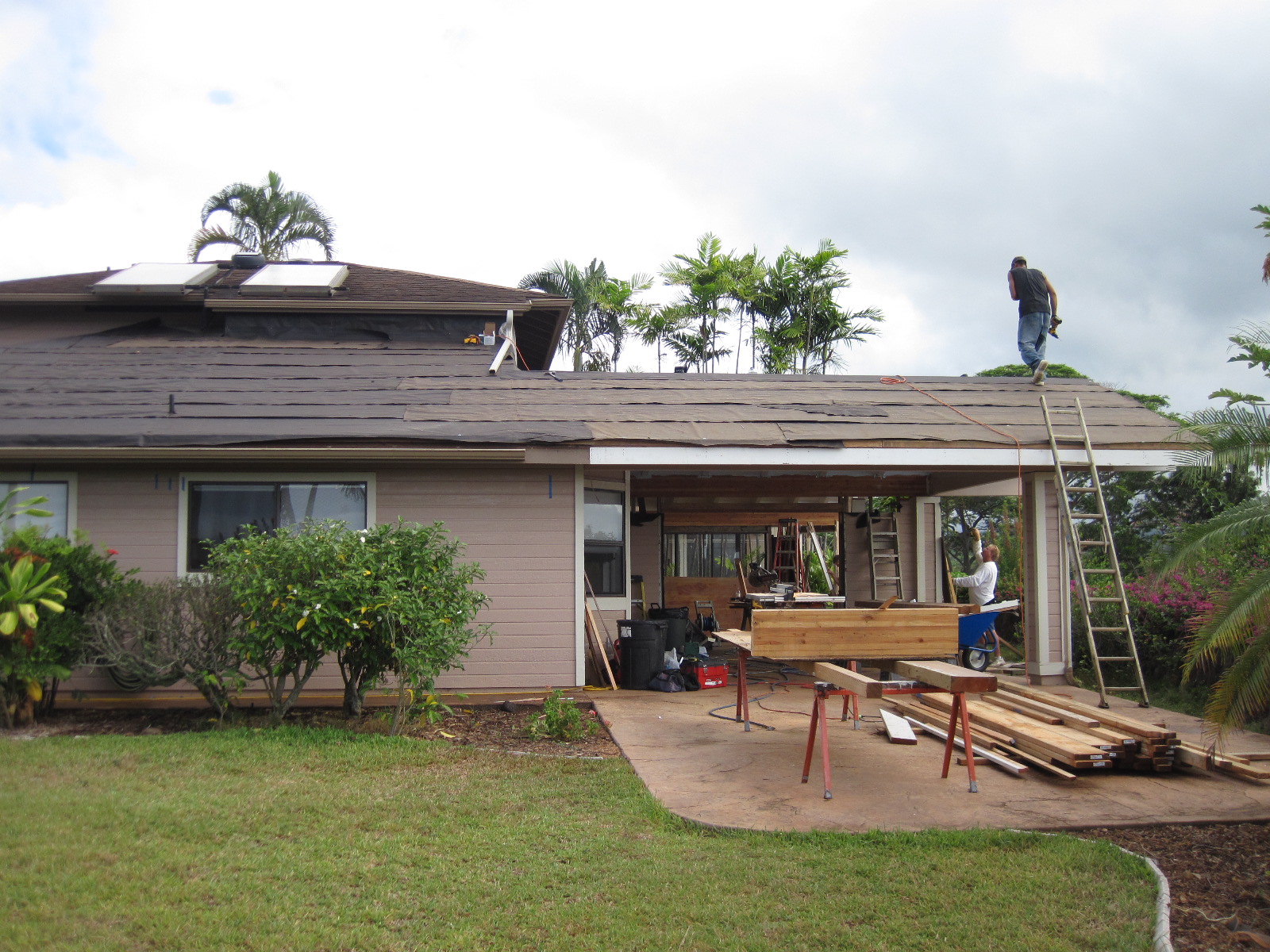
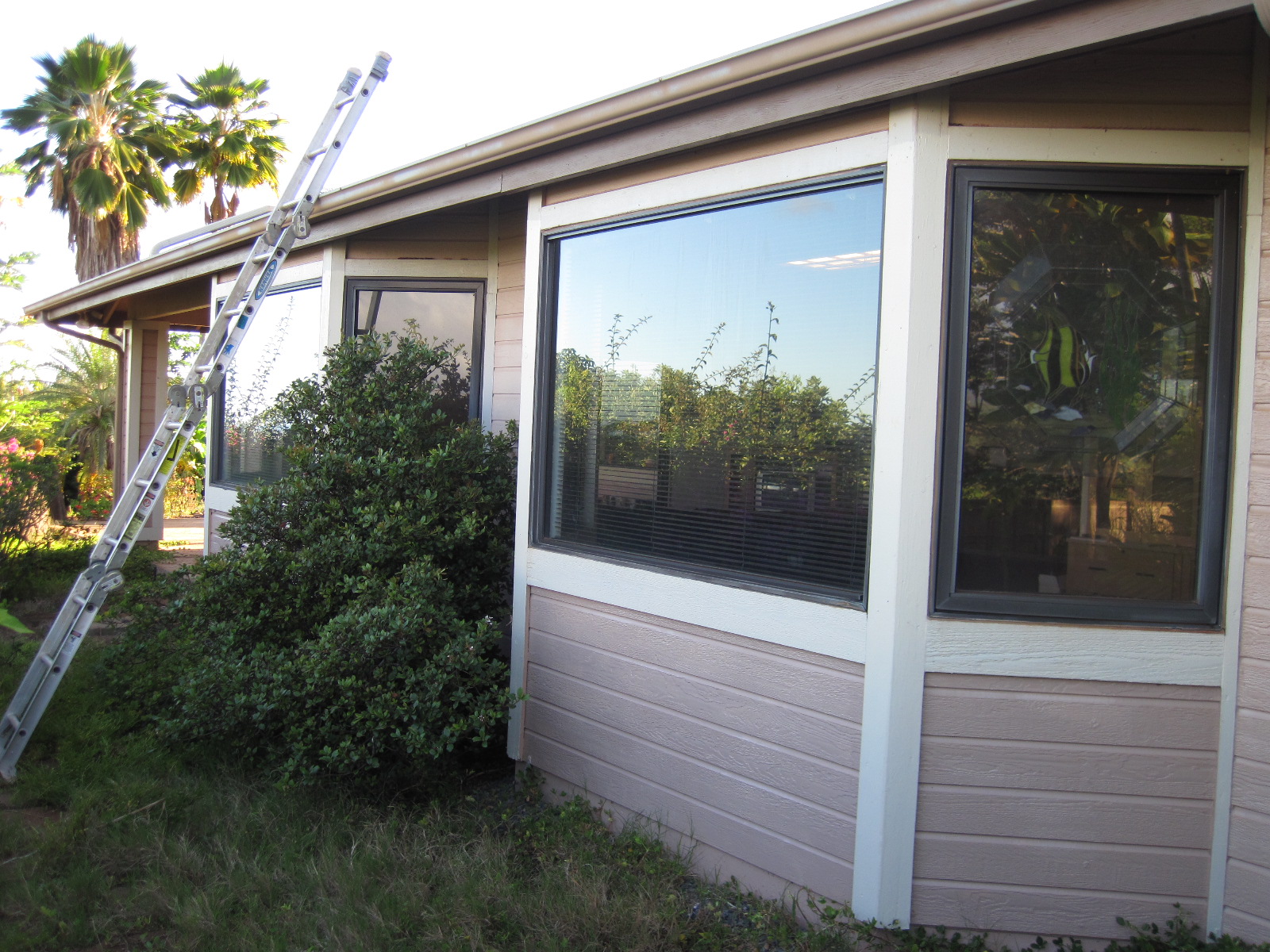
Familyroom bay windows and low roof.

When we bought this “dream home” in 2000, it had issues. We got a great price because of its badly built familyroom extension on the back lanai, including an occasional roof leak where it tied into the kitchen. We started saving the money to fix it while we kept up with the do-it-yourself repairs.

We gained most of our home-improvement skills in the military. You learn electrical safety very early in a Navy career. Sea duty usually teaches you a lot about painting, plumbing, and tools. Add in a subscription to Family Handyman along with spouse’s thousands of hours watching HGTV, and we have no fear of DIY.

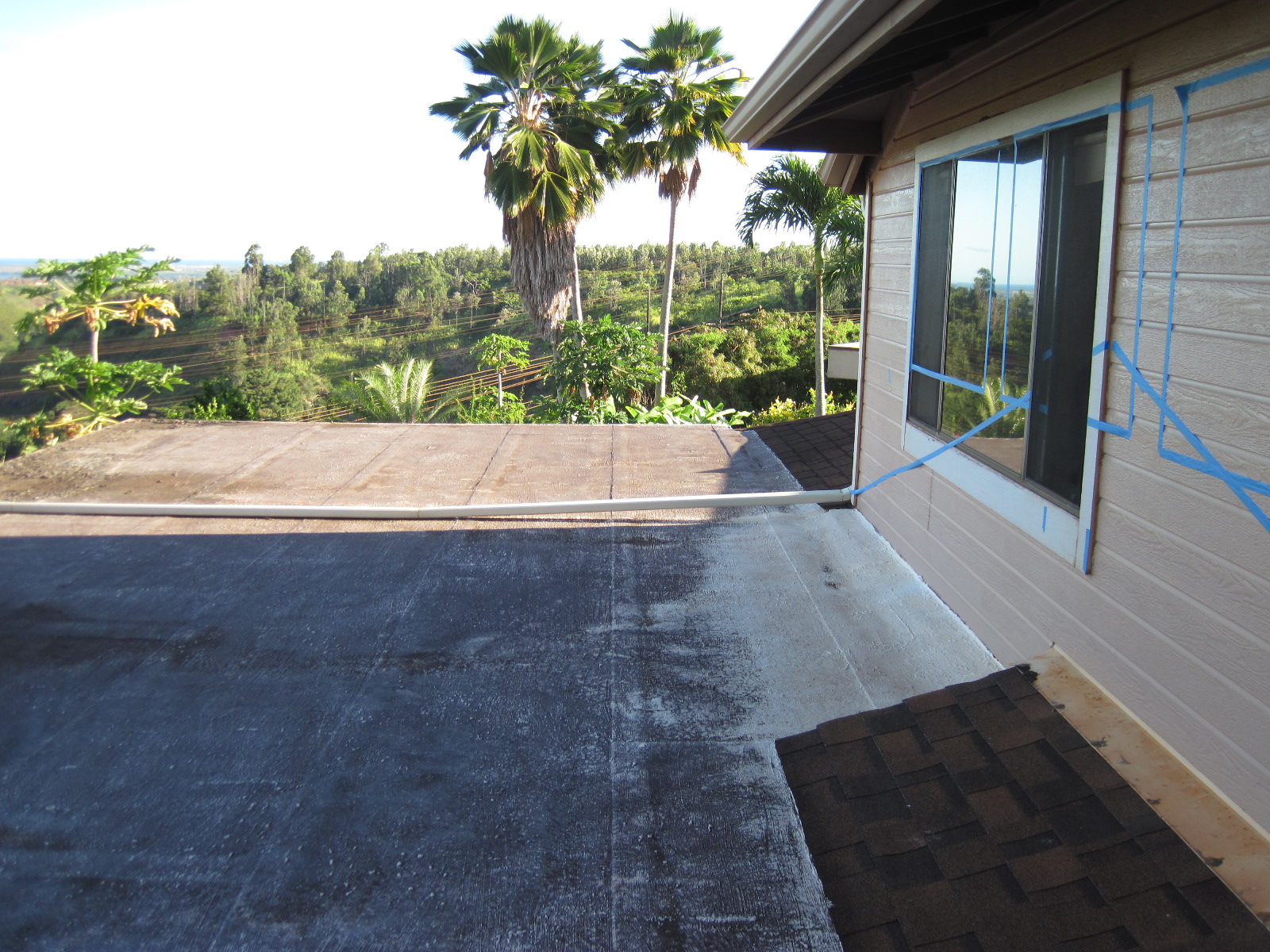
The old familyroom flat roof and back of the master bedroom.

However, we know when we’re outside our “circle of competence”, and rebuilding a room is a full-time job. We knew we’d need electrical permits, which means licensed contractors. When we were finally ready to spend the money, we sought professional help.

Our goals were pretty simple:

  • fix the familyroom roof,
  • upgrade its windows,
  • add insulation to keep the room cooler, and
  • upgrade its floor to match the rest of the house.

However, the most expensive words in home improvement are “Might as well…“, and our list grew steadily longer. “Fix the roof” has grown to “replace the familyroom and lanai roofs and insulate the roof over the rest of the house”. (Here in Hawaii we insulate to keep the heat out, and even halfway through the project we can already feel the improvement.) Working on the rest of the roof meant removing our photovoltaic array for a few weeks, so we’re putting it back up on new mounts & racks. Inevitably the new roofs interfered with the old wall behind our master bedroom, so we decided to upgrade its 22-year-old windows as well. The electrician is completely re-wiring the familyroom, so we’re going to include EnergyStar DC-motor ceiling fans and new light fixtures. The new floor plan leaves a small void behind one wall, so we’re trying to decide how to convert that to a storage space. The only tiles in the world that match our existing floors were in a Dallas warehouse, and you wouldn’t believe what it costs to ship 450 square feet of rocks porcelain tile to Hawaii. Oh, and the new lanai ceiling is going to include longboard storage too.

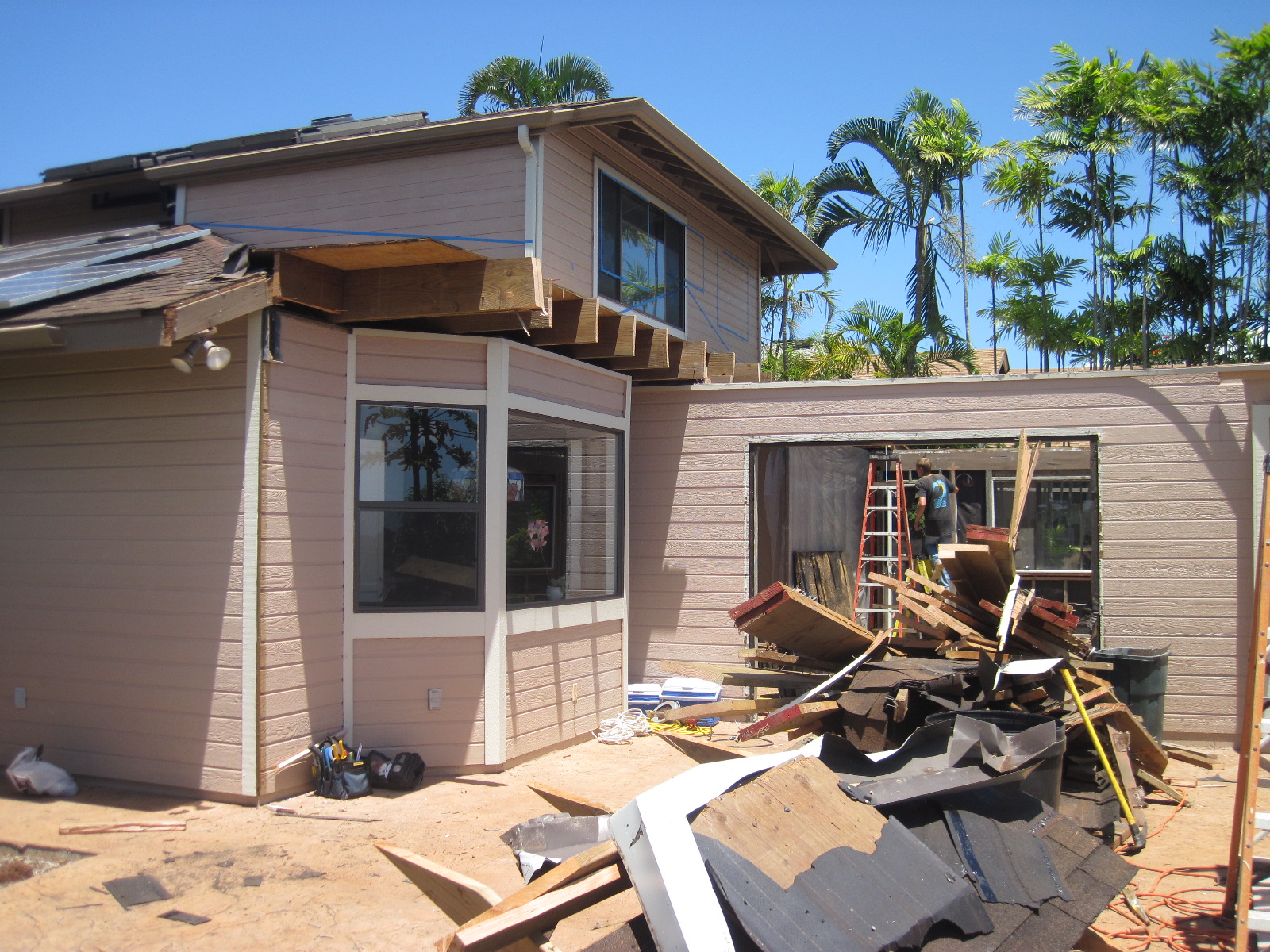
Demolition in progress.

Here’s the frugal part: we’re doing part of the demolition, all of the daily cleanup, and all of the painting. That frees the highly trained (expensive) contractors to concentrate on their highly skilled work. Our Jedi drywall skills are weak, but we sure can party destroy a room.

Here’s the surprising part:  We’ve been doing home improvement for over three decades but I just turned 51 years old. I’m in the best physical condition of my life but I’m losing the raw endurance and rapid recovery of my youth. Much to my disgust, I’m tired & sore after just a few hours of furniture-hauling or drywall removal. It’s so bad that I can barely go surfing, and I can’t even think about training taekwondo. This home-improvement budget includes record quantities of ibuprofen.

So we’ve learned to leverage our labor and to pace ourselves. While the draftsman was working on the plans, we were moving a few pieces of furniture every day. (I highly recommend the ezMoves “As Seen On TV!” furniture-moving lever & glides.) As we cleared the floor, we started taking up the old carpet and padding– just enough to fill the weekly trash can. We spent most of an afternoon draining our 55-gallon aquarium, moving it (and the fish) 10 feet to another wall, and refilling it. (The aquarium, not the wall.) We pulled the baseboard moldings off the walls. By the time we’d selected a contractor, the familyroom was empty.

Much to our relief we hit it off with the contractor right away. He’s been in business for 25 years, comes highly recommended, and he’s easy to work with. He was happy to swap our labor for some contract modifications. His crew has shown up every weekday and they do great work. Best of all, the foreman is a submariner! The rest of the crew is thoroughly tired of our sea stories.

While the draftsman and the contractor worked on the plans and the permits, we removed the familyroom’s drywall. Every day we pulled off a couple hundred square feet, and by the end of the week we were taking down the ceiling. A thousand square feet of drywall fills most of a five-ton stakebed truck. When the drywall came down we realized the job was just getting started.

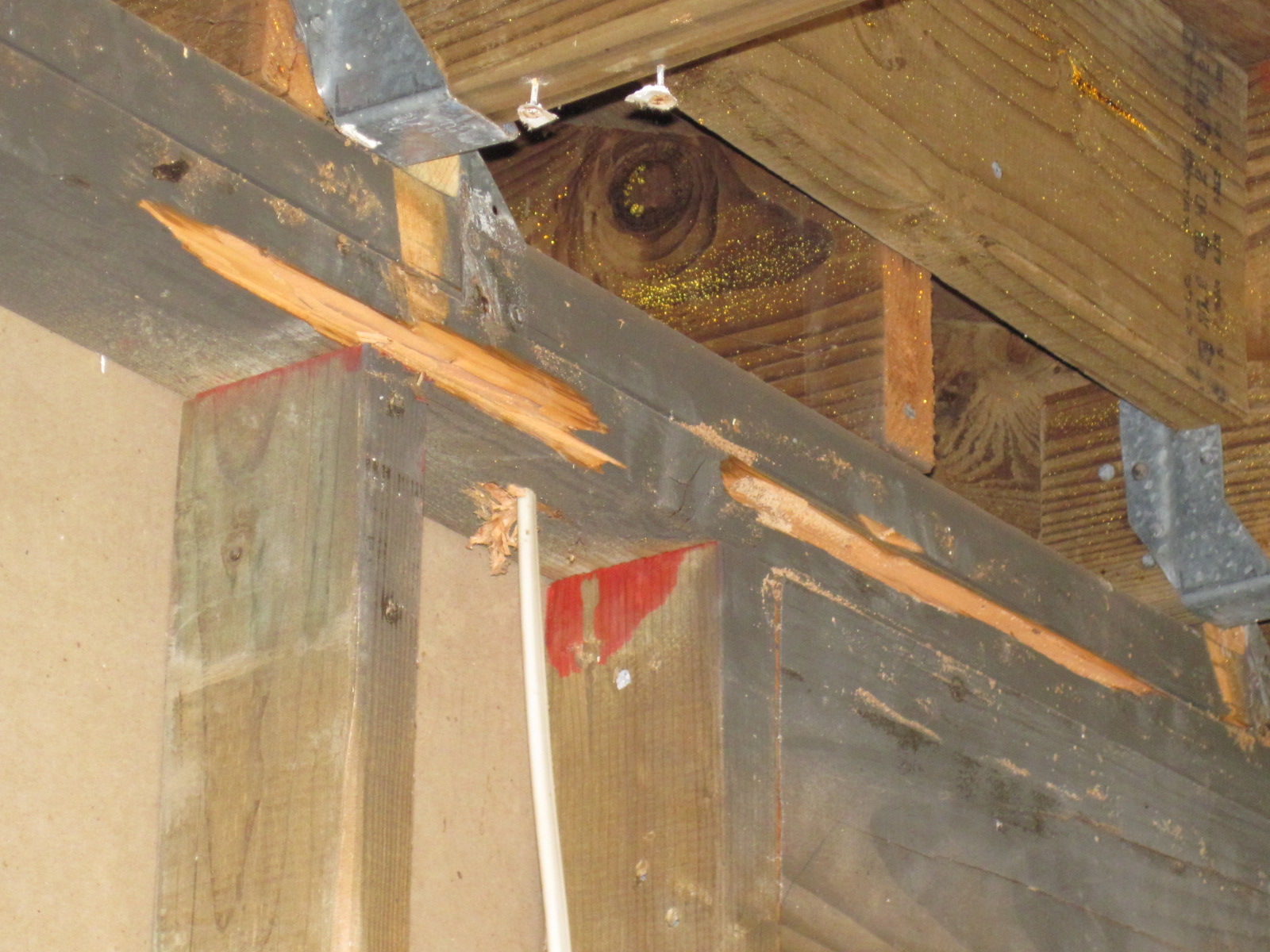
Termite damage, but no live termites.

We had termites in 2003, and the exterminator killed them while they were still behind the drywall. When the drywall came down we could see where the termites had been, and the familyroom was riddled. “Luckily” 95% of the damage was to the parts that were being demolished anyway, and the other 5% is not load-bearing. We also found the usual evidence of a few rats and other critters. We uncovered several “innovative” design choices from the previous owners that could have been avoided by following the building codes with proper materials and craftsmanship. We also found an empty six-pack tucked away between the study’s ceiling joists, which confirmed our suspicions about the quality of the familyroom’s construction.

Work started 46 days ago. The old flat eight-foot ceiling and torch-on roof were demolished in a few days, and after two more weeks they were replaced by a planked-beam ceiling with wood rafters ascending to a 14-foot peak. (The five-ton stakebed demolition dumpster truck was parked in our driveway for nearly six weeks but it just left last week.) Two weeks later the roof had been sheathed with polyisocyanurate foam panels and reflective foil. After the roof was ready for shingles, the familyroom and master bedroom walls were re-framed for their new windows. The new aluminum bronzed windows (and the lanai’s sliding glass door) are insulated, double pane, low-e, and tinted.

Going from one flat roof to two peaked roofs.

We hope estimate we’re past the halfway point. We hope the roofers show up before November. The electrician will be here soon, and then the walls will get regular ol’ fiberglass insulation plus more reflective foil. The construction permit was approved last week. (Or it will be as soon as they get our $706 check.) Siding is going on the walls right now. After the roofers are done, spouse and I are ready to lay out our new photovoltaic racks and clamp on the panels for wiring. The inspector should be here during the first week of November. Drywall will go on after that, and hopefully the floor tile will be laid before Thanksgiving.

Insulated roof up, waiting on the roofers.

If there are no other surprises or problems then we’ll be moving furniture before Christmas. Luckily our daughter will be home from college to help! (Right, honey?)

New familyroom and back lanai with tinted energy-efficient windows.

I can’t imagine doing this project if I was in the office every weekday. We’ve saved a tremendous amount of time (and stopped several mistakes) just by being home to walk around the site every hour or two, talking story and taking photos. (We quickly see where we made bad choices, before it’s too late.) We’ve helped coordinate deliveries, haul supplies, and remove interference. Problems have been rapidly discovered and promptly dealt with because we’re immediately available. Suppliers hear about missing items within minutes after the delivery. Nobody’s had to stop work to find us or to un-do their mistakes. Living among the chaos has been noisy and stressful, but we’re coping.

I’m typing this from our study which now holds three huge desks, three computers, five large cabinets, two extra chairs, a rat’s nest of power strips and extension cords, miscellaneous tchotchkes, and very little open floorspace. The diningroom and livingroom are also piled high with furniture and books, and our daughter’s bedroom is stacked full of chairs and window blinds. (She won’t discover the mess be home for another two months. We’re almost certain this will be finished in time.) We moved out of our master bedroom because we could see through its back wall straight through both familyroom walls to the back of the yard. I almost feel as if I’m “living” in a submarine in a shipyard drydock. (That’s not much of a life.) Another submarine metaphor is that these days my spouse and I are spending hours of quality time in a very small space amid construction chaos, noisy power tools, and demolition debris… you married dolphin-wearing veterans know what I mean.

Retirement DIY is also saving us thousands of dollars. Considering the contractor’s $80 hourly rate, my spouse and I are happy to spend a daily hour sweeping up. (The contractors think it’s a luxury too!) When the lumber was delivered, we laid it out in the yard and spent the first three weekends (5-6 hours each day) priming and painting the rafters and ceiling planks. It’s a lot easier to paint on a sawhorse than to paint over your head with a roller extension. (We’ve already snorkeled through 32 gallons of primer and paint, and the drywall’s not even up yet.) Sure, the paint got dinged up when the rafters were raised and the ceiling was nailed on, but we only had to touch it up instead of starting from raw wood.  For the last few weekends we’ve borrowed a neighbor’s paint sprayer to do the outside eaves and fascia boards. I enthusiastically recommend the Wagner “Paint Crew” high-performance airless sprayer (ours is a 2003 model).  “Unfortunately” the spray job looks so good that spouse has talked me into doing the rest of the house’s eves and fascia boards before the new gutters go up. Happily the sprayer has the power to spew undiluted KILZ primer on the new drywall before we roll on the finish coat.

So how much have we saved? At least $10K so far, and we’ll probably double that. My spouse and I already have over 100 hours of cleanup and painting. We’ve also saved thousands of dollars in furniture moving, demolition expenses, and dump fees. We’ve avoided many extra hours of overhead ceiling painting, and we’ve cut through several days of misguided labor on bad decisions or outright mistakes. We’ve been able to help recycle much of the old lumber and siding back into the framing and walls. Our daughter even contributes from four time zones away– she knows drafting and she’s studying civil engineering, so she’s looked over the designs and asked questions about the construction. Every pair of eyeballs helps.

Here’s a surprising tip for saving on contractor expenses: bathrooms. Many homeowners are reluctant to have contractors “trooping through the house” to use their bathroom. Many less-enlightened contractors will expect their employees to find their own bathrooms, which means that they’ll leave the job site or “find their own” somewhere else on your property. More established contractors will expect you to pay for a port-a-potty. We’ve been delighted to have our crew using our public bathroom (near our front door). They’re enjoying a better quality of life, they’re spending more time on the job and getting more done, and we’re all saving money & hassles.  Admittedly this may not work for every situation or crew, but it’s worked very well in this case.

How much have we spent? Yikes. We just hit $50K but it’s slowing down. The remaining labor & materials should bring the project in under a grand total of $75K (plus our sweat equity). It’s a huge chunk of our retirement savings, and a very big commitment, but we’ve planned the details of this one for over a decade.  We’ve had the cash sitting in CDs and we’ve negotiated discounts for paying in cash.

Wondering where to start your own frugal DIY education? When you’re on active duty, take every chance you get to watch someone work on their gear. Whether or not you’re on active duty, you can read Family Handyman’s website or subscribe to their big truck & power tool ads magazine. If you’re really getting into it then spend an hour or two at Home Depot’s classes. At the very minimum you’ll learn how to tell when something’s breaking down. Better yet, you’ll get to the point where you can do your own maintenance & repairs to avoid expensive service calls. As your skills improve, your hobby can even help you find real estate bargains and turn them back into attractive homes. It’s how we recognized that this was a great property in terrible condition.

The hard part of home improvement is reminding yourself to take a break once in a while.  I was on a Mainland trip during one weekend when spouse had to carry the painting duties all by herself, and since then I’ve felt guilty about catching up on my share.  I’ve even been finding it difficult to take off for a morning or two of surfing. But when this project’s finished and all the furniture is back where it belongs, I need to spend a few months catching up on North Shore winter surf!

Related articles:

DIY home maintenance

Does this post help? Sign up for more free military retirement tips via e-mail, Facebook, or Twitter!
Posted in Mortgage & Real Estate | Leave a comment

Lifestyles in Military Retirement: Living in Hawaii


It must be that time of year again. It’s chilly on the Mainland so people’s thoughts turn to warm tropical breezes, warm beaches, warm surf, and warm sunshine. Yeah, I know, I’m killin’ ya. I won’t talk about how it gets so cold on the North Shore in winter surf that I have to wear a 3mm neoprene shorty rashguard just to be able to stay out there for a couple hours.

But I’m getting a lot of questions about moving to Hawaii and living here on a budget! Let me answer them in one post.

My first caution would be that if you haven’t lived in a foreign country yet, then Hawaii’s multicultural environment will be a big change.  We think it’s great from our years of overseas duty, but not everyone wants to leap into a strange culture to try to make a new life (even if the military sends you there on orders). So if you’ve never even visited here before, then spend a few weeks before making up your mind to live here. And if you want to live here, then rent for a few months in a non-visitor part of Oahu or on a neighbor island. Try to live like a local.

My second caution would be that no matter which island you live on, they’re all a lot smaller than the Mainland. It’s never been an issue for me, but I made a career out of living in tiny enclosed spaces. You may not enjoy it.

Finally, don’t depend on this blog as your sole source of Hawaii advice. I’d strongly encourage you to register at HawaiiThreads.com and start reading their malahini threads. If this post doesn’t answer your questions, then they will.

In no particular order, here are a few observations about Hawaii life:

You’ll either love the islands or hate them. You won’t be ambivalent. I’m a steely-eyed killer of the deep who has only cried a handful of times, and one of them was when I had to contemplate yet another military move from the islands. (We didn’t move.)

If you have Mainland relatives then visits will always be complicated. They won’t want to visit because it’s so expensive. Some island residents chafe at not “being there” for Mainland parents.  Other island residents miss out on a lot of grandkid moments because their kids “escape” to exotic Mainland colleges and tend to build their careers (and families) on the Mainland until they’re in their 30s. One of the major reasons for island residents (especially military) leaving the islands is Mainland family. Of course if your family is born & raised here, or if your parents aren’t in your life, then it’s not a problem.

Our monthly electricity consumption is about 350 KWHrs, which is considered low yet costs about 25 cents/KWHr. (Depends on the price of oil.) Your home may have a solar water heater, which will provide more hot water than you can ever use. Air conditioning is not essential here, and a heating system is only necessary at much higher altitudes. Hawaii homes are not always designed or insulated for air conditioning, so using it can give you a $400 electric bill.

Those who enjoy “transportation lifestyles” will chafe here. You can’t just get in a car and drive in a straight line for hours. You stay off the roads around rush hours. Most highway speed limits are 55 MPH.  Bumper stickers read “Drive with aloha” and “Slow down.  This ain’t the Mainland.”  A plane flight to the Mainland is five hours (or more) and a neighbor island is over $100. Bicycle lanes are sparse. Buses are not as frequent as they could be. However, walking and hiking are year-round activities. Water sports rule, especially paddling and surfing.

Driving in Hawaii can be very different, and motorcycling even scary. People are so polite here that they violate the rules of the road to let others go first. We’ll brake in panic at the first drop of rain, we’ll slam on our brakes when anyone within three lanes slams on theirs, and we’ll randomly change lanes a mile in advance because we don’t get a lot of lane-changing practice. We will not (will NOT!) use our horns. But an occasional “howzit honk” is fine if you’re doing a shaka out of your car window.

Your clothing budget will be very low. Especially “winter wear” (whatever that is) and shoes.

We use less gasoline in Hawaii than we did in San Diego, Texas, the Bay Area, or Washington DC. I used a lot less gas when I was working because I could commute by bicycle all year long. Gas costs more per gallon here but the total cost is lower here because you drive fewer miles.

Hawaii has some of the nation’s highest personal income tax rates. However, property taxes are low. Excise tax (a regressive sales tax) is relatively low but cumulative, so a consumption lifestyle will quickly drive up your spending.

Hawaii is one of the nation’s most tax-friendly states for retirees, usually ranking in the top five.

“Mainland” food is a luxury item here. I’m referring to raspberries, blueberries, cranberries, grapes, potatoes, many kinds of bread, cow’s milk, and most cereal brands. However, I chuckle when I see people actually pay money to eat a mango. It’s also easy to grow papaya, pineapple, bananas, tangerines, oranges, avocados, lemon, tomatoes, and many Asian/Indian fruits high in vitamin C whose names you’ve never heard of. If you want to live in Hawaii on a budget then you must eat local cuisine. A fruit tree wouldn’t hurt, and a veggie garden is a bonus. Fish is plentiful and relatively cheap, as is beef and chicken. Pork is not.

Mainland franchise restaurants are expensive. Local restaurants are generally cheaper. The good news is that there are over 20 cuisines to choose from, although Hawaii is may be lacking in Tex-Mex and Indian. That’s not a complaint–I think the Mainland is lacking in Korean BBQ, kimchi, and curry powder. Hawaii’s lunch wagons and takeout are the world’s best.

Hawaii’s public school reputation is undeservedly poor. All large multicultural school districts with multilingual populations struggle with the same issues. Private schools offer more individual attention, smaller classes, and better tech. However, the “lifestyle cost” of most private schools is also very high: long commutes to downtown locations during rush hours, living too far away from the school for frequent visits outside of school hours, not being able to easily participate in sports. Private school logistics can all be worked out, but families end up sacrificing a lot for it. Nearby public schools (and parental attention) are almost always better than remote private schools.

In my opinion the most important criteria for any high school is: distance. Our family benefited tremendously from being only a mile away from a public high school, close enough for our daughter to ride her bike at all hours. We parents also benefited by being able to attend any school event with minimal advance planning… especially if that plan had to come from a teen.

Cell phone connectivity on Oahu is not that good, especially compared to the Mainland, although 3G service is widespread.  Same for Internet bandwidth. Limiting factors include terrain (ridges & valleys) and undersea cables. However, it’s relatively straightforward to make a good living here from the Internet… unless the surf is up.

Sure, Hawaii has four weather seasons. Summer is a few degrees hotter and drier with higher surf on the south shore, winter is a few degrees cooler and rainier with bigger surf on the North Shore, and spring/fall are in between. During winter it also snows on Haleakala and Mauna Kea.

I don’t know whether NASCAR is available on TV here. If this is important to you then you should investigate cable TV choices, but I don’t hear much about the sport here.

If you were not born here (or raised here for at least 10 years) then please don’t try to speak pidgin. You can let Hawaiian words into your vocabulary if you don’t put verbal quotes around them. Japanese is welcome here, as are over 200 other Pacific and Asian languages.

Pidgin won’t tell you anything about the person’s education level, literacy, or intellect. They could be testing you, your assumptions will be wrong, and they won’t tolerate your attitude. Exhibit A for this syndrome is a former Mainland elementary school teacher and holder of a bachelor’s degree in English. Whenever she heard pidgin she began to speak slowly and loudly, using simpler words. During five years here she never figured out why she had trouble getting help in banks and stores…

Nobody in Hawaii cares about your Mainland stuff-– where you’re from, who you were, what you did, who you knew, what you drove, what you owned. Seriously. No, honestly, we just don’t care. We’re not hostile or envious– we genuinely don’t see how it has any relevance here or why you would still care either. We may seem polite but… we just don’t care, and pretty soon you’ll be standing in the corner talking to yourself. Get over your Mainland culture. Give yourself a fresh start and learn local culture.  We’re eager to share.  Japanese culture is fine. Korean, Chinese, and Filipino culture are good too.

If you want hostility, then try saying “Well, back in … we used to do it this way!” Do not suggest that island life could be improved by “doing it like we did it back in on the States Mainland.” You can actually see the body language turn against you when you say “Well, back in Michigan, we did it this way… ” Delete such words from your conversation. If you must insist on improving Hawaii by making it like it is in Cleveland, then do it by going back to Cleveland. (Thanks to Early-Retirement.org poster Ko’olau for making this point!)

Respect hula. It’s a serious part of Hawaii culture, and you do not make hula jokes unless you’re also a hula student. Some families have been kumu hula for generations, well back into the 19th century. Some halau have been living hula for decades, and they may practice 10 hours per week. You wouldn’t tease Chuck Norris about his karate skills, and it’s the same way with hula. If you’re going to make culture jokes then start with your hometown sports team. Oh, that’s not funny either? Now you understand a little better how locals feel about hula.

If you’re going to insist on talking about Mainland sports then you better know the name of every Pacific Islander on your chosen team. You should know the names of their local families, too. The best advice, however, is to start following University of Hawaii sports… and high school football.

All your Mainland family, relatives, & friends think that you have plenty of spare bedrooms and that you live in the middle of Waikiki. Well, maybe they don’t really think that, but they’re shocked to learn that you don’t spend all your liberty in Waikiki and that your favorite surf spot is 90 minutes away from there.

So is Hawaii really that bad?!?  Well, no, there’s a reason it’s called Paradise!  But it is a huge cultural shift, and many many residents have spent unhappy months finding that out the hard way.  If you’re willing to learn a completely different lifestyle than you’ve ever seen on the Mainland, then living here is wonderful.  The first year is full of changes, but after a few years you’ll wonder why anyone would want to live with freezing weather or air pollution… or without surf.

My spouse and I were born & raised thousands of miles away from here, and even after 22 years we’re sometimes regarded as “the new guys”.  But the main reason that we chose to live in Hawaii is because we’ve lived just about everywhere else in the world, and none of it even comes close!

Related articles:
Recommended book: “So You Want To Live In Hawaii” (Thanks again, Ko’olau!)
Recommended blog (Thanks, ClifP!)“How to Live in Hawaii”

Does this post help? Sign up for more free military retirement tips via e-mail, Facebook, or Twitter!
Posted in Military Retirement, Travel | 6 Comments

Medicare, Tricare For Life, Medigap insurance, and Congress


(Today’s post was inspired by reader Bridget, who also contributed a large portion of the book’s chapter on Reserves and National GuardThanks again, Bridget!)

Do military retirees need more medical insurance than Tricare? For the vast majority of us, the answer is “No”.

America’s healthcare system is confusing, and military healthcare can be nearly as confusing.  This post will concentrate on just three parts of the puzzle: Medicare, Tricare Prime, and Tricare For Life. (I’m trying to keep this post under 1000 1100 1200 words.) If you use additional healthcare (like a civilian employer’s insurance or VA benefits) then your situation is more complicated and this advice might not apply to you. Even if you’re using other benefits, though, consider whether the insurance discussed in this post could save you money after you retire from your bridge career.

Let’s back up for a few paragraphs and discuss how you might use health insurance. One comprehensive approach would be to use it to pay every last dollar of your medical bills. (Of course you’d be paying very expensive premiums for this coverage.) You want to see the doctor without worrying about expenses. You don’t want to wake up with a sniffle (that could turn into pneumonia) and worry about whether you should see the doctor today or wait to see if things get worse. Even more importantly, if you don’t have to pay for routine medical care from your own pocket then maybe you’d be more likely to use “preventive” care programs like annual flu shots. Preventive care costs money too, but it’s generally less expensive than the cure.

A frugal health-insurance approach would be a high-deductible “catastrophic coverage” plan. You pay (much) lower premiums for shouldering most of the costs of routine healthcare. Insurance only kicks in for serious injuries or expensive diseases. The theory is that you’d have to pay for most of your own healthcare so you’d take better care of yourself. (You’d pay for your own flu shots because you appreciate the economics of preventive care.) The reality is that too many people put off seeing the doctor (because they might have to pay for “routine” care) until a minor issue turns into a serious problem. What could have been a small preventive cost (at your expense) turns into a large expensive cure (with a huge insurance claim).

A hybrid insurance approach would be to cover only your expected expenses. You might have daily prescription medication (blood pressure, cholesterol) or age-related losses (reading glasses, hearing aids). You might also have treatments requiring continuing evaluation and care (arthritis, sleep apnea). You might even need assistive technology like orthopedic knee braces or wheelchair ramps. All of these issues can be covered (or excluded) through various types (and expenses) of medical insurance.

Active-duty servicemembers start out with one of the versions of Tricare. When they retire from active duty, Tricare coverage continues for an annual fee.  (After more than 15 years at the same price, this fee is rising.Regardless of their age of retirement, Tricare coverage ends when retirees reach Medicare eligibility (generally at age 65).

Reserve and National Guard servicemembers are insured by Tricare when on active duty or can purchase Tricare insurance when not on duty. At retirement they can purchase Tricare Retired Reserve insurance, although DoD does not subsidize the expense of this insurance. At age 60, Reserve/Guard retirees become eligible for retiree Tricare and continue under this system until Medicare eligibility (usually age 65 again).

Is Tricare enough for all military retirees who aren’t yet eligible for Medicare? I wish the answer was simple, but the best I can do is “It depends”. The vast majority of military retirees with Tricare will still have copayments for doctor’s visits and prescriptions, but a few visits (or prescriptions) a year will cost less than the premium expense of additional insurance. If you and your family are generally in good health then you won’t need more insurance.

A few retirees (or their family members) may have frequent doctor’s visits or several prescription payments. It may make sense to pay the premiums for supplemental insurance (like a MOAA-sponsored plan) when the premium is lower than the cost of the doctor & prescription copayments.

The decision has to be revisited when the military retiree is eligible for Medicare. The details of Medicare are far beyond this post (still under 1200 words!) but the basics are on page 31 of the “Medicare & You” handbook.  Medicare parts A & B cover most hospital & doctor expenses but beneficiaries still have copayments, deductibles, and prescription fees.

Medicare supplement insurance (also called a “Medigap” policy) picks up where Medicare ends. However, even Medigap policies generally don’t cover long-term care, vision or dental care, hearing aids, eyeglasses, and private-duty nursing. When military retirees begin receiving Medicare benefits, their Medigap coverage is Tricare For Life. One of the benefits included in TFL continues to be the Tricare Mail-Order Pharmacy, which covers a wide variety of medications for a smaller copayment.

With Medicare and TFL, does a military retiree need further Medigap insurance? Again the best I can recommend is “It depends”.

The vast majority of military retirees will minimize their expenses by staying with Medicare and TFL. They’ll still have copayments for doctor’s visits and prescriptions, but a few visits (or prescriptions) a year will cost less than the premium of a second layer of Medigap insurance.

What can you do if you continue a bridge career past age 65? You’ll probably stay with your employer’s insurance. Once you decide to go with Medicare, though, it also makes sense to begin TFL and the Tricare Mail Order Pharmacy.

Regardless of your insurance decision when you retire, keep an eye on your expenses and the cost of supplemental insurance. If you’re only seeing a doctor a few times a year, or only paying a few dollars a month for prescriptions, then you won’t need supplemental insurance. As you approach Medicare eligibility (and perhaps pick up a few more medical concerns), make sure that Medicare & TFL will cover all of your issues. This is especially critical for prescription medications and prescription equipment like orthopedic braces and sleep-apnea treatment systems. If you’re not sure then consult the Tricare ombudsman at a military treatment facility or talk with a Tricare contractor directly. Make sure you see Tricare’s policy in writing before you make a financial decision.

As Congress struggles with debt-reduction administration, the Administration is proposing annual fees for TFL. The first fee would start at $200 in 2013 and rise with the military pension COLA.  Regardless of your feelings about this proposal, it’s still far cheaper than other Medigap policies.

The following advice comes from a long-retired shipmate (call sign “Frito”) who’s made the Medicare and TFL choices: “Work the system, don’t wait for it to work! Tell your readers that it is THEIR responsibility to find out for themselves BEFOREHAND what’s ‘required’ and what they must do to work the system.”

What have you learned from your Medicare/TFL transition? Please post a comment!

Related articles:
Book review: The Complete Idiot’s Guide to Social Security and Medicare

Does this post help? Sign up for more free military retirement tips via e-mail, Facebook, or Twitter!
Posted in Insurance, Money Management & Personal Finance | 6 Comments

Lifestyles in military retirement: Empty nester


There’s a persistent rumor among early retirees that you can only achieve the ambitious ER goal if you eliminate all discretionary spending– including the money “wasted” on raising a family.

The reality is that you have to focus your spending on the things that bring you value. (It’s your discretion, not society’s.) The prime gold standard of “value spending” is Amy Dacyczyn (The Frugal Zealot).  Her newsletters turned into a bestseller about frugally raising six kids on one income.  If Amy could do it for six and still retire early, then any of us should be able to figure it out for one or two. Three or more will test your creativity, but you’d already decided that raising kids brought you value!

When it comes to family, first decide whether kids will bring value to your life– and then put together your budget for raising them. (Hint: Goodwill & garage sales.) You’ll know when your family is the right size for your values (and your budget).

It’s possible that raising kids will help you develop the tools and even more compelling reasons to pursue ER. Raising kids forces you to set priorities, to save money, and to generally behave more responsibly. (You certainly have fewer adult opportunities to behave foolishly and spend frivolously!) While you’re acting like a parent, one day you’ll realize that you could start putting some of that unspent income to good use. (Besides diapers and college funds.) As an ER parent, it’s also a very good idea to be spending more time with those budding adolescents as they approach their teen years. Yeah, I know, it’s not always a pleasant experience, but it’s a relief to be able to spend extra time checking up on with them.

When you’re in the military you spend most of your career training other servicemembers. In our case, both my spouse and I had instructor tours at training commands plus years of watch-team and department training. We’re professionally skilled and extremely experienced at meeting new people, teaching them how to do their jobs, and sending them on their way to succeed in their next assignment. Hey, this was an important mission: we were training our reliefs to take over our duties.

(I know I’m hopping among several seemingly unrelated subjects. Stick with me for a few more paragraphs and I’ll tie this all together.)

Our daughter’s in college now, and we’ve been new members of the empty-nester club for just over a year. It’ll be six more semesters before we “upgrade” to a full membership, but we’re already finding it a fantastic reward for our two decades of preparation and hard work. Not two decades of active duty, but two decades of parenting!

I know that a few parents can be blindsided by empty nest syndrome, and it frequently strikes when you’re already coping with other life changes. But one symptom of empty nest syndrome is identifying too closely with your parenting role while not appreciating all the other roles you may play in your life– spouse, family member, worker, volunteer… you’re not “just a parent”!

If empty nest syndrome becomes a challenge, then it the reasons behind it could affect other areas of your life. For example, how will you handle the identity change from servicemember to civilian? Is your self-image tied too closely to your occupation? You may also need to reflect on how you’ll feel when your working days are over. How will you handle the retirement transition? Do you seek outside yourself for your identity, or are you content with your “inner self”? Can you be responsible for your own entertainment, or do you look to others for that?  “But… but… but what will you DO all day?!?”

In some families, parenting becomes a substitute for (a “distraction from”?) your primary role: spouse! Suddenly the kids are gone, leaving the two of you wondering who you’re living with. You not only have to learn your new role of parent emeritus, but you also have to redefine all over again how to live with that other adult. (Who may also be wondering who the heck they’re stuck with.)  Everything (and I do mean “everything”) can be subject to re-negotiation.  For some the transition is seamless, while for others there’s confusion and turmoil. Regrettably, for a few spouses the empty nest just emphasizes that the marriage has also emptied.

Whoa dude. Your skill at coping with an empty nest may be a harbinger of how you handle your marriage, your retirement, and the rest of your life. “No pressure!”

No worries.  If our first year is any experience, then happily this empty-nester phenomenon is the most fun we’ve had since we were trying to start a family.

Sure, the transition is good practice for refreshing your marriage and designing your retirement. But it’s also a second childhood– with fewer responsibilities and no rules!

Consider this (partial!) list of empty-nester lifestyle choices:

  • No schedules. (“Wanna go surf Maui tomorrow?”)
  • No cooking. (Frozen meals are faster and better than ever!)
  • Pizza night. Any night.  All week long.
  • No more school nights. (Monday-night socializing at the local bar? Sure!)
  • No housecleaning… because nobody’s making it dirty.
  • Stay up as late as you want. Pull an all-nighter (if you still can). In Lahaina.
  • Sleep in next morning. And next afternoon.
  • The entire house becomes a clothing-optional zone. Maybe the yard too.
  • Your utility bills are lower– a lot lower!
  • You can play your own music on your own speakers. You can even dance to it.
  • That Internet bandwidth is all yours again, baby.
  • You can do laundry whenever you want to. Or not. Especially not if you’re enjoying the clothing-optional lifestyle.
  • Refrigerator or keggerator?

But the empty-nester lifestyle isn’t all fun & games– you may pick up some extra “duties”. For example, you should check on those unused bedrooms at least once a month to make sure nothing else has moved in.  You may confront the additional expense of converting an extra bedroom to a new purpose– “home theater” or “longboard storage“.  You might have to cycle through the bathrooms every week or two to keep the sink & tub drains filled and to keep the toilet bowl from drying out.  Sadly, if you no longer have a teen driver in the house then you may have to re-learn how to run your own errands and do your own grocery shopping.

You’ve handled a lot of other transitions in your life, and empty nester can be one of the most enjoyable ones. You’ve already been training your troops to “leave the nest”, and after they moved on you’ve looked forward to the next challenge. Your kids will be just as happy to finish their own training program and move on to their own lives. You’ll know that they’re ready to take the duty, and you can look forward to fulfilling your own new challenges for a while. The empty-nester transition makes a great metaphor for your career transition, and you’ll handle both just fine. Even better, it’ll boost your confidence to tackle the ER challenge.

Thursday’s post: part two of the bloggers (in alphabetical order!) from the USAA Blogger Event. You’ve been waiting all week to hear about the rest of us.

Next week I’m working up yet another post on the drawdown and the proposed changes to military benefits. (Hey, you asked for it. The post, I mean.) I’ll follow that up with a post for military retirees who are wondering whether Medicare & Tricare For Life are enough medical insurance, or if they’ll need more. (Short answers: yep & nope.) After that we might need to come up with another sea story… so many to choose from!

Related articles:
“What, me worry?”
Retiring early– with kids?

Does this post help? Sign up for more free military retirement tips via e-mail, Facebook, or Twitter!

Posted in Military Retirement | 2 Comments