Buying a used car on a cash advance in a new town


It seemed like such a simple question: “How do I get a cashier’s check in a city where I don’t have a bank account?

Our daughter’s car shopping coincided with a family wedding invitation in Texas near her college. My cousin the Army Ranger got married last week to the woman of his dreams, and it was an impressive ceremony. The open-bar reception was even more impressive, although I think the police have agreed to drop all the charges. Once we had that important task out of the way (the wedding, not the misdemeanors), we spent some time “helping” our daughter buy her first car.

"Ekahi" is the Hawaiian word for "first" or "number one".

Ekahi: 1999 Honda CR-V

I bought my first car from a dealer in 1981 (a new Mazda GLC, $6000) and I still regret paying top dollar for it. (Over $15K in 2012 dollars.) I had no idea how to buy a car, let alone a used one. I basically looked around our college campus, flipped through Consumer Reports, walked onto the dealer’s lot, held out my credit card, and said “I can afford $6000. Whaddaya got?” I made up for my ignorance by driving that car into the ground over the next 12 years (and eight duty stations in nine time zones). I even sold it for $600, despite the rubber-lined hose clamp on a piece of radiator piping.

In 1993 we were ready to buy a used car. We could look up vehicles in the “classified ads” section of the local “newspaper”. (Kids, you can Google this one. You wouldn’t believe me anyway.) We could go to the library, where the librarian would watch over us as we paged through their only copies of the Consumer Reports Used Car Guide and the actual hardcopy Kelly Blue Book. We spent lots of time making phone calls and visiting cars just to see what they looked like, because you rarely got a photo in the ads. If we were selling a car, it cost $40-$50 to advertise in the “right” places.

By comparison to the last millennium, today’s used-car tools are cheap & frictionless. We’ve bought & sold half a dozen since the early ’90s and we’ve never been burned. If we’d been buying new from dealers then I think I’d still be working. A vehicle can be a significant financial decision, right up there with marriage and buying a house, and buying new can quickly deplete your assets– even before the vehicle starts depreciating. Add in the frustration & drama of the new-car buying process (although that’s improved a lot too) and I’m never setting foot in a dealership again.

When spouse & I got to Texas last week, our daughter had already been on the project for a couple of weeks. She’d read our e-mail guide to buying a used car. She’d thought about what she “needed” in a car. She’d asked her NROTC instructors about their first cars and what they’d do differently today. She’d been window shopping and talking to friends, and she’d decided that she really couldn’t afford more than $5000. (I thought she’d have to go as high as $8K.) She has the money in CDs, but she asked that we parents supply the funds with a credit card/cash advance or a transfer to her so that she could write a personal check.

She’d scoured the local Craigslist and CarMax ads for her chosen models & prices. She signed up for the Consumer Reports Used Car Guide website ($30/year, unlimited access) and CarFax (~$50, five reports). She found a local mechanic who’d do 90-minute inspections ($100). She had a list of sellers and she was ready to go.

Her very first test drive was a total bust. Her high-school Spanish wasn’t up to the task of talking cars over a cell phone, and the seller never showed– but let’s just say that the evolution had significant training value. She bounced back. By next morning she’d run through a dozen Craigslist ads, researched them all on Consumer Reports, talked to several owners, run some VINs through CarFax, and lined up four more appointments.

The next seller had a 1999 Honda Civic CR-V with 163K miles. He showed up on time, and she hopped behind the wheel for a test drive. (I was in the back seat to check out the rest of the car while she drove, but I’d agreed to keep my mouth shut.) I was surprised at how well the engine & automatic transmission had held up, and the highway driving gave her an unexpected opportunity to check the ABS brakes.

The owner displayed a charming ignorance of all things automotive. He’d only owned the car for two years and he was moving out of state. There had been at least two previous owners (including a car dealer) and he only had records for a recent radiator replacement. We crawled around the car looking under the hood and chassis. The engine had a small head gasket leak. The interior was full of dirt and kid’s toy debris. Doors & windows squeaked from lack of lubrication. However, there were no other fluid leaks, the air conditioning was in great shape, the CV joint boots looked fine, and two tires were new. The body was thoroughly dinged up but that was actually an advantage for her— he hadn’t been getting many phone calls because you could see the damage in his photos. She was fine with dings & scrapes, so she dropped it off at the mechanic’s.

While the mechanic put the car on the lift, she chatted with the seller. He was in America on a student visa and had decided to return home to help his family. It turned out that his home country’s air defenses were disabled by the U.S. military last year. (I’m not naming the country in this blog due to SEO keyword & spam concerns, but it starts with the letter “L”.) Both my daughter and I were considerably nervous that he’d ask us what we did for a living.

But our occupations never came up, because he was much more interested in our money. Due to his relative lack of experience with PayPal and American banks, he didn’t trust either of them. We also got the impression that he was leaving in a few days and wouldn’t wait for personal checks to clear. He wanted cash, period. My daughter is much more charming and persuasive than me, but her social skills didn’t cut it. $4700. No checks, not even a cashier’s check. Cash. Period. Deal breaker.

We agreed to meet in another hour (after the mechanic finished), and then we went in search of a bank. It was already after 4 PM.

Last semester she’d set up her NROTC unit with an account at Chase Bank, so she started there. Because of our previous conversation with Navy Federal Credit Union, we thought that we couldn’t use their ATM card as a debit card. (In retrospect that was probably bad advice from their phone rep.) As a result of those other phone conversations, we’d decided that I’d get a cash advance on my American Express credit card.

The Chase teller, however, said the card wouldn’t process on her system. Bummer. Thanks a lot, Amex.

I pulled out my USAA MasterCard. Much to our relief, Chase’s computers were happy and the teller handed our daughter 47 Benjamins. (I was handed the cash-advance receipt.) If USAA hadn’t come through then we would have tried NFCU’s debit card in desperation, and that probably would have worked. So our misunderstanding cost us $141.

The NFCU rep and I didn’t communicate clearly. I asked what the debit card limit would be “If I walk into a bank”, and she responded “The ATM limit is $600/day”. However, if I’d asked “If I show my photo ID to a bank teller”, then NFCU’s answer probably would have been at least $5000 and maybe even higher.

The best solution came from Jay’s comment in the cashier’s check post: traveler’s checks. We still don’t know why Chase wouldn’t process an American Express card, although Amex doesn’t play well with some banks and retailers. We never tried our NFCU debit card, but what if that hadn’t worked either? The only sure answer is very old-school: traveler’s checks. I didn’t want to use them because most people today no longer know how to cash them, and this seller would never have touched them. However, Jay pointed out that the Chase teller would have happily accepted them and promptly handed over the cash. The 1% fee is a small price to pay for the reassurance that you’d be able to process a transaction without worrying about the compatibility of everyone’s computer systems.

The mechanic came up with about $1500 of “nice to fix” repairs: a new boot on the rack & pinion steering. Two wheel bearings that squeaked during hard high-G turns. A new timing belt (before 200K miles). The head gasket. He listed every little thing, both to help her drive the price down and in hopes that he’d get her business.

We put on our sad faces and she broke the bad news with the seller:

Her: “Because of all these repairs, I need an extra $500 off the price. I’m offering $4200.”
Him: “I can’t do that. The price is $4700.”
Her: “I’m sorry, but the car has too many problems for that price. We’re going to keep looking.”
Him: “Did you manage to find a bank that would give you cash?”
Her: (holding up thick envelope) “Right here!”
Him: “Well”…

When we handed over the $4200, he asked us to drive him over to Bank of America. He literally fed the money into the ATM before he signed over the title. I guess he was worried about theft or counterfeiting. The ATM scanner rejected one bill because it had graffiti on it, but she “happened” to have a substitute with her.

It took four hours from test drive to title signatures, but it was done. She canceled her appointments with the other sellers.

She’d called USAA with the VIN while she got the cash, so car insurance was already in place. (Including roadside assistance & towing.) USAA even set her up separately with her own policy, so she’s finally off our policy!

Next morning, Texas DMV went smoothly. We learned that they have their own bill-of-sale form, which took another quick phone call to the seller for his signature, but the title application was finished before lunch. It took almost as long to do the shopping for her car supplies.

So now we know how to get a large chunk of cash in a city where we don’t have a bank account.

I don’t think we’ll ever need to do this again. Military families usually transfer to towns where their (military-friendly) banks or credit unions already have branches. Even if the new duty station is in an isolated location, she’d have the time to establish a bank account weeks before she actually tried to buy the car. Spouse and I don’t ever plan to go out of town to buy a car ever again. Our daughter will drive this beater for a couple of years before having to decide whether to sell it to another college student or to try to fix everything up for a cross-country road trip. But when she gets to her first homeport, her credit union will already have a branch there for her.

Now that she actually has the car, she’s not planning to put a lot of miles on it. She’s only a couple of miles away from campus, and as long as the weather holds then she’ll probably keep bicycling back & forth. But she has convenient transportation for bad weather, and she can really haul her dorm-room possessions to her first apartment!

Best of all, next time she’s looking for a good used car she knows how to do it on her own.

Related articles:
The finances of used cars
Getting a cashier’s check

Does this post help? Sign up for more free military retirement tips by e-mail, Facebook, or Twitter!
Posted in Money Management & Personal Finance | 2 Comments

Book report: “The 36-Hour Day”


Thank goodness this isn’t a book about the military. I’d sure hate to write that mission description!

For those who are reading this topic for the first time here, my father is in a care facility with mid-stage Alzheimer’s. He lived independently for as long as he could, but just over a year ago he ended up in the hospital with a perforated ulcer. My brother and I found a skilled nursing facility for his rehab, shut down his apartment and sold his furniture, and spent nine months on the legal process of becoming his guardian and his conservator.

The book’s full title is “The 36-Hour Day: A Family Guide to Caring for People Who Have Alzheimer Disease, Related Dementias, and Memory Loss“. It’s the best reference manual on the subject. First published in 1981, the fifth edition came out last year.

I found it in our local public library. About halfway through I bought copies for both myself and my brother. The book is essential for any family dealing with dementias.

It starts with an eight-page description of “a day in the life” of a woman struggling with dementia, and it tells the story from her perspective. The first sentence uses the phrase “slipping memory“: exactly the words Dad used to describe his early stage of the condition. The book goes on to describe Alzheimer’s symptoms and the problems they cause with independent living, home care with families, and even in care facilities.

It goes on to discuss caregiver challenges in coping with the behaviors caused by dementia. Most of the time, the person with dementia is reporting how they feel or can’t find the right words to describe the situation. They have little memory of what’s just happened, but they still have some recall of long-ago events. The resulting jumble of garbled memories and damaged language skills means that they can still talk but no longer remember a problem or how to solve it. If a caregiver is trying to obtain more information, or control the situation, or correct them, then it may lead to more confusion and upset. Our caregiver questions or comments often make the situation worse.

The book tries to help caregivers understand the patient’s perspective and to share just enough information to get through the moment. It suggests breaking sentences down into short statements without explanations. It advises not correcting their statements or questions and not controlling the situation any more than necessary for safety. If the patient is upset or arguing, then someone has to change their behavior: it’s usually only the caregiver who can make the change. The Alzheimer’s patient no longer has the cognitive ability to analyze or solve the problem– they can only react to their emotions and feelings.

The book also covers caregiver issues, including burnout. It suggests how to cope with behavioral problems and every social situation you can imagine. (I learned a lot about challenges I’d never even thought of.) It not only teaches you how to cope with the patient and your own feelings but how to navigate the care system for help from non-profits, agencies, and the government. There’s even a short chapter for teenagers to help work through their worries and fears.

This is the best tutorial on the subject. If someone you love is struggling with a dementia, even if you’re not their caregiver, then start here.

Let me mention two other resources. The first is the Alzheimer’s Association, the largest nonprofit funder of Alzheimer’s research. Their website shares the facts of the disease and helps caregivers find more information and help. They also track medical issues, research, and legislative initiatives.

The other is Bob DeMarco’s Alzheimer’s Reading Room. Bob’s mother has struggled with Alzheimer’s for eight years, and Bob has been there every day. He started the website to keep track of the thousands of articles and books he was reading about the disease, and it’s grown into one of the Web’s biggest Alzheimer’s archives. A year or two into his reading, Bob realized that he had to change the adversarial relationship between him and his mother. The only way to handle the situation was to change his own behavior and, in Bob’s words, “enter Alzheimer’s World”.

He stopped correcting his mother’s statements and largely stopped arguing with her. Once he adopted her point of view (that she can’t remember), he realized that debate was pointless. Instead, he reassures her or tells her that they’ll take care of it in a little while.

When she says she’s hungry, Bob no longer reminds her that she ate a meal 15 minutes ago. He realizes that she’s reacting to the feelings of her body digesting her food, and he says that they’ll eat in a little while. If she asks when that will be, he replies “Soon”, and offers to help her use the bathroom. No arguments and a gentle redirect are usually enough to defuse what used to be a contentious situation. Bob has thousands of posts with specific advice on how to deal with these situations, how to discuss problems with doctors & nurses, and how to navigate the medical bureaucracy.

The “36-Hour Day” describes a specific problem and offers ideas on how to deal with it.

The Alzheimer’s Association will explain what research is being done on the problem.

But best of all, Bob’s website will help you figure out exactly what to say and what to do.

Interestingly, the book helped me make peace with myself. Thinking back on early conversations with Dad when we tried to get him to seek medical help and sign a power of attorney, I realize now that we never had a chance. Dad preferred to live alone and largely in isolation. The Alzheimer’s was already too far along by the time that he started talking about “slipping memory“, and he absolutely refused any medical assistance. (In retrospect, we’re all lucky that he kept up with his blood pressure medication and his checkups.) By the time we were aware of Dad’s situation, it was too late to complete a power of attorney. (As another reader pointed out, the only long-term solutions were a revocable living trust or conservatorship.) Dad handled his own affairs for another 15 months before he ended up in the hospital.

When Dad was in the hospital, I wasted everyone’s time discussing his situation with him. (I watched a geriatric care manager try to do the same, with about the same success.) The simple answer turned out to be the one the doctor ordered: Dad “had” to report to a skilled nursing facility for rehab. Instead of spending hours debating the hazards of independent living with him, I should have just stuck to “The doctor says you need to do rehab to finish healing from the surgery“. Once Dad realized that the care facility took care of meals, laundry, and chores, he became an enthusiastic resident.

Bob’s website is priceless. Next time I visit Dad, I’ll know how to keep him happy and entertained. I’ll be able to navigate the conversational minefield and help him stay comfortable. I’ve appreciated that my brother could be feeling burnout symptoms, but now we can work through that together.

Dad’s doing all right now. Last fall he was diagnosed with multiple myeloma and we decided to try chemotherapy. It went surprisingly well, and he may be finished after just five infusions. My brother and the doctor are discussing the next steps, but we favor “slow medicine”. Dad’s still mobile and can still carry on a social conversation. He seems happy, although he wakes up almost every morning with no idea where he is and still does not know the names of his care staff. (As the Alzheimer’s progresses, he’ll lose awareness of those issues and they won’t worry him any more.) He still enjoys a Sunday restaurant lunch with my brother, and that’s as much as Dad cares to leave the facility.

A conservatorship appointment letter is not a silver bullet, but that’s working as well as one can expect from all the various bureaucracies. I’m able to do what needs to be done, and Dad’s finances are fine. He’s an early retiree who’s been financially independent for over 25 years, and there’s no risk of running out of money.

If one of your loved ones is coping with dementia, then you need to read this book. (You’ll probably want to buy a copy for a handy reference.) Subscribe to Bob’s website or add it to your blog reader feed. A little at a time, in small frequent doses, these resources will help.

Related articles:
Geriatric financial lessons learned
Geriatric financial management update
Geriatric financial management
Financial lessons learned from caring for an elderly parent

Does this post help? Sign up for more free military retirement tips by e-mail, Facebook, or Twitter!

Posted in Reviews | 3 Comments

How much will military veterans leave on the table?


Once you’ve started saving and investing for financial independence, you want to know when you’re actually financially independent.

The answer should be straightforward, but it starts out with a simple number and then piles on the fine print.

Here’s an example:  “You’re financially independent when 4% of your investment portfolio can cover your retirement expenses.” *

And the fine print:

*An initial portfolio withdrawal of 4%, raised each year for inflation, when invested in an asset allocation of at least 50% equities (and 50% stocks), should survive for at least 30 years… 95% of the time. This is backtested on nearly a century of data, assumes that the future is no worse than the past, and expects that today’s equity markets resemble those of the 20th century.

If you’ve spent some time reading about stock-market returns and asset allocation, you can probably poke a few skeptical holes in those assumptions.

The authors of that 4% conclusion, now known as the Trinity Study, thought their work was complete. They concluded:

For stock-dominated portfolios, withdrawal rates of 3% and 4% represent exceedingly conservative behavior. At these rates, retirees who wish to bequeath large estates to their heirs will likely be successful. Ironically, even those retirees who adopt higher withdrawal rates and who have little or no desire to leave large estates may end up doing so if they act reasonably prudent in protecting themselves from prematurely exhausting their portfolio.

Yet millions of readers have responded to that conclusion with a rebuttal:

Yeah, but 95% is less than 100%, and I want a guarantee that my retirement will not be one of the failures.

Researchers have spent over a decade since the Trinity Study trying to pin down the “0% failure” numbers. Most efforts tinker with the asset allocation to figure out the best combination of survival rate and withdrawal amount. If you’re willing to take on more risks of failure (longevity, volatility, and loss of principal) then the portfolio can handle a higher withdrawal rate. Or, if you’re willing to assume more risks, then the longer the portfolio will survive and the less likely you are to run out of money. You just have to figure out how well you’re going to sleep at night.

Other researchers have tried to rise above the history by simulating more data and projecting retirements out to 50-60 years. Monte Carlo calculators offer lots of data runs but still suffer from approximations that don’t quite perfectly match the stock market. (As the Great Recession reminded investors– again– the stock market can still behave unpredictably.) If investors can’t find the perfect asset allocation, at least they can try to find a portfolio that never fails, no matter how much data you throw at it.

Others have tried to dismiss failure rates by focusing on “good enough”. At least one popular author has suggested that a portfolio success rate of over 80% is just meaningless. Retirees should be willing to accept the uncertainty of a century that included two world wars and a Great Depression. The future won’t be this bad, so stop worrying about it!

It’s been nearly 20 years since the first researcher suggested that the safe withdrawal rate is 4%, and we’ve spent most of that time bickering over the details. Investors still want two separate goals that might conflict with each other: (1) Zero failure rates, and (2) Minimum portfolio size. In other words, we want to retire the microsecond that we’re guaranteed to achieve financial independence.

Luckily Wade Pfau is on the job again, both through a new article that he co-authors in the Journal of Financial Planning– as well as on his blog.

(Wade has to be rigorous and academic in his peer-reviewed articles & research papers. However, he’s much more informal in his blog, and it’s a great read. If you want to learn more about the challenge of portfolio survival, then subscribe to his blog. It’s refreshing to read small doses of economic research from someone who writes in a conversational tone– rough drafts and sketches and all. This is not the writing of an ivory-tower academic who has his stone tablets hauled down the mountain every 3-4 years for everyone to scratch their heads over and try to decrypt into plain English.)

Pfau gained some notoriety a couple of years ago by pointing out that the “4%” rule only seemed to work in 20th-century America. Other countries around the world during that time had much lower withdrawal rates. A year later he brought more balance back to the debate by looking at ways to minimize failure rates while still being able to withdraw 4%.

Now he’s digging deeper into an area that I think holds a lot of promise: figuring out how human behavior and variable spending will improve portfolio survivability. I think it’s very interesting to see him translate “risk tolerance” into concepts that help real-life retirees sleep well at night, and to figure out what will keep a retiree’s portfolio from being one of the “unfortunate failures”.

Wade Pfau’s article in the Journal of Financial Planning speculates that the 4% withdrawal rate may actually be too low. That’s right, we may not be spending the money fast enough. We’re so failure-averse and so risk-shy that we’re willing to leave a lot of money on the table– just as the Trinity authors predicted.

So, what’s the magic formula for a safe withdrawal rate?

There’s actually two factors in the formula. First, thousands of financial advisors and researchers have observed that retiree spending declines with age. It’s anecdotal, not certain, but it’s widely observed. (I’m only 51 years old and I can already see it coming.) When you are 82 years old you’re probably not going to be scampering around raising kids and paying college tuition and taking expensive vacations and driving fast sports cars and carousing in bars three evenings a week. You’ll still spoil the grandkids at Disneyland’s Autopia ride and contribute to their college-savings accounts. You can still spend a month on your fantasy cruise, but you’re not going to spend as much per month (every month) as you did 40+ years ago. You have less energy and less stamina, and it takes your body longer to recover. The activities which bring you pleasure at that age don’t require lots of money. Unfortunately at this age it’s also likely that a number of us will have passed away, and the surviving partners tend to spend less.

Second, when the stock market drops then retirees spend less. This is investor behavioral psychology, not logic. Researchers just don’t have the computer power or the algorithms to accurately simulate this yet, but when the bear market hits then you’ll spend less. You should buy stocks when they’re on sale, but most retirees don’t have paychecks or “dry powder” cash for it. Retirees react to bad markets by trying to conserve their spending cash and squeezing an extra month or two out of that year’s stash. They don’t use up their cash to buy cheap assets.

If we’re going to behave like that anyway, no matter how risk-tolerant we think we are, then why not make it part of the plan?

If retirees can cut their spending during bear markets, then that means their budgets have some discretionary spending. They’re actually using two retirement budgets: one that they’d like to spend most of the time, and a “bare bones” budget for tough times. If their spending declines with age, then their portfolio is under less pressure during later years.

Neither one of these spending behaviors are modeled by retirement calculators. The 4% rule was derived from assuming constant inflation-adjusted spending throughout retirement. So even though a few of the 4% scenarios failed during computer backtesting or simulation, the realities of variable spending mean that retirees would probably not run out of money.

What if this “probably not run out of money” could be a guarantee?

The answer is an annuity. If retirees can annuitize their “bare bones” retirement budget, then they know that they won’t run out of money (as long as the insurance company stays in business). In fact, some of a retiree’s portfolio is already guaranteed by an inflation-adjusted survivor-benefit deferred annuity: Social Security.

Pfau’s research brought up another interesting investor behavior. When retirees knew that their minimum budget was guaranteed by an annuity, they felt more comfortable taking risks with the rest of their retirement portfolio. In other words, by insuring against the risk of longevity and total portfolio loss, they were more willing to risk volatility and some principal loss.

There’s no magic formula. It’s a matter of guaranteeing a basic income. It’s understanding that your retirement spending will vary with the economy and actually decline when you’re an elder. It’s also a matter of feeling comfortable taking more risks with the remaining portfolio, secure in the knowledge that the annuity means you’ll never face a total loss.


Military veterans have an even bigger advantage.

If you’re one of the 17% of servicemembers who retires with a pension, then you’ve already annuitized a large portion of your retirement portfolio. You’re probably able to cover a bare-bones budget just with the pension and Social Security. You even have inflation protection and survivor benefits. Not only can you easily handle 4% withdrawals from the rest of your portfolio, you’ve guaranteed that you’ll never run out of money. You can take more risks with the rest of your retirement portfolio. I’m not suggesting that you invest in penny stocks or foreign-exchange futures, but you can certainly put more of your asset allocation in low-cost equity index funds and less in TIPS.

If you’re a military veteran without a pension, then you can still annuitize a portion of your retirement portfolio. Your Thrift Savings Plan can purchase an annuity, also with inflation protection and survivor benefits. (It’s not as good as a military pension but it’s still one of the most affordable annuities available from a reliable insurer.) Once again, between the TSP annuity and Social Security, you’ve guaranteed a portion of your portfolio and can comfortably withdraw 4% from the rest. You can also take more asset-allocation risks with the rest of your portfolio.

Pfau’s research even indicates that an annuity, coupled with an aggressive asset allocation in the rest of the portfolio, could raise the withdrawal rate as high as 7%. Some retirees might happily push that envelope. For the vast majority of retirees, military pension or not, annuitizing a bare-bones budget makes a 4% withdrawal rate safe for the rest of the portfolio.

Now that you’ve read this research, how much longer will you work for financial independence?

And once you retire, how much are you going to leave on the table?

[There are two footnotes to retiree spending declining with age. The first is that retiree medical expenses do go up. Once you reach Social Security age, some of that higher cost is deflected by Medicare. If you’re receiving a military pension, then most of the higher cost is handled by Medicare and Tricare For Life. However, the best insurance is still a healthy lifestyle. Second, this data on retiree spending does not include expenses for long-term care. The strategy for that situation is either long-term care insurance (available at a discount for veterans) or Medicaid. It’s also an entirely separate subject for another post.]


Related articles:
Wade Pfau in JFP: Spending flexibility and safe withdrawal rates
Wade Pfau’s blog on the article: “How Much Will You Leave On The Table?”
Is the 4% withdrawal rate really safe?
Tailor your investments to your military pay and your pension
Asset allocation considerations for a military pension
Details of the 4% Safe Withdrawal Rate
The original Trinity Study

Does this post help? Sign up for more free military retirement tips by e-mail, Facebook, or Twitter!

Posted in Money Management & Personal Finance | 1 Comment

Old-school frugal (part 2 of 2)


If you’re coming here from a search engine or another link, the first part of this post went up the week before.

By far the biggest influence on today’s frugal living and financial independence has been Joe Dominguez.

Joe worked on Wall Street in the 1960s, back when American industry and finance was riding high. Nobody wanted to retire– they all wanted to work hard, get rich, and live the good life. Yet Joe saw his work-life balance questions as “life energy” that could be devoted to working for money… or for living. He worked on building an investment portfolio that would pay his expenses, and he tried to keep his expenses as small as possible. In 1969 at age 31, he retired on the income from investing in Treasuries and lived off that fixed income for nearly 30 years.

In 1992 he and Vicki Robin wrote “Your Money or Your Life“. They showed that the cost of working was far more than we realized. Once people added in the expenses of work attire, commuting, childcare, house cleaning, yard care, maintenance/repairs, and unpaid overtime, they were shocked to learn that they were working for minimum wage. They were also sacrificing at least three-quarters of their lives to have a dream retirement during their “golden years”, when their health and physical abilities might leave them far short of being able to pursue their real dreams.

Joe and Vicki also introduced the idea of “life energy”. You have a limited amount of it, you don’t know when it will run out, and you want to spend it for as much value as you can. As you earn money to build your retirement, you’re using your life energy to pay for your expenses.

Eventually you realize that your material consumption will cost you a certain number of hours of life energy. Did you really want to grind out all of those hours (at minimum wage after work-related expenses) to pay for a fancy TV?

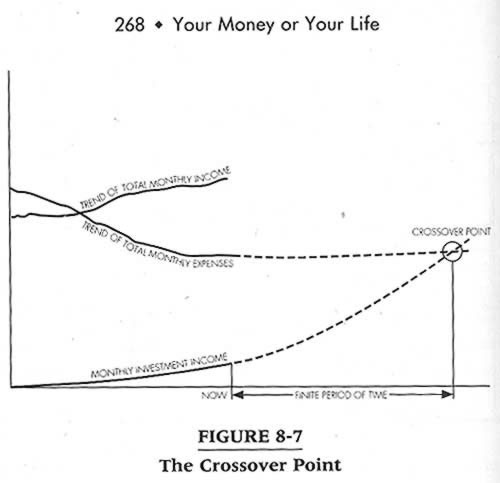
Crossover point chart from “Your Money or Your Life”

Joe’s most powerful concept was the wall chart of investment income and expenses over time. When you post your monthly numbers on this chart, prominently displayed on your wall as a constant reminder, you begin to focus on the spending that’s important to you and the savings that you can achieve to reach your goals.

As your investment income compounds and rises, eventually it exceeds your expenses at the “crossover point”: the date where you’ve achieved financial independence.

By the 1990s, Joe’s insistence on a portfolio of 100% Treasuries was ravaged by inflation. He started at an annual withdrawal of about $7000/year in 1969 and would have needed over $30K/year by 1997 just to preserve his purchasing power.

By this time he was sharing expenses in a group home and living an extraordinarily frugal lifestyle on about $13K/year, but most people would have run out of savings (and frugal motivation) after 20 years. Later editions of the book proposed a more mainstream inflation-fighting portfolio of low-cost index funds. Today, of course, Vicki continues Joe’s work on the YMOYL website.

While Joe Dominguez was living a frugal lifestyle in the U.S., Paul & Vicki Terhorst demonstrated a different sort of low-cost life: perpetual travel. Back in 1984, they retired with $400K to live around the world.

Paul was a CPA with a large firm, but he wasn’t happy in that avocation. When he was featured at a high-school career day and a student asked him what he really did, Paul’s epiphany was that he spent all day on the phone talking to people. He realized that he’d much rather have enough money to live the life he really wanted rather than piling up money to live any lifestyle. As a CPA, he knew how to analyze their finances and make it happen.

When they retired in 1984, Paul was 39 years old and their theme was “$50/day”. That spending goal helped them search out frugal ways to live a new life as a “perpetual traveler”. Instead of seeing Paris on a two-week pre-paid holiday tour, they found a cheap apartment and lived like locals. They spent months overseas in Thailand and in South America. They learned to speak foreign languages so that they could negotiate discounts on apartments. They learned the best places to shop for food and laundry with the locals. They learned how to get around on buses or taxis.

In 1988 they wrote the book “Cashing in on the American Dream: How to Retire at 35“. (It’s long out of print but still carried in some libraries.) Back then the Terhorsts saved enough money to put all their assets in CDs. (Kids, this is back when CDs were paying over 10%/year, but American inflation was pushing 5%. The American dollar was also much more valuable overseas.) Today they live off a diversified portfolio of low-cost index funds including equities and bonds. They can’t reach their original goal of $50/day in Paris any more, but they can still manage it in Asia.

The Terhorsts didn’t lock themselves into the perpetual-traveler lifestyle. In 2005, after over 20 years of traveling the world, they bought land and built a home outside of Buenos Aires. They lived happily there but they’ve just sold the place. After the second major downsizing of their lives, they’re spending a few months in the U.S. and then they’re headed out to Thailand, China, Malaysia, and India. You can follow the Terhorst’s travels on their website and through perpetual-travel updates in “Live and Invest Overseas”.

A third old-school frugal icon, Amy Dacyczyn, has a unique distinction: she’s one of the original frugal military spouses. Although the meme “milspouse” didn’t even exist back then, she developed her money-saving techniques on her spouse’s enlisted salary & benefits. When they retired in the early 1990s, they raised a family of six kids on his military pension and their bridge-career income.

Her writing career started with a newsletter of frugal tips that grew to over 100,000 snail-mail subscribers. After six years she began to “archive” them in three separate volumes, and today The Tightwad Gazette is available as one book.

The books made Amy a celebrity, with interviews on national TV shows and many talks on book-marketing tours. However, she values her privacy, and after six years of the newsletter she retired again. These days she offers occasional “where is she now” interviews, and this 2009 video lets viewers into her home for an update of her latest frugal tips and accomplishments. Even nearly 20 years after she started her newsletter, she’s still enthusiastic about the challenge of monitoring your spending, patiently hunting for bargains, and figuring out new ways to save money.

I read the original three-volume set and still have notes from some of those pages, but it’s a lot to absorb at one sitting. The best part of the newsletter was that it delivered regular small doses of advice throughout the year. Readers got constant reminders of ways that they could improve their budgeting and maximize their savings. Although they could put most of the advice into action during the first year, after a couple of years their learning curve began to flatten out. Each newsletter edition came out with new tips (Amy didn’t want to repeat her advice) and kept showing her readers new areas to work on.

I don’t think I’ll ever see a newsletter in my mailbox again, but these days I get my small doses of ideas & advice through e-mail and RSS feeds from other personal-finance blogs.

So where are today’s frugal leaders?

Everywhere. There are literally thousands of them, and you can find them all over the Internet or your local library. Personal-finance blogging is extremely popular, as are blogs on “green”, “minimalism”, and “simple living”.

Jeff Yeager is one of the latest frugal zealots to receive national attention with his first book. “The Ultimate Cheapskate” is a blatant tribute to not spending money. Jeff proudly writes that he’s not just frugal, but he tries to avoid even needing the item or the service in the first place.

He points out that there’s a return for not investing in a new way of doing something when the old way is “good enough”. He also thoroughly trashes the idea of saving your way to riches by avoiding the daily latte. In Jeff’s view, the best way to save for financial independence is to make thoughtful decisions about the big expenses that come along just a few occasions during a lifetime: buying a car, buying a home, getting a college degree, or paying for a wedding.

Sure, you can save $5 by skipping tomorrow’s caffeinated beverage, but you’re not likely to run to an ATM to deposit the money in your savings account. Yet by keeping your vehicle running for as long as possible, or by buying the smallest house you need, you can avoid the big spending decisions and see a significant difference in your net worth.

Jeff’s continues his quest in “The Cheapskate Next Door”, taking a road trip (by bicycle, of course) to interview cheapskates across the nation. Of course you’re going to look for this one at your local library.

Jacob Lund Fisker has shown thousands how to overhaul their lives with Early Retirement Extreme, a manual that combines frugality with high savings rates and financial independence in your 30s. The book is frankly a much more challenging read than the usual “get out of debt and retire early” genre, and the best place to absorb Jacob’s advice is on his Early Retirement Extreme blog. He continues the lifestyle but he’s currently working for a paycheck, so the blog is set on “recycle” with old posts being automatically sent out on a daily RSS feed.

Jacob’s designated successor is MrMoneyMustache, who also achieved financial independence through frugal living. He continues his lifestyle by rehabbing houses with re-used materials and turning them into income properties, as well as zealously promoting bicycle transportation. (He’s not totally car-free, but he can make a tank of gas last for literally months.)

His blog challenges you to find your own inner frugalista, even if it’s just by drinking cheaper wine or taking the stairs instead of the elevator. A word of caution: MMM has adopted a writing style that the popular media and employers would label as “not family friendly” and “not safe for work”. Don’t be offended by the occasional four-letter word– it’s part of pumping yourself up to tackle a better lifestyle.

Perpetual traveling has grown its own niche from the Terhorst’s early days, and now there’s another entire category of bloggers freelancing from overseas and traveling the globe. I think the most well-known PTs are Billy & Akaisha Kaderli, whose Retire Early Lifestyle website includes several e-book guides, a newsletter, and a blog. They began their perpetual traveler lifestyle in 1989 and continue to document their travels with impressive photographs and detailed advice.

Do you have a favorite frugal resource, either old-school or new? Please post it in the comments so that I can add it to our references and the blogroll!

Related articles:
Old-school frugal
Frugal living is not deprivation
Military retirement with low savings
A complete waste of money
Do you have affluenza?

Does this post help? Sign up for more free military retirement tips by e-mail, Facebook, or Twitter!

Posted in Money Management & Personal Finance | Leave a comment

If I Only Knew Then What I Know Now – How to Catch up on Your Retirement Planning


Jeff Rose over at Good Financial Cents is a CFP who sees dozens of older clients. Nearly every week he meets people in their 60s and 70s who tell him “I wish I’d started earlier and saved more.

Recently I heard from a military spouse with the same sentiments. The difference is that she’s figured it out at a much younger age, and she’s already started on her plan.

Hi Nords, thanks for writing such a wonderful book. If I only knew then what I know now and had lived a strategic life– you can quote me on that!!

Here’s our story:

Spouse is active duty enlisted with one year left. I truly believe if he makes rank this year he’ll sign up for two more because it is in his comfort zone. We’ve been married for 10 years, but I tell him to do what he likes because he started this before I came into the picture. He’ll probably retire with a pension.

I was a single parent when we married but I managed to be successful in my career. I’ve had the opportunity to make lots of additional income– when we first married I made more than he did. I’ve always been a worker bee and never worried about taking care of myself. I worked two jobs for 10 freakin’ years because I remembered a time as a single parent when I didn’t have two cents to rub together.

Reflecting on those 10 years, I probably made at least $60K/year in my part-time job and $35K/year in my full time job. When I wonder where all the money went, I can tell you: we have three children between the two of us. Only our youngest is home with us now.

I estimate spending $40K in childcare alone for our youngest before first grade– plus food, clothing and additional childcare through the years. My oldest was cheaper but we spent at least $60K. My spouse’s middle child was a bargain because child support payments were relatively cheap. But when we were all together during the summers we tried to make up for lost time by taking the kids on expensive trips.

I never knew much about investments but knew I needed to have them. I contributed just enough to 401(k)s to get the match. I’ve had three jobs in our 10 years of marriage and I just rolled over the 401(k)s into my IRA when I left. I have about $15K in the Thrift Savings Plan and I used to have $25K in the IRA. (More about this below.)

Today I only contribute $100 per month to my IRA and I have a small taxable account. We’re renting out our underwater home (in another state) for less than the mortgage. To make matters worse, as an out-of-state landlord I was using credit cards to cover expenses and I racked up more debt. (We now have a property manager.) Speaking of debt, that is where the rest of all the extra money went from my 10 years of labor.

I received a late charge on one of the credit cards and got really angry. (I mean in my mind, you can call me a debtor but don’t call me a LATE paying debtor.) I flipped out and transferred $18K out of my IRA and paid off all of our debts. I know I’m paying taxes and penalties, but I actually feel great because now our only debt is the mortgage. With our other debts paid off, we’re really ready to start saving money.

Right now my spouse earns his pay and I’m currently bringing in $1500/month by working part-time as an instructor at the local tech college. I would like to keep teaching but I really need to spend the time training for my national certification. When transferring to new duty stations left me unemployed, the military threw spouse benefits at me like crazy. They paid for my additional training which will increase my income. (MyCAA even paid for my Registered Property Manager certification.)

I still have to finish competency exams before I can sit for the certification. This involves an hour’s drive to volunteer for the time and exams, which adds additional commute expenses as well. Unfortunately I am so burned out in this career field and really want to find an avocation. I’ve also been taking accelerated math classes so that I can complete my bachelor’s degree. That’s been a dream of mine since I was a baby toting single parent.

Our plan is to live below our means, maintain my part-time job, and start throwing all extra funds into investments.

My latest dream? Retire from active duty. Keep landlording our out-of-state home. Move to the east coast (near hubby’s family) and raise our youngest in the country where housing is cheaper. Use my college degree to leave this career and find an avocation. I’d eventually like to buy rental property for another source of income but I still have to learn how to do that.

Sorry for the long rant but it sure felt good to write it all down!!

Thanks for writing! I’ve learned that when I can write it all down, it helps me understand the problem. Then I can figure out what the next step should be.

You’ve been digging out of debt and now you’re making progress. If your spouse is enjoying what he’s doing then he should keep doing it until he’s had enough. You will both recognize when it’s time for him to retire. It won’t be difficult to figure it out. Until then you’re building your savings and the job security is a tremendous comfort factor.

You’re probably already considering these suggestions:

1. Build up your emergency fund. It can be small while your spouse is earning active-duty pay, but it should be big enough to cover a landlord’s major repair on your rental property. Find an amount that lets you sleep comfortably at night.

2. Consider contributing to the Roth TSP. The Roth TSP starts on 7 May, and it’s the world’s cheapest index funds. Try to max out your contributions to the TSP or the Roth TSP (however you decide to split it up). When your spouse retires then you can roll part (or all) of the TSP over to an IRA.

3. Teach yourself about asset allocation so that you’re comfortable putting your new savings into equity index funds. I recommend the Bogleheads.org wiki on investing and asset allocation. You could also read Rick Ferri’s book “All About Asset Allocation“.

(Rick is a retired Marine aviator; you can find his books in the library.) The more you know about AA then the more comfortable you are with stock-market volatility– and the less likely you are to panic during “buying opportunities”. Once you’ve figured out your AA, then try to max out the TSP and both your IRAs. Put any additional savings into taxable accounts.

4. If you’re not happy in your career then you’re going to burn out and get even more frustrated about the obstacles to certification. You want an avocation that’s fulfilling, interesting, and with autonomy. Could you use your certification & skills to focus on the teaching part of the field? Would that be an alternate avocation? Or maybe it’s worth talking to your base’s transition office about a new career search with those factors. I can tell you that the best time to explore a new avocation is “now” rather than “later”.

5. Do you have the GI Bill working for you and your kids? That would help you finish your college degree (if that’s not already being paid for) and fund some of your kids’ educations. The key is for your spouse to sign up to transfer eligibility, even if it’s just one month for now with more later.

6. You probably know enough about living below your means, but if you want to hone your skills then you could check the “Military Family Finances” forum at the Dollar Stretcher, as well as their other community forums. I’m perpetually amazed at how those posters can squeeze a nickel, and I mean that in a good way.

7. Review your insurance. Make sure you have enough insurance on your rental property, your vehicles, and your personal property. You could save a little on the premiums by choosing a higher deductible, but keep those premium savings in your emergency fund to cover the higher deductible. You could drop the comprehensive & collision insurance on your older vehicles if you put those premium savings into your vehicle replacement fund. The key is to insure yourself against a catastrophic loss or to have your own funds saved up for the expense.

8. Review your insurance again. Your spouse should have maximum Servicemen’s Group Life Insurance now. (Hopefully he already updated it to make you the beneficiary instead of an ex-spouse.) When he retires you should select the maximum Survivor Benefits Program (it’s your choice, not his). If he starts a bridge career after military retirement then he might need additional term insurance to protect his income. Once you start earning the big bucks then you should consider term life insurance for yourself, too. The idea is to cover each other with enough to finish raising your kids while you continue a career.

9. If you have the temperament for landlording, then I’m a fan of doing it near a big military base. (The trick is to make sure the military base doesn’t shut down on you and bankrupt the community.) Landlording is much easier if you’re within a short drive of your property, but a property manager can keep you out of trouble for a tour or two. Learn the property market around the base and start going to open houses to talk with realtors.

Eventually you’ll know the area well enough and they’ll start calling you about bargains. The two best books I’ve read on the subject are (1) Investing in Real Estate, 4th edition or later, by Andrew McLean & Gary W. Eldred (who’s taken over the new editions) and (2) Landlording by Leigh Robinson (7th edition or later).

(The books are probably at your local library.) Another website for hard-core financial analysis of a rental property is Frank Gallinelli’s “Real Estate Investment” blog. Subscribe to his blog, read his archives, and learn about assessing the financial potential of a rental property. You’ll also learn how to maximize the potential of your current rental property– eventually the area will recover and you’ll be able to raise the rent to generate cashflow.

10. Focus on your progress, not your regrets! It sounds like you’ve done a great job of raising a family under tough conditions. It hurts to remember where all that lovely money went, but at the time you were doing the best you could with the skills and knowledge and opportunities that you had. Now you’re smarter, and the pain of the experience has given you the motivation to succeed. Consider the money to be tuition payments to the School of Life, and now you have a graduate degree in the subject. Now that you’ve paid off most of your debt, it may take you fewer years to achieve financial independence than you expect.

Thanks for sharing your story, and please keep us posted!

Related articles:
Military retirement with low savings
Is the Roth Thrift Savings Plan right for you?
Save or invest?
Is the 4% withdrawal rate really safe?
Military retirement: how much can I really spend?

Posted in Money Management & Personal Finance | Leave a comment