Navy: women are joining the crews of VIRGINIA-class attack submarines


Let me start this post with a couple of our household’s famous naval sayings:

“You are such a freakin’ nuke.”
— My spouse, USNA ’83, to me, USNA ’82, many times over the last 30 years.

“You hear her? Someday soon you could be a freakin’ nuke too…”
— Me to our daughter, NROTC ’14.

The Secretary of the Navy has formally announced the news that the Chief of Naval Operations (a submariner) has been quietly sharing with submariners for months: women officers are joining the crews of VIRGINIA class submarines. Enlisted women are joining soon after that. It’s expected that women will be joining the rest of the OHIO class submarine force as well.

That news led to an interesting conversation with our daughter.  It’s possible that there might be far more women midshipmen interested in joining the submarine force than there would be billets for women submarine officers.  The competition could be brutal.

Let’s see if we can put some numbers on that speculation.

My fellow nukes are smirking right now. They know there won’t be much competition. They know that it’s hard enough to find men willing to join the submarine force, and research has shown many times that women are the smarter gender. If the assignment officers already have to bribe the guys with large buckets of money just to join (let alone to stay in) then why would they think that the women would be eager to join too? Equality of choice is long overdue, but does that make the submarine force a good choice? As always, you have to ask why the military is being so nice to you. “Nice” as in $25,000/year bonus money.

Nukes are an analytical bunch, and that carries over to the subject of financial independence. For example, there are about 75 posters on Early-Retirement.org who have identified themselves as military veterans. At least five of those 75 posters (me included) have gone to sea on a submarine. When I left the Navy, the submarine force was less than a tenth of the Navy’s personnel and the Navy was less than a quarter of the total strength of the U.S. military. By those fractions, no more than two of the military posters on Early-Retirement.org should have been submariners– yet we’re more than twice the expected population. Admittedly a small sample, selection bias, math geeks, and other disclaimers. But financial analysis attracts nukes like flames attract moths.

Nukes do a lot of math. I don’t know why it was such a big deal in nuclear power school and again in the submarine force, but we were taught to do all sorts of math in our heads– “mental gymnastics”. Ironically on a submarine we’re surrounded by expensive MILSPEC fire control systems and dozens of personal computers. (Plus our cool calculator wristwatches.) But junior officers are expected to correctly determine a watchstander’s radiation exposure or the range to a target. They have to do it in their heads, and at least as fast as the executive officer. If they can’t consistently be both correct and fast then they may lose their privileges to take a shower– let alone watch the evening movie. Oh, and they’ll have the midwatch too.

I can guarantee that the subject of women crewmembers is being discussed in dozens of submarine wardrooms and watchstanding spaces now, and the entire submarine force is trying to quantify the estimates. So let’s do some of every nuke’s favorite retention analysis: billet math. How many women officers will the submarine force need in order to comply with the SECNAV and CNO announcements?

I’m going to pull my numbers from public sources. All of this data is (or should be) available to everyone. If you have better data, please correct my estimates.

Each submarine crew has (so far) three women officers.  Only two of these officers will have nuclear training and the potential for an entire career in the submarine force.  The third billet comes from the Navy’s Supply Corps for just one submarine tour of 2-3 years.  Most of the Navy’s new women officers will not be eligible to join the Supply Corps, so we’ll focus on each sub’s two nuclear-trained billets.  There are 18 OHIO-class submarines, and each submarine has two crews.  There are also eight VIRGINIA-class attack submarines in the water or on the builder’s docks, and attack submarines have only one crew. Each of those VIRGINIA crews will also probably have three women officers (one from the Supply Corps), since that’s how many are berthed in an officer’s stateroom.

That’s 44 submarine crews and 88 women officer submariner billets. 16 of those billets are already filled with women (the first four OHIO-class submarines), leaving 72 billets yet to be filled.

Junior submarine officers typically have a three-year tour on their first submarine, so a third of the officers in those billets will roll ashore every year. Assuming that there are at least 88 billets for the next few years, then every year 29 of them will open up.

The Navy needs at least 72 women officers to show up on those submarines beginning in October 2014, and another 29 every year after that. Let’s assume that new VIRGINIA-class submarines are commissioned as quickly as OHIO-class submarines are decommissioned, and that wardrooms stay at three women officers (instead of six or more). The reality is that these numbers are minimums and will grow, however, let’s assume that they stay steady for a few years.

But wait– before those nuclear-trained women submariners can walk across the brow, they have to finish 15 months of training: six months in Nuclear Power School classrooms, another six months qualifying at watchstanding on shore-based military nuclear reactors, and three more months at Submarine School partying studying the rest of the sub’s systems.

The graduation rate of this pipeline is not 100%. It’s not even 90%. In fact, 30 years ago a few of my classmates actually ended up hospitalized for treatment of stress-related exhaustion. Hopefully, Millennials are made of sterner stuff than us Baby Boomers (good luck with that!).

I’m going to assume that only 80% of the officers make it through the training. The military is pushing through a large drawdown, billets are tight, and nobody wants to be perceived to be cutting any slack for the women students.

When attrition is 20%, then those candidate numbers are now 90 in October 2014 (which means they start training in summer 2013) and 36 every year afterward. The real question on the assignment officers’ minds is: From where are these women officers going to appear?!? They need to find the first 90 in the next six months, and mostly from the college Class of 2013.

Women have been at military service academies since 1976, and today women make up approximately 20% of the graduates. I’m going to assume that the U.S. Naval Academy will graduate roughly 1000 midshipmen per year for the next few years, and the women from other commissioning sources (NROTC, OCS, NUPOC, the surface fleet, and a handful of other acronyms) will make up another 1000/year. At least 800 of that second thousand will be NROTC.

At this point, the assignment officers might heave a sigh of relief– problems solved. 200 women officers will be coming from USNA and another 200 from other sources, so that’s plenty!

Well, not so fast. USNA Class of 2010 had over 800 male midshipmen, and only 127 chose the submarine force.  (The linked article gives the impression that the submarine officers wish they’d enticed more into the service.)  I’m not sure how many men volunteered from NROTC or the other commissioning sources, but USNA usually has at least half of the total number of officer submariners from all sources.   Let’s assume that 130 men volunteer from USNA (out of 800 men) and another 130 from all the other commissioning sources (out of another 800 men). That’s about 16% of the total of all officers who are volunteers for the submarine force, not voluntold.

I was a military training instructor for nearly eight years. I don’t know about you civilian professional teachers, but I only want eager volunteers in my classrooms. I can just imagine what will happen when a “drafted” officer shows up at nuclear power school and makes it their mission to convince the chain of command that they’re only suited for aviation… or for the Marine Corps.

The assignment officers expected all of those sources to commission 400 women.  If only 16% of those 400 women officers volunteer to be submariners then the candidate pool shrinks to… 64.

32 of the 64 volunteers would come from USNA, another 25 or so from NROTC, and the rest from those other sources.  We already decided that women are generally smarter than men, so 64 seems like a pretty optimistic number.

If I was an assignment officer, I’d be just a tad worried about filling those initial 72 billets with 90 candidates from the Class of ’13. I’d need a bunch of extra volunteers from the Class of ’14 to catch up, and I might need a few extras from the Class of ’15 as well. Even after I caught up I’d still have to steadily recruit another 36 per year. It wouldn’t take much to screw up my plans for the subsequent classes, either, if volunteers are consistently fewer than the billets.

If I was a male or a female hard-chargin’ engineering major with a decent GPA at a top-ten college, with impressive military leadership performance (perhaps owning a ballistic missile submarine deterrent patrol pin from my midshipman summer training aboard a sub whose CO gave me top grades)… then I’d feel pretty confident that I could get picked for submarine duty. If I thought that the assignment officers were already sweating the quota then I’d be downright optimistic.

My daughter is smarter than me. (My shipmates are smirking again.) She’s also more mature, more organized, with better leadership skills, and better study habits than I had at that age. (She’s also much more sober than I was at that age.) Three decades ago I managed to stumble through the nuclear training pipeline. I lurched through the qualification gauntlet on my first submarine, and (much to my XO’s surprise, let alone my own) I actually qualified for command. Frankly, I’m a little jealous of my daughter’s opportunity to go to sea on one of the Navy’s newest submarines, perhaps out of Pearl Harbor. I think she’ll do a lot better at it than I did.

Maybe my daughter’s question shouldn’t be “If?” she’ll make the cut for the submarine force. Maybe the question should be “Why?!?” she’d want to join the submarine force.

That’s a question only she can answer.

But while she’s waiting for the chance to volunteer, she won’t slack off.

And she’ll keep saving as much as she can for her own financial independence.

[Disclaimer: If a retired geezer can come up with these numbers, I hope you active-duty experts can provide better ones (with public links when possible). I’m standing by these numbers until we get more credible data. Let’s see how close my mental gymnastics come to the actual 2013-14 numbers.]

Related articles:

Join the military to get rich and retire early?: the rest of the story
Will the military pay off your student loans?
Sea story: Simulate submarine life at home
Getting rich in the submarine force

Posted in Career | Leave a comment

Book Review – To Forgive Design: Understanding Failure


Good nature and good sense must ever join;

To err is human, to forgive, divine.

— Alexander Pope, “An Essay on Criticism”

WARNING: Engineering geek alert.

Bear with me here, and I’ll eventually get around to personal finance. If you’d rather skip all that engineering stuff and just read about financial independence then jump down to the final paragraph.

One of Henry Petroski’s previous books (25 years ago) is “To Engineer is Human”. His latest is To Forgive Design: Understanding Failure. He’s a civil engineering & history professor at Duke University, and he makes the most of the overlap between his two fields.

This book sings to me because I started the Navy’s nuclear power school nearly 30 years ago. It seemed that as soon as we understood the basics of a system, whether it was nuclear or electrical or mechanical, the very next thing we were taught was how it would fail.

The same trend followed through our land-based military nuclear plant training, and out in the submarine fleet it ramped up several notches. Everyone expected you to know how the systems were designed and how they worked together, but you really had to understand how they failed.

You trained a dozen times a week on these failures and the emergency procedures. Even during the world’s most boring midwatches you were monitoring for signs of impending failure and doing maintenance before it failed. You were never happy when something managed to fail without warning, but you were rarely surprised.

It’s a little ironic. The Navy’s submarine force has the world’s most expensive equipment and most highly trained personnel, but all we do is chase down broken gear. Every day we pushed our gear (and ourselves) to the limits of the safety margins, and we needed to know how to handle failure. Imagine how bad it would be if we didn’t buy quality and spend all our time training.

My family will confirm that three decades of watchful paranoia has made me a little difficult to live with, but I immediately recognize the failure philosophy in Petroski’s book. He describes one design and construction triumph after another, and in the very next paragraph he explains how they turned into miserable failures.

Probably the most famous example of a civil-engineering disaster is the 1940 Tacoma Narrows Bridge collapse. Millions of high-school physics students have seen the video of undamped oscillation resonance, and I’m sure that many of them have snickered at our ancestors’ engineering hubris. Who could design such a vulnerable system, and why didn’t they see this problem coming when they were building it?

Petroski digs into the details and leads us down the primrose path to destruction. Dozens of these bridges were built during the 1930s, and their physics and construction were quite well understood. However, the Tacoma Narrows design pushed the envelope, and its construction clearly showed that it was susceptible to oscillations.

Construction crewmembers actually suffered from motion sickness, and on the drive across it was common for the roadway to flex enough that cars would lose sight of each other. For several months it was the country’s most popular bridge adventure, and it generated a huge revenue in tolls. But in retrospect, the failure analysis showed that the span behaved more like a wing than a bridge, and when a small part eventually failed on one side it took very little time for the Tacoma Narrows winds to generate the lifting forces that pushed the rest of the bridge to collapse.

Another example is the Comet passenger jet airplane. It was a marvel of 1950s aerospace technology, taking passengers faster and higher and further than any propeller-driven aircraft. Everything went fine at first but then several of them exploded during routine flights, killing everyone on board and spreading debris over many square miles.

It seemed impossible to reconstruct the cause of the disasters, let alone fix the problem. One engineer suspected fatigue cracking and eventually managed to carry out a series of horribly expensive full-scale tests on Comet fuselages. The results finally showed that cracks began in the squared-off corners of windows and hatches where metal stress was highest, and where fatigue cycles had a critical effect. The entire industry redesigned aircraft and maintenance to minimize this danger and to reduce the impact of failure.

Petroski writes chapter after chapter of one failure after another, from 18th-century bridges to the space shuttles. In each case he shows how designs and operating procedures were declared safe mainly because nothing bad had happened– yet. Even mathematical analysis, full-scale models, and computer simulations could only predict known effects on materials and designs. All of the world’s engineering expertise couldn’t account for failure from effects that weren’t even recognized, let alone understood. If we blindly (and optimistically) pushed the parameters of materials and their lifecycles, we couldn’t accurately forecast the results.

Part of his book is a warning. Many of the disasters occurred during what appeared to be routine operations or inspections, but later analysis showed that “normal” had evolved over the years to “extreme”. Other disasters happened from events that seemed like a good idea at the time, like staging construction materials on a bridge without accounting for the cumulative concentrated effect of the heavy weight. Crane operators became accustomed to minor equipment annoyances and learned to work around them, not appreciating that a “minor” safety violation would have catastrophic effects when the cranes were loaded to their capacity.

Petrsoski’s harshest criticism is reserved for flawed corporate culture. A disconnect between engineering and operations, or flawed communications and rivalries, will hasten failure. Confused reports or even alerts from the trenches are explained away (or ignored!) by upper management, with predictable results. It happens in the best of organizations, and in a few entrenched bureaucracies it can happen more than once.

He also explains how institutional memory only seems to last for a generation before the warning signs are forgotten. Thumbrules of design and construction are forgotten, or new materials & techniques appear to make the “old” guidelines obsolete. A disaster may resonate through the industry for decades, but eventually a new generation of engineers has only a faint appreciation of the history– and they don’t see how the lessons of an old building collapse could apply to their “modern” understanding of the technology.

Back to the personal finance theme.

The author writes for engineers, but the lessons are also painfully applicable to personal finance. It’s all too easy to ignore warning signs in our budget or our spending, let alone in Wall Street’s latest “sure thing” financial engineering. Every analyst assures us that “it’s different this time”– until it isn’t. Every new generation doesn’t comprehend how truly awful the last recession felt, until they personally experience their own recession. Every retirement plan is susceptible to dangers whose symptoms may be misunderstood or, even worse, ignored until it’s too late.

Will we ever learn from our flawed design process? If two centuries of history is any indication… no. However, Petroski’s book is a text in my daughter’s civil-engineering curriculum, and she’s ready to sign up for the submarine force. I hope that all of our design and operating experience will make us skeptical of the process, painfully aware of how far we can push our equipment, and sensitive to signs of trouble. We may not be able to avoid failure by design, but hopefully we can minimize its effects during operation.

Consider failures when you save for financial independence, too. Be aware that you can’t predict every catastrophe, let alone avoid them. Diversify your investments so that a failure in one or two areas won’t wipe out everything. Have a safe source of income for a subsistence level of spending– even if your safety net is “just” Social Security. Read as much financial history as you can so that you’re ready to stay calm when it tries to repeat itself. And once you’ve achieved your financial independence, keep watching for those little alerts that a problem might be starting. You can’t eliminate failure, but you can deal with it.

Related articles:
Problems with retirement calculators
Is the 4% “safe” withdrawal rate really safe?
Retirement planning: “Just tell me what to do!”
How much cash in a retirement portfolio?

Does this post help?

Sign up for more free tips on financial independence and military retirement by Facebook, Twitter, or e-mail!

Posted in Reviews | 2 Comments

Guest Post Wednesday: “My Road to a Reserve Retirement”


This guest post is brought to you by a servicemember who’s approaching Reserve retirement after an unusual career path… and you can too!

If you’re interested in guest posting, please see our guest posting guidelines.

I enlisted in the Army as a combat medic in 1990. Being the oldest of three and a first-generation American, I felt a responsibility in alleviating the college costs from my parents. They paid for the first year, but my sister was the next in line to graduate from high school. So, after a year of school, I enlisted in the Army Reserves.

I was never athletic and never dreamed of being in the Armed Forces. But I enjoyed Ft. Disneyland, I mean Ft. Dix. I discovered in Boot Camp that the National Guard actually gave you a scholarship, a Combat Medic bonus and loan repayment.

The Reserves only offered loan repayment. So, after returning from Advanced Individual Training at Ft. Sam, I moved from the Reserves to the National Guard. The catch was that I had to conduct training for one year in my unit in order to get the scholarship and Montgomery GI Bill.

The year was 1991, and it was my first experience of dealing with a “recession.” I had to take a year off of school so that I could receive a scholarship. My plan was to transfer to a school closer to my unit. However, I decided that I missed my friends at my former school, which was five hours away. I returned to my former school and traveled five hours every month for drill.

The Guard did not reimburse soldiers for travel then, so my $100 Amtrak ticket canceled out any money earned for a weekend drill. I did annual tours in Ft. Bliss and Ft. McCoy. I was even mobilized for flood duty. It was getting close to graduation and realized that I had signed an eight-year contract— not 6 in the Reserves and 2 inactive years that I thought. I was about to graduate and did not want to stay stuck in my city due to the Army National Guard. I also wanted to become an officer and see the world. I found Air Force ROTC in my last semester and never looked back.

All in all, I spent 14 years and 9 months on active duty as an officer. I got to live in Turkey, Japan, and Korea. I earned several awards, even one in Squadron Officer School.

I had started to become interested in saving for retirement in 1999. We had a guest speaker visit our base who lost all of his retirement savings at an airline company. I was in tears. He said that you need at least three pots of money for retirement.

I began with a Roth IRA at $50 a month and a $2,000 annual limit. We did not have the Thrift Savings Plan (TSP) until 2003 and it does not match military contributions. I had racked up $40,000 in student loans (at 8% interest) for my bachelor’s and graduate degrees. About $4,000 was from capitalized interest when I deferred them for four years. I decided to clean up all of my debt from 2007-09. And did.

I met my Lt. Col.’s board with hopes of making it to an active duty retirement. Unfortunately, my boss did not know how to write a performance recommendation form (PRF) and along with not enough or strong enough stratifications (I had been in 3 or 4 person shops most of my career), I was passed over for Lt. Col. in 2010. I was devastated.

When you meet the board above the promotion zone (APZ), there is about a 3% chance of making promotion. I thought that I would just have to endure being a “major” for the rest of my career. I look pretty young for my age, so unless you are in my year group or nosy, you would not know what rank I should be. So, I decided to deal with the humiliation.

Well, the Air Force had different plans. In 2011, the AF claimed to have notified those meeting the APZ that if you did not get picked up you may be involuntarily separated. I had feared that in the back of my mind, but seeing the occasional passed over majors around base, I ignored that feeling. Plus, I ended up winning a major command award before the board, so I felt like a phoenix rising from the ashes. I also felt more hopeful since my new boss wrote a really good PRF that included the new award.

My 3-star general called me in two and a half weeks before my move to Texas to tell me that I had been passed over again and this time I would be involuntarily separated. I was stunned. He asked if I had any questions after he explained that I would get a severance. I said, “No.” He said, “At least you are prior service” and I left his office. In my mind, I thought “Well my prior service does not count towards an active-duty retirement.”

So, my follow-on assignment to San Antonio was canceled. I redirected my household goods shipment to storage in California. I called my parents and asked if I could stay at their empty house in Florida until I could find a federal job. I had heard that you could buy your military time and my career could easily translate to a fed job. I also like to have job security and a matching TSP. I had a vacation planned en route to Europe, which I ended up doing. When I returned to the states, I worked and re-worked my resume. After reading the horror stories on a fed message board about it taking some folks two years to get a job in government, I hired a resume writer.

I enjoyed four months of terminal leave pay. But I decided that I needed to finish my military time in the AF to get a reserve retirement. I felt slightly humiliated when I tried to apply for the Reserves. Since I was passed over, I had to get a waiver and find a unit that would take me in. I waited until I found a GS-13 position 6.5 months later in the federal government. I called a Reserve unit near the town I was relocating to. The commander hired me after reviewing my last five Officer Performance Reports. I had to submit three letters of recommendation for the waiver. It took seven months for me to be gained into the AF Reserves.

I have been in my federal position for 11 months. Over the holidays, I realized that my Reserve point summary was missing my last year of active duty. I found an old printout from the Army National Guard in my records. It was hard to read, but I thought that I might have about 3 good retirement years. I requested a point summary audit and forwarded my Army NGB-12 (discharge record) and DD-214. The point summary personnel also requested my Army Reserves points from their counterparts. When the smoke cleared, I had 20 good years at $2,951 a month when I turn 60 years old. Of course, I have to repay the $118,000 in severance money. However, the AF cannot garnish more than 40% of my retirement check. I also plan on buying my military active-duty time so if I work 17 more years in the federal government, I can retire at 57 years old with 31 years from civil service.

I meet the Lt. Col. board next year for the Air Force Reserves mandatory promotion board. I think I have a good chance since I have my Air Command and Staff College finished (completed in 2007) and my masters. My AF Reserves boss said she got promoted to a Lt. Col. without having a master’s. Also, our deputy chief got passed over for not having Air Command and Staff College finished. It looks like a different playing field this time. So with a solid PRF in hand, I am indeed a phoenix ready to rise again.

Reminder: This is a guest post. Please be polite, or the comments moderator will kick in.

Related articles:
Should you join the Reserves or National Guard?
Retiring from the Reserves and National Guard
Retiring on multiple streams of income
The transition to a bridge career
The Reserve Component Survivor Benefit Plan
Calculating a Reserve retirement
Reader questions on Reserve retirement Tricare and points

Posted in Military Retirement | 3 Comments

Dealing With Credit Card Fraud — Any Suggestions?


My credit card data was stolen last month. I was lucky– the thief moved slowly and there were only two charges before the fraud computer kicked in. But it was still a hassle and an inconvenience, and at first, I had to push pretty hard to get the fraud staff on the job.

Of course, it’s the card that I use all the time: a Fidelity Rewards American Express. It’s only my fifth credit card in over three decades, and I’ve never used a debit card. I’ve had the American Express account for nearly four years. There are no fees and it offers a 2% rebate that’s painlessly credited back to my Fidelity investment account. Since our local Costco also sells gas and only takes Amex, I swipe that card for nearly every single purchase in our household. We live a low-key beach-bum lifestyle these days, and I use so little cash that I can go more than a month between ATM visits.

I’ve had one card stolen over the years, and one other data theft, but surprisingly this time I was the guy who caught the online fraud. (First time ever.) I was waiting for a refund from a company and I was checking my account website to see if the credit had cleared yet. To my surprise, I saw that my Amex card had a temporary authorization for $1.30 at a cosmetics store– in Florida.

No, it’s not what some of you are thinking. My spouse and I have been married for over 25 years, but we’ve kept our finances separate because we were overseas (and underway) for most of our Navy careers. You couldn’t be confident of balancing your accounts, let alone know what each other had spent. Back in the good ol’ 1980s, it took so long for your credit-card bill to be forwarded by APO snail mail (and for your paper check(!) to be mailed back to the U.S.) that you were lucky to make your payment before the due date. Back then I was also underwater for over 90 days at a time on submarine patrols, so my card was unreliable. The fraud computers would regularly suspend it whenever I returned from sea and tried to use it.

This means that my spouse and I have had separate personal finances ever since we married. Separate paychecks, separate checking accounts, separate ATM cards, and separate credit cards. We have separate credit histories. We don’t use each other’s cards, and we regularly track our spending in Quicken. We almost never have one of those “Oops– honey, I’ve been meaning to tell you…” conversations.

Two months ago at USAA’s blogger conference, we saw how frighteningly easy it is to duplicate a credit card. A very cheerful exec from their banking services division did it in about 90 seconds. (Of course he’s cheerful– he can give himself a credit card whenever he wants!)

He started with his USAA corporate credit card and a fistful of hotel “room key” cards. He showed us how to buy a card reader on eBay (a completely legal item for small businesses) which even comes in a smartphone model. He showed us where to buy the hardware to write the credit-card data onto a magnetic stripe. (Also completely legal– and cheap!) He swiped his corporate card on the reader, fiddled with his laptop for a second, and then started swiping hotel key cards through the writer.

After making a dozen copies of his corporate credit card, he was also ready to go online with the same card data to buy more stuff. Finally, he showed us how to wirelessly transfer the data (by smartphone) so that your credit card data can be swiped by a clerk as you’re making your purchase– and sent overseas before you even sign the charge receipt.

When I saw that $1.30 “temporary authorization” on the website summary of my card purchases, I knew immediately that it wasn’t mine. I knew that I still had my credit card, and I’d been using it with local businesses where I’d been shopping for years, but none of that mattered. I knew that a clone of my card was being tested (5000 miles away from me) so that someone could start their spending spree.

Either that or someone in a store five time zones away from me had made a data-entry mistake and accidentally typed the wrong card number (my number) into their cash register.

Guess which scenario the card services company thought it could be.

The credit card services company, FIA Card Services, is part of Bank of America. BofA has been a popular media punching bag for a few years, and maybe we’ve been too harsh on them. You can assess FIA Card Services however you want– as a galaxy-spanning enterprise with decades of eagle-eyed security experience at handling credit-card fraud, or as a disorganized Megacorp “Office Space” zombie lurching about cluelessly.

I discovered the fraud on the weekend between Christmas and New Year’s, so perhaps they were down to a skeleton staff. I phoned them on a Saturday evening in Hawaii, which made it very late at night for the Mainland call center. Whatever time zone they were in, I could tell that the A-Team was not on duty.

FIA Card Services did not exactly make these guys proud.

They don’t do credit cards.

Even after I explained the problem, they started at the beginning of the script. First I got the “Credit Card 101” lecture:

“Sir, do you still have your card in your possession?” Hey, pal, that’s why I called.

“Have you tried to use it recently?” Yeah, see all those Costco charges? In my ZIP code?

“Have you bought anything online?” Yeah, but are any of those companies flagged for fraud?

“Well, sir, it could be someone else in your household using your card.” Um, no. It’s theft. Seriously.

Then I was upsold:

“Would you like to purchase our monitoring service that…” No, I’d like to report a crime.

Then they went for “computer glitch”:

“It’s only a temporary authorization, not an actual charge, and that might not be the final amount. It’ll clear up in a couple of days.”

I could see where this was going, so I asked him if he was recording the call. When he affirmed, I told him that I was formally notifying FIA Card Services of an unauthorized use of my credit card and that any fraud would be their problem. As you might expect, he was cool with that. Apparently, the call center script doesn’t have any tripwires for customers slinging words like “theft” or “crime” or “fraud”. I had no desire to get to know the supervisor on duty that night, either.

Our daughter was home from college, so we had plenty of activity in the house. I dropped this problem and we resumed surfing our usual routine. I even used that Amex card the following Wednesday with no problems.

But when we came home from surfing on Thursday morning, our answering machine was blinking like a holiday light show. I had calls from both a computer and from a human who was “urgently” trying to reach me. Good thing I hadn’t needed to use that Amex card in the surf break, either, because it was “suspended pending resolution of the matter”.

You would think that FIA’s fraud department would want to speak to me as soon as my return call connected. You would think that they’d leave a callback number ringing directly in the cubicle of the person working on the problem. You would think that they’d have an expedited service for customers returning their call– especially for calls about fraud.

You would be wrong.

At this point, I was beginning to wonder if FIA Card Services even has an “A-Team”.

When I called back, a cheerful computer audio track insisted on telling me about my card balance and my last dozen transactions. I had to wade through the usual “interactive” voice “response” menus to get to a live human. Then I had to be transferred to the fraud department, where I was again put on hold. I’ve revised my opinion of FIA’s abilities from “eagle-eyed security” to “zombie”.

While I was waiting, I logged on to my account. Yup, the card had been used to buy a ticket on Norwegian Air– and $381.25 to Sweden seems like a good price.

The fraud squad hadn’t even read my call center file. When they launched into their own Credit Card 101 lecture, I mentioned that I’d already called FIA Card Services on this problem. I was put back on hold while they reviewed their records, and they returned to inform me that they’d reverse the charges. They also said that they’d canceled the card and would issue me a new one in “five business days”.

In Hawaii, when someone on the Mainland tells you it’ll be there in five business days, what it really means is that it takes five business days to get to the West Coast. They don’t understand that from there it can take another week to get to Hawaii. I pointed out that I’d already been inconvenienced by FIA Card Services on my first phone call and again on this call, and they needed to reciprocate with some of the famously advertised Amex rapid response. FIA grudgingly admitted that they could FedEx the card to me on Saturday morning– in just 48 hours.

Sure enough, it arrived only 96 hours later. Good thing I asked for expedited service.

My USAA credit card covered the four-day gap… admittedly at a smaller rebate rate, but with no drama.

I activated the new Amex card with no problems, the charges have been reversed, and the old account data was transferred over. I didn’t have any automatic payments linked to that card, so I didn’t have to scramble to update anything. Life goes on.

A week later FIA piled insult on top of injury by requiring me to fill out not one but two fraud statements– in two separate envelopes on two separate days. The website had already been updated and my new card had charged up a storm. However, they still snail-mailed me paper forms to fill out, add my signature, and snail-mail back.

So how do I keep my card data from being stolen again?

Beats me. I still don’t know how it happened the first time, and if FIA knows then they haven’t told me. Was my credit-card data skimmed at the Thai restaurant in our local shopping center? Was it the genetic testing that I ordered from 23andMe.com? The books I ordered from Amazon.com? Was the card data stolen two months ago during my Mainland travel and eventually sold to someone who finally got around to using it?

I’m going to do some basic follow-up to protect against more credit fraud problems. I’ll request a free annual credit report from one of the three agencies every four months (as usual) to make sure that this incident doesn’t slop over onto my records. I’ll add a fraud alert to my credit file for the agencies to keep an eye on.

My new credit card number is on file with Amazon.com but I’m not going to store it on any other websites unless it’s absolutely necessary. If I do, I’m going to use a one-purchase number provided by FIA’s website. I’d love to get an e-mail alert from FIA Card Services every time my credit card is charged, but they don’t seem to offer that convenience.

If my credit card data is stolen from the new card, though, then I’m done with FIA Card Services. Of course, I have a fairly hefty credit limit built up with them, and I’m reluctant to mess with that. I’d like to keep a high credit rating for our insurance rates. I’m retired and I don’t plan to borrow more money, but if I decide to refinance a mortgage then I’d also like to do it on that high credit rating.

I won’t have to give up Amex if I give up FIA– I can just sign up for a Costco rebate Amex card and enjoy their customer service.

Are there any other steps I should be taking to recover from this fraud?

Posted in Money Management & Personal Finance | 9 Comments

Save Money by Fixing Your Own Plumbing


Everybody wants to save money to reach financial independence, but it’s even more challenging to avoid unnecessary expenses. Sometimes “spending avoidance” requires sweat equity, training, and experience. Other times you can avoid expenses with a little knowledge and good habits. The trick is to find the balance where “do it yourself” is not slave labor.

If you’re a little bit familiar with the design of a house, and if you read a free website or a weekly e-mail (or subscribe to a monthly magazine at $10/year), then you can save yourself thousands of dollars.

Here’s a real-life example.

Our neighbor had a plugged kitchen sink drain: on New Year’s Day, just a couple of hours before company showed up for dinner. I have no idea what plumbers or handymen cost on that holiday– $100? $250?!? I doubt you could even persuade one to show up. By the time our neighbor called for help she was very worried.

Their kitchen sink drain line first plugged about 2-3 years ago. Back then they didn’t want to spend real money for a real plumber, so they bought a tool for a garden hose: a jet nozzle in front of an expanding rubber bellows. You screw it onto the end of the hose, stick it in the drain pipe, and turn on the water. The water pressure in the hose inflates the bellows against the pipe and seals it, while the jet fills the downstream drain pipe with water. Between the jet and the water pressure, the clog is supposed to get broken apart and pushed down the pipe to the sewer line.

If the drain line is clogged, and the hose is inserted under the sink to block that line while adding more water, then the water will fill the vent line all the way up to the roof.

Kitchen sink drain and vent lines

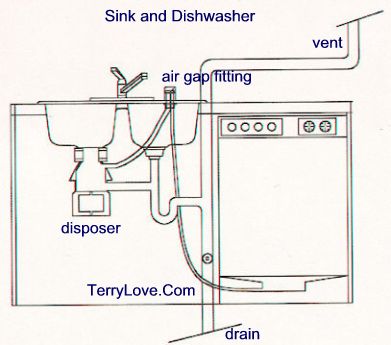
Unbeknownst to my spouse and me, this drain-unclogging evolution had turned into a quarterly requirement. (This is not normal, and it meant that a clog kept re-forming.) The kitchen sink drain would stop draining again, so the neighbors would take apart the trap under the sink and stick the nozzle in. (See the diagram from Terry Love’s plumbing forum.) The water jet would clear some of the clog pretty quickly (but not all of it!) so they’d put everything back together… until a few months later when it clogged again.

The New Years’s Day clog was especially bad, or maybe it had been a few months since the last jetting. When they took apart the trap and stuck the nozzle in, the clog didn’t break up. They kept the hose running, which squirted more and more water into the drain line.

They didn’t know that kitchen sink drain lines are also vented to the roof. (That link starts a 90-second video showing how vent lines work.) They squirted enough water into the drain line to fill up the pipe against the clog (which refused to budge), and then the drain line filled back to the kitchen sink where the hose was inserted (which was sealed by the bellows). After that, the water filled the vent line– up the wall, above the kitchen ceiling, and up to the roof. After filling about 10 feet of vent line, it started to fountain out onto the roof– overflowing the gutter and raining outside the kitchen.

This can be pretty upsetting, especially if you don’t know how it can happen. You’re putting water into the drain and it’s spraying out onto the roof?!?

They shut off the hose water but thankfully they left the hose (with its expanded bellows) plugging the sink drain. That hose bellows was the only thing holding back the gallons of water that was still filling the vent pipe all the way up to the roof.

Seen from the outside wall, with the decorative cover removed.

Kitchen sink drain cleanout plug

Once my spouse and I saw the layout, we understood the problem. We went to the drain cleanout plug on the outside wall (on the other side of the kitchen sink drain trap). It hadn’t been used in years and its cover had been painted to the wall. We pried the paint off the cover and unscrewed the retaining screw in its center.

Unfortunately, that cover’s screw was so long that it had punctured the plastic drain cleanout plug underneath. As soon as I pulled the screw & cover off the wall, a stream of water started peeing out of the hole in the kitchen drain cleanout plug and onto the front lanai. (This caused some consternation among the observers.)

The “good” news was that the roof’s vent pipe was draining. While we waited for that to finish emptying onto the lanai, we searched for the house’s main drain cleanout plug which is downstream toward the street’s sewer line. It turned out to be a cast iron metal cap under a driveway cover, and it didn’t have a fitting for a wrench. I’d never seen that design before but we later learned (thanks, Google!) that we’d have to soak it in WD-40 before hammering it loose with a chisel and a sledge. I didn’t want to mess with that, at least not until a quiet weekday morning when the plumbing supply store was open.

Unscrew the plug to see inside the drain piping. Now you can work on the drain piping without being in the kitchen or under the sink.

Kitchen sink drain cleanout plug pipe hole

We headed back to the sink drain cleanout plug, which was almost finished squirting water through its hole. We put a wrench on the plug and unscrewed it out of the drain. Water was standing in the pipe right up to the rim of the plug, so we knew that the drain was still clogged.

Up to this point, our tools came out of the standard homeowner’s repair bag that’s available at most home improvement stores for $20: a razor knife, screwdrivers, and an adjustable crescent wrench. We could have stuck that garden hose jet down into the drain pipe from the cleanout plug (where the bellows would keep the water from flowing back up the vent!) but I wanted to try a plumber’s snake.

Hopefully, you never have to buy this tool (see the final three paragraphs of this post) but they’re under $20. My spouse and I are home-improvement enthusiasts with a collection of specialty toys tools, so we have a 50-foot snake that we expected would reach all the way to the driveway cleanout plug.

Insert the pointy end into the drain pipe and push it down the drain. As you turn the handle, you'll spin the snake in the pipe to clear out the clog.

A typical plumber’s snake

We stuck the snake in and immediately found the clog at the drain pipe’s right-angle bend a couple of feet below the sink. I sawed back & forth for a while to dislodge it. (Yummy pasta and chopped onions– just like clearing the galley drains on a submarine.)

While my spouse chatted with our neighbor about using more cold water with their disposal, I kept inserting more snake. Sure enough, there was a second clog about 20 feet further into the drain. I worked the snake some more and suddenly heard water gushing down the drain to the sewer.

Since we still had the hose jet ready for use, we pulled it out of the kitchen sink trap and moved it outside to the drain cleanout plug. We stuck it a couple of feet down the drain line (below the trap and the roof vent) and turned it on. The bellows expanded to seal against the pipe walls and the drain started to fill with water again. The hose struggled for a few seconds but then you could almost feel the pressure pulse as it completely washed away the remains of both clogs.

If we had been able to open the driveway cleanout then we could have watched a flood of ancient food debris spewing into the sewer (or maybe into the gutter). Hopefully, we never have to unclog this drain again, but if we did then that driveway cleanout plug would be the next step. We let the hose run for a few minutes (just in case there was a third clog) but the drain seemed fine now!

We pulled the hose out. I started to pull out the plumber’s snake and… *clunk*. It was stuck. Clunk. I tugged on it some more. Clunk-clunk. I tried chanting the magic words “[expletive deleted]“.  Clunkclunkclunk. Still stuck.

Modern drain pipes are a plastic called ABS. (Older ones are wrought-iron pipes.) ABS plastic is pretty tough, but if you crack it then you have to dig a hole in the yard (maybe through a concrete sidewalk) to replace it. As I thought about that, little fine beads of sweat began to pop out on my forehead. Luckily after more patient twisting and some steady, firm, sustained pulling… the snake popped free. (It was probably stuck on a flange by a joint in a bend of the drain piping.) It came out of the rest of the pipe with no problem.

We filled the hole in the kitchen sink drain cleanout plug with silicon caulk, screwed it back into the drain pipe, and put the sink trap back together. Water happily flowed down the drain and gurgled to the street sewer. The neighbors could buy a new plug another day, along with a shorter screw for the drain cover.

Our neighbor was relieved. The crisis was averted. Dinner (and kitchen cleanup) proceeded without a hitch. The rest of the day was a success.

Ah, but you submariners know that we have not yet addressed the “root cause” of the casualty. (“Muster on the mess decks for the incident critique.”) Why did the sink drain keep clogging up in the first place? They’re not supposed to clog at all, let alone need quarterly cleaning with a hose jet!

The best answer is to only put watery liquids down a drain. Never any grease or fats, as little food debris as possible, and hopefully no pasta or rice or onion peels or coffee grounds. Use a sink strainer to stop the food waste, and dump that in the trash (or a compost pile!) But if food waste does get into the drain, then use the disposal to grind it up. Flush everything down the drain with plenty of cold water. Hot water seems easier, but cold water solidifies any grease and fat for the disposal to chop into small pieces and flush into the sewer. Hot water merely dissolves the grease/fat to cool and reform further down the drain line.. and clog it.

Of course, there are plenty of other problems that could clog a drain: jewelry, kid’s toys, broken drain piping, dirt seeping in through a hole, tree roots infiltrating the piping joints… it’s a long list. I hope we’ve found the answer, and I hope that better kitchen cleanup habits keep that drain clear for years.

The next question is usually: “Gee whiz, Nords, where do you learn this stuff?!?” Luckily you don’t have to go to sea on a submarine (although that certainly gives you plenty of practice). You can start with an Internet connection and Google. Eventually, you’ll find a site like FamilyHandyman.com or the home of the Samurai Appliance Repair Sensei. If you’re even mildly interested in home maintenance and repairs then subscribe to a newsletter or a hardcopy magazine. Get small monthly doses of knowledge & inspiration, and eventually, you’ll gain the confidence to tackle your own repairs. Better yet, you’ll recognize the symptoms of impending doom trouble and know when to seek professional help– before it’s a holiday crisis!

Related articles:
DIY home maintenance
DIY home improvement
Lessons learned from DIY home improvement

Posted in Mortgage & Real Estate | 3 Comments