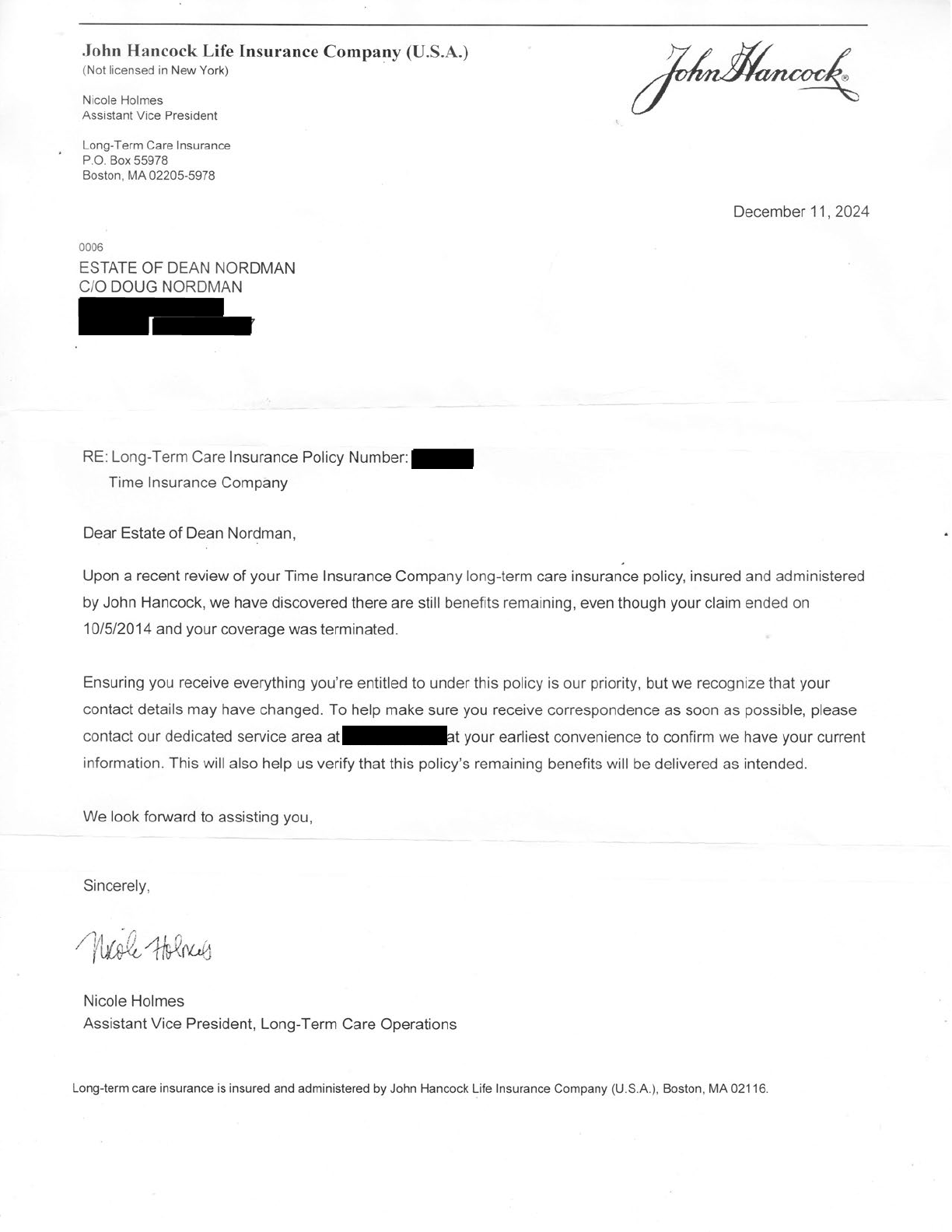
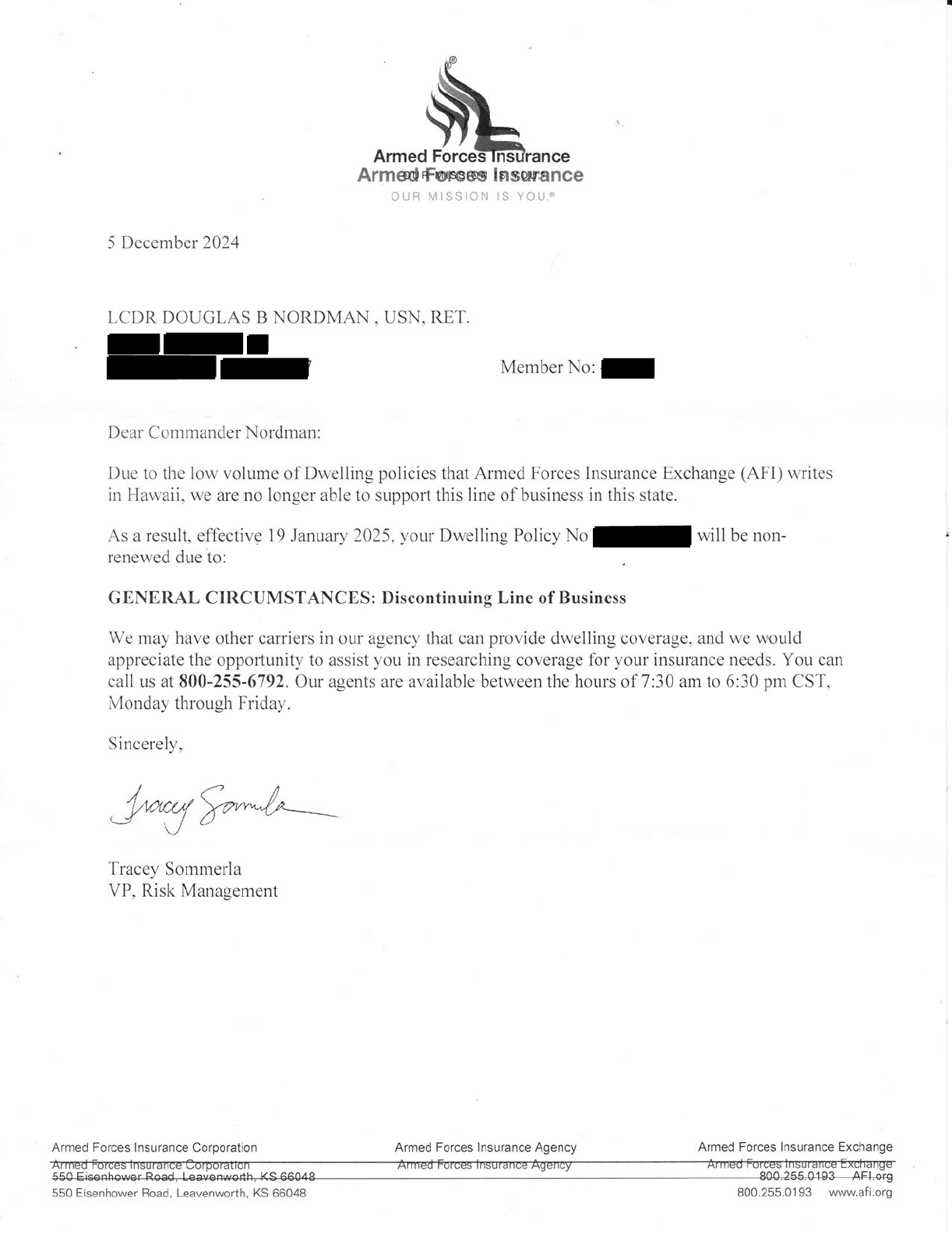
Armed Forces Insurance: “Your home policy is canceled.”


My spouse and I have been with Armed Forces Insurance for 44 years… starting with a personal-property policy way back when I was (unbelievably) a teenage midshipman.

It’s quite possible that their decades of low premiums and generous claims service have accelerated our financial independence by a year.  We spent less for our insurance during the 1980s-90s and cut those expenses even further after retiring from active duty.

In 2025, though, AFI kicked us to the curb with barely six week’s notice. (Maybe it’s not personal: it’s just business.) They’ve told Hawaii that they’re pulling out of our market. Their retrenchment could be related to the catastrophic August 2023 Lahaina wildfire.

Are you one of the hundreds of thousands of Americans dealing with the insurance crisis?  I’ll share our coping tactics at rebuilding our insurance.

Image of letter from Armed Forces Insurance canceling our homeowner's insurance policy with six weeks' notice. | MilitaryFinancialIndependence.com

“Hasta la vista.”

Whatever AFI’s financial or risk-adjusted reasons for pulling out, their timing certainly destroyed our one-sided trust. During our four decades, 13 military moves, and five houses we only submitted two claims. Both were under $2500, and that second claim was nearly three decades ago.

We’re not risky clients, either. We don’t carry personal-property insurance, and we don’t carry collision or comprehensive insurance on our autos— only liability.

The really annoying part of AFI’s cancellation was that we’d just spent the back half of 2024 overhauling our policies. Our home, rental property, and umbrella liability were with AFI and our autos were with USAA but it had been several years since we’d shopped around.

We’re keenly aware that America’s insurance expenses are skyrocketing, and that national insurers are pulling out of several areas of the country. All of the corporations seem to be struggling with their claims ratios and they’re losing more money every year.

My spouse and I are not pinching pennies. We’ve saved tens of thousands of dollars with AFI over the decades, and today we’re not price-sensitive. However we feel that we invested hours of effort to negotiate with AFI in good faith, only (a couple months later) to have the rug jerked out from under us by a change of corporate policy.


The Process

In June 2024 we started all the insurance adulting. We:

  • contacted five independent brokers for referrals and quotes,
  • talked with several insurers about the details of our home & rental property,
  • gave copies of our AFI policies & premiums to the interested companies,
  • updated our replacement-value rebuilding databases with the companies offering the best quotes,
  • requested manual underwriting for higher deductibles on hurricane insurance (because Oahu),
  • researched a more realistic limit for our umbrella liability policy, and even
  • considered minimizing our coverage of our rental property.

One broker responded with a warning:

“I reviewed the details of your current policies and my premiums were way higher than your current premiums. I have a suggestion regarding your current coverage: please increase your limits for the dwellings. Labor and material costs have increased over the last few years.”

Good advice. This is why we check our insurance every few years.

Image of rental property built in 1979 with cedar shake roof from 1997 still in good shape. | MilitaryFinancialIndependence.com

Hurricane-ready!

The worst part of this review was our rental’s 27-year-old cedar shake roof. In 1997 our homeowner’s association codes required this roof style, and national insurers had not yet declared cedar shakes to be a fire hazard. (Back then, clay tiles and aluminum shakes were expensive and even more problematic.) We keep the shakes in good shape (regular maintenance with spray coatings every four years), it still looks brand-new, and we expect to get another 20 years from it.

After a long discussion, AFI agreed to renew our rental’s policy with a limit of actual cash value for the roof (not replacement value).

Those rental-property discounts were our reason for renewing with AFI, and that facilitated our subsequent decisions to keep our home & liability policies with them… until the company decided to abandon Hawaii.

During our months of slogging through policy reviews, we checked with USAA about our real estate. We were only doing our due diligence, and we weren’t counting on them. They’d already pulled out of the Hawaii property insurance market in the early 2000s, and when they returned a decade later they were much more expensive than AFI.

In 2024 USAA’s app immediately shot back:

“We are unable to provide you an insurance policy because of an increased exposure from coastal storm-related damages.”

Well, yeah, that’s because *every* storm on our 30×40-mile island is coastal, even when we’re in the center of that landmass. But that bot’s boilerplate probably applies to all three coasts on the Mainland too.

I called USAA’s member service representative, and they clarified that they’d be willing to insure our home because it was built in 1989 and upgraded in 2011 with hurricane-resistant hardware. However our 1979 rental with its 27-year-old shake roof would have to be laid off with their specialty-insurance partner: American Modern Insurance.

Just to be clear, AMI is not related to American Family Insurance.  AMI is a boutique subsidiary of Munich Re and has a pretty good track record of insuring older (problematic) homes.

However by this point Armed Forces Insurance was quoting premiums of $1300/year while USAA and AMI were closer to $3000/year.

As I expanded our search, I contacted our local State Farm agents. Their e-mail quotes were lower than USAA but still higher than AFI.

During our research I learned that Costco offers insurance from affiliate companies.  After entering our property ZIP codes into Costco’s site:

“Thank you for your interest in getting an insurance quote with us. We are unable to provide an online quote for you through Costco CONNECT. However, we have established relationships with other reputable insurance carriers and would be happy to help you find coverage with one of them.”

Hey, at least Costco is trying to send us an affiliate link. Yet when I phoned Costco’s call center, they said they’re not offering property insurance in Hawaii.  “Never mind.”

If there’s anything good about the months we spent on our insurance review, it’s that (like any good nuclear-trained submarine veteran) I’d built a spreadsheet summary of our research.

When AFI bailed on us, I went back to that spreadsheet and started the tab for Plan B.


Oh That Was Fun. Let’s Start Over And Do It Again.

By the time we finished negotiating earlier in 2024, AFI had hiked our home’s comprehensive insurance premium by 17% (to $1326/year) and our rental’s landlord “named perils” policy premium by 30% (to $1292/year). Annoyingly, they’d insisted on their standard 2% hurricane deductible instead of our request for a 5%-10% deduction. We’re happy to shift some of the risk to us owners, but AFI didn’t want to spend the time or money on the manual underwriting.

A couple of months later that deductible debate felt moot when they sent us the cancellation letter on our home policy. We became skeptical that AFI would renew our rental’s policy, too… and if they wouldn’t insure our real estate then they wouldn’t renew our umbrella liability policy either.

We were happy to re-engage with USAA, especially for their military affinity. It also makes sense to coordinate home, auto, & liability policies with a single insurer so that a catastrophic loss doesn’t involve negotiations with 2-3 separate companies.

However I’d felt a similar affinity with our local State Farm agents, a couple who literally live in our neighborhood, and the company has a good reputation in Hawaii. After a few e-mail exchanges, we updated our properties in their database and got a more precise quote for adjusted rebuilding costs and revisions to the construction codes. We’ve kept up with local building codes but if a big hurricane hit the island then construction contractors would be in very high demand while materials would be scarce.

For $2505/year our home would have State Farm’s deductible of 5% and a hurricane deductible of 10%.* That’s 90% higher than AFI yet still cheaper than USAA. Better yet, State Farm does a lot of business on Oahu and seems less likely to abandon us like AFI or USAA.

Image of Oahu home with photovoltaic panels on ground-floor roof and solar water panels on second-story roof. | MilitaryFinancialIndependence.com

Also hurricane-ready.

(*We really wanted a higher deductible because our home has a newer shingle roof that’s covered with photovoltaic & solar-water panels. We can DIY repair any shingle damage from a CAT 3 storm.)

For $1541/year our rental property would have a deductible of 3% and a hurricane deductible of 5%. That’s 20% higher than AFI’s renewal but… we’d be insured for a 27-year-old shake roof and we have a long-term landlord plan for a 2040ish rehab.

I was pleasantly surprised with State Farm’s user-friendly website. Their app is not as robust as USAA’s world-class member service, but both insurers’ apps have dramatically streamlined their claims process. AFI’s website looks like it was last overhauled in 1998, with bare-bones navigation.

AFI billed on something like a four-month payment plan for each of their separate annual policies, which meant that we could only predict the annual totals. The monthly ACH transfers for those bills fluctuated by several hundred dollars.

State Farm bills on a 12-month schedule, so we know today that our next year of property premiums will cost a consistent $338/month.


Our First Attempt At Umbrella Liability Insurance

Our next step with State Farm was a $4M umbrella liability policy (on top of our home & auto liability coverage). The agent readily admitted that he could only approve $2M without additional underwriting, but he was confident that State Farm would approve $4M.

That was good enough for our next step: ditching AFI.

We took State Farm’s $2M binder while awaiting underwriting approval for $4M. Once my spouse and I checked over the three policies we were ready to talk to AFI.


“No, We’re Not Canceled, *You’re* Canceled.”

I have to admit that I fantasized a few times about calling AFI to cancel our accounts.

I hadn’t talked with them since last September (when we updated our policies) and I certainly wasn’t going to call them about their December cancellation letter.

I was quietly hoping (against hope) that this was all a horrible mistake. Maybe they’d reversed their decision, or they’d meant to only cancel beachfront properties, or their retention team would negotiate a different policy with higher deductibles.

I certainly wasn’t going to argue about their decision or beg for reconsideration, but I was willing to be persuaded.

I poured a fresh cup of coffee, Bluetoothed my hearing aids to my iPhone, logged into AFI’s website, made the phone call, and… ended up in their call center’s hold queue. This was fine.

The member service rep came on a few minutes later and went through the usual identity verification. When they began asking questions about updating our records, I politely interrupted that we wanted to cancel all of our AFI policies.
Them: “I see we’re already declining to renew your homeowner’s policy.”
Me: “Yes.  Please cancel that as of today. Please also cancel our rental property policy, our liability policy, and our umbrella liability policy. We’d appreciate it if you’d refund us the unused premiums.”
Them: (keyboard clicking) “I’m sending you the confirmations now. You’ll have to Docusign them to verify that you’re canceling.”
Me: “When will that take effect?”
Them: “As soon as you finish the Docusign. We’ll refund your unused premiums. Will there be anything else?”
Me: “No thank you, I’ll watch for the refunds.”
Them: “Yessir. Thank you for calling. [click].”

Our conversation was professional yet notably free of empathy– let alone any retention discussions or offers to refer us to other insurers.

Maybe the rep was burned out from handling all of the other Hawaii policy cancellations? Or maybe the call center didn’t even know about the corporate decision to “discontinue the Hawaii line of business.”

44 years of history ended in less than 10 minutes… just like that.

Two weeks later, I still can’t tell that AFI is issuing any premium refunds. We’ll give them another couple weeks to honor their commitment.

AFI’s refund check ($75.95) arrived on Day #17.


The Liabilities of Umbrella Liability Insurance

Unfortunately we learned that we weren’t quite finished talking with insurers yet.

State Farm’s auto insurance couldn’t compete with USAA, and then their $4M umbrella liability policy came in at $1476/year. That was nearly double what we were paying AFI for a $5M umbrella liability policy.

Even the State Farm agent thought $1476 was high. Upon further research, it was because State Farm wasn’t insuring our autos and couldn’t give us a consolidated discount. It was also one of the highest umbrella liability limits that they were willing to underwrite.

The reason we were even considering buying ridiculously high limits of $4M-$5M was because Oahu real estate has been appreciating at a compounded annual rate of 5%/year for over two decades. We can do math, and we wanted to get this policy in place before we had to renew our driver’s licenses in our 70s.

I was also making the (flawed) assumption that we’d want to have umbrella liability coverage for our (future) gross worth. I thought that judges and juries would routinely impose damages at that level, and we’d need to insure for it.

I was wrong.

It turns out that the vast majority of liability suits don’t even get to court, and (short of a felony) multi-million-dollar judgments are rare.  $3M would be plenty conservative for our current needs and at least the next decade. $4M was overkill, let alone $5M.

Sure enough, State Farm was ready to pry us loose from USAA with a financial crowbar.

If we left our auto insurance with USAA then we’d pay:
USAA annual premium + State Farm $4M umbrella liability = $961 + $1475 = $2436/year.

If we moved to State Farm for both then our premiums dropped by 19%:
Auto + $4M umbrella liability = $1241 + $738 = $1979/year.

If we reduced the State Farm umbrella liability to a slightly more reasonable limit then:
Auto + $3M umbrella liability = $1241 + $606 = $1847/year.

A rigorous comparison would reduce USAA’s $961/year premiums by their $100-$150 distributions from their Subscriber Accounts, but that annual rebate is unpredictable and could drop to zero if USAA’s claims year is especially bad.

Even so, insuring everything with State Farm and dropping our umbrella liability to $3M would reduce our annual premiums by 25%.

I was ready to send the e-mail, but at the last minute I realized that I was overlooking a different move.

We’d only considered quitting USAA’s auto insurance because AFI is backing out of the Hawaii property market. It wasn’t USAA’s fault that we had to find our umbrella liability insurance somewhere else.

With that epiphany, I went over to USAA’s site for a quote on umbrella liability.
USAA auto + USAA $3M umbrella liability = $961 + $527 = $1488/year.

39% is a heck of a consolidation discount over State Farm.

It’s a bit unusual (and very gratifying) to see that USAA offers umbrella liability even if we only insure our autos with them, and not our real estate. Considering USAA’s real estate premiums, I’m surprised that they’re cheaper for umbrella liability than both AFI and State Farm.

USAA wants nothing to do with Hawaii homeowner’s insurance, but apparently they’re willing to get paid to accept the risk of people slipping and falling on our wet driveway.

Better yet, USAA is still (as usual) much cheaper for auto liability than other insurers. Dropping collision & comprehensive has saved us tens of thousands of dollars over the decades. Not having C&C on our cheap used cars has also accelerated our financial independence!

I checked with the State Farm agent again, who already knew that USAA has lower umbrella liability rates. (Not that he was required to volunteer that detail.) I confirmed that we can have our homes with State Farm for these prices while we do auto liability & umbrella liability with USAA. He responded:

“There is no discount on your home or rental dwelling for having the umbrella policy with State Farm. The homeowners would get a discount for having car insurance with us.
You are correct the biggest discounts are on your auto policies. You should definitely keep your umbrella and auto insurance with the same company to maximize the discounts for those two policies.”

10 minutes later, USAA’s app issued us a $3M umbrella liability policy. (No phone calls required.) I e-mailed State Farm to cancel our umbrella liability policy, and we promptly received their confirmation.

We’re still split between two insurers, but USAA doesn’t compete with State Farm on Hawaii real estate– and State Farm can’t compete with USAA on Hawaii auto liability. If they get along then I sure hope this reduces the hassle factors from a possible large claim with both.

I’m very relieved to put this seven-month insurance saga behind us.


Your Call To Action

I recognize that people are paying far more for insurance in their ZIP codes (if they can even get the coverage they want) and I’m not complaining about our new premiums.

But if this happened to us– 40-year customers in our 60s– then it could happen to everyone facing damage from winds or fires.

We’re done with Armed Forces Insurance and we’re not goin’ back, but if you’re still with them then I’d check their annual report to see if their reserves and claims loss ratios raise any financial concerns with you. (And maybe you’d want to build your own quotes spreadsheet from other insurers.) We’ve generally been happy with their customer service over the years, but their Hawaii exit is clearly a financial & risk control. Customer loyalty does not seem to be considered.

And self-insure whenever you can afford the risk!


(P.S.:  Once again I’d like to thank the mentors and other members of the Millionaire Money Mentors forum. The information they shared during our insurance research helped us make the right choices for the right prices, and their feedback also helped write this blog post. If you’re already a member there then you can read more of those threads by searching the forum for the phrase “American Modern Insurance.”)


There are no affiliate links or paid ads in this post.  Try your military base library or local public library before you pay money for these books– in any format.


Military Financial Independence on Amazon:

The Military Guide cover
  • Reach your own financial independence
  • Retire on your terms
  • Success stories and personal checklists
  • Royalties donated to military charities

Use this link to order from Amazon.com!

Raising Your Money-Savvy Family on Amazon:
The Money-Savvy Family cover
  • Reach your own financial independence
  • Teach your kids how to manage their money
  • Specific tactics from my adult daughter
  • Checklists and spreadsheets for your family

Use this link to order from Amazon.com!


Related articles:
“Do I Really Need Servicemembers Group Life Insurance?”
How Much Life Insurance Do You Need?
Your Auto Insurance Premiums Are Rising, But It’s Not Just You
Why I Won’t Buy Long-Term Care Insurance
USAA Answers Your Insurance And Financial Questions
20 Years Of Financial Independence & Military Retirement

Posted in Insurance, Money Management & Personal Finance, USAA | 2 Comments

Updated VA disability claim and medical tests


In early 2023, as the pandemic restrictions eased (and as healthcare workers tried to recover from burnout), I decided to catch up on three years of deferred maintenance: my medical bodywork.

Financial independence is great, and Tricare (plus military veterans’ benefits) make it even better.

The physical exams and blood tests came out fine. I even volunteered for a routine tetanus shot, because it was my first decade in 50 years without hearing an ER nurse admonish me “… and you’re gonna need a tetanus booster before the stitches come out.”

Image of the seal of the Department Of Veterans Affairs | MilitaryFinancialIndependence.com

The PACT Act has helped speed up claims.

Yet later in 2023, other problems started to snowball. In mid-2024 I updated my VA disability claim to raise my 30% rating to 40%.

(And before anyone asks: No, I don’t want to pay the price to get to 50% for Concurrent Retirement and Disability Pay.)

This blog post closes the loop on over three decades of chronic health issues that have affected me (and hundreds of other vets) from the 1991 Mt Pinatubo volcano eruption.  Reading about this process can help you (and many more vets, and their families) file their own claims.  I’ve included links to the references.

We’ll explain why you need to file your VA disability claim (beyond simply helping your loved ones) and then why you need to get a copy of your claims file.

“Future You” will be greatly relieved that Today You has taken care of this.

(Side note:  my apologies for the details of the organ recitals. I’m focusing this post on the VA disability claim process– and the admin, and the potential mistakes– but it still requires more context from the symptoms.)

“Normal For Your Age…?!?”

I’m in my mid-60s, and I’m coping with my body’s emerging issues “as well as can be expected for a man of your age.” I had to learn a few lessons the hard way, and I hope sharing my personal experiences will help some of you solve your own medical mysteries.

First, when Congress passed the 2022 PACT Act, it greatly simplified the disability claims process for hundreds of thousands of vets. This is a Very Good Thing. I wasn’t in a hurry to join the crowd, but in 2023 (after some politely firm nagging from my adult daughter) I went back to the VA clinic for my PACT Act screening.

During that screening we verified that my left knee has run out of cartilage in one meniscus, and my tibia’s the bone-on-bone contact with my femur explains why it’s hurting a bit more.

Everyone feels the pain of bone-on-bone differently, and I’m apparently tolerating it well. (The pain is typically 2-3 out of 10, and I’m strengthening my quads & hamstrings to compensate.) I’ll never hike the Appalachian Trail (let alone return to Haleakala Crater) and my taekwondo sparring days are over, so that knee might give me a couple more decades.

Unfortunately my pain management is slightly more challenging because my kidneys recently announced that they’ve reached their lifetime quota of ibuprofen. (Note for Crew Dog at One Sick Vet: thanks for reminding me all those years ago to keep an eye on this.) These days I’m treating the pain with acetaminophen while we’re putting my knees through all of the physical therapy. While I’m waiting for medical science to regrow human cartilage, perhaps someday I’ll try orthopedic (unloading) braces and injections of various cartilage substitutes.

My knees have kept their same VA bilateral disability rating (20% total) and… this is fine. I don’t want to experience the problems that qualify for a 30% rating.

Second, the pandemic clearly demonstrated how quickly my hearing has declined, because it’s really hard to lipread a facemask. In 2023-24 I went through a couple rounds of audiograms and even a contrast MRI to sort out the medical questions before fitting me for hearing aids. The VA audiologists did a great job, and (for my fellow Oahu vets) I highly recommend the Akaka clinic in Kapolei.

Image of Phonak Audeo hearing aids | MilitaryFinancialIndependence.com

Seriously: a big help.

I’ve worn my hearing aids since July 2024, and boy did I need them. You don’t know what you’ve lost over the years until you get it all back in a few seconds.

I’m sporting Phonak Audéo L90-RLs with rechargeable Li-ion batteries– and Bluetooth connections to my iPhone and my PC. My left ear is once again carrying its share of the load, and my right ear needed some help too. Better yet, people have stopped sneaking up behind me.

I enjoy legitimately talking to myself in public when I’m on a call with hearing aids. Best of all, I can wear them when I’m guesting on podcasts or videos– no more headsets sliding around on my skull during recordings!

My entire family agrees that it was time for hearing aids, although my audiogram is still good enough that I’m not (yet) rated for hearing loss. I’m still rated by the VA at 10% for tinnitus, and it’s tolerable. I’m hoping (against hope?) that the hearing aids will slow my hearing loss and maybe even reduce the tinnitus a bit. More importantly, I’d much rather get used to wearing these in my 60s than trying to learn the gear in my 70s.

Finally, in late 2023 near the end of our slow travel in Japan, thirty years of sinus infections caught up with me. I made it back to the U.S. (with lots of headaches & heavy decongestants) and it took three separate courses of antibiotics over five weeks to kill the bacteria. I’m now doing daily sinus flushes (preferably while I’m surfing!) and using Flonase to keep the mucous moving. I’m sorry to report that this has become a new lifetime routine like flossing & brushing my teeth.

Ironically the PACT Act screening questionnaire is all about burn pits, chemical exposure, and even Gulf War Syndrome— yet none of those questions had made me think about chronic sinusitis. I wasn’t trying to be a tough guy… I’ve just never had such a nasty infection before.

During the sinus treatment with the ear, nose, & throat doctor, I went back over my medical records. My VA disability claim file (my C-file) from my 2016 claim is nearly a thousand pages, and this time I had a new perspective on the old evidence.

My dawning awareness began in 2013 when I profiled my genome (with 23andMe) and learned that I’m a carrier for cystic fibrosis.  While I was recovering from my 2023 sinusitis, a random comment on a medical website mentioned that CF carriers often have minor CF symptoms like thick, heavy mucous. The ENT doctor raised his eyebrows at my question and said that ENT docs know about it… but in the days before consumer genome analysis, very few humans even knew whether they were CF carriers.

Image of a human head showing the location of the ethmoid sinuses by the nose. | MilitaryFinancialIndependence.com

I never knew.

Reviewing only the existing evidence in my C file (no new info!) it became clear that my respiratory system (with its heavy mucous) was fine when I started my Navy career. That abruptly changed in June 1991 when our submarine crew inhaled volcanic ash from the Mt. Pinatubo eruption.

Over the next three decades I had over three dozen different incidents of respiratory infections, allergic rhinitis, sinusitis, ear infections, bronchitis, and even pneumonia. That included my final decade of active duty as well as 20 years of retirement. Each doctor’s summary listed symptoms of sinus pain while my heavy mucous was getting particularly stuck in my left sinus. Over those decades, the repeated cycle of infections caused scarring of the spongy bone in my left ethmoid sinus. Today that scarring impedes the flow out of the sinus.

When you’re on active duty, it’s all too easy to believe that your respiratory infections are caused by chronic fatigue. You’re also worried about being beached or grounded (or even separated), and you don’t want the medical professionals digging too deeply into your symptoms.

In retirement, I thought that I was simply vulnerable to respiratory infections. (Especially in the parenting years when your kids are bringing home viruses from school, and later in the empty-nester decades when you’re traveling the globe.) Eventually you decide that you’re getting older and your immune system must be getting weaker.

None of it seems like a big problem… until the day when your scarred sinus barely drains your thick mucous, and then it gets infected. While you’re visiting Japan.

The ENT doctor observed all of this with a nasal endoscope (on a 4K HD large-screen monitor, yay?) and later a radiologist confirmed it with a CT scan. I’m fine as long as I keep up with daily sinus flushes and Flonase, but if this chronic condition ever gets worse then the next-level treatment is a sinusotomy.

Don’t search on that keyword while you’re eating. Maybe not even while you’re drinking.

Updating Your VA Disability Claim

After I recognized the sinus story in my medical records, I summarized the documents for an updated VA disability claim.  Once again I returned to a Veteran Service Officer (at Oahu’s Disabled American Veterans office in Tripler Army Medical Center) and asked for their professional help at updating my claim.  They sent in the letter requesting a review of my rhinitis & sinusitis ratings. In retrospect I could have done that myself, but I wasn’t sure what had changed in the process since my 2016 claim.

My 2024 summary (based on my C file from 2016) listed the Mt. Pinatubo eruption as an example of the PACT Act’s service-connected exposure to toxic substances and fine particulates (breathing volcanic ash). I included a copy of a fitness report documenting my submarine’s presence in Subic Bay plus two pages with the dates of all the infections.

I added copies of my ENT doctor’s exams, and I described the sinusitis treatment with the terms used in the VA Schedule for Rating Disabilities, requiring “four to six weeks of antibiotics.”

Finally, I filled out a draft copy of the VA’s Disability Benefits Questionnaire for my sinusitis symptoms.

DBQs are completed by the doctor during the Compensation & Pension exam, using their medical keywords and ICD-10 codes. I give them my draft if they feel it would help them write up their reports.

When I showed up at the C&P exam, it turned out that the VA’s doctor could already access my Tricare Select electronic health record with the ENT doctor’s diagnosis & treatment. (This is a big improvement over the last decade.) He was happy with everything in my memo and the records. He even canceled his CT scan because he could see the other radiology results.

The C&P doctor sent in his recommendations for a sinusitis rating.

Image of the Mt. Pinatubo volcanic eruption with a mushroom cloud of ash to demonstrate how it feels when a VA disability claim is denied. | MilitaryFinancialIndependence.com

How a claim denial really feels.

A few weeks later the VA mostly denied the claim:
“Service connection for sinusitis is granted with an evaluation of zero percent.”

I have to admit that I was a little sad & frustrated, because everything in the claim appeared to meet the rating criteria for 10%. Yet for the long term, I was happy that I’d documented the problems today so that my family wouldn’t have to do it for me years later.

That week I was also busy with physical therapy, audiology, grandparenting, and everything else in my life. I set aside the VA’s letter until I could make the time to start the appeals process.

Surprisingly, the system eventually worked— I didn’t have to file an appeal after all. A month later I got a new letter from the VA:
“A clear and unmistakable error is found in the evaluation of sinusitis and a retroactive increased evaluation to 10 percent disabling is established.”
I can’t tell whether a senior rater checked another rater’s work, or whether the DAV VSO flagged the error and told the VA to do better.

The additional 10% disability rating for sinusitis pushed me up to a 40% rating. Instead of waiving $586.31/month of my $4581/month (taxable) pension for tax-free disability compensation, I’m now waiving $838.28.

Call to action

Over the last 20 years I’ve heard from a few Pinatubo veterans. If you’re one of the vets who’s contacted me in the past, check your e-mail or please reach out.  I’ve already sent an update to those who’ve contacted me.  Hopefully they’ll be able to pursue treatment (and VA disability compensation) for the damage caused by the ash.

If you’re a veteran, go get your PACT Act screening. It’d be great if you could backdate your claim, but it’s more important to do the screening now so that (someday) your loved ones won’t have to do it for you.

If you’ve already finished a VA disability claim (whether it’s been approved or denied), then follow up by requesting your C file.

That claims file is the VA’s legal archive of your service and your symptoms. If it’s not correct (or if it’s missing some details) then update it before your memories get any older. Nobody else can do it as well as you can, and your loved ones will appreciate that you’re easing their potential caregiver stress.

Finally, if you’ve never had your genome analyzed, I think it’s worth the price.  This is controversial with some cultures and religions (and families) but it could be the important first step in taking care of your health.  I’m not particularly happy with the zingers in my DNA, but my awareness is the first step in doing the best I can with what I have. Genetics may have loaded the gun on my longevity, but a healthy lifestyle can help me keep the safety on.

Check the related links at the bottom of this post for far more background info.

When’s the last time you checked your VA disability claim?

There are no affiliate links or paid ads in this post.  Try your military base library or local public library before you pay money for these books– in any format.

Military Financial Independence on Amazon:

The Military Guide cover
  • Reach your own financial independence
  • Retire on your terms
  • Success stories and personal checklists
  • Royalties donated to military charities

Use this link to order from Amazon.com!

Raising Your Money-Savvy Family on Amazon:

The Money-Savvy Family cover
  • Reach your own financial independence
  • Teach your kids how to manage their money
  • Specific tactics from my adult daughter
  • Checklists and spreadsheets for your family

Use this link to order from Amazon.com!

Related articles:
Will Your Retirement Plan Handle Long-Term Care Needs? How Your Genome Impacts Disability, Caregiving, And Estate Planning
I’m going to retire. Now what? (part 2 of 2)
The VA’s Public Disability Benefits Questionnaires (DBQs)
The VA Schedule for Rating Disabilities (Title 38 of federal law)
A four-part series:
Why You File Your Veterans Disability Claim (Not Just How)
(It’s for your spouse, family, & caregivers.)
What Happens When (Not Just How) You File Your VA Disability Claim
(This will be done in parallel with your retirement physical)
What The VA Really Does With Your Disability Claim
What Happens After Your VA Disability Claim Has Been Approved

Posted in Military and Veterans Benefits, Money Management & Personal Finance | Leave a comment

The World’s Best Asset Allocation


Military families ask a frequent question about financial independence:

“Hey Nords, what stocks should we buy?”

It’s a trick question. Before people start picking investments, the first step is deciding on an asset allocation. Yet the responses quickly devolve into a debate of the merits among commercial real estate, Nvidia, and cryptocurrencies.


Logic + math versus emotions

The key is not just picking an asset allocation that will optimize your returns, but also picking one that you’ll be willing to stick with during the volatility of a plunging bear market and a nasty recession. (Nobody complains about the volatility of a rising bull market.) The right asset allocation (right for you!) feels comfortable and helps you sleep better at night– especially if it helps your spouse sleep better at night too.

If that “comfortable sleep” priority isn’t met, then nothing else matters. If it doesn’t “feel” right, then the emotions of behavioral financial psychology will always derail a highly logical asset allocation plan.

Then there’s decision fatigue.

Image of a block of concrete on the head of a man trying to do work on a laptop, like design an asset allocation plan and invest for financial independence. | MilitaryFinancialIndependence.com

How it… feels.

If you have to keep making the same investment decisions over and over again, whether they’re easy or hard choices, then you’ll deplete your cognitive stamina.  Even worse, you’ll abandon the entire decision-making process and end up with minimal retirement savings.

If you’re lucky, your excess cashflow has piled up in a savings account while you dither on your choices.  Or the money could slip through your fingers.

Think about the people you know who haven’t started budgeting, saving, or investing. Maybe they’re not even paying down their credit-card debt or their student loans. Yet they seem like functional adults. Are they really that incompetent with money? (They can do math, right?) Why aren’t they moving their assets?

Or are they just feeling tired and defeated every time they contemplate the numbers, and paralyzed by indecision?

What the heck does this squishy pop psychology have to do with picking an asset allocation?

Understanding your emotions helps you build a plan that you’ll stick with through good markets… and in tough markets.

Better yet, your plan makes it a lot easier to automate your investing and minimize your decision fatigue.

Your chosen allocation has to give you the patience to keep buying shares when the market drops 30%. It has to support your discipline to ignore the hysterics of the financial media and persevere with your plan. It has to give you a written document (or an affirmation on your phone, or a Post-It on your refrigerator) to override short-term panic and to visualize your future financial freedom.

Over the long term (>10 years) you’ll grow more wealth with steady (automated!) dollar-cost-averaging into your asset allocation.

You won’t have to feel (there’s that emotion again) obligated to try to time the market.


Stocks or bonds?

Waaaaay back in 2008, Moshe Milevsky’s book “Are You A Stock Or A Bond?” suggested designing your asset allocation to complement your occupation. Over a decade later his thoughts are still relevant to your life stages and investments.

Image of the cover of Moshe Milevsky's 2008 book "Are You A Stock Or A Bond?" for asset allocation complementing a career | MilitaryFinancialIndependence.com

High career volatility or low?

What’s a career look like as a stock?

Well, if you succeed as a professional athlete, or as a big swingin’ Wall Street trader, or as a full-stack developer tech nerd (you know who you are) then your occupation is likely to have high earnings for a few years. The vast majority of rockstars in this category have big payouts, but they tend to be for less than a decade. They might face frequent layoffs or even firings. Their reliability of continued employment is low and their financial uncertainty is high.

Just like picking a stock, their careers might be highly volatile with a risk of a loss of principal.

Take a look at the bankruptcies of NBA basketball players, the movie tropes of Wall Street traders, or the tech industry’s layoff cycles. The income might be awesome while it lasts, and the lifestyle looks exciting from the outside, but the net worth… not so much.

As thrilling as it might be to earn (and spend) those staggering sums of money, there’s no guarantee that your career will end on your terms. You might not even vest in your stock options, let alone in your pension.

Instead, Milevsky suggests offsetting a volatile high-earning career with investments that are high in bonds, Treasuries, and even single-premium immediate annuities.

On the bond-career side there are civil servants, university professors, and military families. The starting salaries are low and the raises are small, but their careers generally have a higher likelihood of continued employment. Persistence is usually rewarded with promotions, and there are retirement investment accounts. Better yet, some of these occupations tend to have untaxed compensation, employer’s matching contributions, annuity income, or even decent pensions to supplement a few decades of saving & investing.

Your bond career won’t get you rich quick, but you’ll have time and compounding on your side. Some of those professions have a much better work/life balance, too.

Milevsky suggests that people in reliable, lower-earning careers should invest in an asset allocation which is high in equities. As long as you expect steady employment, you could even go as high as 90%… if it feels right.


The 4% Safe Withdrawal Rate (and the Trinity Study)

These two historical computer simulations ran through many different combinations of stock & bond asset allocations. They’re limited in the scope of their simplistic asset studies: large-cap stocks and government bonds.  They did not include international equities or real estate, and cryptocurrencies didn’t even exist yet.

However this research consistently contrasted volatile assets that are highly likely to beat inflation (stocks) against less-risky assets that reduce volatility without consistently beating inflation (bonds).

None of the withdrawal rate simulations include Social Security, pensions, or annuities. Those benefits were beyond the scope of their research questions. Besides they’re hard to add to a computer model, so both the original 4% SWR study and the Trinity researchers ignored them.

Despite the limits and omissions, these studies answer the most important question of your career: how long do you need to keep trading your life energy (finite yet uncertain) for financial security? When do you have enough?

Even more importantly, when will you reach the point of trading life energy (which you might not have) for money that you won’t need? When does your safety margin become ridiculously excessive?

If the 4% Safe Withdrawal Rate has a very high probability of lasting for at least 30 years with assets of 25 times annual expenses, then why would people keep working for 33x, 40x, or even 50x?!?

Extra assets get back to those emotions of behavioral financial psychology. Words like “security”, “enough”, and “safety” are loaded with feelings. We can be highly logical and do all of the math, but if we don’t feel good about the results then nobody will be happy enough to stop working for paychecks.

Yet nobody is happy about working for paychecks until they die, either.


How much of each asset class?

Image of a pie chart showing 10 different asset classes in an asset allocation plan. This is way too complicated. | MilitaryFinancialIndepende.com

Nope. Waaaay too complicated.

There’s a growing body of research data to support an asset allocation that’s higher in equities (to beat inflation) with some bonds (to reduce volatility).

Most of that research is based on over a century of data for large-cap stocks. The S&P500 is a popular index, and more recent data comes from total stock market indexes that cover a much wider variety of company sizes.

The asset allocations analyzed for the 4% SWR & Trinity studies were at least 50% large-cap stocks and the rest in Treasuries or corporate bonds. Depending on your career, your life stage, and your tolerance for volatility– you could go up to as high as 100% equities.

Bond ratings and durations will affect their yields (and make investors feel sad when those yields drop) but the main reason for bonds is reducing overall volatility of your investments. Once you’ve lowered volatility, there’s no reason to chase yield— especially if a higher yield (from a riskier bond) raises that volatility again. Even if your bonds have a lower yield, your stocks portion of your asset allocation does the real work of beating inflation with higher yields.

It doesn’t matter whether the bond yields match inflation or lag it. Bond duration doesn’t matter, either, especially if they’re in an index mutual fund or exchange-traded fund being held for at least five years. It probably doesn’t even matter whether they’re Treasuries or junk bonds, as long as they reduce overall volatility and don’t default.

Picking the actual asset-allocation number can be tinkering at the margins, but any stock/bond asset allocation between 60/40 and 90/10 has been generally proven to last for at least 30 years.  (Allocations with more stocks are more volatile.) Pick numbers in that range which help you sleep best at night.

Your choices could be as simple as one total stock market fund and one total bond market fund. Both of them should be passively managed and have low expense ratios. If you buy exchange-traded funds then you can hold them at nearly any brokerage instead of paying extra fees. For example the Vanguard total stock market index ETF (ticker symbol VTI) trades commission-free at other brokerages.

If you must pick stocks, then limit your overall asset allocation of individual stocks to no more than 10%. That’s big enough to move the needle on your net worth if you turn out to be a brilliant investor, and small enough to limit the damage when you’re… not.


Other asset classes?

Image of adult emu bird being raised on an emu farm for an asset allocation option (snarky humor) | MilitaryFinancialIndependence.com

Emu farms, anyone?

“But what about real estate?” Sure, if it makes you feel better (there’s that emotion again), but nobody has shown that real estate is absolutely necessary. There’s more research about stocks & bonds than about real estate, so this is a question of comfort (and volatility) instead of strictly asset allocation.

An investment property probably appreciates at least at the rate of inflation and has a yield of at least a high-quality dividend stock or a corporate bond. The leverage of investing with cheaper mortgage money is the stock-market equivalent of buying shares on margin. You could replace some of the stock asset allocation with an equivalent value of real estate.

We’re just exploring how hard you want to work at managing properties (landlording, REITs, syndications, or anywhere in between) and how well you’re sleeping at night.

“But what about alternatives?” Sure, if you can tolerate the volatility. Again: nobody knows if alternatives (including cryptocurrencies) are absolutely necessary.  There’s not enough history for confidence in the statistics over a 30-year period.

In this case, I’d limit the asset allocation for alternatives to 10%. See the comment above about brilliant investors… or not.

If your asset allocation percentages are measured with increments of less than 10 percentage points then you’re probably overthinking it. Nobody knows that either. At smaller numbers like “6.82%” you’re just tinkering at the margins and giving yourself more busyness to track.

There’s no single perfect asset allocation for anyone, but there are plenty of good-enough asset allocations. You could go with the cake & fruit salad theory, or some variation of your age.  The important part is picking an assert allocation and investing in it instead of being paralyzed by a perpetual quest for the best asset allocation.

Once you’ve started investing in your asset allocation, and put it in autopilot with periodic deductions & share purchases, then you can step back and consider whether it’s worth your time to seek a better asset allocation.


What’s next?

Use the 4% Safe Withdrawal Rate as a tripwire for your financial independence.

Once you reach assets of 25x your annual spending (25x is the inverse of 4%), your investments are very highly likely to last for 30 years.

“Tripwire” means that you could decide to keep working if you find your career challenging & fulfilling. You could stop working and go full-throttle FI lifestyle if that’s your plan (and if you’ve been preparing for that new life). If you’re not ready to quit work then you could negotiate part-time hours, work from home, remote work, more paid time off, a sabbatical, or simply an unpaid leave of absence.

You could even start searching for a different job that meets your new standard of work/life balance and your desired quality of life.

If you qualify for Social Security, that income stream drives your portfolio survival to 100%. Social Security was never included in the Bengen SAFEMAX 4% SWR research or the Trinity Study. It’s extra.

For the first decade of financial independence, you can minimize the risk of an adverse sequence of returns by keeping about two years’ expenses in cash.  Replenish the cash stash after years when the stock market is up, and keep spending it after years when the stock market is down.

Two years does the job well enough to minimize this sequence of returns risk, although some bear markets & recessions might last longer. We’re not trying to outlast the bear market or recession– we’re trying to keep just enough cash to avoid portfolio failures.

If the recession lasts longer than two years then you might have to sell bonds or stocks at lower values, but you’ll still probably be able to offset capital gains & losses in a tax-efficient manner. Better yet, your investments avoided worse damage during the first two years and are two years closer to a recovery. You’ve survived the sequence of returns risk.

Is there a better number than “two years”? What about four years of cash? 37.8 months? That answer depends on whether we’re back to sleeping well at night.

How much longer do you want to trade your limited life energy for money that you won’t need?

After a decade of financial independence, while your asset wealth grows faster than your original inflation-adjusted withdrawal rate, the actual withdrawal rate dropsEconomist Karsten Jeske’s research has shown that SORR is negligible when the withdrawal rate drops to around 3.25%… and when there’s no SORR, then that withdrawal rate is sustainable for at least 60 years.  (Parts 38 and 54 at that last link.)

Finally, anyone who’s receiving annuity income (particularly inflation-adjusted annuity income!) can hold an asset allocation that’s lower in bonds (and higher in stocks). That’s because an inflation-fighting annuity (like a military pension or Social Security) is the equivalent of the yield from a fund of low-volatility high-quality TIPS or I bonds. That’s a flawed analogy in some ways (because bonds mature) but it’s acceptable for a discussion about asset allocation.

This analysis has led recent financial researchers to propose asset allocations like Wade Pfau’s review of variable-spending strategies, or Michael Kitces’ “rising equity glidepath.”

None of this discussion addresses rebalancing. Do whatever helps you sleep better at night, but every 2-5 years or +/- 10 percentage points is probably good enough. We don’t have enough research to be confident that rebalancing is necessary.


Call To Action:

1. Decide on your asset allocation with a percentage of stocks & bonds between 50/50 to 90/10.
2. Get started by automating it! Use payroll deductions to your 401(k), and deductions from your checking account to your IRA. As your income rises, deduct even more from your checking account to taxable accounts.
3. Make sure that those accounts (your 401(k)s, IRAs, and taxable accounts) are invested in your asset allocation. Pick passively-managed index funds with low expense ratios, and reinvest the distributions.

Once you’ve automated the investments (and the reinvestments), you can dig deeper into this post’s links and consider tinkering with your long-term asset allocation. As your wealth grows, maybe you’ll choose to add other asset classes– but it’s not essential.

The good news is that your investments are quietly compounding away for your financial independence, whether or not you finally find your perfect asset allocation.


There are no affiliate links or paid ads in this post.  Try your military base library or local public library before you pay money for these books– in any format.


Military Financial Independence on Amazon:

The Military Guide cover
  • Reach your own financial independence
  • Retire on your terms
  • Success stories and personal checklists
  • Royalties donated to military charities

Use this link to order from Amazon.com!

Raising Your Money-Savvy Family on Amazon:

The Money-Savvy Family cover
  • Reach your own financial independence
  • Teach your kids how to manage their money
  • Specific tactics from my adult daughter
  • Checklists and spreadsheets for your family

Use this link to order from Amazon.com!


Related articles:
Jim Dahle’s “150 asset allocations better than yours”
Mike Piper’s asset allocation: fruit salad
“How Should We Plan Our Finances For The Rest Of Our Lives?”
Financial Myths Of Retirement
Ben Carlson:  “A Balanced Portfolio Always Comes With Regrets”
The Bogleheads Wiki on asset allocation

Posted in Financial Independence, Investing & TSP, Military Retirement, Money Management & Personal Finance | Leave a comment

Military families: hearing aids


This is a financial independence Public Service Announcement for:

Abilities you never knew you lost until you regained them.”


If you’re a military veteran, and if people (other than you) think that you’re losing your hearing, the VA could give you a free set of hearing aids.  They’ll pay your expenses even if you’re already financially independent and can afford to buy your own.

The VA considers hearing aids to be “assistive tech” just like prescription eyeglasses, dental crowns, orthopedic braces, hiking sticks, or any other prosthetic device.

“Free” means that you don’t even need a VA disability rating. You don’t need to file a VA disability claim, and you don’t need to use the VA for your healthcare. (You can still do those things if you want to, but you should get the hearing aids as soon as you need them.) The VA buys the gear in bulk and then schedules military vets for free hearing exams.  If your audiogram shows that you need hearing aids, you’ve already paid the (physical) price for them.

Admittedly the VA might have an ulterior motive: hearing aids today make it easier to care for you tomorrow.

When you need hearing aids, the VA would greatly prefer that you start using them now. Waiting until you’re older (and deafer) just makes it that much more difficult to help you cope with what you’ve already lost. There’s even a correlation between hearing loss and worse issues like declining cognition, balance problems, and falls.

Speaking of “waiting too long”, I learned that in my usual manner: the hard way.  Just ask my family.


Signs that you might want hearing aids

In my 50s my hearing was as good as ever, especially compared to other submarine shipmates. Yet as my 60s approached I noticed that a lot of customer-service staff had started muttering and mumbling. I even began wearing a headset for phone calls & podcasts because my earbuds (let alone my iPhone’s speakers) were no longer doing the job.

When the pandemic started, my hearing loss made life much harder for me– and for my family. Submarine vets have spent their entire careers practicing self-isolation and social distancing, but it soon became clear that my hearing was a problem for everyone.

Once I’d received my vaccinations and ventured out again with a facemask, I quickly realized how much hearing I’d lost even before the pandemic. When everyone else is wearing facemasks, it’s a lot harder to read their lips and facial expressions. Maybe they were muffled behind their N95s and the plexiglas shields, or maybe I was struggling to hear them even before that interference was in place.

These days my hearing aids help me regain the sounds that I hadn’t realized I’d stopped hearing.

“Lost hearing” is a subtle point. Restoring mine helped me appreciate how much I’ve lost, despite decades of seeing the evidence on my audiograms. In retrospect, I wasted a few years on whining & sniveling before getting fitted.

Although the gear greatly improves my hearing, I’m still working on my listening.


The first step: an audiogram

The audiograms are pretty much the same as active duty exams, only this time you don’t have to worry about being grounded or even disqualified. It’s a great opportunity to have a full-disclosure discussion with an audiologist.

Audiogram of Doug Nordman showing a divergence between the ears of more than 15 decibels. | MilitaryFinancialIndependence.com

Try not to get here.

Once I reluctantly decided agreed to try hearing aids, my audiogram quickly attracted the wrong kind of attention.

If both of your ears lose 30-40 dB of acuity, that’s all too common with chronic occupational exposure to high noise levels– and from aging. However if one ear loses more than 15 dB beyond the other, then you end up with your head in a MRI machine (contemplating your life choices) while the radiologist checks for polyps or an acoustic neuroma. (An acoustic neuroma has already killed at least one other submariner.) Ironically the MRI hardware is so noisy that you wish you could wear hearing protection.

(Note to submariners: as an Engineering watchstander, my left ear spent a lot more time pointing toward noisy enginerooms than my right. I shoot long firearms from my right shoulder. And yes I rigorously wore hearing protection.)

I don’t have acoustic polyps or tumors, but if I hadn’t dragged my feet for so long then an earlier MRI exam might have noticed a bunch of (unrelated but serious) sinus problems. Earlier detection could have led to faster treatment of sinusitis scarring (while avoiding more VA disability compensation). That’s a lessons-learned story for another post.

Even worse: because my left ear is significantly worse than my right, I lost most of my azimuth & elevation discrimination. I could still match noises to bearings with my eyeballs– if I heard the noise– but I couldn’t hear people approaching from behind me. I only found out when they spoke up… or when I started moving and bumped into them.

That particular aural deficiency led to several regrettable domestic incidents over the years. I’m still apologizing to my spouse and my daughter.

I’ve eventually learned to head-check my baffles and rotate my body in place before I step out. Yet every time I discovered someone behind me I felt simultaneously ambushed, antagonized, and apologetic. Nobody was happy.

As I told the audiologists on my first visit: “I’m here at the request of my family.”

The whole team smiled, and the doctor said “We hear that a lot.”


Getting the ear gear

Image of a pair of bronze Phonak Audeo L90-RL hearing aids with earlobe wiring and open cone covers. | MilitaryFinancialIndependence.com

Surprisingly easy to use.

I’m sporting a pair of Phonak Audéo L90-RLs. (That link goes to the owner’s manual. If we meet up in person, feel free to ask me to show them off.)  They’re a 75-year-old Swiss medtech company and their full package (with batteries & accessories) retails for ~$3000. The audiologist claims that Phonak currently has the most reliable Bluetooth code (more on that later) plus decent water & sweat resistance.

After the audiograms, getting the hearing aids still took a couple of appointments. The first one measured the size of my earlobes and external ear canals. This determines the size of the hearing aid’s shell, the length of the wiring to the amplifier by your eardrum, and the diameter of the support dome holding that amplifier centered over your eardrum.

We also consulted a color wheel to choose a shell tint that, um, nicely complements my skin color and what’s left of my silver-fox hair. The shells are neatly hidden behind my earlobes, mostly under my hair. They’re smaller (and a lot lighter) than a shelled almond.

The second visit spent about five minutes checking the physical fit. (Note to Navy & Coast Guard veterans: despite our maritime red/green running-light standard, hearing aid amplifiers seem to be red on the right and blue on the left.) 15 minutes went into synching the electronics to my audiogram. Most of my amplification is from 4-8 Khz, and my left aid is cranked up 15 dB higher than my right aid. The audiologist tweaked those parameters on their diagnostic computer system.

While she set up the electronics, I downloaded the myPhonak app on my iPhone.  (Of *course* there’s an app for that.) In addition to the “Automatic” default it offers settings for Restaurants, Music, TV, Calm environments, and my favorite: “Bluetooth streaming + mic.”

Phonak uses three Bluetooth connections: one for controlling each aid and a third for connecting them to other audio devices. In my case, the right hearing aid happens to run most of the Bluetooth code for controlling both hearing aids, which drains the right battery a little faster. At the end of the day the charge on the right battery is 10-15 percentage points lower than the left battery.

It took me a long time to understand the third Bluetooth connection’s potential: it offers both a virtual headset (with a virtual microphone) and stereo headphones. The technical term is “hands-free AG audio” with my desktop personal computer acting as the audio gateway to handle Zoom calls.

Now I can use my hearing aids as an expensive headset or earbuds– and their Bluetooth works a lot better with a Windows PC than the Bluetooth on my expensive Jabra headphones.

The headset mic handles speech largely through bone conduction, and the quality is similar to the condenser mic on corded earphones. Both of them go through the hearing aid’s Bluetooth (instead of the phone’s external mic). I’ll still use a podcast mic for my vocal contribution to high-quality audio recordings, but it’ll be nice to record audio (and video) without an entire headset strap across the top of my skull.

Stereo headphones are what you’d expect, without much bass driver. The hearing aids are great for text tones and phone calls, or for listening to podcasts & music. For full-spectrum audio you’ll still want to use external speakers.

Phonak’s app even includes a movement tracker: now I can count my steps with my hearing aids instead of carrying my phone. Phonak’s corporate partners also helpfully upsell their health tools of interesting cognition games, better sleep, improved focus, and “More coming soon!” Yay?

Cognition is an important reason for hearing aids. Research shows a moderate correlation between hearing loss and declining cognition, especially leading to dementia. The theory is that if we can’t clearly hear (let alone parse) the activity around us, then our brains work even harder to try to understand our environment.  The extra effort quickly leads to that dead-tired end-of-the-workday feeling of cognitive depletion.  Eventually we withdraw from society and gradually lose the ability to communicate. Audiologists and neuroscientists don’t fully understand the causation but I’m not willing to experiment with the risk. I’d rather wear hearing aids now and choose to selectively withdraw from society on my own introvert terms.

(Intriguingly, Phonak’s app used to have a setting for “Find my hearing aids” which might have been dropped from the latest version over privacy concerns. When I’m wearing them, that feature could be used by family to keep track of an elder’s location. I think it’s far better than putting Apple AirTags into footwear or wallets.)

After the audiologist walked me through the app, we spent another 20 minutes tweaking my hearing aids. Their tiny Li-Ion batteries last about 20 hours (longer than I do) before recharging overnight, and the gear includes a wireless charger to hold them when I’m sleeping. There are also consumables to swap out every month or so. I learned how to replace the speaker’s tiny earwax traps, the open dome over the speaker (for a better fit in your ear canal), and the plastic molded retention tail that stabilizes the aid in the ear.

For those military veterans who are tired of dealing with the traffic around the VA’s Matsunaga clinic at Tripler Army Medical Center, I highly recommend our brand-new Akaka clinic in Kapolei. Traffic is light (compared to the Honolulu area) and parking is plentiful. It’s only a few minutes away from White Plains Beach, too.

Once the audiologist thought I had a handle on the gear, she handed over my goodie bag and I was released to enjoy my better life.


Daily life with hearing aids

I wore them home from the audiologist, of course, and spent Day #1 being amazed by every sound. (Probably with a goofy smile on my face.) I can (re)hear rainfall on leaves & grass (not just on gutters & sidewalks). I can hear our neighbor spraying water from a garden hose, and their laundry dryer’s buzzer when it finishes. (“They have a buzzer?!?”) I can hear my spouse’s approaching footsteps before she enters the room. Once again, I can tell when people are walking behind me.

I can even hear my spouse moving around the other end of the house or opening the garage door. She’s not sure how she feels about me regaining my enhanced counterdetection ranges.

In other news, as I walk I can hear my heels hitting the ground (or scuffing it). Chewing food (let alone ice cubes) is a completely new experience coming through both the hearing aids and bone conduction. Birds and geckos are noisier than I ever remember. I can hear my PC’s keyboard keys clicking on their backplane.

Ironically I’m still hyperaware of transients: dripping faucets, flow noises, motor bearings, and slamming doors. (That definitely comes from submarine sea duty.) I’ve continued to hear these noises every step of the way through hearing loss, even as I was losing the ability to hear conversations in a crowded room. However now I hear transients even more clearly, and once again I can pick out a quiet conversation from the noisy crowd.

When I’m listening to my PC or iPhone’s audio and the soundtrack ends, I can still hear the audio carrier wave in my hearing aids. I don’t know whether that’s always been on the PC’s external speakers or in the headset earphones. Maybe it’s a design of the “Bluetooth steaming + mic” software.

When it’s very quiet in our house or yard I’ll occasionally hear a slight electronic echo in my ears from the hearing aids trying to amplify the background. (Well, I’ll hear it when my tinnitus abates a little.) At first my left hearing aid reverberated more often than my right, which gets annoying. After a few weeks I e-mailed our local VA clinic’s Audiology department for an appointment to tweak that setting, and that quiet reverb is no longer an issue. In quiet places I can also use the app’s Calm setting to back off the amplification a bit.

My ears mostly adapted to the app’s Automatic settings over the next 4-6 weeks, and I can adjust each of the app’s amplification levels on my iPhone. Blog posts and YouTube have plenty of tutorials for hacking the settings on your hearing aids or the app. Of course I can return to the audiologist for more detailed experimentation on their special-purpose software. I’ll also get a new audiogram every year or two.

You’d expect that my earlobes and ear canals would feel the skin contact or the rubbing.  I was subliminally aware of that for the first few days, and now I don’t notice it.  It’s even worse than that:  at the beach I have to confirm I’ve removed my hearing aids, not just my wallet and my car’s key fob.  When I go to bed, I have to remember to remove my hearing aids (and put them on the charger) or they’ll wake me up with their low-power alerts.


Potential pitfalls of hearing aids

Speaking of audiologists: be aware that your hearing aids log your user hours.

After six weeks of hearing-aid experience I had a followup session with the local VA’s audiologists. They use a paper questionnaire asking (among other things) how often and how long I wear my hearing aids. During our discussion they asked for more details of how many days, how long, and when & why I remove them.  While they were checking my hearing aids in another room, I answered with the facts: I’m wearing them all day unless I’m napping or surfing.

It turns out that my hearing aids also record those run hours, and they can rat you out.  When the audiologist returned from checking the hearing aids, she actually smiled at me:  “Your hearing aids verify what you’ve told us. You’re doing a great job with your hours. This is my happy face!” Apparently the audiologists have way too many veterans lying to them about how much they actually use their hearing aids.

Hearing aids are great for clarifying audio, yet they still have their limits.

Among the VA’s choices in hearing aids, some of them are MFI: Made For Iphone. My Phonaks are specifically *not * MFI, but I’ve seen at least one model of Oticons that are MFI.

MFI hearing aids integrate wonderfully with iOS devices. Unfortunately MFI hearing aids don’t stream with Windows OS. There are rumors that Win11 will be able to stream audio with MFI hearing aids, but until that happens I’m sticking with hearing aids which work directly with a Windows PC. If you’re a Linux user… well, you already know you’re on your own.

When I want to feel the vibrations of classic-rock bass and percussion in my skull, I still need a set of car speakers or a subwoofer. (Now I understand why so many musicians are wearing hearing aids.) I still have to figure out how I want to use hearing aids on airplanes, but I’ve read that most people use headphones. When I’m flying, though, I’d rather read or sleep than listen to audio. It’s even worth removing my hearing aids to put in earplugs, but over-the-ear muffs can do the job too.

I regret that hearing aids are not yet ocean-friendly. Their “water resistant” rating (and their warranty fine print) is more about heavy rain (and heavy sweat) than the action at my favorite surf break. However if I wiped out on a wave then I’d lose them on my first faceplant. Unfortunately my friend Uncle Bob at our White Plains Beach surf break is even more hearing-impaired than me, so when we’re out on the waves together (with only salt water in our ears) we mostly just say “Nice wave!” to each other. We’ll save the detailed analysis for when we’re back on the beach with hearing aids.

I’ve learned that the VA will usually replace a set of hearing aids for free: once. After that you’ll have to provide your own until you’re off the penalty list.


How your Bluetooth audio looks to everyone else

Now that I use hearing aids, my phone calls look exactly like talking to myself in public. (“Finally, an excuse!”) When I get a call I’ll look away from whatever I was doing, say “Hello”, and start a random conversation.

As a newbie hearing-aid user, when I forget to turn down the ringer on my phone then the loud ringtone of an incoming call makes me jump & flinch. I’m getting better about that.

When I’m with family or friends, I’ve learned to hold up a “wait a second” finger and say “I’m getting a call.” If it’s more than a couple of sentences, I’ll walk away from our group (maybe even to another room) to finish. In public, though, I’ve learned to pull out my phone and hold it near my chest, even though the Bluetooth connection doesn’t need it. People see me talking at my phone and realize (as far as they can tell) that I’m on a call.

When I’m streaming audio from my PC, people can’t hear it and might not be able to see my screen. With my family, I can hold up my hand in a phone-call pose, say “Wait a second”, and shut off the streaming audio to talk with them face-to-face.

When I tried this phone-call hand with our neighbor, a nine-year-old who frequently visits us, she looked at me and asked “Why are you giving me a hang-loose shaka?” She’s never in her life seen an adult hold a landline phone receiver up to their ear.

Before hearing aids, if I tried to listen to music with headphones or earbuds, I was always struggling to keep them from slipping around or falling out. Now when I’m doing mindless chores or yardwork, it’s easy to stream music from my iPhone (in my pocket) without worrying about tangling cords in the shrubbery (or in the blades of my hedge trimmer). But again, to the rest of the world it looks like I’m singing badly or whistling while I work. At least people will make eye contact with me and wait for me to shut off my noisy tools (and mute my phone) so we can talk.

When I’m driving the car with a passenger, I have to think about the navigation software. Its voice can be on the car’s speakers, on the phone’s speakers, or… only in my hearing aids. If I forget to use an external speaker with navigation then I’ll be deep in a conversation with my passenger and suddenly have Siri talking in my head. (It reminds me of submarine watchstanding when three people will call out reports to you at the same time.) If we’re doing can’t-miss navigation on busy roads then it’s best to switch to an external speaker so that your passengers know when to stop talking and help the driver.

When I’m driving alone, I connect my iPhone to my car’s sound system and blast classic rock through multiple JBL head-pounding speakers. That way if Siri needs to give me directions (or if anyone calls or texts) then my iPhone and my hearing aids will automatically mute the music to let someone else talk. Of course that always happens during the best parts of a solo.


Other hearing aid options (not from the VA)

For fashion-conscious military veterans, I regret to report that the VA does not offer Headbones, Deafmetal, or Vulcan (elf?) earlobes.

(I’ll enjoy watching search-engine algorithms deal with those keywords!)

I’m keeping an eye on those avant-garde trends. I’m not concerned about this aspect of fashion, but I’m certainly interested in a waterproof version that’s tightly connected to my earlobes. As more Gen Xers and Millenials get fitted for their hearing aids, maybe we’ll see better options for surf-friendly hearing.


A reader testimonial

When I posted about hearing aids on the Millionaire Money Mentors forum, I got lots of advice from other hearing-impaired users. When I started posting about the VA’s free hearing aids, I also got this note from a happy reader:

“I just wanted to thank you for a post about the hearing aids you got from your VA health benefits. My dad is 87 years old and has worn hearing aids for some time. He also can’t hear very well even with them. Unfortunately, his are getting old and with only a small pension and their Social Security income, it’s financially difficult for him to get a new pair.
After reading your post and how well you like yours, I decided to see if my dad qualifies for VA health benefits. He was in the the 1960s Army Reserves with about six months of active duty. He never applied for VA benefits because he assumed that he wouldn’t qualify with his limited active duty time. I took the time to apply and sent in his DD214 form. Yesterday, we learned that he qualifies and now will get benefits!
His insurance and Medicare won’t cover new hearing aids, so I’m very curious to see what the VA might be able to do for him.
I don’t know what all is included with his VA benefits. He is supposed to get a packet in the mail within 30 days, but I’m really hopeful he will benefit from a new set of hearing aids. I’m also very curious to see what other benefits he might be able to use for the remainder of his life. I only wish I had submitted the application years ago.
Thank you again!”


Life lessons from hearing aids

I’ve had several reminders of another benefit to this pursuit of better health. My Medical Commando missions over the last few months have driven home an important point: when I’ve felt sad about my aging body, an hour in a waiting room quickly recalibrates my self-pity perspective.

Hearing aids have improved my life, not just complicated it. I wish I’d stepped up to this reality a few years ago— and it’s an example of other aspects of aging.

My “waited too long” revelations are all too common. I’ve heard elders (older than me!) say they should have downsized into age-in-place housing years ago. Friends have shared that they waited too long for hip or knee replacements. I know many people who wish they’d quit tobacco or alcohol much earlier in life.

And yet I made the same mistake by resisting hearing aids.

My hearing is certainly better today, but my listening seems unimproved.

Pay attention to the parallels between pursuing better health and pursuing financial independence.


There are no affiliate links or paid ads in this post.  Try your military base library or local public library before you pay money for these books– in any format.

Military Financial Independence on Amazon:

The Military Guide cover
  • Reach your own financial independence
  • Retire on your terms
  • Success stories and personal checklists
  • Royalties donated to military charities

Use this link to order from Amazon.com!

Raising Your Money-Savvy Family on Amazon:

The Money-Savvy Family cover
  • Reach your own financial independence
  • Teach your kids how to manage their money
  • Specific tactics from my adult daughter
  • Checklists and spreadsheets for your family

Use this link to order from Amazon.com!


Related articles:
Why You File Your Veterans Disability Claim (Not Just How)

Posted in Military and Veterans Benefits, Military Life & Family, Money Management & Personal Finance | Leave a comment

Reasons To Keep Your TSP Account (or NOT)


A long-time reader (and good friend!) writes about their financial independence:

“Is there ever an issue to keep money in the federal Thrift Savings Plan instead of moving it to a brokerage firm? I still have my military and civilian accounts at the TSP.”

As you might expect, rolling over has turned into a complicated decision. The TSP used to have the world’s largest passively-managed index funds at the world’s lowest expense ratios, yet in the last decade they haven’t kept up with the rest of the industry.

While you’re in the military, you can’t move your TSP to another account.  But when you leave the military, what should you do with your TSP?  And if you happen to have a civil-service career with a federal TSP account, then when should you move that?

Disclaimer: this is 4600 words of financial and lifestyle advice. (Yeah, long-form posts seem to be turning into my brand.) This analysis is packed with the nuances of your options, and I deliberately chose NOT to include a TL;DR summary of the pros & cons.

I recommend reading the entire post– or at least asking your financial advisor to read it.  But if you must skim, you could skip down to the Call To Action at the end.

I’ve already run a draft past an experienced paraplanner, and if I’ve overlooked an issue then I’m sure my advisor contact network will chime in with their forceful backup.


Financial advisors want your TSP account

Image of the seal of the Federal Retirement Thrift Investment Board of Thrift Savings Plan managers founded in 1986 | MilitaryFinancialIndependence.com

Take your time on this decision.

Before I dig into the advantages and pitfalls that you might care about, I’ll discuss the motivations of other people who are intensely focused on your TSP account: financial advisors.

It’s worth your time to consult financial advisors, especially if you’re feeling paralyzed by analysis or a lack of confidence. However the advisor’s incentives should align with yours.

Advisors (even the fiduciaries with your best interests in mind) have built their own industry around TSP rollovers. That’s a very good thing because (as we’ll describe in this post) the TSP’s features and infrastructure make it ridiculously complex to roll over “your” money.

The danger from financial advisors is that TSP accounts are still part of the nation’s largest collection of retirement assets. (As bank robber Willie Sutton might have said: “That’s where the money is.”)  Advisors can always offer more options for your assets than the TSP funds can give you, but moving a TSP account to a brokerage firm gives the advisory profession a personal motive: boosting their assets under management.

Traditional advisors who are paid for assets under management can immediately raise their income (you’re paying them!) simply by rolling over your TSP account(s) to their platform. Even worse, if they’re earning commissions or using a sketchy “fee-based” revenue model, they can grow their income ever-higher by piling on more products and services.

Advisors are supposed to base their recommendations on all of your assets (whether or not they manage them) and after considering your life priorities. Unfortunately (for them) they only get paid AUM fees for your TSP investments if you roll those assets over to their control.

The world’s best fiduciary fee-only advisors still have an ulterior motive to roll over your TSP assets. They’re not charging you for AUM or earning other commissions, but your assets on their platforms make their business look bigger. The size of their company helps them scale to a higher level of services and could enable them to negotiate better terms with service providers. Someday (possibly decades later) if your advisor decides to sell their firm (or partner with other advisors), then one of the valuation metrics is their assets under management.

Advisors may suggest a TSP rollover as “consolidation, convenience, and customer service.” It’s easier for them to track your assets and focus on tactics to boost your wealth while cutting your expenses. That’s generally a good strategy as long as it’s still in your best interests.

One way or another, advisors benefit when you roll your TSP over to your IRA. Just make sure that you get your share of the win too.


The TSP is falling behind the fund industry

In the last millennium there were few ways for military families to invest for financial independence. My spouse and I joined the military in the late 1970s, and and the TSP was opened to civil servants in 1987. (But not to the military!) Servicemembers finally got TSP accounts in January 2002. (I retired a few months later.) Yet my spouse and I still managed to invest for financial independence with our IRAs and taxable accounts.

Although civilian 401(k)s had employer contributions and matches way back in the late 1970s, the TSP didn’t offer matching for military families until 2018 (with the Blended Retirement System). That discussion only started in 2015 when military families campaigned the Dept of Defense (in surveys and at all-hands calls) about employer matches. I’m pretty sure DoD only got interested when retention became even more of a challenge.

The TSP’s employer match is essential… for workers. Once you leave military and civil-service employment, the matching stops and you have more options for your retirement accounts.

Roth 401(k)s were created in 2006, yet the Roth TSP didn’t roll out until 2012. (National Guard & Reserve families had to wait many more months for their Roth TSP accounts.) The TSP has had nearly a decade to implement the federal law for in-service conversions of retirement accounts. Yet I doubt the TSP will ever offer to handle converting traditional TSP accounts into the Roth TSP, so rolling a TSP account to an IRA is (still) the only choice for Roth IRA conversions.

The TSP was America’s greatest investment during the 1990s-2000s era of mutual funds with front-loaded sales charges and 1.5%(!) expense ratios. Unfortunately since those bad ol’ days the TSP hasn’t kept up with the industry, especially compared to Vanguard & Fidelity expense ratios.

Then there’s the TSP’s 2022 software “update” with its ensuing chaos. In my opinion, the TSP’s program management (and contractor execution) demonstrated inexperience and incompetence bordering on criminal negligence.

After you’ve separated from the military or the federal civil service, nobody needs that “upgrade risk” hovering over their TSP accounts— let alone inadvertently deleting their beneficiary designations.

Before we abandon the TSP, let’s review a few reasons to keep a TSP account.


Federal protection with the TSP

Legally, the TSP offers more federal protections than most states for bankruptcy, liability, litigation, and divorce. Your assets might be safer from those risks in the TSP than in your IRA. Surgeons, architects, and civil engineers can appreciate the potential shield from malpractice or civil lawsuits. If you’re sued as a landlord (especially by a tenant’s health insurer) over injuries from falling tree limbs, then the TSP could offer more federal litigation protections than a state’s IRA laws.

Of course there’s liability insurance for landlords, too, and you might not need to care about the TSP’s federal protection. Check your state law (and consult a lawyer or a financial advisor) to confirm how the risks affect you, your occupation, and your family.

Next let’s look at the money.


Five financial benefits of the TSP

First there’s the G fund.

Image of the Thrift Savings Plans funds G, F, C, S, and I. The text only discusses the G and I funds. | MilitaryFinancialIndependence.com

Maybe keep your G and I funds? Or not.

Long-term government securities might seem like a great place to park your cash that you’ll spend in the next year or two.  (There’s zero risk of principal loss.)   The G fund also seems a lot easier to manage than a TreasuryDirect account or Treasuries in your brokerage account. (The G fund was especially popular during the last two decades of record-low interest rates.) However CDs and high-yield savings accounts are currently paying… higher yields.

For your first decade of financial independence, the G fund can help new retirees avoid sequence of returns risk as they draw down their assets.

Keeping an asset allocation of two years’ expenses in the G fund might be all the reassurance you need for coping with bear markets or recessions. After a decade of retirement, though, almost everyone is past the sequence of returns risk for at least the following 20 years (probably longer).

Once your pension or Social Security deposits begin, then the G fund’s cash stash is no longer financially necessary. Emotionally (as documented by behavioral financial psychology) you might still care about the G fund for sleeping comfortably at night.

Your asset allocation preferences can change during your decades of retirement, and you could hedge your choice to use the G fund. Even if you decide to roll your TSP over to your IRA, you might still want to keep a few hundred bucks in the TSP (for their minimum-balance requirements) in the G fund.

Second, there’s the I fund.

Continuing the discussion of asset allocation: if yours includes international equities then the TSP’s I fund may still have a lower expense ratio than most other international index funds. Unfortunately the expense ratios of the TSP’s other funds are no longer competitive with Fidelity, Vanguard, or Schwab, but the I fund still has an edge… for now.

If you decide to buy the I fund, be aware that holding international equities in a retirement account means you can’t take the foreign income tax credit. My spouse and I are still lugging forward a $998 credit from seven years ago (when we shed our last international equity fund in a taxable account) and that credit is only good for 10 years.

A third financial benefit is a TSP annuity.

This might be a great idea for vets who didn’t stay long enough to vest in a military pension or to pay the price for VA disability compensation. Every retiree needs a little annuity income to hedge against longevity risk, even if it’s “just” Social Security.

Perhaps the TSP contract managers (Blackrock and State Street Global Advisors) get a better price on buying annuities in bulk, although I’ve not yet been able to confirm this. If you think a single-premium immediate annuity is a good idea for your retirement asset allocation, then check the TSP’s pricing along with the giants of Berkshire Hathaway, Vanguard, Fidelity, and Schwab.

Fourth, there’s the backdoor Roth IRA tactic.

An employer’s traditional retirement account sets up a backdoor Roth IRA. (If your eyeballs are glazing over, please stick with me for a few paragraphs and I’ll link a video.) Military vets with high civilian incomes (from bridge careers after active duty) can blow through the earned-income limits and get locked out of contributing directly to a Roth IRA. Their traditional TSP account lets them work around the limits.

It’s not just the employee, but also their spouse. “High earned income” in 2024 starts phasing out Roth IRA contributions at $161K/year for single filers and $228K/year for married filing jointly.

If you’re the spouse of a high earner, this could also affect your contributions to your spouse Roth IRA.

The first step for a backdoor Roth IRA contribution is emptying out your traditional IRA account by rolling over its assets to an employer retirement account. Your traditional TSP (or just about any ol’ traditional 401(k)) can take a rollover from your traditional IRA. Emptying your traditional IRA means that you’ll no longer have any tax-deferred contributions (let alone taxable gains) in it.

Traditional IRAs don’t have earned-income limits on contribution eligibility. Once your traditional IRA is empty then you make that year’s lump-sum non-deductible contribution from your high earned income. Shortly after the contribution has settled in the account, you do a Roth IRA conversion from that account. The contribution wasn’t deductible (it’s already been taxed before the contribution and is not taxed by the conversion) and the traditional IRA probably didn’t have any gains in that short period, so the Roth IRA conversion costs minimal (or zero) income taxes.

Caution:
I’ve glossed over a few esoteric details of backdoor Roth IRAs, and timing is critical. If you expect to reach those earned income limits then check your plans with your financial advisor or a CPA. They might be a tad twitchy about the IRS’s step transaction doctrine, although it seems to be rarely inflicted on backdoor Roth IRAs.  For us mortal humans, Michael Kitces has translated this reference into plain English.

Of course when your corporate salary is that high, then a backdoor Roth IRA tactic is tinkering at the margins. Maybe it’s just simpler to contribute to a taxable investment account. My friend Rob Berger can talk you through the process in this video and help you decide if it’s worth the hassle.

Fifth and finally, there’s the Rule of 55.

This benefit is only offered to those who separate from the military, or retire from active duty, or retire awaiting pay (from the Guard/Reserves) “during or after the year at which you reach age 55 or later.”

Yeah, you have to still be in uniform during the year in which you reach age 55.  Very few servicemembers will be sticking around for this benefit, but it’s in the tax code.  This is far more common in the Guard/Reserves, or with people who joined the military later in life, or for servicemembers with broken service.

It’s an IRS exception to the early-withdrawal penalty of retirement accounts for

“Distributions made to you after you separated from service with your employer after attainment of age 55.”

Keep in mind that the Rule of 55 withdrawals can only be made from a TSP account, not from an IRA.  Withdrawals are penalty-free, however withdrawals from a traditional TSP account might also be subject to a 20% withholding rate for income taxes.  If this 20% is withheld then you might get some or all of it back when you file your next income-tax return.

We’re finally finished with the reasons you might want to keep your TSP account.


Why you might want to ditch the TSP

Still with me? None of those considerations are keeping you in the TSP? Then let’s roll… over to an IRA.

Here’s the first and most important reason to leave the TSP as soon as you separate from the military and the civil service: your beneficiary designation.

As my spouse and I get older, our life planning has shifted from financial independence to legacy, estate taxes, and beneficiaries.

I’m alarmed by what I’ve read about the treatment of TSP beneficiaries. Frankly, the TSP makes life hard on your beneficiaries— and it’s hardest during the most vulnerable days after your death.

WARNING: Before you read any further, please check that the TSP’s 2022 software update has not “accidentally” deleted your previous beneficiary designations. Make doubly sure that these beneficiaries are the people you want to receive your money!

Image of legal office with book on Probate Law and judge's wood gavel for probating the estate of a deceased TSP account owner. | MilitaryFinancialIndependence.com

Use a beneficiary designation, not probate.

Here’s the TSP’s policy: your surviving spouse is probably not eligible to have a TSP account, let alone any of your other beneficiaries. The TSP has dealt with their eligibility problem by making it your beneficiary’s problem.

If your beneficiary designation is 100% to your spouse, the TSP sets up a Beneficiary Participant Account.  Right in that link, on a red background, is this text:

“You cannot make contributions to, borrow from, or roll over money to your beneficiary participant account.”

On another part of the TSP’s website:

“Spouse beneficiaries can keep their balance in their TSP beneficiary participant account.”

If your spouse has read the first 1800 words of this post, they probably already share those concerns. With the TSP’s additional restrictions on beneficiaries, would they still want a TSP beneficiary account? Here’s a handy 20-page PDF for them to consider their options.

The TSP is even worse for non-spouse beneficiaries. Here’s the verbiage from the TSP’s site:

“Non-spouse Beneficiary. A beneficiary who is not a surviving spouse cannot retain a TSP account. We will establish a temporary TSP account for the non-spouse beneficiary. Payment from this account will be made directly to a non-spouse beneficiary or to an inherited IRA.”

Your non-spouse beneficiary has to move quickly, too… along with everything else that your loved ones have to accomplish after your death:

“Non-spouse beneficiaries have 90 days to request payment from their temporary TSP account. If a non-spouse beneficiary does not initiate payment within 90 days, we will automatically send the payment on the 90th day or the next business day.
Beneficiaries must first be identified and located, their Social Security numbers (or Employer Identification Numbers for estates or trusts) must be obtained and verified, and their addresses and dates of birth must be confirmed.”

All of the beneficiaries of your TSP account (spouse or others) have a second beneficiary’s clock that starts ticking as soon as you pass away:

“If a beneficiary participant dies, the new beneficiary(ies) cannot continue to maintain the account in the TSP. Also, the death benefit payment cannot be rolled over into any type of IRA or plan.”

If your beneficiaries won’t want a TSP account after you’re gone, then maybe it makes sense to roll out of the TSP now (before you die) and save your heirs the additional financial bureaucratic hassle.

Bottom line for beneficiaries:
The TSP’s beneficiary rules make IRA beneficiary requirements look a lot easier. If the TSP is inflicting their malicious compliance with inheritance law to drive your beneficiaries out of the TSP, then maybe you want to roll the TSP over to your IRA now. You can designate your beneficiaries with your IRA custodian and save everyone even more (literal) financial grief from the TSP.

Let’s move on to other reasons to leave the TSP– while you’re still alive.

The second reason to roll over your TSP account: Roth IRA conversions.

If you’ve decided to do a Roth IRA conversion (a topic for an entirely separate post, just as soon as I write more than this comment response) then eventually you’re going to move money from your traditional TSP through your traditional IRA and into your Roth IRA.

The big question is whether you roll from your traditional TSP to your traditional IRA all in one transaction (and then do smaller annual Roth IRA conversions) or whether you roll over your traditional TSP to your traditional IRA in a series of smaller annual transactions.

Image of the old Thrift Savings Plan video for using the TSP Wizard to help create a withdrawal request from the TSP. The narrator emphasizes that there are no do-overs. | MilitaryFinancialIndependence.com

“Once You’re Gone, You’re Gone.”

How many times do you want to use the TSP’s website to request your rollovers?

Fortunately the TSP has greatly streamlined their bureaucracy of the rollover process. You can even obtain your spouse’s rollover permission through Docusign (instead of using a human notary). Since you’re rolling over your traditional TSP to your traditional IRA without any of the funds actually touching your hands, you do not have to withhold income taxes from the rollover.

Let me re-emphasize two points from earlier in this post:
– The TSP does not offer a conversion directly from a traditional TSP to a Roth TSP, not even after leaving the military.
– If you’re a high-earning veteran who wants to do a backdoor Roth IRA contribution, this is best done with an empty traditional IRA account. That could be emptied by rolling it back into the traditional TSP.

Personally, unless you think you’ll want to do a backdoor Roth IRA or otherwise leave some money in the TSP’s G or I funds, I’d roll over your entire TSP to your IRA in one transaction. Once you’re free of the TSP (and free of any “upgrade” risks to the TSP’s software or website), you can continue with your Roth IRA conversion plans on your own schedule.

By the way, if you’ve contributed to your military TSP (traditional or Roth) from Combat Zone Tax-Exempt pay, then keep reading for more advice on handling this edge case.

The third reason to roll over your TSP account: tapping your TSP funds early.  These are much more than Roth IRA conversion ladders.  These are methods to access your TSP contributions from Combat Zone Tax-Exempt pay, or to tap your Roth TSP contributions with no taxes or penalties.

I’d only withdraw your funds before age 59.5 if you urgently need the money. If you yank these contributions early from your TSP (or your IRA) then you’re cannibalizing the compounding for your retirement. If you’re facing a large expense (or a long layoff) then you’ll also need to wait for a few weeks for the TSP or your IRA custodian to accomplish this financial engineering.

Maybe there’s a better way to cover your unexpected expenses: consider withdrawing some of your Roth IRA contributions (tax-free and penalty-free) before you touch your TSP funds.

Caution:  These TSP-tapping techniques are advanced tactics, and they’re not for everyone. If you have any questions or concerns about the best way to handle this then consult a CFP, ChFC, CPA, or AFC. I strongly recommend one of the members of the Military Financial Advisors Association.  They’ll probably answer your questions for free, and they’ll help you do the transaction on a fee-only basis.

Tapping your traditional TSP contributions from your CZTE pay is relatively straightforward: (1) roll your traditional TSP over to your traditional IRA, while (2) specifying on the request to the TSP and to your IRA custodian that you do NOT want the tax-exempt balances to be accepted in your traditional IRA. Instead you want to receive the CZTE pay contributions directly, either as a paper check or by an online transfer into your personal checking account.

Finally, you’ll send that paper check (or transfer the money from your checking account) straight over to your Roth IRA custodian with instructions to deposit it as a rollover into your Roth IRA (not as a contribution). You have up to 60 days to complete this transaction, but do it right away in case your Roth IRA custodian has more questions.

Of course you could choose to spend the CZTE contributions. (They’re tax-exempt, so there’s no penalties or taxes.) Unless you urgently need the money (medical debt or high-interest loans) then I recommend depositing it into your Roth IRA to compound for your retirement.

The TSP knows how much CZTE pay you’ve contributed (it’s on your TSP account statements), and they might even pass those numbers to your IRA custodian. (Please save copies of all your LESs with CZTE pay… for the rest of your life… and for your heirs.) You’re still on your own for making sure that the IRA custodian uses the correct IRS Form 1099-R withdrawal codes for your tax returns. Refer to my earlier recommendation to consult a financial advisor.

Tapping your Roth TSP contributions is slightly more complicated. In this maneuver you roll your Roth TSP over to your Roth IRA. (That’s the easy part.) If you have already had a Roth IRA (any ol’ Roth IRA) for at least five tax years, then after you roll over your Roth TSP you can withdraw the amount of the contributions you made to the Roth TSP (but not the Roth TSP’s gains!) from your Roth IRA, tax-free and penalty-free.

Again, you’re responsible for making sure that your Roth IRA custodian understands what you’re doing and uses the correct 1099-R codes. In addition, they’re probably going to tell you that they’re withdrawing your other Roth IRA contributions first, not your Roth TSP contributions. That’s the default assumption the IRS uses for Roth IRA withdrawals.

Here’s the fourth (and last) reason to roll over a TSP to your IRA: Qualified Charitable Distributions.

This is totally a first-world problem of philanthropy planning for wealthy retirees.

Briefly, if you’re required to take Required Minimum Distributions from a traditional IRA, you can designate up to $100K of the RMD as a QCD. (The IRS raises the annual QCD limit with inflation, just like they do with IRA contributions.) Instead of paying taxes on that $100K (at your personal income-tax rates) you send the money straight to the charity. You “lose” $100K– but if you were planning to give away that much money in the first place, then you’ve at least avoided some income taxes.

Here’s a pro tip that I’ve learned from the Millionaire Money Mentors forum:  QCDs are especially important if you (or your spouse) have high earned income after you leave the military. Roth IRA conversions only make sense when you have an opportunity to do smaller annual conversions in years of lower income-tax brackets. If you leave the military with a large traditional TSP (perhaps with DoD’s matching contributions from the Blended Retirement System) or a large traditional IRA balance, and move on to a high-paying bridge career, then good for you! You’re winning at financial independence, but those tax time bombs will keep ticking while you’re earning even more income.

Exponential compounding in traditional retirement accounts can work its magic for years without you noticing.  Compounding looks linear until it turns the corner and goes hyperbolic. If that happens in your 60s or even your 50s then you’ll have less time to accomplish a substantial Roth IRA conversion.

When you save & invest for financial independence then you’ll almost certainly have more than enough money for the rest of your life. You can spend it, gift it, bequeath it, or donate it to charity– but if you don’t think ahead then you’ll surrender some of it to the U.S. Treasury on your income-tax returns.

Do the math, learn the rules, and plan ahead.


Call To Action: “What Would Nords Do?”

As Charles Barkley said, “I’m not paid to be a role model”— but I have a lot of experience.
When my spouse and I separated from the military, the following year we started converting our TSP accounts (and our traditional IRAs) to Roth IRAs.

We did this primarily because we could see that our pensions and our investment compounding would drive us into higher income-tax brackets in our 60s. It took us 16 years of small annual incremental conversions to accomplish this task in a tax-efficient manner.

In my personal opinion, the TSP is a great military plan for matching contributions.

However the TSP is much less useful after the military. Like almost all 401(k) plans, there’s rarely a reason to keep it after you leave your employer– and lots of reasons to roll it over to your IRA.

Personally, I would only keep a TSP account after the military or civil service if I was:

    • in an occupation or a lifestyle with high risks of liability, litigation, bankruptcy, or divorce– and if my state’s IRA laws had weaker protections than the TSP’s federal law, or
    • earning a very high civilian salary and wanted to do a backdoor Roth IRA contribution, or
    • highly enamored of the TSP’s G or I funds, or
    • strongly attracted to the idea of a TSP annuity, or
    • expecting to separate or retire from the military at age 55.

I’d also review each of those choices with a fiduciary fee-only financial advisor, while keeping in mind that their incentives need to be aligned with yours while they’re boosting their assets under management.

Can you think of another edge case? Post a comment, or use the “Contact me” form, or e-mail NordsNords at Gmail.


(There are no affiliate links or paid ads in this post.  Try your military base library or local public library before you pay money for these books– in any format.)


Military Financial Independence on Amazon:

The Military Guide cover
  • Reach your own financial independence
  • Retire on your terms
  • Success stories and personal checklists
  • Royalties donated to military charities

Use this link to order from Amazon.com!

Raising Your Money-Savvy Family on Amazon:

The Money-Savvy Family cover
  • Reach your own financial independence
  • Teach your kids how to manage their money
  • Specific tactics from my adult daughter
  • Checklists and spreadsheets for your family

Use this link to order from Amazon.com!


Related articles:
What To Do With TSP When You Leave The Military
“Should I Invest In The Thrift Savings Plan Or In Taxable Accounts?”
Understanding Tax Exempt Contributions and Withdrawals to the TSP
Early Withdrawals From Your TSP and IRA After The Military
Should You Rollover Your TSP Account Into an IRA? Pros and Cons of Transferring Your TSP
Podcast:  “Should I Rollover My TSP Account For Slightly Lower Expense Ratios?”
(scroll to ~4:15 for the TSP question.)
Maximizing Your TSP Contributions In A Combat Zone
TSP News Release:  Updating The I Fund Benchmark Index

Posted in Financial Independence, Investing & TSP, Military Retirement, Money Management & Personal Finance | Leave a comment