Book Review: “Rent vs. Own”


When you’re striving for financial independence, does it really make sense to rent instead of owning your own home?

One of the hidden costs of serving your country is relocating all over the world. The moving process is hard enough: my spouse and I have 19 duty stations between us, and we spent more of our careers outside the continental U.S. than in it. However, the military’s frequent moves also effectively prevent most servicemembers from joining the majority of Americans who own their homes.

Homeownership seems even more tempting when you’re at a large duty station and expect to stay there for a follow-on tour. It’s frustrating, too, if you’re giving up your free money housing allowance to enhance your landlord’s lifestyle instead of building your own equity. And when you can get a VA loan to cover the entire purchase price of your own home, then how could you lose?!?

You homeowners– especially you former homeowners– can see how this temptation might affect your ability to make a good decision.

Author Jane Hodges rented happily for a number of years in big cities and small neighborhoods, but she was also attracted to the idea of owning her own property. In 2004 she was swept up in the real-estate frenzy and bought a home in a marginal neighborhood that was already improving. In 2007 she and her new fiancé decided to sell it and buy another home together, so she took out a large home equity loan (on top of her mortgage) for major renovations. Then she put the house on the market.

You’ve heard this story before, right?

Nope– not that story! Actually, their place was only on the market for a week and they sold for a huge profit. They used their new cash stash to buy the home they’re living in today.

An image of the book cover of "Rent vs. Own"

Try your local library first.

Then Jane wrote the book “Rent vs. Own: A Real Estate Reality Check for Navigating Booms, Busts, and Bad Advice“. I’ve spent a decade on Internet forums debating this perennial topic, and this the most thorough and even-handed discussion that I’ve ever seen.

She starts out with a brief description of one homeowner who ended up severely over-leveraged during the 2008-09 Great Recession because her home and her rental properties lost so much value. She also describes how previous generations of Americans used to buy a property, pay off the mortgage as quickly as possible, and live there for decades– even for the rest of their lives.

Owning a home was “The American Dream”, freed you from the landlord’s indentured servitude, and made you a true citizen. You stayed put where you could work the land and decorate your property any way you wanted. It was also a great investment that led to better communities. Your down payment (and years of mortgage payments) kept you from making other stupid mistakes with your money.

Today, of course, people are (re)learning that renting is much less risky than buying, and may even be cheaper. Americans are much more mobile (especially in the military!) so the ownership costs are higher and it takes longer to build up equity. Renting used to imply a lack of commitment, but now ownership exposes families to more expenses than they realized. Singles want flexibility without being tied to a particular job or location, and married people might need a larger place (in a neighborhood with better schools) when they start a family.

Jane goes on to describe the constant tug-of-war between financial logic and emotional rewards– or, as she states it, “investment versus sentiment”. She goes through the calculations that prospective buyers should consider before they buy, and gives you thumbrules to decide whether it’s better to rent or buy. She describes how to be a sustainable housing consumer by renting when properties are expensive, buying when they’re cheap, saving large down payments, and buying less house than you think you can afford. She offers a concrete way to compare renting expenses to owning expenses. (It’s not just “rent checks” against “mortgage payments”.) All of these tactics offer a margin of safety for catastrophic job losses, unexpected recessions, unpredictable mortgage rates, or other volatility in the housing market.

After you’ve read through the first 75 pages of the debate, she shows you how to be ready for both renting and owning. She digs into the details of credit histories, researching properties, down payments, mortgages, agents, negotiations, and even distressed properties. She takes you not just up to the actual closing but through ownership, maintenance, and repairs–all the way to your graceful exit to another home– whether you’re buying again or renting.

In the last chapter, Jane considers some of the fundamental attitude shifts that have happened during the last five years:

  • Renting may be better than owning
  • The government should offer less support for mortgage lenders
  • Ownership tax breaks might be too generous
  • Down payments should be higher
  • Homes may be too big for affordable ownership
  • Total cost of ownership (not just mortgage payments) should be compared to rental costs.

The book is packed with checklists, summaries of pros & cons, questions to consider, and the stories of other renters & homeowners.

If You’re in the Military, Should You Rent or Own?

This book is especially helpful for military families. It will help you think through whether you prefer to live on base (with its advantages and drawbacks) or out in the community (with a different set of pros & cons). It will help you decide whether to use that housing allowance for risk-free rent or for a leveraged ownership opportunity. It will even help you understand the impact of having to move and the possibility that you won’t be able to sell your home.

I wish this book had been out 30 years ago before I blissfully (ignorantly) bought my condo. (We lost money.) I wish it had been there when my spouse and I bought our first home. (We made money.) I wish we’d read it before jumping on the ownership rollercoaster in Hawaii, where we’ve spent over 20 years verifying that homes appreciate at about the rate of inflation– with wild swings in both directions. We haven’t figured out our graceful exit from Hawaii real estate, so I can’t tell you whether it’s better or worse than the stock market.

If you’re in the military, should you ever buy a house? I vote “No” when you’re on active duty because the risks generally outweigh the rewards. You can do much better by renting (and saving more money to invest in other assets) than by owning and hoping for price appreciation (or an extended stint of landlord duty). Even if you’re a dual-military couple with two housing allowances, I think it’s still better to rent (and save and invest) than to buy more house than you really need.

If you’re in the Reserves/National Guard, or if you’re a veteran, then home ownership might be worth the risk. Have a “financial emergency” plan for a possible pay cut when you’re mobilized. Consider how likely you are to move for career, school, or family. Be ready to stay put for a decade or two, and give yourself a margin of safety: buy less house than you can “afford”, and use a large down payment to avoid being trapped upside-down on a mortgage during a recession. Keep a larger emergency fund for home repairs and, if you’re unemployed, for mortgage payments. You might even consider how much it would cost to get the house ready to sell if you’re surprised by a sudden career relocation.

Whether or not you’re in the military, if you feel that you absolutely must exert control over your property then you’ll probably ignore these cautions and plunge into home ownership. In that case I’d refer you to the most excellent advice I’ve ever read, courtesy of Kate Kashman at Paycheck Chronicles: make sure you can afford the entire cost on top of all your other living expenses. If you’re going to be a homeowner (and possibly a landlord without tenants) then make sure you have enough money for the lifestyle. By the way, Kate prefers to own her homes– and she speaks from experience.

Thanks to The Finance Buff for mentioning this book in one of his 2012 posts. When I put a title on my reading list it can take a few months until I actually get it from the library. Then the post goes into the blog’s “draft hopper” until it’s time for yet another book review. “Rent vs. Own” could be in your public library by now, so try there first.

Related articles:
Real estate: rent or buy?
Five benefits of VA home loans
So you want to be a landlord…
Five retirement strategies that don’t work
Hedging inflation with a mortgage

Posted in Mortgage & Real Estate, Reviews | 10 Comments

Lifestyles in Retirement: Cable TV Troubleshooting


I’ve blogged before about how do-it-yourself home maintenance can accelerate your goal of financial independence. (See the related posts below.) Unfortunately, sometimes you have to put down your tools and seek professional help. My spouse watches a lot of HGTV and we spend a lot of time on DIY websites, but I’m weak on TV & telephone infrastructure.

Our cable TV choices in Hawaii (to put it politely) suck. We live in a cul-de-sac at the very far end of a long string of hundreds of cable customers, so we get the weakest remnants of the signal. We’re also at the bottom of a hill, and all the rainwater flows past our property into the storm drain. We use two TiVo Series 2 digital video recorders (with lifetime subscriptions) that work well with analog cable, not so well with satellite or digital cable.

When we moved into this house 13 years ago, we fell into a familiar pattern. My spouse would be watching TV (Oceanic Time Warner Cable analog service) and I’d be geeking away on the computer (RoadRunner). The signal would start to splutter. First I’d have trouble with downloads, and then she’d have trouble with static on the higher channels. Eventually, conditions would deteriorate to the point where I wouldn’t be able to get online and she’d barely be able to watch any of the channels.

After a year or two we noticed that Hawaii’s winter rains were correlated with this problem. When it really rained hard, or when it drizzled steadily for several days, we’d start to lose service.

The cable company’s customer service staff was never sympathetic. Long hold times were common and the script’s questions were barely above a fifth-grade level:

  • “Is your computer turned on?”
  • “Is your modem turned on?”
  • “Is your TV turned on?”
  • “Is your cable box turned on?”

Then I’d get the suggestion that would really fire me up: “I’m sorry, sir, but we have no other complaints in your area. Maybe you should check with your neighbors, because the problem seems to be in your house.”

People used to wonder what we early retirees do all day.  As a nuclear-trained submariner, I have graduate degrees in persistence & tenacity. I’d stay on the phone with the customer “service” people for up to an hour, patiently and politely working up through several levels of supervisors (with progressively more annoying questions) until they’d send out a tech. I’m sure the cable company made a little note in my file, because subsequent calls would be greeted with the attitude of “Oh, it’s you again…

The techs were pretty good (compared to the customer service staff) but their job seemed to be to do as little work as they could get away with, and as quickly as possible. For the first couple of years this consisted of replacing cable connectors at the house and installing a small RF amplifier. Eventually one of them traced a signal loss to the street box in the sidewalk, which was full of water after the last rainstorm. He replaced a connector there, but that improvement only lasted another couple of rainstorms.

After several years of phone calls every few months, Oceanic Cable and I burned out on each other.  The techs claimed there wasn’t much else they could do.  After the connector replacement the cable signal never got really bad again, but it was never very good. My phone calls were met with stonewalling: “We’ve done everything we can” and upselling: “Would you like to upgrade to our digital service?” In 2004 we gave up on RoadRunner and went with DSL from Hawaiian Telcom. We kept the analog cable service because it was barely good enough, but every rainstorm we’d lose signal quality for the day– until things dried out.

We eventually decided that this was as good as it was going to get. I don’t watch much TV, and apparently my spouse was willing to put up with substandard cable instead of no cable. This standoff continued for over eight more years.

A couple of months ago we had a torrential downpour and the cable signal suffered its usual decline. However, four days later it was still full of static, so we finally started troubleshooting. We’ve accumulated a huge supply of co-axial cable after two decades of military moves, so we connected a cable directly from the cable company’s service connection (outside our garage door), dragged the cable through the house, and plugged it directly into our DVR. The signal was a little better (so our cables in our walls were losing a little signal strength) but still not good enough to watch. I plugged in another RF amplifier and the signal got a little better, but it took 14 db to get from “no signal” to “barely viewable”. 14 db is a lot of signal amplification, so we knew we had a real problem this time.

Next morning we called the cable company as soon as they opened for business. After eight years I had to start all over again. I endured the usual interrogation to establish that I’m not an idiot, and that nobody else in our neighborhood had complained. I told them that our cable box in the street was full of water. They agreed that was a problem, so they’d be able to send someone out during the afternoon of the next day. We volleyed that negotiation back & forth for a few more rounds and decided that they’d call us if they had an opening later that day. When you’re retired, you can spend all day waiting at home for the cable guy.

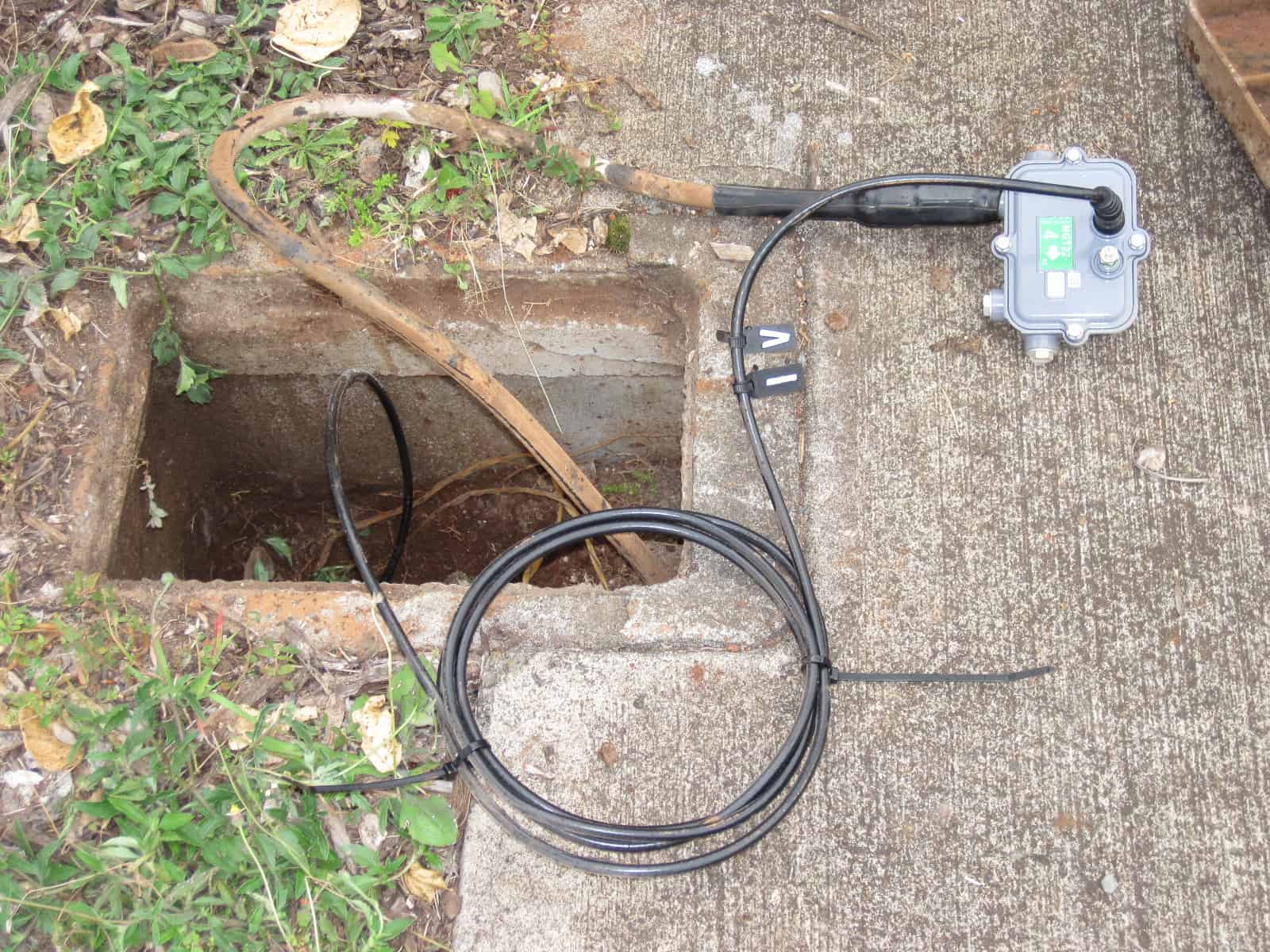
Old cable TV street connector box

The old cable TV street box

The tech finally showed up at 3 PM and agreed that our service connection at the garage looked a little old. He understood that we were at the end of the string and might need a little more signal strength than the usual cable customer. Then he opened the street box in the sidewalk and saw that the ground was still damp (four days after the last rain). He unscrewed the cable from the connector box, and water dripped out. (Cable boxes aren’t supposed to drip anything, let alone water.) He saw that the coax cable’s center wire was actually rusted, so he cut off a few inches of the cable and tried to put on a new connector. (Just like all the other times.) However, the 23-year-old cable was so brittle that he couldn’t get a good fit. When he went to the garage service box to fix that connector, he couldn’t get a good connection there either. He was almost out of cable slack, and fine beads of sweat were beginning to pop out on his forehead, so he decided to replace that whole 50-foot stretch of cable.

He tried to stick a fish wire down the conduit between the street box and the garage service box, but the fish kept getting stuck. He called for backup tech support, and a few minutes later a second truck showed up. They squirted a few pints of soapy lubricant down into the cable conduit, added several gallons of water from our garden hose (flooding the street box again), and were finally able to move the old cable. Then they pulled over 60 feet of shiny new coax cable through the conduit (under the sidewalk, under our driveway, and up to the garage) and put on new connectors.

Water damage to electronics inside the cable TV connector box

The inside of the cable TV street box

Meanwhile, a third truck showed up to help. That tech went to the street box and checked the neighborhood cable’s signal strength to the connector that had been dripping water. After a few choice four-letter words, he unscrewed the bolts on the connector housing and pulled it open. Water poured out, and it looked as though they’d finally identified the root cause of the last decade of problems.

You don’t have to be a submariner or an engineer to recognize what water has done to these electronics. Believe it or not, the filtering circuitry had still managed to let through some signal over the years– until it turned into a solid block of rust.

The techs used an impressive power tool to cut the cable and put on a new connector. At this point, I was really glad I’d sought professional help, because I wouldn’t even have wanted to try to fish in a new cable.

Just by replacing the connector in the street box they gained 18 db of signal strength. They guessed that the new cable from the street box to the service connection was another 3-6 db improvement. I unplugged our 14 db amplifier and reconnected the regular house cable to the DVR.

Cable TV street box with new connector and new cable to house.

New connector and new cable to house.

It’s amazing. No static anywhere. All the channels are totally clear. The coax cable in our house’s walls may be old & brittle, but there’s more than enough signal strength to handle it. It’s amazing what crappy service (both cable signal and customer support) we’d become resigned to during all those years of frustration.

We’re still at the end of a long string of customers, but we seem to have plenty of power. The seals on the new box should last for at least five years, and now I know what to watch for. I’m even considering going back to RoadRunner. If the signal is this good we could ditch our Hawaiian Telcom landline and go to digital phone service. Our cable bill is “only” $70/month, and our combined telephone landline/DSL bill is “only” another $55/month, but now that we have good cable again it’s time to shop around.

Maybe I need to get out my 100-foot roll of RJ-11 phone wiring and start troubleshooting our DSL signal too. And if HGTV ever moves to Hulu (or Netflix?) then we might be done with cable TV.

Related articles:
Save money by fixing your own plumbing
Lessons learned from DIY home improvement
DIY home improvement
DIY home maintenance

Posted in Military Retirement | 8 Comments

5 Ways to Ease the Transition from Military to Civilian Career


This guest post is brought to you by Aaron Walker. (If you’re interested in contributing a guest post, please see our guest posting guidelines.)

I’ll be honest: When I began the job search as I moved from the military to civilian life, I often felt like I was speaking a different language than the people who interviewed me. I’d detail my experience with military terminology and often drew blank looks from interviewers who had no idea what I was talking about, or how I could fit in at their company.

It left me feeling frustrated and, I’ll admit, and a little defeated. Add in a terrible economy, and I wasn’t sure I would ever find work in any field, whether it be food service or human resources translations.

Luckily, that turned out to be wrong. Eventually, I found a great position. These five tips can help you, too, make the often rocky transition from a military to civilian career.

Speak the Same Language

There are a lot of terms that we throw around in the military that are second nature to us, but civilians don’t understand them. Do a practice interview with a civilian friend and have them help you hone in on what words you’re using that might be confusing. Remember this during your real interview, and try to explain yourself in a different way. The less confused the interviewer is, the better chance you have of getting the job.

Be Your Own Cheerleader

In the military, we’re not used to putting ourselves first. We do things for the good of our unit. But in civilian life, it’s the opposite. If you don’t tell an interviewer how great you are at making donuts or crunching numbers, they’re not going to want to hire you. Don’t be afraid to brag about all the things you do well.

Get Help

Many of us in the military tend to think that reaching out for help shows weakness. It’s not true. Sometimes a helping hand is just what you need to get on the right track, and it could be the difference between finding a job and heading back to the unemployment office. There are lots of great government-sponsored programs that help veterans find jobs. There are also local and regional programs that can help you get your foot through the door.

Have a Realistic Outlook

A study by Prudential Financial and Iraq and Afghanistan Veterans of America found that 80 percent of military job seekers are looking for “the right job” rather than just any job. That may be setting your up for a failure. If you have your sights set too high, you won’t see what’s right in front of you, which could be the perfect job if only you’d lower your standards a bit.

Revamp Your Resume

Military resumes tend to be too long for civilian employers’ tastes. It’s a great idea to give your military resume a pruning. Make sure to define any acronyms that are included in it, even something as basic as D.O.D. Though you assume everyone knows that’s “Department of Defense,” not everyone does, and rather than take the time to figure it out, they’ll just toss your résumé in the slush pile.

Aaron Walker is a former serviceman who now works in translation and freelance writing.

Related articles:
Should you start a civil service bridge career after the military?
Military experience to civilian careers
Starting your bridge career after the military
The transition to a bridge career

Posted in Career, Money Management & Personal Finance | 2 Comments

“I’m setting a good example by working at a job”


I read an interesting forum thread about the conflicts between living life on your terms or meeting society’s expectations. When you reach financial independence and can choose whether or not to work for a paycheck, there may still be other issues affecting your employment decision.

(Note: this post was originally published in 2013 and eventually consolidated with other posts on TheMilitaryWallet. I’m re-publishing the 2019 version and some comments, updating it for my years of personal experience.)

Here are some (anonymous, edited for clarity) quotes from the post that started the discussion. The quotes eloquently state the issues faced by so many military veterans:

“By most people’s standards, I could retire if I want to. We’re financially independent.

I’m in my 40s. My wife and I have no debt other than our mortgage. We have investments in the stock market and I’ve always lived well below my means. I have a military pension and another source of passive income (outside of my investments) plus military health insurance.

My dream used to be to never work after I left the military. Somehow that didn’t happen.

The reasons:

  • I’m not sure what I would fill my time with.
  • My job doesn’t drive me crazy, maybe because I refuse to let it do so. I get paid fairly well for a job with not much stress and steady hours. I get every weekend off, plus every other Friday (thanks to a compressed schedule), and you can set your watch by my arrival time home every day. Between vacation time, every other Friday, holidays, and vacation days, I get 160 days off per year. I like to focus on the positives of that, and not the 205 other days per year. I have a long commute, and I’m not solving world hunger, but, that’s not so bad. If I can’t be happy with 160 days off per year, I probably can’t be happy with 365 days off per year.
  • I inherited a small amount of money from my dad and would feel like a freeloader if I didn’t pass on the same amount to my kids.
  • I think I owe my kids the example of getting up and going to work and being successful in the world (not just hanging out in my shorts all the time) before I one day tell them to go out into the world and bag a bunch of money. They were young when I was in the military and never really saw me work my butt off. Most of that happened before they were born or really aware. In the military I worked days on end, every holiday, every hour on the clock, 24 hours straight twice, and almost “gave all” one day in Iraq. We moved 13 times in 21 years.
  • I don’t think my spouse and I have an agreement of what “the dream” looks like. I used to dream about sailing around the world but one day I noticed my spouse likes a house with air conditioning, screens on the all the windows, heat, and other conveniences.

So I focus on finding as much joy as I can every day while still working, trying to enjoy what I have without becoming consumerist. I’m raising my kids to grow up with a healthy attitude to work and a sensible attitude about what money buys and what it doesn’t buy.”

I’ve seen several variations of this discussion over the last decade, so here are some thoughts to consider as you make your own transition.

“Filling your time”

In Malcolm Gladwell’s book “Outliers,” his ideal occupation includes autonomy, complexity, and fulfillment. Personally, if I was a doctor, lawyer, university professor, or financial advisor then maybe I’d see no reason to quit working. (Yet I saw no reason to start those careers, either.) Writing certainly delivers those three factors to me, although if I was doing it for profit then I’d be a starving author.

All retirees worry about “But… but what will we DO all day?!?” There’s not much comfort from trite answers like “Whatever you want!” or “Every day is Saturday and every night is Friday night!”  Those answers state the facts, but they’re just not detailed enough to be reassuring. Most military veterans have spent an entire career with their operating tempo at max throttle, and they’re not even able to imagine slowing down. Add in the clichés of “golfing all day” and “rusting rocking on the front porch”… there doesn’t seem to be much to look forward to.

Yet six months after these worried veterans leave the workplace, every retiree with whom I’ve spoken has said that they wonder what the heck they were worrying about. They’re finding plenty of autonomy, complexity, and fulfillment in their lives without having to go to the office.

The reality is that your retirement days will fill themselves. You already have your own goals along with the military skills and the personal discipline to make it happen. You’ll sleep better and you’ll be able to exercise “when you want” instead of “when there’s time”. You have a home to take care of (and maybe a yard) and you know how to build a maintenance task list.

Your military occupation might translate directly to “handyman” or “domestic executive”, only without ammunition or midwatches. “Weekend duty” becomes family time. You might enjoy cooking & cleaning, or you’ll find a way to minimize the chores you despise. You’ll spend more (quality) time with family, neighbors, & friends. You’ll spend more time relaxing with a cup of coffee to read a book. You can run your errands at 9:30 AM on a Tuesday (while the rest of the world is at work or in school) instead of with the weekend crowds.

You’ll explore your interests whenever you want, and as much as you want, without having to get back to work and empty your IN box. This could be more of a problem than you might expect: when you’re responsible for your own time then you’re in charge of your own schedule. During your working days when you had too much to do, you could blame it all on work and the boss. If you overcommit yourself during retirement then you have only one person to blame.

If you’re still concerned about filling your time, author Ernie Zelinski has you covered: you can jumpstart your thinking with his “Get-A-Life Tree”. It’s a straightforward mind-map of your interests and ways to turn them into activities. I’m pretty sure that it works because I’ve had a blank copy on my desk for over a decade. I’ve never made the time to sit down and fill it out because I’m too busy doing other things.

“The job’s not THAT bad”

Military veterans have plenty of employment challenges before we even hang up the uniform, and you’ve probably already read about them many times in the media. I’m not going to repeat the common ones here, but there are two which you don’t read about very often.

The first issue is a powerful internal motivation to serve. When you’ve been taking care of the mission and your troops for years, even decades, then it’s hard to turn off that compulsion. We military veterans have a commitment to service. After the military you’re not only looking for a new purpose in life, but you’re also trying to find a cause and a group of people to take care of. When you’re financially independent you may still find yourself serving with nonprofits or the schools or local government. You’re not alone, either– retired civilian corporate executives also struggle with the constant desire to lead a major project with a big group.

The second issue is a little more controversial: the military inferiority complex. We’re our own worst enemies, and we all do it to each other. For years you’re told that you’re barely capable of functioning adequately at your current rank, let alone worthy of a promotion. Even when we’re alone we have a little internal drill sergeant that’s critiquing our performance. I’ve watched a senior submariner– a future admiral and an instructor of other prospective commanding officers– tell his dozen steely-eyed killers-of-the-deep students “You’re never as good as you think you are, and you’re never better than your next mistake.

We may be in the military’s top units with the nation’s best people, and we’ll still beat ourselves up over every error. It’s a relentless drive for perfection that’s been keenly honed by centuries of combat, and it’s a type of teamwork that’s been elevated to an art form. It keeps us humble and it keeps us alert for surprises or ambushes. It’s one of the reasons that puts the U.S. military among the world’s best.

However, it’s also a problem when you’re thinking about leaving the service. Your chain of command is concerned about retention, and they’d like to keep you around for a few more years: “How can you find a civilian job in this economy? What makes you think you can hack it in the corporate world? What possible skills do you have that an employer wants?” When we finally leave active duty our own competitive spirit kicks in, along with that little internal drill sergeant: “Do I have what it takes or am I worthless & weak? Am I still relevant? Do I still have a dog in the fight? What do I need to do to succeed in this strange civilian corporate culture?

Any military veteran knows that the civilian transition can be treacherous, but we bring plenty of skills. We can evolve into great corporate employees and executives. However, our competitive spirit, our constant drive for improvement, and our military inferiority complex all make us work at careers we may not particularly enjoy– for far longer than we should. “Heck, the job’s not so bad. Why, compared to this one time in Iraq…”

If you choose to quit the job then it’s even more intimidating: you have to be responsible for your own entertainment. A workplace can form a social structure to provide that stimulation, as well as giving you a reason to get out of bed in the morning. But back in 2006 the creator of Early-Retirement.org used to describe the workplace with an analogy: You go through your working career with one bucket in each hand, labeled “Financial Independence” and “Workplace BS.”  Both fill slowly over the years, although you have some influence over their fill rate. When the FI bucket is full, however, something odd happens to the BS bucket:  it suddenly fills rapidly and begins overflowing.  For a few people, it… explodes.

If you’re getting autonomy, complexity, and fulfillment from your workplace then maybe the BS bucket doesn’t overflow. But FI certainly gives you choices. Once you’re financially independent and have no compelling fiscal reason to show up for work, the dissatisfiers quickly become worse. You suddenly can no longer tolerate the rush-hour commute, the workplace uniforms, the meetings, the mandatory training seminars, the boss, some of the co-workers or customers, the business travel, or even the poor timing. When the surfing is good, you want to be able to just go surfing instead of having to rearrange your work schedule.

If you enjoy your work so much that you’re willing to put up with all of those dissatisfiers, then you should keep working. But if the BS bucket is getting too full, then figure out if there’s a way to change the way you work. Maybe you need to shift your schedule to avoid rush hour, or cut back on your hours, or be excused from further meetings, or otherwise re-define your job to your new expectations. If your office claims they “can’t support that” then you could tactfully let them know that it might be time for you to find a new office– or no office at all. When they understand that their choices are “less of you” or “none of you” then they may reluctantly accommodate your desires. If they cannot negotiate– part-time, remote work, a sabbatical, or unpaid leave– then you’re getting a strong signal that your BS bucket will shortly be sloshing over the edge.

You can run the experiment for yourself. See if you can get 30 days off (or a minimum of two weeks). Treat it as a financial independence sabbatical. Instead of cleaning the house and your desk, doing the yardwork, and catching up on your To Do list, treat it as the rest of your life. Spend a day or two getting caught up on sleep, but then put some thought (and spouse discussion) into how you’d spend your day. Get your exercise, do 20 minutes a day of chores, work on a project, spend time with the family, keep adding boxes to your Get-A-Life Tree.

At the end of your time off, take that long commute back to the workplace and see where you stand on your FI & BS buckets.

During the 1990s Intel Corporation used to have a very generous sabbatical program for their more senior employees. A high percentage of them did the same retirement experiment during their time off, and when they returned to work it didn’t take them long to realize what a toxic workplace environment they’d been slowly boiling marinating in. That sabbatical benefit led to at least two early retirees who I know personally, and I think the attrition jeopardized the entire program.

“I’m doing it for my kids.”

Here’s a story posted on Early-Retirement.org. One of the old-timer members, a military veteran, went on to a successful career and became financially independent in the early 1980s. He decided to stop working, but he was concerned about setting a good example for his teenage daughter so he decided to demonstrate the virtues of work. Each morning he’d get up, shave, dress up in coat & tie, and be at the breakfast table to greet her as she got ready for school. He’d drive off “for work” before she caught the school bus. He’d hang out at the local coffee shop until she was clear, and then he’d return home to change clothes and enjoy his retirement day his way. This continued until she left for college.

Two decades later he confessed this subterfuge to his adult daughter, and she laughed at him. She said that she’d never noticed what he was doing because she was too totally wrapped up in her teenage life (with its drama & angst) to notice what her Dad was doing with his time. She said that even if she’d noticed, she was still too busy with her own drama & angst to care. She never noticed or cared what kind of employment example he was setting. All she really cared about was him being there when she needed him.

Another story:  A few months after I retired from the military I told my nine-year-old daughter that I had a job offer. I explained how we already had enough money for the family so that I didn’t need to work, but if I took the job then we’d have even more money. We’d be so rich that we could buy her a horse now and a car for her 16th birthday.

She was absolutely thrilled at a “Dad Of The Decade” level.

Then I told her that I’d have to be gone every weekday from 7 AM to 5 PM instead of being around when she got home from school. She’d have to get herself up in the mornings, get her own breakfasts, get out the door on her own, come home from school on her own, fix her own snacks, and take care of herself (and her homework) until I got home. I told her that I wouldn’t have midwatches or weekend duty (let alone deployments) but I wouldn’t be able to volunteer to help out at school or chaperone fieldtrips.

It took her about 10 seconds to decide that wasn’t worth the privileges of having a horse and a car. She wanted the quality parental time.

Oddly enough, for the next nine years she got herself up in the mornings, got her own breakfasts, got out the door on her own, came home from school on her own, fixed her own snacks, and took care of herself (and her homework).

She didn’t need me to do anything for her. She just wanted me to be there for her. Of course from a parental perspective my after-school presence helped her talk through a few drama/angst meltdowns.

She turns 21 years old in a few months, and when I started writing this post I asked her again if she would have rather had my money or my time. She chose “time”, of course, and then went on to say that she thought my retiring so young actually set a better example for her. In her 20-something wisdom, she now has a goal of saving & investing as much as she can so that she’s also financially independent in her 40s.

(2025 spoiler: she and her spouse reached FI in their early 30s on a high savings rate.)

The only thing your kids want is your time. Younger kids just want to play with you or have the thrill of seeing you in their classrooms and on field trips. Older kids may be a little skeptical that you have enough money to take care of them, but you can explain the family budget and reassure them that their allowance is part of the plan.

Teens would be relieved to see that you’re busting your butt in the workplace to bag the money to achieve financial independence, and then hanging out in your shorts to be successful in the world in your own way. I think they’d rather be judged on fulfilling their own goals than to see us keeping score with dollar bills or worrying how to occupy our time.

“My spouse and I see retirement differently”

If you and your spouse could handle the military together, I’d hope that the two of you could figure out how to handle retirement together. If you’re working because your spouse isn’t ready for retirement, then the two of you need to communicate and negotiate. Maybe your better half has their own personal struggles with the issues I’ve already mentioned, or maybe they’re concerned about having you underfoot (or in their face) all day long.

Maybe you want to do things in retirement that they don’t care for, but does it mean that neither of you can ever retire? Those are perfectly valid issues that need to be acknowledged and then worked through. Retirement can provide a tremendous boost to your relationship– the sooner you have the conversation, the sooner you can reach an agreement.

Call to action:

I’ll leave you with one more thought. On active duty you had a set of emergency & casualty procedures that you trained on, held drills on, and critiqued the performance of.  No matter what happened or when, you were ready to drop everything and deal with the problem.

Do the same with early retirement for both yourself and your family.

The reason is that someday there’s going to be a medical emergency or a family problem. Maybe it’ll be yours personally, or your spouse/kids, or one of your elders. You’ll take leave from the job and deal with the situation. But whatever happens, about 48 hours into that crisis you’re going to find yourself questioning exactly why you’re still going to work when you could be living life on your own terms.

Whatever struggles you’re going through will make your own life seem a lot more precious than the corporate routine. You may even be facing weeks or years of potential recuperation, rehab, and caregiving (hopefully not for you but possibly for that loved one). These crises will force you to define and reorganize your priorities.

Your military training and your emergency & casualty procedures got you through the operational crises. Maybe you’ll get through your personal or family crisis just fine, shake off the fallout, and scamper back to the workplace to pick up where you left off. But perhaps you’d have much more time for thoughtful analysis & discussion of this situation if consider it now, just like training & drills, instead of having to go through it when the crisis happens to you.

It’s much better to achieve financial independence and have an early-retirement contingency plan rather than to boldly proclaim that you choose to work for the rest of your life.

Give yourself choices, and be ready for your own personal growth without paid employment.

There are no affiliate links or paid ads in this post.  Try your military base library or local public library before you pay money for these books– in any format.

Military Financial Independence on Amazon:

The Military Guide cover
  • Reach your own financial independence
  • Retire on your terms
  • Success stories and personal checklists
  • Royalties donated to military charities

Use this link to order from Amazon.com!

Raising Your Money-Savvy Family on Amazon:

The Money-Savvy Family cover
  • Reach your own financial independence
  • Teach your kids how to manage their money
  • Specific tactics from my adult daughter
  • Checklists and spreadsheets for your family

Use this link to order from Amazon.com!

Related articles:
When should you stop working?
Financial myths of retirement (part 2 of 2)
Retiring early– with kids?
Raising a financial independence money-savvy family

Posted in Career, Financial Independence, Military Life & Family, What Do You DO All Day?!? | 6 Comments

Book review: “The Longevity Project”


“Come on, you [men], do you want to live forever?!?”

— Marine Corps First Sergeant Daly, Belleau Wood
(slightly edited for a family-friendly blog)

One of the challenges of financial independence is “longevity risk”, where you ensure that your assets will last as long as you do. Unfortunately when we stop working for a paycheck (even at the “traditional” age of 65) most of us have no idea how long our assets will have to last. If you stop working in your 40s then the actuarial odds are pretty good that you or your spouse will be around for another five decades. Even the Internal Revenue Service has noticed the issue and revised the IRS required minimum distribution tables to reflect longer lifespans (and lower RMDs). Financially, the only way to hedge longevity risk is through annuities like a military retirement, Social Security, or an insurance contract.

But longevity is not just financial probabilities and statistics. If you’re going to minimize your financial longevity risk, how can you also maximize your longevity? For example, Dominguita Velasco turned 112 years old on Mother’s Day. That’s not a typo: one hundred and twelve years old, yet she’s barely in the top 30 centenarians whose ages have been authenticated. They’re humanity’s fastest-growing age group.

So what’s Ms. Velasco’s longevity secret? “Stay happy.”

The researchers of “The Longevity Project” have nearly a century of data, but it fails to confirm Ms. Velasco’s insightful analysis.

The book cover of "The Longevity Project" on what promotes long lifespans.

How long will you live?

The data came from a study that began in the early 1920s when a Stanford psychologist interviewed over 1500 elementary school children.  Dr. Terman was looking for bright kids whose intellectual potential might be identified by its early signs and tracked to its fulfillment. (Terman invented the Stanford-Binet IQ test, which is still in use nearly a century later.) He checked back with his group every decade or so until the early 1950s, and then followup interviews were carried on by his successors. When “The Longevity Project” authors began their study, they spent a tremendous amount of time and effort tracking down all the death certificates of the participants. By verifying their subject’s ages and causes of death, they completed the collection of one of the 20th century’s largest and most detailed databases of human health and longevity.

The children profiled by Dr. Terman were born between 1900-1925. A few of them lived into their 90s and as of 2003 over 200 of them were still alive. They dealt with the Great Depression, a world war, and the Cold War. They led America’s 20th-century expansion in population and technology, and they represented a typical segment of its middle class. A few found fame & fortune and some were well-known in their professions. They also died at all ages and of almost every cause, so the researchers could test many theories about the factors affecting their longevity.

Several books have been published on the study. “The Longevity Project” represents 20 years of analysis by Doctors Friedman & Martin, assisted by over 20 graduate students and other PhD collaborators in various research specialties. They explored the data from many different aspects and then compared their results to other (shorter-term) studies in physiology, psychiatry, sociology, mental health, and aging. They were even able to compare some of their data to the Grant Study, another longitudinal database of 268 Harvard undergraduates that continued for 75 years.

By today’s standards, Terman’s original study was flawed. The chosen children were recommended by their teachers and selected for IQ results. They were overwhelmingly white, middle-class, and from California. They were also a product of their times, when women had limited opportunities while these particular men were offered exceptional favor for their gender and race. Dr. Terman interfered in the study by writing recommendation letters for some of his subjects and even exerted his influence to get others admitted to Stanford. Years later, however, he concluded that IQ did not correlate to achievement. After modern researchers accounted for the study’s flaws, they agreed with him.

Friedman & Martin looked at longevity, not potential or achievement. They debunked some surprising conventional wisdom of their own. Based on their data, all of these myths appear to be false:

  • The good die young.
  • The bad die late.
  • Married couples live longer.
  • You’ll live longer if you take it easy and don’t work so hard.
  • Happy thoughts reduce stress for a long life (contrary to Ms. Velasco et al).
  • Worrying is bad for your health.
  • Don’t be so serious. Be more spontaneous and have more fun.
  • Religious people live longer.
  • Vigorous exercise is better for longevity than gardening or walking.
  • You’ll live longer if you believe that you’re loved and cared for.
  • You’ll live longer if you retire as early as possible.

So what works? Surprisingly, the words “prudence” and “persistence”. Children who Terman had assessed as “conscientious” were highly correlated with longevity. Modern society is all too familiar with the Darwin Award for a lack of conscientiousness (“Eh, brah, hol’ ma Primo an’ watch dis!”) and more conscientiousness also promotes longevity. It not only leads to healthier habits but to better friendships, improved workplaces, and happier marriages.

What’s wrong with thinking happy thoughts? It turns out to be a two-edged sword. There are positive health aspects to being cheerful, but it can also result in a happy-go-lucky disregard for health. Centenarians like Ms. Velasco are optimistic, but the problem with studying this age group is that darn near all of them are smiling. There’s no comparison group (the ultimate “survivor bias”). Happiness seems to be a result of longevity, not a cause of it. It’s more likely that they’re happy only because they survived so long– not because lifelong happiness makes them healthier. Ironically, some studies determined that worrying and neurotic behavior were better survival tactics than maintaining a cheery outlook.

Since this is a blog about financial independence and retirement, I’ll skip ahead to the end of the list. Does early retirement really reduce your longevity? If that’s the case then I’d better type faster.

The most notorious claim relating early retirement to early demise is the Boeing Study. Although it’s been debunked, it regularly resurfaces and resonates across the Internet. Other studies purporting to prove the same conclusion do not distinguish between early retirement for health reasons versus early retirement for financial independence. Once the data is corrected for that difference, there’s no correlation between early retirement and shorter lifespans.

There’s also no correlation between early retirement and longer lifespans! In fact the data seems to conclude that working longer leads to extended life. “The Longevity Project” authors analyzed this hypothesis against their data and determined that the actual workplace correlations to longevity are conscientiousness, prudence, persistence, and productivity. If you satisfy those factors through working for a paycheck then you’ll live a long life. If you satisfy those same factors by reaching financial independence and retiring early, while still maintaining your personal productivity, then it also turns out that you’ll live a long life. If you retire early due to poor health, or if you retire early to vegetate on the couch all day (perhaps sipping margaritas and nibbling bonbons), then your longevity is also dramatically reduced.

By the way, the definition of “retirement productivity” is up to you. In the workplace, it’s usually measured by happy customers, meeting deadlines, and cashing paychecks. If you’re financially independent then it’s whatever you find entertaining and fulfilling. That could be training for an Ironman triathlon, working on your house & garden, painting portraits, or simply reading & writing. If you’re active and happy then you’re probably healthier and more likely to live longer.

If you’re curious about marriage and religion, you’ll have to read the book. (It’s been out for two years so you’ll probably find a copy at your local public library.) The important longevity factors turn out to be the quality of those two institutions for their participants, not merely their membership.

Despite the flaws of the original Terman research, “The Longevity Project” is still the world’s best collection of lifespan data. Regardless of why it was started, it offers insights on what led to long life in the 20th century. Death certificates are objective evidence of the cause of death, and a tremendous amount of data was collected on these people as they lived their lives. The analyses conducted by Drs. Friedman & Martin are peer-reviewed, statistically rigorous, and frequently confirmed by other sources.

Better yet, applying their recommendations won’t require any radical lifestyle changes. We can pick & choose from their results and implement the concepts which suit our confirmation bias. Just by reading the book and reflecting on our own lifestyles, the placebo effect can practically guarantee an improvement in our own longevity.

One day you, too, might be offering the media your own analysis of how you managed to stay alive for so long. And when you do, you’ll be happy about it!

Related articles:
During retirement: Healthy lifestyle
How much will military veterans leave on the table?
Asset allocation considerations for a military pension (part 2 of 3)
“Present value” estimate of a military pension
Retirement planning: “Just tell me what to do!”
More SBP details
Military long term care insurance
Interview: what’s wrong with long-term care insurance?
23andMe genetic testing

Posted in Reviews | 10 Comments