How Do You Justify Your Spending?


Ohana Nords just finished a three-week family vacation in Bangkok. As spending goes, it was the most frivolous blowout we’ve enjoyed in decades. When we roamed the city we saw vignettes of incredible luxury, scrappy entrepreneurialism, and abject poverty. It was a very interesting mirror that reflected our own attitudes toward using money or hoarding it– and the value we get from our spending.

My spouse and I have enjoyed financial independence for over a decade, and it’s worked out very well.  We should enjoy these types of vacations more often.  We know that we could build a huge collection of material luxuries. If we wanted more exotic experiences then we could afford a world cruise. However, our frugal habits were set early in our adult lives, and we keep “relapsing” to that behavior.

For example, submarine duty taught me how to live in a small tube with over a hundred of my closest friends. I slept in a three-person upper bunk on a 28″x72″ Naugahyde-covered foam pad, and the overhead was too low to sit up. I had storage space for about two seabags to last a 90-day patrol. I had to take care of my things or learn to live without them, because if they broke we might still be months away from a portcall.

My spouse spent the first three years of her Navy career in 1980s Spain and the Azores. Her apartment was warmed with a portable butane heater and an electric blanket. Water pressure was unreliable yet the Azores rain squalls frequently flooded out her apartment. Electric power regularly failed, so she stocked candles & flashlights and used a windup alarm clock to wake up for duty on time.

Our lives occasionally crossed the line from frugality to deprivation. However, we were busy learning how to do our jobs and didn’t have much free time, we had lots of friends to share our fun, and we were saving money. Life was good.

Today our adult daughter smirks at those sea stories. She thinks that when we parents were young we walked to school barefoot in the snow all year long (uphill both ways) and we were poorer than Monty Python’s Four Yorkshiremen. But we actually grew up in typical 1960s families with relative affluence. We graduated from a service academy to begin our adult lives with small car loans, ensign starter kits, and steady paychecks. We had great times with our friends & shipmates, we traveled all over Europe, and we have many fond memories of those first duty stations. However, our standard of living definitely took a big dip during those early career years, and we formed frugal habits that are surprisingly hard to change.

We still seem to need a purpose for our spending. Even our trip to Bangkok had a mission. For over 20 years the Navy helped us travel the world for free, but it was almost always for a reason. It was frequently in cramped military fuselages on webbed seats, and a charter flight on a civilian aircraft felt like getting away with a minor felony. Today we have the entertainment budget to go anywhere but we still find it psychologically hard to just hop on a plane for fun. We still feel as if we should be leading training or attending a conference and working for our liberty. In Bangkok we were running an offsite retreat: we enjoyed a few final weeks of quality family time before our daughter starts her own Navy career. We joked about showing her how to do safe overseas liberty without getting ripped off– and she put up with that for three weeks.

Our frugal habits reflect our mental attitudes. These attitudes aren’t simply a fear of losing our wealth and enduring our elder years on cat food. We know that we have “enough”. Instead, we feel the burden of stewardship and we try to squeeze the most out of every nickel that we spend. We still have a difficult time spending money unless we feel that we’ve earned the privilege. When we give ourselves permission to spend, the experience or the possession still seems way overblown compared to our memories of how we used to live.

Even today, both of us still pick up spare change off the sidewalk. (My spouse spent two years at one command doing daily runway FOD walkdowns. 30 years later, she can still spot a coin on the sidewalk at 10 paces.) Like Bill Gates stooping for a $100 bill, we’re wasting our time picking up pennies– but it pains us even more to just leave them lying there. The free money gives us a tiny high from the little jolt of endorphins.

In Bangkok, we continued this habit with quarter-baht coins. (The Thai economy must be doing very well– after a decade of Bangkok trips, this is the first time we regularly found money.) A quarter-baht coin is worth about 0.75 cents at today’s exchange rates, so we were working even harder for less. However, a quarter-baht coin goes a lot further in Bangkok than a penny goes in America.

I know that 100 baht buys me more street food than I can eat in one meal, so I felt extravagant by spending 350 baht for a restaurant buffet. But again I’m deciding between spending $3 versus $11 for a vacation experience… probably a waste of financial effort in America, let alone in Bangkok.

When we started our military careers, we were frugal by occupation and necessity. Today it’s a choice, yet we still live a green lifestyle and can’t stand to waste resources. We get a huge sense of satisfaction from our DIY handyman skills.

During one meal in Bangkok, the hotel restaurant had a problem with their buffet equipment. We watched a cluster of kitchen staff and waiters struggle with it. The maître d’ got involved, and then an exec was summoned. Eventually, a maintenance guy in coveralls and gear belt showed up, tweaked a few things with his tools, and all was well again. As the crowd dispersed, I realized that the person I really identified with wasn’t the service staff or the management or the leadership– it was the guy in coveralls who could fix things. I bet he has a really cool workshop, too.

In our luxurious Sukhumvit serviced apartment, we realized that big-city high-rise living in a rented air-conditioned box is not for us. We enjoy owning a home that blends with the environment, where we can feel closer to nature. We like ground-floor lanai doors that open to a yard full of wildlife. We like composting and vermiposting and fruit trees and flower gardens. We enjoy having solar water heating and a photovoltaic array to make our electricity. We like living lightly without wasting energy or water.

These days our guilty pleasure is hiring a housecleaner to do the dusting and vacuuming that we despise, but we even make ourselves work for that indulgence. While the house is being cleaned we’re tackling a home-improvement project or fixing a car or pruning & mowing the yard. We have the assets to do whatever we want, but we still feel compelled to earn it. Housecleaning may be a luxury, but we use that time to do the jobs which cost a lot more than cleaning a house. We’re working at least as hard as the housecleaner.

Our feelings about lifestyle and spending came to a head in Bangkok when we met a couple of other American visitors for drinks. They own a business and they’ve been financially independent for years. We proposed meeting at a local coffee shop, and they suggested the opulent lanai bar of a five-star hotel. We took the Skytrain and walked to the lobby, while they had a car & driver.

Along the way we passed a street vendor selling fresh-squeezed fruit juice for 20 baht. The hotel bar’s mango smoothie was 350 baht(!), and their featured drink was the bartender’s performance art in an insulated glass with dry ice. We wore walking shorts & t-shirts, while the other couple was dressed for a formal dinner. We chatted about everything we’d seen and done, while they described the thousands of dollars of fine art and silks that they’d bought for their luxury home. After our farewells, we dined on 100-baht street food on the walk back to our apartment. They spent hours (and tens of thousands of baht) on a multi-course meal in the hotel dining room.

We all had a good time in our own ways, but their life is not for us. We each have more than enough wealth to live the way we want for the rest of our lives, and we all enjoyed ourselves with our activities and purchases. My spouse and I could learn to be more comfortable with spending money. However, we seem to have aligned our spending with our values, and we enjoy the small challenges of living a frugal, green life.

What about you? Do you feel comfortable spending money? How do you align your spending with your values?

Related articles:
Lifestyles In Retirement: Bangkok
Lifestyles in early retirement: long-term travel
How many years does it take to reach financial independence?
Frugal living is not deprivation
Frugality after financial independence
Do you really need $2M to retire?!?
Do you have affluenza?
Book review: “All The Money In The World”
During retirement: take small financial steps (part 2 of 2)
Retirement finances: what will I spend?
Extreme home improvement: DIY photovoltaic array
Save money by fixing your own plumbing
Lessons learned from DIY home improvement
DIY home maintenance

Posted in Money Management & Personal Finance | 10 Comments

Medical Tourism at Bangkok’s Bumrungrad Hospital


The two biggest obstacles to financial independence are inflation and healthcare — yet military veterans and retirees seem to have more options for dealing with inflation.

The Patient Protection and Affordable Care Act gives the American medical system a strong incentive to reduce expenses. The military Tricare system is also struggling to control expenses, but unfortunately military retirees are paying more for Tricare Prime– if they’re even eligible for an “upgrade” from Tricare Standard. Military veterans are nudged away from PPACA insurance exchanges to use all of their veteran’s benefits through VA clinics. Whether they’re willing to pay for a civilian policy or qualify for subsidies by their income levels, their veteran’s status could mean that they’re not eligible for any subsidy. “Reducing healthcare expenses” seems to mean fewer services and more billing.

I’ve been a military retiree for almost 12 years, and we’ve been eligible for Tricare Prime the entire time. (Oahu is a 30×40-mile island with several military treatment facilities.) Tricare has generally given excellent healthcare inside the doctor’s office, but it’s always been a challenge to persuade the Tricare bureaucracy to let you into that office. You’ll be treated when you’re sick or injured, but if you’re worried about your cholesterol or your breathing or your general health then you’re much more likely to get what the system calls “education and reassurance”. That includes plenty of actuarial statistics and guidelines for healthy living, but you probably won’t be approved for diagnostic exams unless there’s a significant family risk history. “Keeping an eye out for problems” is not considered worth the expense. Financially I understand the rules. Emotionally, though, I’m not so happy.

When I was on active duty I endured frequent “routine” physical exams (whether I felt that I needed them or not) yet in retirement I rarely have the privilege of being monitored for those same routine parameters. DoD has to keep the troops fit to fight, but they’re not spending as much time keeping veterans fit to receive our benefits. Perhaps that’s the way it should be. However, the system spent over two decades of my adult life gathering data on me, and now it won’t do that as much. Yet I’m a nuclear-trained submariner– I love taking logs and analyzing the trends, and I’m reluctant to give that up.

I didn’t worry much about my health in my 20s or my 30s because I was invulnerable. Heck, I was darn near immortal. However, I’m 53 years old now, and a few of my fellow invulnerable & immortal college classmates are waking up dead or expiring during their workouts. That tends to occupy your attention when you’re going to sleep– or trying to work out. My family history also has a few zingers that I’d prefer to have medical technology keep an eye on. If I’m tracking my medical issues, then I’m going to be that much more motivated to live the lifestyle necessary to control them. We can debate the cost-effectiveness of evidence-based medicine, but when it comes to getting regular feedback and sleeping comfortably at night then I’d prefer to spend a little more money.

One solution is supplemental health insurance– if you want more exams and tests then you have to be willing to pay for it. I’ve checked the premiums, and as near as I can tell they’re the cost of the exams plus an additional fee for the insurance infrastructure. It also puts you at the mercy of a second healthcare bureaucracy, and I’m not sure that I want to be squeezed from both sides.

However, another option is concierge medicine. This a refreshingly capitalistic situation: you pay a fee for the doctor’s attention, and they agree to make more time for you. If you want care beyond that, then you tell them what you want and they’ll tell you what it costs. Now you’re paying for professional advice instead of bickering with cost-control gatekeepers.

Our family finances are doing well these days, and I like sleeping comfortably at night. (Especially the part where I wake up the next morning.) However, American concierge healthcare can cost thousands of dollars a year because you’re paying for the system’s higher expenses of labor, liability, and research & development. It’s also tough to shop around for a better deal on a 30×40-mile island.

On Oahu the retail price of a basic urinalysis screening can run close to $100 (plus an hour of your time) and several days to learn the results. A complete blood workup might cost a little more. Did you want a chest X-ray or an EKG with that? Would you like to see a doctor to help you interpret the numbers? Ah, now your exam price is pushing four figures.

But you’ve read the title of this post– you see where this is going.

Last month we enjoyed a three-week family vacation in Bangkok, and our lodgings were right across the street from Bumrungrad Hospital. I’ve read about medical tourism on Billy & Akaisha Kaderli’s website, and I decided to learn more about their physical exams for a future trip. I was a little reluctant to start the process because checking American healthcare prices is a major project and I was expecting a similar gauntlet, along with cultural & language challenges.

I pleasantly surprised. The entire research project took me 10 minutes, and now it can take you two minutes: Bumrungrad Hospital health screening programs. At 32 baht per dollar, a detailed physical costs about $525. That seems like a lot of money for a physical, but click on that link to see what you get for the price. It’s been 20 years since my last chest X-ray, let alone a “whole abdomen ultrasound” along with an EKG and a treadmill stress test.

Military veterans remember their induction physicals: long lines, standing around for hours in your underwear, no idea of what just happened or what’s next. Maybe a tech took the time to explain a procedure, but that meant everyone else was waiting on you for their turn. We’re also familiar with the long waits for appointments at military clinics, so I e-mailed them to see how far in advance I’d need to schedule one.

More pleasant surprises: three hours for the tests, the results would be reviewed at the end of the exam, and would this Saturday morning work for me?

Bumrungrad has several large office buildings on a bustling one-block campus. Unlike any American hospital that I’ve ever seen, Bumrungrad’s labor is cheap and they’ve made a huge investment in information technology.

Better yet, it’s a great deal for doctors because Bangkok’s cost of living is a fraction of any major American city. A doctor with an American medical degree is welcome almost anywhere in the world, but their salary goes a lot further in Bangkok. They’re also surrounded by people who have scored their own excellent jobs and are eager to please, and they have the efficiency tools to boost their productivity. Bumrungrad has a world-class reputation because they’re hiring the best and leveraging their labor in a city where everyone can keep more of their salaries.

We stopped by the hospital a few days before my appointment to look around. The entrance resembles a five-star luxury hotel, not an industrial medical facility– right down to the valets hustling taxis and patients. Instead of being ignored in the lobby (as would happen in a metropolitan American hospital), a concierge was stationed right by the coffee shop. She explained where to go and who to see.

When we stepped off the elevator at the physical exam floor, another concierge suggested that we spend 15 minutes pre-registering now so that we could skip the Saturday-morning crowd. As I filled out the forms, I noticed that several concierges were working the elevators in at least six languages. The monitors showed who was next in multiple languages, and speakers also announced the numbers. When the clerk entered my form into their database, she also took a digital photo that was printed on my “itinerary” and displayed on their monitors. Each time a concierge was ready to escort me to the next station, they could look at the thumbnail image to recognize me instead of shouting my name across the room like a roll call.

Bumrungrad’s website clearly lays out their prep requirements for their physical exam, including fasting and drinking. I asked the concierge whether I should do anything else to get ready for Saturday morning, and she quietly supplied me with a stool-sample kit. Who knows, maybe she’s an American military veteran too.

On Saturday I showed up a few minutes early, and they were ready. During the next two hours I never waited for longer than five minutes. The staff stepped us all briskly through the sequence (including the payment desk, all major credit cards welcome) with quiet efficiency. Every station not only had a half-dozen clerks behind the counter, but also another half-dozen concierge staff working the room to answer questions in multiple languages.

Each exam room had a tech running the procedures, and at the end of several of them (like the EKG) the doctor was brought in right away to check the results for problems or additional tests. The techs and doctors had done literally thousands of exams and were extremely familiar with the medical issues as well as the equipment. (The ultrasound tech even gave me a tour of my trunk and major organs.) I chatted with at least four doctors during the physical, and another doctor for the review. I had plenty of time to ask all the questions I wanted, the techs were happy to brag about their gear, and nobody rushed the patients– but as soon as I was finished, a concierge was ready to walk me to the next stop.

The only paper I saw all morning was my one-page itinerary checklist and an EKG printout. Every other bit of exam data was reviewed on a monitor and then went from the equipment straight into the patient database.

I’ve never had a stress test before. (Other than being a submariner.) The tech slathered electrodes all over my chest, wired me to the data harness, and strapped on the blood-pressure cuff. I walked on a treadmill as the equipment recorded the numbers, and every three minutes the treadmill raised the incline to boost my heart rate to the age-adjusted 85% level. After 10 minutes they’d seen enough. I wasn’t even breathing heavily, let alone sweating, but I passed several exam rooms where patients were working a lot harder. Bumrungrad finds it necessary to inform their clients that the stress test treadmill is limited to 150 kilos.

I counted at least 40 customers during my two-hour circuit, and there were probably more who I never saw. American faces and languages were as common as Middle Eastern, Asian, Russian, and European ones. The clerks & concierges kept hustling, and the techs & doctors never had to go find somebody to fetch something. By 11 AM I was shown into the lobby, asked to help myself to the free snack bar, and told that I might have to wait as long as (*gasp*) 20 minutes before they were ready to review the results with me.

The exam was summarized on a monitor for the doctor and me to review together. (The PDF was e-mailed to me later that day.) My family history was included. He could click through most numbers to get to the actual test, the analysis, and the details. Any number outside the spec was automatically highlighted for further discussion. The EKG printout was scanned into the package for his review. If we had multilingual vocabulary issues or acronym questions then he could whip up a search box. He only had two questions (cholesterol and a liver enzyme) and we sorted through the answers in a few minutes. I had a few more questions, and he took the time to explain his answers.

The doctor was bemused: “You’re perfectly healthy. Why are you here?!?” I explained my age, my exercise-related shortness of breath and pounding heart, and my muscle soreness. My physical capacity was declining, my reflexes were slower, I couldn’t lift as heavy, I couldn’t keep up in taekwondo, and lately I needed at least 48 hours of recovery. 800 mg of ibuprofen almost daily. Even a few hours of surfing would wipe me out for the rest of the morning.

About two minutes into my recital he’d heard enough. He explained the details with technical medical vocabulary, but the surfer’s summary was “Dude. Yer gettin’ old. Welcome to Geezerland. Stop hotdogging it and use a longboard– or go stand-up.

The good news is that I’m unlikely to wake up dead or collapse during a workout. I could make a few changes: lifting for more reps, not so much for strength. Intense anaerobic intervals, not so much aerobic endurance. Stretching. Yoga. Thai massage. Ibuprofen and other anti-inflammatories as desired. Less sugar, less carbs, more protein, more fiber. Maybe supplements. If you were alive during the Kennedy administration then you’ve heard it all before.

I may be stuck with my physical limits, but Bumrungrad showed me lots of medical options. The next time we’re in Bangkok I’m bringing 30 years of medical records. I’m going to talk to a pulmonary specialist about acute exposure to volcanic ash and submarine atmosphere-control chemicals, and maybe I’ll buy a lung function test. I’m going to ask the orthopedic surgeon about an MRI update and discuss my knee longevity. I’m going to get an audiogram and a tinnitus talk. We’ll even have the geezer chat about thyroid function, vitamin B12, and other supplements. And while I’m there, I’d like to know whether there’s a better way to do a colonoscopy than my experience with Tripler Army Medical Center. I’d hate to learn that things could have been worse.

If you’re a military servicemember and you’re a little concerned about symptoms that may affect your eligibility for submarine pay (or any other specialty pay), then consider an off-the-record trip to Bumrungrad. You’ll have to burn a week of leave, but a few months of that specialty pay will cover your expenses. You can obtain reassurance and consider your future without feeling stigmatized– and perhaps without the risk of being unfairly benched for further research. I’m sorry that the American active-duty military healthcare system can’t already do this, but its priority is force readiness rather than our personal career issues.

If you’re an American hospital administrator then you need to visit Bumrungrad. If you’re a Hawaii medical professional and you’re not already familiar with Bumrungrad, then your credibility is suspect. Please consider adopting their administrative procedures at your practice.

Best of all, I can stop worrying about medical bureaucracy (and insurance companies) and start managing my longevity.

Related articles:
TRICARE Prime premiums and United Healthcare
The Affordable Care Act and Military Veterans
40 miles for Tricare Prime — or maybe Tricare Standard
I’m still a Tricare delinquent
Tricare fee increases coming in October
How I cost my Dad over $2000 in Medicare benefits
Economic Refugees at RetireEarlyLifestyle.com

Posted in Insurance, Travel | Leave a comment

Lifestyles In Retirement: Bangkok


Last month our Ohana Nords enjoyed a three-week family vacation in Bangkok. I’ll describe what we saw and learned, and another post will go into the details of my “medical tourism” trip through Bumrungrad Hospital. If you’re seeking your financial independence through a lower cost of living, this is one of Asia’s best starting points.

I’ll mention what’s changed since our last visit, but I’m skipping over the basics. If you’ve never been to Bangkok then I recommend Nancy Chandler’s shopping map plus the Frommer’s Bangkok Guide, the Lonely Planet Bangkok Guide, or Impact Publication’s “Treasures and Pleasures of Thailand and Myanmar“. Billy & Akaisha Kaderli also share their decades of Thailand experience on their website with photos and a travel guide. Their stories are particularly useful for understanding Thai culture and attitudes toward visitors. For even more details on expatriate life in Thailand, try Roger Welty’s “The Thai and I”.

This is not a post on frugal travel, although Bangkok is cheap even at 32 baht/dollar. I’ll describe some of those tactics, but we weren’t trying to stay on a budget.  (I barely even kept track of our spending!)  Yet it was also a very interesting opportunity to reflect on our attitudes toward spending money (or hoarding it) and the value we get from our spending. More fodder for another post.

When my spouse was in the Reserves, she worked in Thailand for exercise COBRA GOLD. I carried her luggage for a few of those trips, so this was her ninth Bangkok visit and my fourth. Our daughter stayed home with Grandma & Grandpa, and this trip was finally her opportunity to see & do all the things that she’d only heard about. Our vacation dates were set by her college break: it was our last chance for a family vacation before she graduates and gets her Navy commission.

Our previous visits had all been between late January and April. Bangkok’s climate is warm & muggy in January, and by April your breakfast is over 90 degrees & 90% humidity. October and November can be very rainy, but December and early January were wonderful. The weather was just like Hawaii– even a little cool at night– and we never saw any rain.

Bangkok is one of Asia’s largest cities, with population estimates of 7-10 million. Growth has accelerated since the late 1990s but planning & infrastructure are lagging. Air pollution is probably no worse than Los Angeles, but it’s far fouler than Hawaii’s voggiest days. Some locations are filthy with trash & sewage while others are sparkling clean. The streets & sidewalks are clogged with vehicles and pedestrians but life is at least as safe as any other large American city. Labor is relatively cheap– most hotels and apartment buildings are staffed 24/7 by traffic & security contractors.

Getting to Thailand from Hawaii is at least 14 hours because there’s no direct flight. It’s usually two six-hour flights through Tokyo’s Narita airport with a 4-6 hour layover, but this time we managed to find flights with “only” a two-hour wait. We arrived at Bangkok’s new Suvarnabhumi International Airport at the usual 1:30 AM. Several other flights arrive then, so the terminal was packed and taxis were plentiful. The airport is only about 30 minutes by expressway but surface streets are so congested (even at 2 AM) that the last six blocks take 15 minutes.

Bangkok traffic is absolute chaos– and on the left-hand side. Traffic control, vehicle safety inspections, and driver licensing enforcement are laughable. Tuk-tuks and motorcycles ooze into every gap, and at each stop light they weave in between the cars & trucks to gather at the very edge of the starting line intersection. Motorcycles carry paying passengers on the rear seat: young women demurely ride sidesaddle with a gymnast’s balance, holding the grab bar with just one hand and their bags with the other.

Red lights are regarded as challenges. Left turns on red are routine, but right or even straight on red seems to be allowed for motorcycles (at their own risk). The green light is greeted with a fearsome roar as motorcycles drag-race the half-block to the next traffic jam while laggard pedestrians leap for the sidewalk. Any vehicles cross the centerline when necessary, and motorcycles will even use the sidewalk if it’s not too crowded. There are no bike lanes and Darwin Award bicyclists risk their lives at every block. Jaywalking is technically illegal and frequently lethal. An average Bangkok rush-hour commute would leave a Manhattan cab driver quivering in tears.

Even walking in Bangkok is a challenge. Sidewalks are beautiful around luxury hotels, large stores, and visitor attractions. Elsewhere they’re narrow, uneven, pitted, and filled with street vendors. Entrepreneurs set up collapsible booths with flashy shelves and eye-popping displays. Passage is throttled to two abreast with frequent chokepoints and streetcorner crowds.

Pedestrians are constantly distracted by the environment, and many of them– mainly men of apparent Middle-Eastern attire– are unaccustomed to yielding right-of-way to large middle-aged steely-eyed surfer dudes, let alone a woman. (Even when we’re all sober.) Storm drains run directly underneath the sidewalk in a channel covered by perforated pavers. These handy holes are used for a store’s bucket of dirty water, street vendor food waste disposals, and occasionally a urinal. You quickly learn to watch out for broken pavers.

Sidewalk survival skills are essential to steady progress. If you’re not seeking a taxi then don’t make eye contact with a taxi driver, let alone a tuk-tuk operator– especially not when they slow and honk their horn to encourage you to check out their ride. Looking at a merchant’s display makes you a customer. Eye contact starts the haggling.

If a man holding a laminated photo sheet enthusiastically greets you, ignore him or you’re going on his tour. If you’re walking by a massage business but you’re not seeking one, then do not make eye contact with the attractive young women in high heels and tiny dresses. (Hint: not all of them are women.) If you’re a guy accompanied by a woman (especially your spouse or daughter) then stay within her arm’s reach– or a helpful entrepreneur will assume you’re seeking a woman. (Hint: not all of them are women.) Dogs, cats, rodents, street beggars, and small children are constantly underfoot.

Do not, under any circumstances, pull out a map and look around for street signs— a crowd of touts will swarm you to fight over your carcass. Step inside a 7-11 or hide in a doorway and huddle over your map. Maybe a clerk will take pity and help you, especially if you’re a paying customer.

I love it. Some mornings and evenings we walked for blocks just watching the street life.

It’s easy to have a Western hotel experience in Bangkok, but you’ll pay full retail price to live like an ignorant farang in an air-conditioned bubble. When you stay for at least a few weeks, it’s much cheaper to live local in an apartment. Some are “serviced” homes while others are simply a studio box to crash in.

We were traveling with a friend so we rented a three-bedroom apartment in the Mahajak Building (Soi 3 off Sukhumvit) by the Japanese and Pakistani embassies. It cost 58,000 baht/month, with a kitchen and a washing machine and free WiFi. It’s serviced three times per week, it has air conditioning, and they even threw in free electricity. The building includes an exercise room and a pool. Higher floors are quieter and the views are incredible. It’s across the street from Bumrungrad Hospital and just a few blocks from two Skytrain stations. This is luxury in a central neighborhood, so it’s incredibly expensive. There are many cheaper places, but do your research on the location and included features. We’d happily stay there on our next trip (especially for easy medical tourism) but serviced apartments are plentiful.

An added benefit to our Bumrungrad neighborhood was the Muslim visitor crowd. We saw a constant Middle Eastern fashion parade of chador, hijab, burqa, batula, abaya, dishdasha, ghutra, and topi with every family combination imaginable. (Our daughter’s seen most of this at Rice University, so she helped me with that vocabulary.) Local restaurants offered halal cuisine and hookahs, and a few even played muezzin calls. We also commonly heard Japanese, Mandarin, Hindustani, Russian, German, French, Australian English… and Thai.

Street traffic is clogged and rush hours are gridlocked, so the Skytrain is the preferred transportation. It’s elevated light rail, highly automated, very reliable, air conditioned, and not too crowded because trains run every 5-10 minutes. Trips are 15-45 baht each way and commuter passes offer discounts. It’s expanding but you may have to supplement it with the subway or a taxi to reach your destination. (Take a bus, motorcycle, or tuk-tuk just once for fun, and then you’ll never do it again.) Taxi drivers are supposed to use their meter, although some of them would rather tell you that it’s a meter holiday or it’s broken or your destination is “closed today” or “just burned down”– but they know another great family shop to visit! A typical metered taxi ride is 60-100 baht to areas around Skytrain stations, or 300 baht to the airport. Without the meter (or with a trip to the driver’s brother’s business) it’s at least 500 baht. If you’re told “no meter” then just chuckle, shake your head, and exit the cab. The driver will shrug (“Worth a try!”), drive off, and another prowling cab will quickly take his place.

You can cut Bangkok’s atmosphere of entrepreneurial capitalism with a chainsaw.

The city never sleeps and rush hours never end, yet most stores and visitor sites open after 9 AM. Each morning we’d wake up around 7 AM. (Right after the local kawao birds woke up– they sound just like their name). When we were ready for the day we’d have a large breakfast of street food (80 baht), or at a café (200 baht), or at the Zenith Hotel buffet with an omelette chef (350 baht). That would last us until an early dinner, although on the walk home we’d often take a break for chilled pineapple slices or fresh-squeezed juice (20 baht). Bangkok’s water system is much cleaner in the last few years, but restaurants always offer bottled water and we had a five-gallon water cooler in the apartment. Two minor digestion problems were probably caused by chile sauce or other unfamiliar cuisine, and they cleared up within 24 hours (especially with Immodium). Street food is safe because nobody wants to poison their steady customers. We even saw several new public drinking fountains– under prominent government billboards touting the benefits of clean water.

Christmas was everywhere, and it was hilarious. Most Thais practice Buddhism although Muslim, Hindu, and Christian cultures are also present. However, this holiday is totally secular with lots of shopping, gift exchanges, parties, and Thai interpretations of Christmas decorations. Nobody had a clue about jingle bells, let alone one-horse open sleighs, but the full Western Christmas-carol soundtrack was blasting in every store and lobby. Jesus was absent but Thai Santas and reindeer were on every TV and billboard.

Thailand commerce still runs mostly on cash. ATMs are abundant, but the banks are slathering on the fees. My Navy Federal Credit Union ATM card carried a $1 withdrawal fee and a 1% “international transaction” fee. My USAA Mastercard hit me with a 1% fee on every transaction, and my Costco American Express stayed in my room safe because it charges 3%. The real pain started when ATMs ran out of cash on weekends: pushing the menu button for 20,000 baht would be met with “unavailable”, and you’d start button-pushing for baht until it grudgingly gave up just 5000 or even 1000. Meanwhile NFCU charged me $1 for each “unavailable” button push as a “denied transaction”. For our next trip, I think I’ll open a USAA checking account and carry their debit card to use in ATMs.  That should reimburse the ATM fees but I need to check on the international transaction fees.

Picture of Monkey Guard in the courtyard of the Grand Palace | The-Military-Guide.com

Grand Palace courtyard Monkey Guard

By 10 AM we’d be at our day’s destination. Two of Bangkok’s most popular visitor sites are the Grand Palace and Vimanmek Mansion (the teakwood palace). Proper attire is required (long pants, sleeved shirts) or you’ll buy their 100-baht sari to cover up. English-language tours are available but check websites or a hotel concierge desk to confirm the times. We’ve done both guided and unguided tours on separate days because there’s so much to see. Cameras are allowed outside of temples and Vimanmek but going inside requires locking up your bag, your shoes, and your cell phone. (Vimanmek even gave me a courtesy patdown when I claimed I had no cell phone to surrender. Nobody believed me.) The Grand Palace seems to be getting a huge overhaul– scaffolding, fresh paint, and exhibit restoration– but Vimanmek is not aging as gracefully. Its lighting is especially difficult, access is restricted, and many of the exhibits need curating.

Photo of the Jim Thompson House courtyard | The-Military-Guide.com

Jim Thompson House courtyard

Jim Thompson House is as beautiful as ever. We spent an enjoyable day wandering the grounds and buildings, and also spent an obscene amount of money (by Bangkok standards) relaxing in the very nice restaurant for a leisurely meal. They’ve greatly improved the exhibits so that you can follow the craft from silkworm cocoon through demonstrations of unwinding, spinning, and weaving. Luckily my spouse already has all the fine silk products she wants, but as usual she filled up our home-improvement project notebook. Our daughter almost went nuts in the store but decided to check other markets first– a wise decision.

All three weekends were reserved for the Chatuchak Weekend Market. You can buy 98% of your souvenirs and collectibles here, and 100% of them are cheaper than anywhere else. As a veteran husband I should know better than to volunteer for pack-mule duty in trail of my spouse and adult daughter at the world’s largest display of capitalism. However, it was fun to watch their sensors & cognition lock up on consumer overload. Wear cool clothing with sunscreen and a hat, carry water, navigate with your Nancy Chandler map, and bring lots of 100-baht notes.

Speaking as a professional guy: it’s your turn to blow your consumer fuses at Pantip Plaza, which is Thai for “Computer City”. (Yes, I know that link is in Thai, but it’s a lot more fun than the Wikipedia entry.) It’s the Consumer Electronics Show on sale at 70% off. It’s Geek Galactic Headquarters for all genders & ages, and my daughter and I could spend several days there. Pirated DVDs are attractive, but if you’re bottom-fishing in those waters then you may have troubles with display formats, language, online registration, updates, or even viruses. However, this is where overstocks, outdated versions, and gray-area OEM software gathers for ridiculously low prices. DVDs of old movies/TV shows are everywhere, as are some new shows (see the piracy note above).

Guy pro tip: unless you’re accompanied by an adult female, every vendor will assume you’re shopping for pornography and will eagerly display large, full-color samples promising incredibly creative fantasies. (Or so I’ve heard.) I’m told that they particularly prey on balding ponytailed geezers. Stay within arm’s reach of your woman at all times– even male Navy submariners hesitate to roam here unescorted.

Next, plan for at least three trips (per week) exploring all six floors of Mahboonkrong Center: MBK mall. Do a thorough reconnaissance with geocoordinates & notes so that you can compare prices with the Weekend Market, and then run wild in MBK’s household/kitchen stores. Aside from the obvious reasons for women to gather here, the multiple trips allow for a haircut & style during one visit, a facial during the next, and a manicure/pedicure during followups– rotating several times through each at about 500 baht.

Again, speaking as a professional guy, males can wait out the grooming & preening with 60-90 minutes of foot massage for 350-500 baht. If you have any ligament or muscle damage, a kindly little grandma with hands like hydraulic grapples will find it and fix it. (I had a massage every 48-72 hours. My knees have never felt better.) Don’t waste your time (or your baht) on the comely young scantily-clad lasses in high heels– they don’t have the grip strength or the endurance. Yes, we’re still talking about massages.
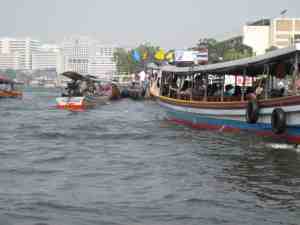
Photo of Bangkok Chao Phraya riverboat taxi landing | The-Military-Guide.com

Chao Phraya riverboat taxi landing

We enjoyed a late-morning stroll through Chinatown (long pants & sleeved shirts for the wats, hat & water for the sunshine), which ironically looks exactly like Honolulu’s Chinatown (but has its own unique olfactory experience). We enjoyed two trips on the Chao Phraya riverboat tourist taxi (blue flag). 150 baht lets you ride all day, and it’s the only way to avoid the street traffic around the Grand Palace. (Unfortunately it only stops every 30 minutes.) Save your camera battery for a separate trip just riding the entire route– don’t disembark. As the crowds come & go, eventually you’ll get an outside seat to take plenty of photos.

One last shopping tip: if you have any jewelry or watch repairs (or dead batteries) then consult the experts at Chatuchak, MBK, or Pantip. Service while you wait (new batteries included) is 150-500 baht.

I also recommend that you set aside a day each for a dental cleaning (1500 baht) and a Bumrungrad physical exam, but that’s a separate post.

Dinners were either a small a restaurant (250-400 baht), a sidewalk café (150-200 baht), or street food (80 baht). I happily consumed kilos of chili peppers and curry along with lamb, beef, chicken, and all sorts of seafood. (As I get older, the spices just taste better.) Shawarma vendors work on nearly every street corner (60 baht). Unless you’re at a large restaurant there’s not much cheese or other dairy, and almost no chocolate. Desserts and snacks are usually fruit or mango sticky rice.

Photo of Ronald McDonald showing wai in Bangkok

Seriously?!?

If you must have a seated air-conditioning break from the street then McDonald’s sells ice cream cones for nine baht. (Between the walking and our eating habits, I lost three pounds in three weeks.) If you want food in your lodging then buy on the street or scout a few square blocks around the neighborhood for a local grocery. If you want Western snacks or cereal then walk to a TescoLotus, Tops, or Foodland and get ready to pay farang prices.

This was our best Bangkok trip ever. My spouse and I will be back. (Our daughter will be on sea duty!) I’m going to work on the Thai alphabet and more vocabulary. We’ll get tourist visas for at least 60 days to return to Chiang Mai and Phuket (for Kata Beach surfing) as well as Bangkok.

Two final notes:

1. $1700 is a staggering sum for a round-trip ticket (especially with a layover) but we were flying during high season. We went through Narita (instead of other countries) because we know how to stay overnight if we miss the connection. It’s convenient to book United because all of the flights can be handled on their website instead of phoning a codeshare partner in Bangkok. You can find cheaper flights, but the hassle factors rise exponentially. Thailand is very cheap, too, so the best way to handle the high airfare is to stay as long as you can.

2. If you must travel with a cell phone, Thailand uses GSM instead of CDMA. Our daughter’s dual-band iPhone promised to work in WiFi mode, too, but she could never get a connection to synch. Unless you have a very helpful (and cheap) service provider, it’s easier to just buy a Thai GSM phone and SIM card at Pantip Plaza or… a 7-11. Yes, there’s a 7-11 on practically every Bangkok street corner.

Got a question, advice, or a family-friendly sea story? Share it in the comments.

Posted in Travel | 4 Comments

Book review: paperback version of “The Power of Habit”


(Ohana Nords just returned from our three-week Bangkok vacation. I have several “lifestyles in retirement” posts to write about our experiences, but I also have a backlog of other material about new books and investing. I’ll post about all of those subjects, but Bangkok reporting will have to wait a few weeks.)

How’s your New Year’s resolution working out?

Yeah, I know. But Charles Duhigg is here to help with a new version of his confirmed winner.

The Power of Habit” is now out in paperback. It was first published in early 2012 and it’s a huge hit with tens of thousands of people who’ve struggled to change their behavior. Mr. Duhigg gave them the tools to break the challenge into manageable parts. When we examine our cues, routines, and rewards we can create new habits and literally reprogram our brains to change our behavior.

Image from "The Power of Habit" book on cues, routines, and rewards.

Just do this!

You can use this book to reach financial independence, but people have used it to save their lives.

The hardcover book has nearly 900 five-star Amazon.com reviews (out of almost 1500!). Mr. Duhigg also did an excellent guest post on Get Rich Slowly about changing your spending habits, so I never wrote my own book review. However, I blogged about the impact that “The Power of Habit” has had on my habits and apparently he kept track of these stories. Last month I was surprised to receive an e-mail from a best-selling author (who’s also a New York Times investigative reporter) offering to share a review copy of the paperback edition.

I quickly responded (from Bangkok) but I was already too late– Random House “ran out” of paperback review copies. Luckily I travel with my iPad, and they offered me a NetGalley subscription. (Let’s pause a moment to appreciate the irony of a publisher being overwhelmed with demand for their paperback. Didn’t they see it coming? Maybe RH uses artificial scarcity as a marketing tactic, but as eBooks are outselling hardcopy I think that tactic just puts another nail in the coffin of the old-school book business.) This post reviews the eBook version of the paperback because the publisher couldn’t figure out how to supply an actual paperback review copy.

Of course, you could scamper over to your public library to read the two-year-old hardcover version for free, but you’d miss out on the paperback’s new material. It includes inspiring stories and advice from those who read the original edition and have changed their habits.

The book saved the lives of dozens of readers who had hit bottom and wanted to change– but couldn’t figure out how to break their bad habits. One reader used the book to finally start attending Alcoholics Anonymous meetings, and she celebrated over 40 days of sobriety with Mr. Duhigg.

Another reader was using food to relieve boredom & stress, but those habits pushed his weight up to 340 pounds. The book showed him how to replace one of his routines with a small change (fruit instead of pastries for breakfast) that led to quickly losing a few pounds. That easy victory motivated him to start walking for exercise, and his progress inspired him to keep trying. He’s lost over 70 pounds and has the confidence to keep going despite occasional relapses.

A personal trainer knew he needed to quit smoking, but he’d already failed a dozen times. The book taught him to experiment with different routines and rewards until he found the key. When he quit his “keystone habit” of smoking, he was able to stop drinking too.

I sat down to read the new section, but I found myself reading the entire book all over again.

When I read a non-fiction book more than once, that means it’s a reference manual. When you read the book you’re going to start changing your life with small changes to your habits, and you’ll want to read the material several times. Try the library if you’re skeptical, but I think you’ll want to buy the paperback or the eBook. I found the eBook particularly good for highlighting text and finding keywords. I have to admit that the iPad’s backlighting and enlarged font size is also much easier on my presbyopian eyes.

Once again, I’m another testimonial for the book’s techniques. 20 months ago when I first read “The Power of Habit”, I wrote about doing more stretching and less Windows Solitaire. To my surprise, these days I’m still doing more stretching and zero Windows Solitaire. The beauty of the changes is that they’re habits, and I don’t even think about them anymore. I simply come downstairs in the morning and start stretching while I’m brewing tea, and when I sit down at the computer I’m ready to work instead of mindlessly clicking cards.

Last year I took the habit-forming techniques even further: pullups. The Marine Corps physical fitness test includes the men’s minimum of three, but the maximum is 20. The Navy doesn’t even test for pullups, so I struggled to do more than five of them– until I encountered the FinCon pullup competition. I won’t embarrass the personal-finance bloggers who enjoy this event, but we’re almost all testosterone-poisoned hypercompetitive guys (and a few hypercompetitive women). Unsurprisingly, many of us are military veterans.

Image of He-Man Masters of the Universe

Your typical personal-finance blogger guy…

Sounds pretty juvenile, right? Of course, I’m too mature to be suckered into something like this. But as I listened to the He-Man Masters of the Universe trash talk, I realized that this could be my motivation to improve my own pull-up performance. Silly, yeah. Old enough to know better– sure. But it’s working.

A year ago I started doing pullups every day. I rigged a bar right out on our back lanai (where I can’t avoid it) and I tested it out whenever I walked by. I researched pullup mechanics and learned that (men or women) it’s all repetition with incremental improvement and no magic. (This is catnip to submarine nukes.) After some experimentation (and a lot of sniveling) I settled on doing them in the morning– after my first cup of tea and before I ballasted myself down with breakfast. At first I’d miss the occasional day or two, but I stubbornly persevered. I already knew how to turn a small change into a new habit, and I even imagined how surprised the FinCon attendees would be when a balding middle-aged geezer started knocking out the reps.

Once I had my cue and developed a routine, you’d expect that the breakfast reward visualization would be enough. The improvements almost immediately reinforced my efforts, but I was surprised at my change of attitude. Instead of looking 10 months down the road to the next FinCon, I was looking forward to the next morning’s pullups. By March I was not only pumping out more pullups but growing new muscles. That fed right back into my surfing skills and led to doing even more strength-building pullup exercises. I reached two long-term goals just by creating one small daily habit.

Last week as I read people’s success stories in the new “Power of Habit”, I realized that I’ve joined their club again. Today I can pop my chin over that pullup bar 10 times, slowly and with strict form. I’ve added muscle around my shoulders and upper back, yet surprisingly I’ve lost 10 pounds. (Pullups get a lot easier when you reduce the weight.) Once again I’m in the best shape of my life. I have no idea when I’ll make it to 20 pullups, but I have the rest of my life to find out. Ironically I got distracted at the last FinCon and completely missed the pullup competition, but that “reward” had faded in comparison to the lasting physical and mental benefits. I even did pullups during our Bangkok vacation– not with a grudging “just do it” attitude, but because I wanted to satisfy my habit.

Once again I have to thank Charles Duhigg for helping me demonstrate the power of habit. Once again I wish I’d read his book 30 years ago.

It’s brilliant timing to release the new edition when many people are struggling with their New Year’s resolutions. Sure, this time you’re going to try harder and it’s really going to be different, but you’ll still make the same mistakes and burn out before Valentine’s Day. Do yourself a favor: make it really different for yourself this time, and learn how to build small changes into new habits. Then tell us how you did and share your advice with the rest of the readers!


Related articles:
Lifestyles in early retirement: habits and getting things done
Just write it.
Update to “Just Write It”
Book review: “Lean Body, Fat Wallet”
Exercise with a purpose

Posted in Reviews | Leave a comment

How I Cost My Dad Over $2000 in Medicare Benefits


[Update:  my father passed away due to Alzheimer’s in November 2017.]

It’s been a few months since I posted about Dad. He’s still happy and healthy in the care facility, and he’s a little deeper into mid-stage Alzheimer’s. (In his mind, he’s consulting on-site about their electrical engineering needs– just as he did in his career for nearly 30 years. He says he’s happy that they let him stay there on weekends because he can’t remember how to drive home.) As near as I can tell from his files, he’s been coping with Alzheimer’s for at least five years.

Financially, 2012 and 2013 were busy years. When I was appointed as his conservator I spent quite a few hours tweaking his asset allocation. He lived extremely frugally on his small pension and had over 80% of his investments in equities. (He’d held some shares for over 20 years and had a very low cost basis.) By the end of 2012 I reduced his equity allocation to 25%. After paying the taxes, the remaining capital gains are now invested in a CD ladder with one maturing every few months to pay the care facility bills.

After nearly three years, Dad’s finances have finally settled into a routine again. Dad’s long-term care insurance policy has paid most of the facility’s bills for the last two years and will reach its limit in late 2014. Medicare (and his supplemental insurance policy) take care of the doctor’s visits and therapy, and his pension’s prescription insurance handles most of the medication expenses. I’ve projected a 10-year spreadsheet (including inflation), and financially I think he’ll be all right. This year I’ve spent an hour per week updating spreadsheets, answering e-mails, and moving money.

Then I received the Social Security letter announcing his 2014 benefits and Medicare premiums.

The annual letter says that his 2014 Social Security benefit is rising by 1.5%. He’ll continue paying the standard Medicare B monthly insurance premium of $104.90. That was all expected, and I’ve seen similar numbers in his 2013 and 2012 benefits letters.

However, this letter also says that he’s now going to pay an additional $167.80/month in Medicare premiums for “the income-related monthly adjustment amount based on your 2012 income tax return”. (That’s abbreviated “Part B IRMAA”.) Dad’s 2012 gross income was much higher than usual due to the one-time long-term capital gains that I incurred when I reduced his equity asset allocation.

I’d never heard of IRMAA before, so I started searching. I found an excellent IRMAA summary by CFP Michael Kitces about the situations which can trigger the higher premiums. Essentially if you have a high retirement income then the government asks you to pay more of the cost of Medicare.

When I rebalanced Dad’s assets in 2012 I was ignorant of IRMAA, let alone this particular tax implication of harvesting capital gains. I was more interested in reducing principal risk. I saw no reason to spread out the rebalancing because low tax rates on capital gains were expiring at the end of 2012. (These low rates were later extended by Congress.) I was ready to pay the long-term capital gains taxes, of course, but my actions effectively incurred an additional $2000 “IRMAA tax” on those gains.

In retrospect, I still would have rebalanced Dad’s accounts and generated most of those capital gains. He was heavily overweighted in equities (to put it mildly) and the risks greatly outweighed the limited rewards. However, if I’d held back on a little bit of that rebalancing until 2013 then I would have avoided breaking into the higher income bracket, and I probably could have completed the rebalancing in 2013 without triggering IRMAA. (See page 8 of that Social Security PDF for the brackets.) Carefully navigating those IRMAA brackets would have avoided $750 of the $2000 expense.

This 2014 IRMAA is a one-year event. Next year (when Social Security reviews Dad’s 2013 tax returns) he’ll be back under the income threshold where IRMAA kicks in, and his Medicare premiums will drop back down in 2015.

The Social Security letter goes on to describe some special situations that may merit an exception to the IRMAA. Dad doesn’t meet any of those exceptions, which are mainly bad things like divorce or death of a spouse, or unemployment, or loss of a pension.

(Side note: one of the exceptions is a change of work status. That didn’t apply to Dad, either, but it did apply to a neighbor who’s just retired from her career. She showed me her version of the IRMAA letter a week before I got Dad’s letter, so when I finally understood the situation I was able to suggest that she file an appeal with Social Security. She visited the local office last week and they’ve removed the IRMAA from her records.)

I asked Michael Kitces about filing an appeal for Dad’s one-time capital gains event, but Social Security won’t approve that exception. (This one is all on me.) I’m actually a bit relieved that I’m not going to file an appeal, because frankly, a conservator’s court appointment is not the magic wand that the probate court thinks it is. I could see myself ending up having to answer a whole bunch of other questions with a Social Security bureaucrat, and I’d prefer to stay off their radar. I’ve done my fiduciary duty, but I’m not going to volunteer for an SS inspection of my performance.

It’s “lucky” that Dad doesn’t have an IRA or a 401(k). (He cashed out his IRA in the 1990s after he reached his 60s, but I don’t know why. He also has a “traditional” defined-benefits pension instead of a defined-contribution plan.) Conventional IRAs and 401(k)s start required minimum distributions at age 70½, but many retirees begin withdrawals as early as age 59½. Social Security benefits reach their maximum amount if deferred to age 70, but they can be started as early as age 62. In other words, an affluent (or extremely frugal) Medicare retiree can have enough retirement income to be close to the limits where IRMAA kicks in. A large Roth IRA conversion, or the sale of a home for downsizing, or a significant rebalancing of an investment portfolio will trigger the IRMAA without warning.

If you’re a military retiree who also earns a civil-service pension or a civilian pension, then you’ll be pushing the IRMAA limits. If you have a 30-year career (and the military pension to match) then you’ll be close to the IRMAA limits. If you’re part of a dual-military couple with two military pensions, it’s highly likely that you’ll be bumping into IRMAA when you start your “free” Tricare For Life.

In other words, if you can “afford” to pay more for Medicare, then you probably will.

So how does this cautionary tale apply to you?

  • If you’re a conservator, you now know how to navigate this minefield for your ward’s behalf.
  • If you’re converting your Thrift Savings Plan and your conventional IRA to a Roth IRA, then you might want to finish that conversion strategy before age 63.  That’s the most recent income-tax return available to Medicare for determining your premium at age 65. *
  • If you’re planning to incur any major taxable gains after age 62 then you might want to accelerate that event too.
  • If you’re planning to work after age 62, be aware that you could be paying IRMAA.

Finally, keep reading. (Start with Michael’s “Nerd’s Eye View” link.) This legislation was passed in 2007 and I didn’t realize it existed until it was too late. Even if you have a professional take care of your tax returns, the more you learn about your taxes then the more questions you can ask.

[ * Thanks to Elizabeth Boardman for pointing out the age-63 issue in a Facebook military group!]

Related articles:
Geriatric financial management update
Geriatric financial lessons learned
Financial lessons learned from caring for an elderly parent
More on caring for an elder’s finances
Interview: what’s wrong with long-term care insurance?
Military long term care insurance

Posted in Military Life & Family | 4 Comments