“Should I Invest In The Thrift Savings Plan Or In Taxable Accounts?”


A reader writes:

Nords, I’ve been tracking you across a few blogs and appreciate the military perspective. I just bought your book as well so I am looking forward to flipping through that. Anyway I am trying to set mine and my wife’s savings to combine the 40% you mention here with the pension for a cushy retirement. Do you have any advice on how to allocate savings across accounts? My numbers give me a higher average standard of living if I contribute about 30% to taxable accounts and 10% to the Thrift Savings Plan, which goes against all advice to max out retirement accounts. As you are currently living in the gap between retirement and TSP withdrawal, do you wish you had allocated one way or another?

Before we talk about accounts, here’s a minor emphasis on one point: if you maintain a 40% savings rate for 20 years then you’ll reach financial independence without the pension. The advantage of the high savings rate is that you don’t have to count on gutting it out to 20 for the pension. If you’re no longer challenged and fulfilled by active duty, you can choose to leave for the Reserves. It’s far better than grimly hanging on for 20 years (and sitting on a slightly larger pile of money) while risking your health and burning out.

I’m not sure where your numbers are coming from, and feel free to share them here or e-mail them to me. Frequently this difference arises when the taxable portfolio has a substantially different risk/return asset allocation from the TSP. Your first check on your analysis would be to make sure that those high-return taxable accounts are using benchmarks identical to the C, S, and I funds. Your second check would be that the fund performance is assessed over as long a period as possible (at least the lifetime of the fund). Too many fund companies will cherrypick the dates for their performance claims.

The reason I suggest this is because a passive equity index fund with low expenses will almost always outperform the vast majority of actively-managed funds (and their higher expenses) over a decade. There are a handful of exceptions to this generalization (like Berkshire Hathaway), but even then you’d have to be able to pick out those exceptions from over thousands of funds.

Here’s a link comparing the TSP’s funds to their equivalent Vanguard & Fidelity funds. Check their long-term performance against the TSP, and decide which you’d rather invest in.

From the tax perspective, the Roth TSP and Roth IRAs generally win again because military compensation is very lightly taxed. (Allowances aren’t taxed at all.) With income-tax deductions and tax credits, it’s possible for junior military families to pay almost no taxes. You’ll save more money during your investing life if you pay taxes now and invest in the Roth TSP and Roth IRAs before investing in taxable account. The same logic applies to a civilian employer’s Roth 401(k), especially when you maximize the employer’s contributions to those retirement accounts.

When you’re just starting out on active duty, especially with dual incomes and a high savings rate, you can invest in a high-equity portfolio. The TSP’s L2050 fund or any combination of the C, S, and I funds will do just fine.

Admittedly in the junior ranks it’s tough to max out the Roth TSP plus two Roth IRAs. However, you have to make the most of the Roth TSP (and the Roth IRA) contributions every year before that year’s opportunity is lost forever. When you promote to the next rank (and have a big pay raise) yet continue to live on your lower expenses, then you’ll be able to max out those contributions much more easily.

When my spouse and I were contributing to our TSPs, we contributed the maximum amount and invested in the S and I funds.  (Small-caps and international funds generally have higher expense ratios than other funds, so we used the TSP for those assets and put the rest of our asset allocation in our Roth IRAs and taxable accounts.)  I wish we could have contributed even more to the TSP:  for the last decade our taxable accounts have been >90% invested in equities at an average expense ratio of about 0.25%/year, at least 8x the TSP’s expense ratio. In the 1980s-90s (before the military could invest in the TSP) it was even worse: we paid fund expenses of 1%-2% in our taxable accounts. Yet even at those high expenses we still saved enough to reach financial independence.  Despite two recessions over my 14 years of retirement, today that’s grown to “way more than enough”.  Life is definitely cushy.

If your spouse’s income includes a 401(k) then you should try to contribute enough to least maximize the employer’s match. 401(k)s have higher expenses than the TSP, but the employer’s match will probably overcome even a higher expense ratio.
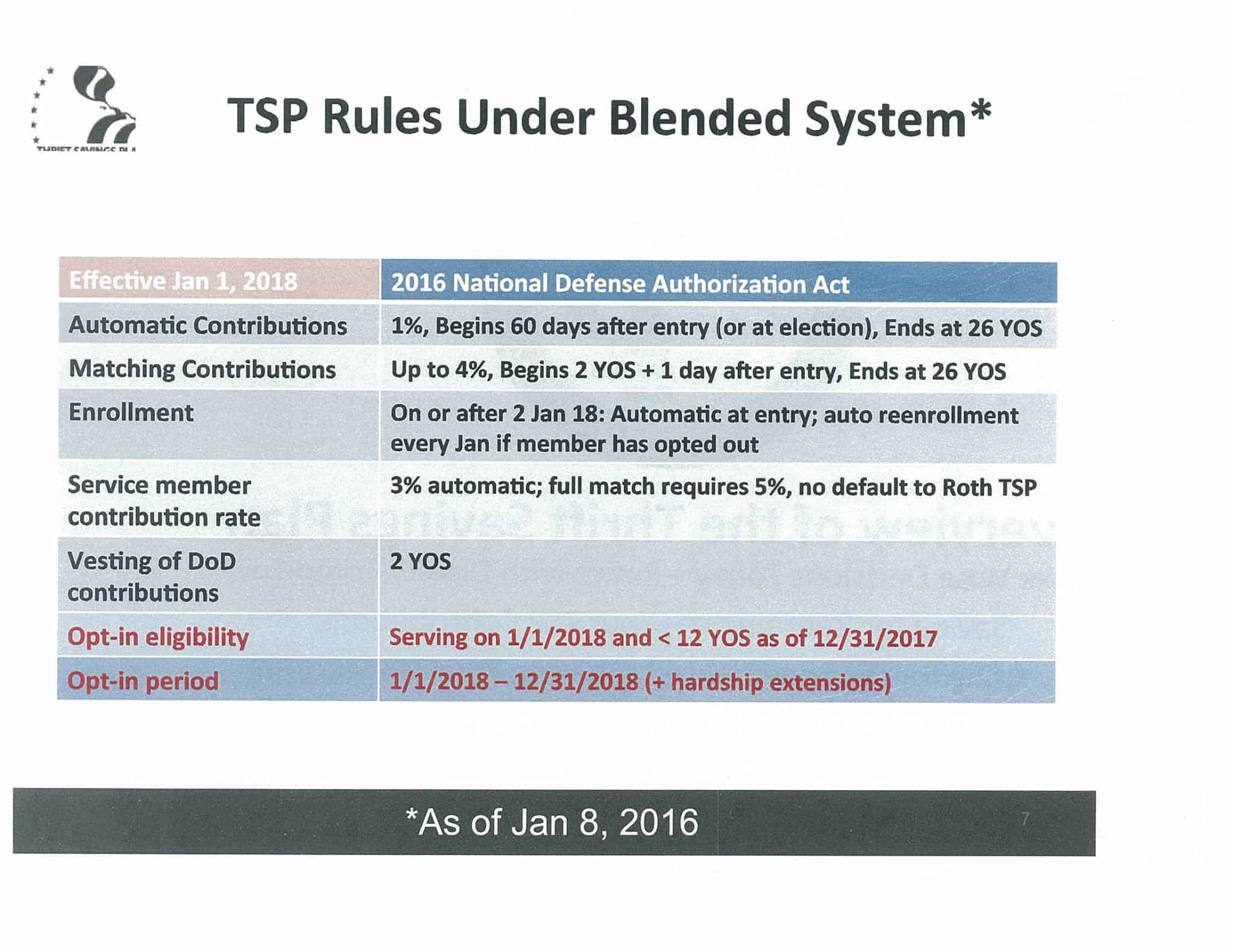
Image of the Thrift Savings Plan's new matching contribution rules under the military's new blended retirement system | The-Military-Guide.com

Click on the image for a larger view.

So the priority for your 40% savings rate is TSP, 401(k) to the match, Roth IRAs, perhaps the rest of the 401(k) to the limit, and then even more in taxable accounts. Your asset allocation can be high in equities using passive index funds with low expense ratios.

When the military’s new blended retirement system starts in 2018, newer servicemembers might benefit from converting to it. In that case, you’d absolutely want to maximize your contributions to your Roth TSP account to obtain all of the DoD match.

You’ve asked a great question.  Keep reading and learning all you can about investing. Your asset allocation (and your entire investing plan) also has to help you sleep comfortably at night despite stock-market volatility. The best way to do that is to read about investing and the markets so that you can confidently stick to your plan when the media is screaming about selling everything.

Continue that learning by checking the “Related articles” section below to learn more about your TSP and Roth IRA options while you’re in uniform and afterward.

Related articles:
How Many Years Does It Take To Become Financially Independent?
Financial Advice To Start Your Military Career
Tailor Your Investments To Your Military Pay And Your Pension
Saving base pay and promotion raises
REVEALED: Our Asset Allocation During Financial Independence
Should You Choose The Military’s Blended Retirement System?
How (And Why) To Transfer Your TSP To An IRA
Early Withdrawals From Your TSP and IRA After The Military
TSP Tax-exempt Rollovers and Withdrawals

Posted in Money Management & Personal Finance | Leave a comment

One Last Post Before The Pro Bowl Presented By USAA


Short bonus post today: the runup to the Pro Bowl continues.

Thursday’s pre-game event was “Marine For A Day” up at Kaneohe. I can’t show it any better than this NFL player getting to try on a set of explosive ordnance disposal gear:

Once again it was hard to tell which groups were the bigger fans of each other: the Marines or the football players.

On Friday our USAA group recorded the Pro Bowl players practicing for the game. These are the teams picked by Wednesday’s draft, and they’re spending today and tomorrow figuring out their playbook. This year the team is staying at the Turtle Bay Resort up at Oahu’s tip of the North Shore, so they held the practice at a field by the golf course instead of riding a bus all the way down to Aloha Stadium.

The real thrill during the practice was having a player wander over to the sidelines every few minutes to sign autographs. They worked particularly hard to meet the kids and the servicemembers who showed up in uniform.

The Saturday Pro Bowl practice seems to be an event for NFL ticket holders, but there are several Waikiki Pro Bowl events that are open to the public. I’m going to take a break on Saturday and get in some sorely-needed dawn patrol surfing, but on Sunday I’ll be at Richardson Field at 10:30 AM for the tailgater.

My thrill? I don’t follow football, but I really enjoyed the conversations with everyone. Every 15-20 minutes, for over four hours, I found myself with a servicemember talking about Hawaii life or surfing or personal finance or military careers or making the transition. I met a lot of impressive military and spouses. Today alone I’ve handed out over 20 cards with my website & e-mail address.  (NordsNords -at- Gmail.) I can’t wait to see what questions pop up into people’s minds after the Pro Bowl is over.

Personal financial independence: one reader at a time.

This is my final Pro Bowl post– I’m not going to analyze the game on Monday morning or put up more blog photos of the tailgater or the game at Aloha Stadium. However, I’ll be tweeting from both places, so follow along on Twitter or Facebook to enjoy a little more sunshine.  When I pick up my ticket, I’ll post my seat location so that you can drop by to say aloha.

Related articles:
The Pro Bowl Presented By USAA
I’m Goin’ To The Pro Bowl With USAA!

Posted in Travel | Leave a comment

The Pro Bowl Presented By USAA


[Note: my condolences and sympathies to those of you digging out from Winter Storm Jonas. I grew up in Pittsburgh and was incarcerated at Annapolis for four winters, so I know how it feels. It’s why I live in Hawaii now. There’s a very good reason that the Hawaii Tourism Authority and the Hawaii Visitors & Conventions Bureau work so hard at this time of year to promote the Pro Bowl and other visitor attractions.]

[USAA members with storm damage can use the mobile app to file a claim (with your mobile photos!) and call a member service rep for assistance. If you don’t have USAA insurance then consider getting a USAA membership and a quote.]

We’re ramping up to Sunday’s Pro Bowl tailgater– and, oh yeah, the football game.

Those of you who know me well are probably smirking as you read: Nords at the Pro Bowl?!?  I know, “pearls before swine.”

For the rest of you, here’s a confession: I hardly watch TV, I no longer follow football rankings or statistics, and I can’t even spell ESPN. The last time I got excited about the NFL I was an impressionable young teen in the 1970s, back when Terry Bradshaw had hair and Mean Joe Greene was making Coke commercials.  But one of the USAA staff noted that I have a reputation as a numbers guy (guilty) and I’m fascinated by the tech and financial aspects of the business.  They wanted an articulate military veteran (that would be me) sharing the Pro Bowl events from a different perspective.

Hawaii doesn’t even have a professional football team– and when’s the last time you saw the UH Rainbow Warriors in the college national championship? Never mind, don’t answer that.

Image of a Pittsburgh Steelers NFL football team logo on a Hawaiian ikaika helmet | The-Military-Guide.com

Steeler Nation is everywhere!

No worries: no ticket buyers were denied access to let me into the game. In fact, USAA and the NFL gave away several hundred military passes to the pre-game events, and more tickets to the game itself.

That’s because Hawaii has tens of thousands of football fans.  They might be a little island-style low-key, and there might be 32 different groups of them, but locals still enjoy a good professional football game.  The islands also produce a surprisingly large number of high-caliber college and professional players.

It’s even better when you can vote for your favorite players to bring their families to Hawaii in January to enjoy the sun, surf, and sand– and maybe autograph a few jerseys.

The Pearl Harbor boat tour

Image of USS ARIZONA Memorial USAA tour group including COMPACFLT Admiral Swift and NFL football player Hau'oli Kikaha | The-Military-Guide.com

PACFLT Boathouse before the tour

Tuesday’s trip around the harbor was offered to three NFL players (and USAA’s staff & families) by the PACFLT Boathouse.

Frankly, this is a tough tour to get because it’s in high demand. You might have to know somebody, or your teen has to want to go to the Naval Academy, or you arrange it as part of a military retirement ceremony. This was my third one (in 26 years) and it’s still as impressive as the first. It’s not just cruising by the USS ARIZONA Memorial and the USS MISSOURI Memorial. It’s also a glimpse of the restored WWII air traffic control tower on Ford Island’s Pacific Aviation Museum.  It’s seeing the USS NEVADA Memorial on Hospital Point.  (The ship my daughter is on, the USS ROSS, is named for Donald K. Ross, who received the Medal of Honor during the attack for leading the engineering effort to get the USS NEVADA underway that morning.)  It’s a reminder that the USS UTAH Memorial is right around the other side of Ford Island, and that the USS BOWFIN at the Submarine Museum is nicknamed “The Pearl Harbor Avenger”.

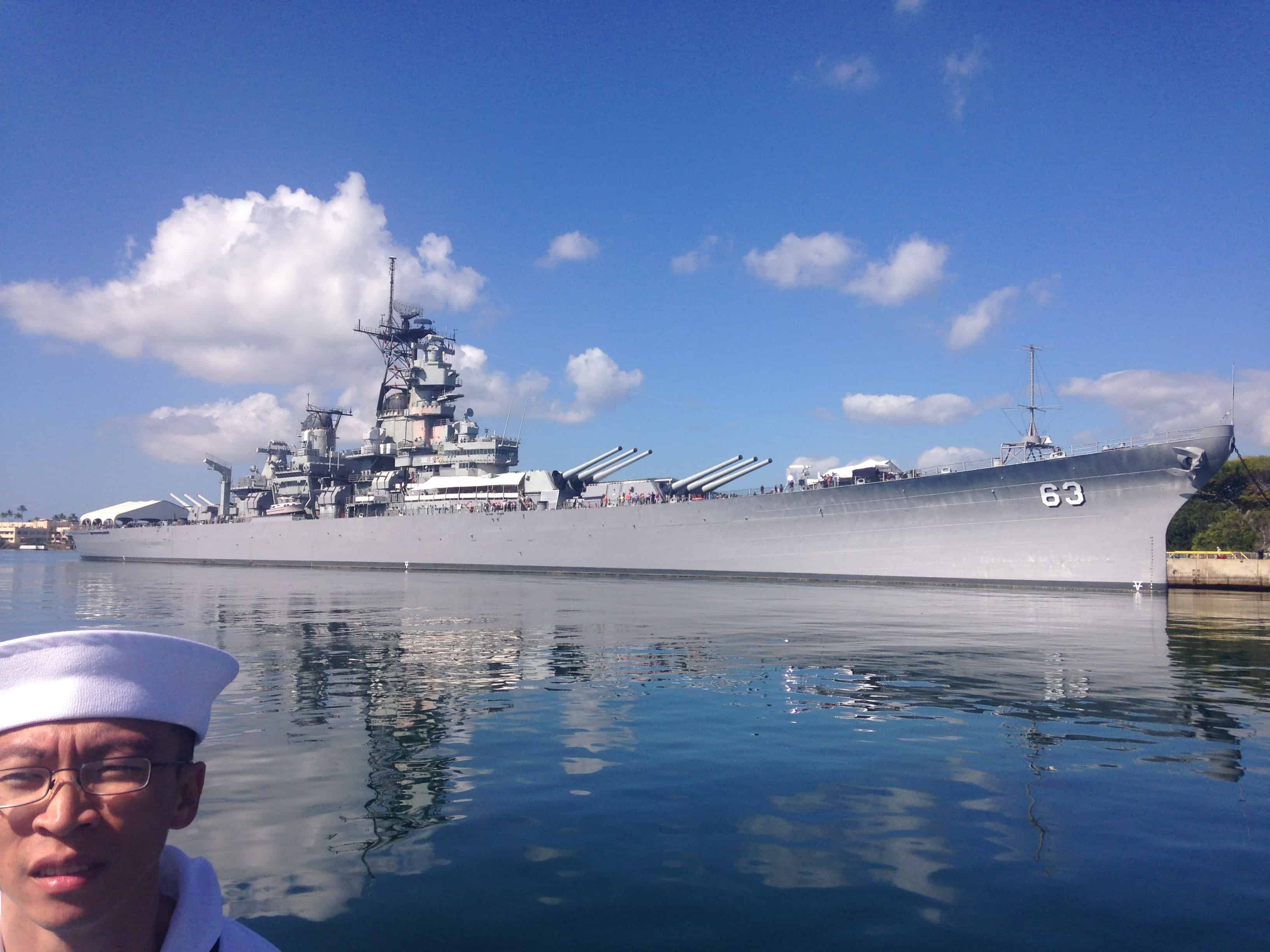
Image of the ship USS MISSOURI Memorial on USAA tour of Pearl Harbor | The-Military-Guide.com

USS MISSOURI Memorial

It brings back personal memories. When I was stationed at the Naval Submarine Training Center Pacific, you could walk around Building 39 on Ford Island and see the concrete patches filling in the bullet holes. You could sit out back in the old smoking area, where several times a year WWII veterans would walk up to mentor, I mean, chat with you about their experiences during the attack. You could visit the COMSUBPAC admiral’s base house and see the concrete rooms in the basement’s old coastal-defense gunnery foundation where terrified families sheltered on 7 December 1941.

If you have the time, your small boat could take a 10-minute detour to the site of the West Loch Disaster.  I’d never even heard of this WWII incident until a retiring shipmate asked for the admiral’s barge to go there.

Remember. Honor. Understand.

2016 is the 75th anniversary of the attack, and USAA will be sponsoring more Pearl Harbor events for servicemembers & families.

The tour’s three NFL players are from the islands:  Hau’oli Kikaha (playing for New Orleans), and retired brothers Chris & Ma’ake Kemoeatu (with three Super Bowl rings between them).  Like many kama’aina, the last time they’d toured the USS ARIZONA Memorial was during an elementary school field trip.  They were thrilled to be able to see Pearl Harbor from this new perspective.

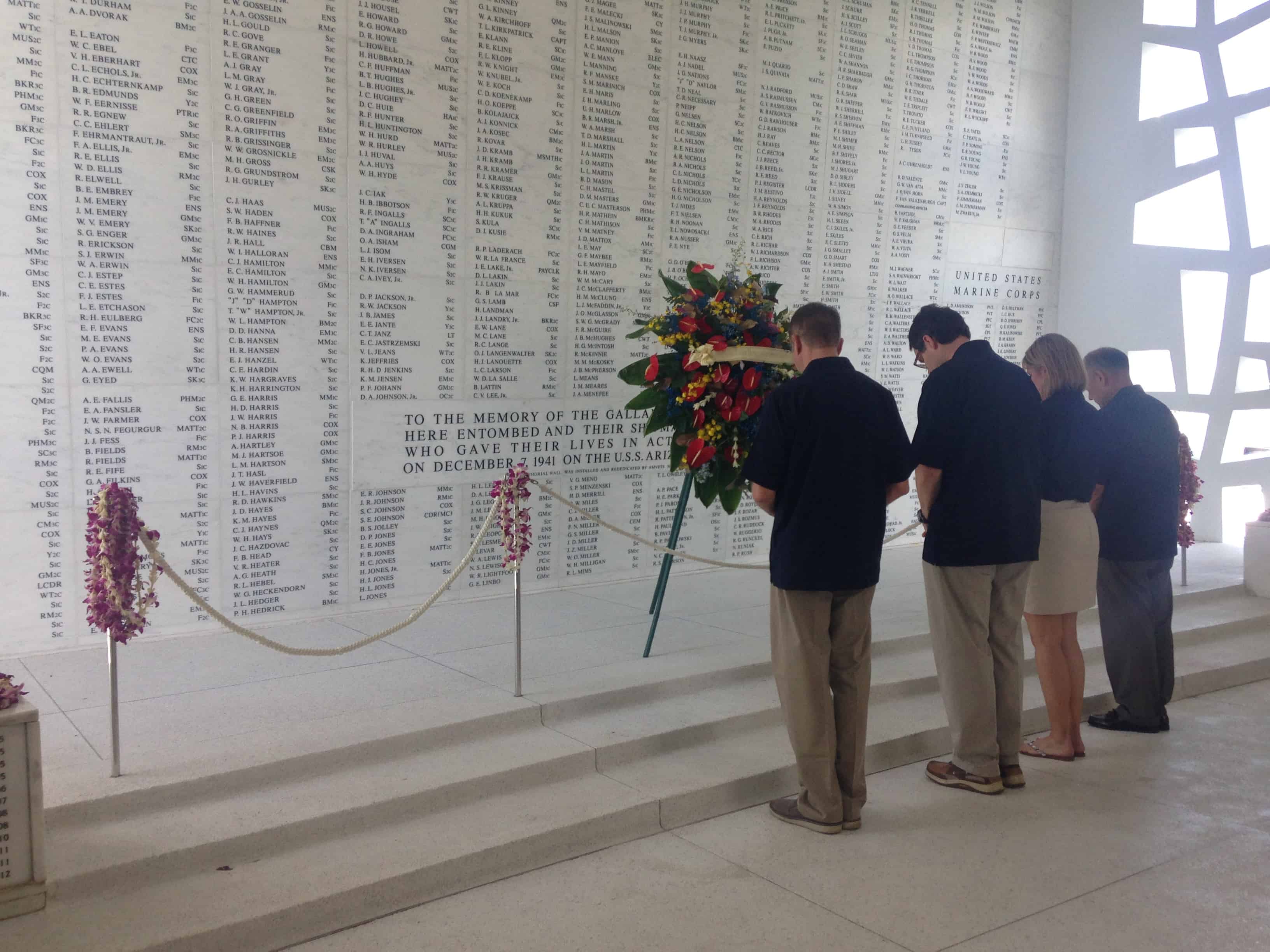
Image of four people in front of a wreath at the USS ARIZONA Memorial USAA wreath ceremony | The-Military-Guide.com

USS ARIZONA Memorial wreath laying

Our boat tied up at the Memorial to deliver a memorial wreath in the hall before the marble wall listing the names of the 1177 USS ARIZONA crew killed in the attack.  The Memorial was open for visitors, and over a hundred people were hearing the history of the attack and how the Memorial was built.  I’ve been on the tour a dozen times and it still gets to me.

(Trivia fact:  I learned a lot of this information when I was fortunate enough to edit the expanded 10th edition of Michael Slackman’s “Remembering Pearl Harbor”.  You can buy it online or browse it in the book store at the Memorial’s Visitor Center.)

After the boat tour ended, the NFL players met with a group of Naval Station sailors while the USAA crew worked on more interviews and video for this week and for future marketing products.  I enjoyed chatting with the Kemoeatu brothers about life after football (a transition process similar to life after the military) and with Hau’oli about how his career is growing.  He’s not a sports stereotype– he’s had a lot of time to think about his priorities and his local family, and he’s making sure he does football right.

The Pro Bowl Draft

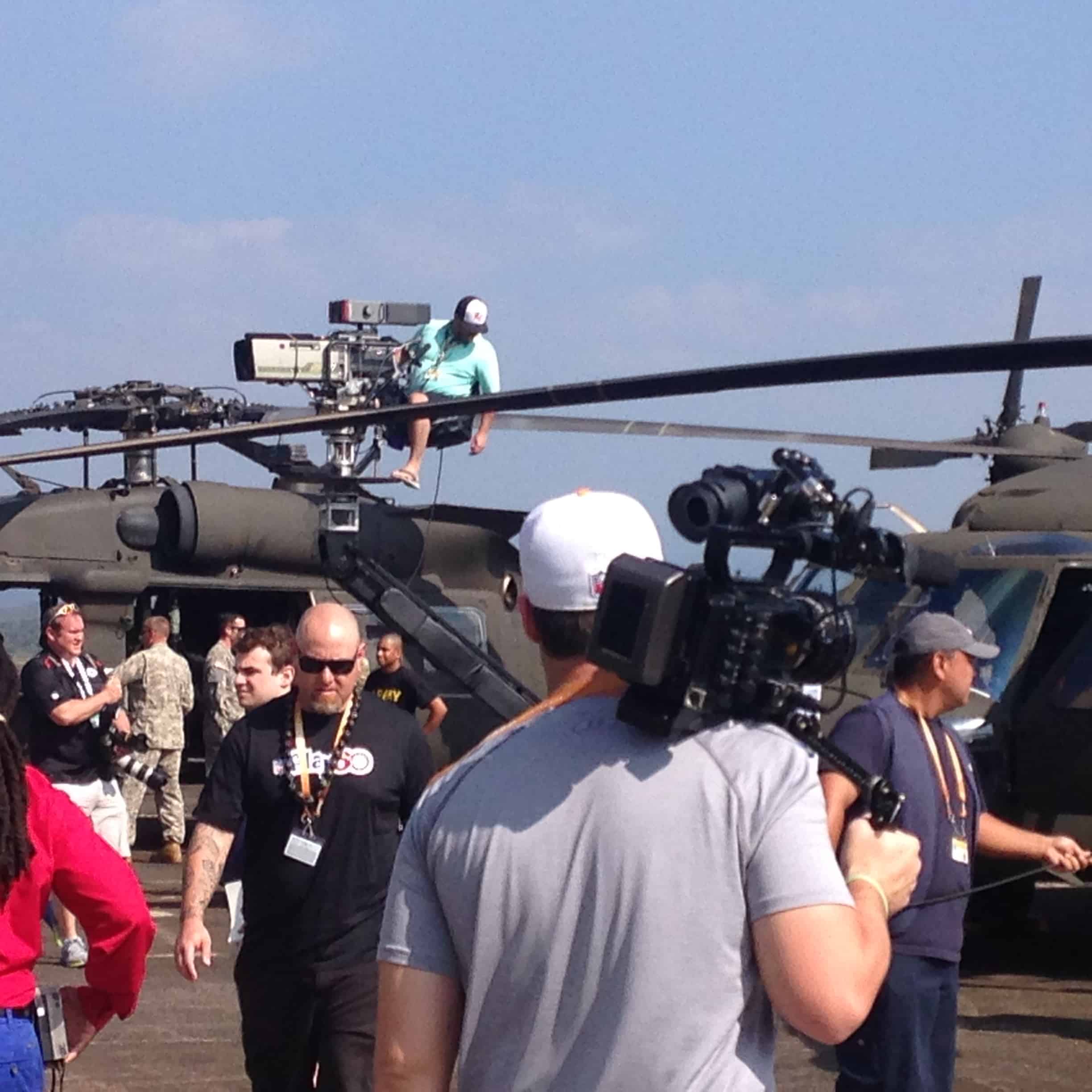
Image showing Army attack helicopter surrounded by media interviewing military and NFL players for a Pro Bowl TV commercial | The-Military-Guide.com

Shooting a commercial… take #17.

The draft ceremony was held at Wheeler Army Airfield. (Before the comments start, I’ll backtrack a second to point out that this base was attacked about five minutes before Pearl Harbor.  Several American pilots got into the air and scored the first dogfight kills of the Pacific war.)  Wheeler is going through a huge multi-year renovation (my spouse and I drive by there a few times a month) and it’s becoming one of Oahu’s best-kept secrets for base housing and incredible tropical scenery.

This draft had none of the tension or suspense of the NFL rookie draft. If anything, it was more like the middle-school pickup game where you worry about being the last player picked for the team. I’ve never seen so many gigantic humans gathered in one big room to enjoy the ambiance while talking trash at each other. Hey, the coaches, players, & fans decided who could be here.

The Army’s attendees seemed to be having a good time, too. Pro Bowl Draft tickets were donated by USAA and the NFL for hundreds of servicemembers & families to view the event, and it was broadcast live on ESPN2.

Image of cameras everywhere among attack helicopters at Wheeler Army Air Field for the Pro Bowl draft event

“Best seat in the house”

The TV set for the draft was closed to all but a small audience of 50 military (too much noise on the set!) so most of the attendees were on the flightline or in the hangar next door.  I spent my time brushing up on my helicopter recognition training and talking with the flight crews, but I was surprised at how many NFL players were out there with us.  They could have stayed in the cool hangar drinking cold beverages and yummy pupus, but instead, most of them jumped right in among the helicopter crews– peppering them with questions and asking about war stories.  Tyler Eifert even carried around a football helmet and asked the helicopter crews to give him their autographs.

Let’s just say that defensive linebackers don’t seem to fit into the cockpits of attack helicopters.  One crew chief admitted that they’d spend most of the next morning fixing parts that were accidentally snapped off as people got in & out of the helos, and then another hour checking that all the switches were in the right positions.

Among the camera crews from USAA (commercials and member stories), the NFL, and the local media, we had a professional photographer for nearly every football player.

The rest of the week

So what are the players and fans doing for the next few days?

Well, that’s the funny part: only a couple days of football.

If you’re reading this post on the day it’s published, today is “Marine For A Day” at Kaneohe Marine Corps Base.  It’s a private event for the Marines and families with the players and I won’t be tweeting from that.  Being Marines, I predict they’ll be supervising NFL players generating plenty of expended ordnance and a few demonstration explosions.

Friday and Saturday is practice time, but with a twist.  Instead of public events at fields around Joint Base Pearl Harbor Hickam as in previous Pro Bowls, this year the players are up at Turtle Bay Resort.  Rumor is that they’ll use football fields at the resort or at local high schools where fan attendance will be limited to teens & student coaches.

Oh, there’s also plenty of meets & greets.  The players are visiting local hospitals & charities, including Wounded Warriors at Tripler Army Medical Center.  The media might occasionally run an interview or show coverage of the players getting ready for the game. But most of the people who flew here are seeking a couple of days of sunshine, surf, and sand along with the military events. Maybe it’s not the single-minded hard-charging aggressive pursuit of victory that’s happening on the Mainland this week, but if you’re not in the Super Bowl this year then it’s a great consolation prize. And if you live here, we call that “quality of life” or “island style”. If you’re going to work hard, then you’ll play hard.

Me? I’m still trying to convince a few of these Mainland folks to ride a longboard. They seem skeptical that if a veteran in his 50s with bad knees can learn to surf, then almost anyone can do it.

By the way, the Hawaii Tourism Authority just announced that the Pro Bowl will be played on Oahu next year on 29 January 2017.  USAA will be sponsoring another week of activities for military & families.  Save the date and make your travel plans now!

Related articles:
“I’m Goin’ To The Pro Bowl With USAA!”

Posted in Travel, USAA | 2 Comments

I’m Goin’ To The Pro Bowl With USAA!


If you’re at the Pro Bowl events next week, please stop by and say hello. I’m the 5’10” 190-pound middle-aged balding ponytailed surfer dude who’ll probably be wearing sunglasses, surf shorts, & t-shirt. And SPF50 sunscreen in the middle of winter because, you know, Hawaii.

Image of National Football League Pro Bowl 2016 logo next to USAA eagle logo | The-Military-Guide.com

Brought to you by…

Most of the tickets to the pre-game events were handed out to active-duty servicemembers & families. You can probably still get your hands on a Pro Bowl ticket, and if you’re at Aloha Stadium then you can track me down on Twitter or on my Facebook page. I’ll post regularly on social media during next week and at the game itself.

USAA has been the NFL’s “Official Military Appreciation Sponsor” for nearly five years, and they’ve helped shine a big spotlight on the military at games and other NFL events. * As part of that campaign, I’m one of the select few USAA Member Community bloggers who was invited to cover the Pro Bowl. (Well, maybe it’s because I live here too. But I digress.) USAA is showing their appreciation for our servicemembers & families with a chance to share in the pre-game festivities. I’d like to chat with some of you to share your stories of how USAA has helped you over the years. In return, if you have questions about financial independence or USAA services & products, I’ll be happy to supply the answers.

On the afternoon of Tuesday 26 January, I may be on the Remembrance Tour of Pearl Harbor aboard the admiral’s barge from the PACFLT Boathouse. I’ve spent quite a bit of time on (and in) Pearl Harbor in the last 26 years, and it’ll be a pleasant change of pace to see it without being on duty.

I’m also planning to cover the Pro Bowl Draft on Wednesday 27 January from a secure location on a military base. It’ll be broadcast live because, you know, Hawaii. Laugh all you want, but our visitor numbers take a big jump in February.

On game day, Sunday 31 January, around 10:30 AM, I’ll be in the parking lot of Richardson Field with the USAA team to assist whoever needs help identifying our local kine grindz at the tailgaters. (No worries, we will post Twitter photos.) During the game, I’ll be wherever USAA and I think we can find military families to chat with.

The Pro Bowl only happens once a year, but USAA has more events planned for Hawaii. They’ll be a prominent participant around Oahu in 2016 as we prepare for the 75th anniversary of the Pearl Harbor attack. (For many WWII veterans and their families, this may be the last Pearl Harbor ceremony that they’ll attend.) My spouse and I have spent quite a bit of time at the USS ARIZONA Memorial, and it’s fitting that USAA is supporting the motto of “Remember, Honor, Understand”. Keep an eye on USAA’s website during 2016 for more information.

(* Yes, I can already predict a comment! Some of you may be concerned that your insurance premiums are spent on military appreciation events at football games. However, that marketing tactic costs a lot less than direct mail or traditional media display ads, and it’s bringing in a whole new generation of members who did not realize that they’re eligible. They actually use more products– and spend more money– than us older members. This sponsor expense has a return on investment because the new members are holding down our insurance costs!)

Posted in Travel, USAA | 2 Comments

Military Retirement Journal – Pre-Separation Counseling Checklist


This article was written by Forrest Baumhover.

This is the second in my series of retirement journal blog posts.  Although this post isn’t an update on my personal situation, I wanted to cover something that I have been thinking about since I wrote my last post–what TAP looks like now–or at least the pre-separation counseling portion.

If you know people who went through TAP ‘a few years ago,’ you should understand that TAP has completely changed.  According to the DoD TAP website, in 2013, DoD redesigned TAP into “a cohesive, modular, outcome-based program that bolsters and standardizes the opportunities, services, and training that Service members receive to better prepare them to pursue their post-military career goals.”

There are three TAP components that each service member is supposed to attend:  pre-separation counseling, the 5-day workshop, and the capstone course.  Since I’ve only attended pre-separation counseling (referred to as PreSep), I’ll give you an overview.  I do have some of the other courses scheduled for later in the year, so I will write separately about them.  Since I’m transitioning from MacDill Air Force Base, I will reference their transition assistance website quite frequently…however, since schedules & optional program offerings may differ by location, you should refer to your local transition office’s website.

I attended in October 2015, which is almost two years from my planned September 2017 retirement date, for several reasons.  First and foremost, attending as early as possible maximizes your schedule flexibility.  Waiting until six months out means that you have a more compressed timeframe to get a bunch of things done, which means you probably will rush through events that require more attention to do properly.

I do not want to risk losing benefits or creating a bunch of extra work for myself, so I took the time to go to PreSep earlier.  Second, I personally felt like attending PreSep was the first opportunity for me to think about retirement planning in military terms.  I’ve spent a lot of time thinking about what life will look like after the military, but taking an afternoon to attend PreSep helped me mentally review the checklist of all the military-specific items that I need to go through.

Finally, it will help me formulate what 2016 should look like.  My goal is to accomplish most of my required transition activities (appointments, classes, etc) by the end of 2016, so that I can hit my terminal leave period (hopefully May 1, 2017) with a full focus on my financial planning business. Getting PreSep out of the way helped me identify the other TAP-related events that I should plan for—not just the mandatory course, but the optional programs that are available, such as the Small Business Administration’s Boots to Business class.

What is the purpose of PreSep?

Officially, the real purpose for PreSep is two-fold:

  1. Generate your DD 2648 (Pre-separation checklist)
  2. Develop your Individual Transition Plan (ITP)

According to Title 10, US Code Section 1142, PreSep is required for all regular service members with at least 180 days of continuous days of active duty, and all eligible deactivating members of the Guard and Reserve, to include Individual Ready Reserve and individual mobilizing augmentees, with 180 cumulative days of service (other than training).  MacDill’s AFRC suggests attending PreSep as soon as possible.  People who are separating are allowed to attend up to 1 year prior to separation, while retirees can attend up to 2 years in advance.

PreSep Registration

According to the MacDill AFRC,  you should do a couple of things prior to PreSep:

  1. Schedule an appointment.  You can do this by calling 828-0145/2721.
  2. Register with eBenefits.  (www.ebenefits.va.gov). Use a CAC enabled computer to register.  Ensure you bring proof of your registration with you.  (Print the page that has you logged in)
  3. Download the Individual Transition Plan (ITP):  Complete the information on page 1; Review the Overview information (pg 1) and the Career Readiness Standards (pg 2).  Print the completed first two pages and bring to PreSep.
  4. Bring a laptop.  Instead of printing your ITP, you can store the ITP on your laptop.

When I tried to follow this, I couldn’t find an ITP in my profile.  I’m pretty sure that I have a blank version in the DVD that I received in PreSep, but I have not taken the time to go through it yet and figure it out.  I’ll make a note to take some time, go through an ITP, and write an additional post on it later on.

You may want to check with your local office to determine scheduling availability.  For example, MacDill only schedules retirement PreSep on Mondays, and separation PreSep on Wednesdays.

What is the Pre-Separation Counseling Checklist?

The Preseparation Counseling Checklist, or DD-2648, is a comprehensive checklist of ‘resources’ that you can look into regarding employment assistance, relocation, housing, education, mental & physical health, health & life insurance, finances, reserve affiliation, veterans benefits, and legal assistance.  You fill out yes or no (as in yes, I would like more information, or no I don’t) for each item in a 5 page checklist.  However, I would give you several caveats:

I asked two different counselors the same question and got two different answers.  When you ask for assistance on a program with which you’re not familiar, you should probably ask the person what their background is.  Ask for a second opinion if the answer sounds weird, and ask for a resource that you can look into if needed.  If it’s a program with an instruction (like the Survivor’s Benefit Plan) ask for a reference to the instruction.

Be prepared to do a lot of research yourself.  While the transition counselors may want to help you, their primary focus is to get you to the resources.  You still need to take the time to do the research & understand these programs yourself.  No one will spoon-feed this to you.

Budget your time for all the stuff you want to tackle.  This can be an overwhelming list.  If you start early enough, you can schedule enough time to go through everything you want without having to cut anything out.  People who start late end up having to rush through things & may inadvertently short-change themselves.

Separate things into categories—medical, job hunting, education, etc., based upon your priorities.  Then, separate the mandatory stuff from the ‘nice to have.’  For example, MacDill has a LinkedIn workshop.  This might be great, even practical for the career field you want to go into, but TAP is mandatory.  Taking the time to prioritize each of these items will help you in terms of scheduling, and will allow you to develop your own plan of action to address everything you need to address.

One thing that I learned during PreSep is that there are more offerings through your local office than what is included in Transition GPS.  For example, MacDill AFB offers the previously mentioned LinkedIn workshop, which is a two-day course.  The takeaways from this course will help military personnel navigate the ins and outs of LinkedIn, and is probably as important as a powerful resume.  Take the time to learn a little more about what is available locally.

The next entry in my retirement journal will go into more depth about the ITP—what I saw, and what you may or may not want to pay attention to.

Posted in Military Retirement | Leave a comment