
Everyone knows that they need to spend time on their estate plans. It’s part of financial independence, and it’s even more important if you’re a military veteran with survivor’s benefits.
Yet how much time have you spent adulting on your disability plan, especially for later in life with declining cognition? What about your loved ones and *their* plans?
Recently in a thread on the Millionaire Money Mentors forum, the subject of cognitive impairment came up. (For those of you who are members, the thread is “Friends/Family Who Are Bad at Money.”) I wrote about my father’s dementia, and I’ll expand on that here in 4600 5500 6500 words of excruciating detail. It’s a long read so I’ll include frequent summaries as we go.
Disability planning makes dying look easy. As an example, I’ll write about my father and the lessons we learned from his long, slow slide into dementia.
I’ve already written many financial summaries about the years as my father’s conservator. This time I’ll try to show how easy it is to be derailed by a lack of experience— despite my fiduciary good intentions.
As I started writing about this, I was surprised to realize that it’s been over eight years since his death. This post is more keyboard therapy, and also for the benefit of anyone else who might be headed down a slippery caregiver slope.
I’ll point out where we could have done things differently, and I’ll also link a book & videos which could help.
I wasn’t even sure that I should put this on the Internet. My beta readers convinced me to completely rewrite it and then publish before I change my mind again. Hopefully this case study (and its timeline) will help you recognize the issues if they start appearing among your loved ones.
Keep in mind: I learned nothing during the events leading up to my father’s cognitive decline. (I learned about dementia and Alzheimer’s care long after we were on the job.) All of my lessons from this experience were gleaned after months of introspection.
Since this is a long read, I’ll break up the chronological flow with the lessons that I should have learned by that time. You can scroll to the bold uppercase font of LESSON LEARNED.
I’ll show you where I made my mistakes. I hope this will help you with your loved ones.
If you use trigger warnings, then please stop reading now… or else buckle up.
The Background
For those who are new to this story, my father reached his financial independence in 1987 and retired at age 53.
For the next 22 years he lived such a low-key outdoor lifestyle among the Rocky Mountains that he was spending less than 40% of his small pension + Social Security. In 2004 when my brother and I tried to convince him to stop gifting us he asked: “What else in the world would I spend it on? I’m doing everything I want to do.”
In 2008, dementia oozed into his life. It crept in “on little cat feet” (as the poet wrote)— and then it took over.

Dad, Colorado National Monument Park
Alzheimer’s killed our father in late 2017.
Dad spent his final six years in long-term care. My brother was his court-appointed guardian, and I was his conservator. A few weeks after our father died, I also had to step up as a self-appointed executor when my brother simply… flamed out… and stopped doing his part of the paperwork.
Worst of all, in late 2024 John Hancock’s long-term care insurance team re-victimized and gaslighted us all over again.
What Our Family Has Done Since 2017:
My spouse and our daughter can vouch that I’m still recovering from these years. Our daughter’s a military vet (same as us parents), and she’s heard these family stories before. She’s spent her entire life putting up with my submariner’s snarky black humor, including 15 years with my excessive (possibly obsessive) focus on this topic. In addition, our son-in-law is still on active duty and staring at his “someday” military transition— while watching the impact of dementia among his family’s elders.
I talk about this for a reason: I’m trying to desensitize our entire family to the worst-case possibilities of my genome, as well as reassuring our progeny (yet again) that we parents are reducing their caregiver burden if our cognition declines.
We have a full disability plan in place now, and our two generations iterate on it as we learn more. In retrospect, estate planning was the easy part. Disability planning is far more complicated— and fraught with even more emotions.
Personally, I’m working on my health with validated tactics from medical research. I hope my lifestyle efforts overcome my genes! Yet I have a mental timer ticking down the months until I reach age 74, the same age when my father first noticed his cognitive symptoms. My 2034 alert may seem macabre but again… submarine engineer… and we humans never know our last day of anything.
As far as dealing with John Hancock’s gaslighting, we turned down their “offer” in early 2025. I hope to never hear from them again, and if I do then I’m not going to re-engage. If you’ve bought any products from that insurer, please read the post and be aware of their incompetence.
A Reader’s Question
I started writing when a reader asked:
“I am sure you have covered this in other posts, but when your father was dealing with Alzheimer’s: Why did you just not just rely on a POA, when your father was of sound mind before the dementia, to take control instead of having to use the conservator path?”
The Chronology
We’ll start with Dad’s caregiver burnout.
My father was widowed in 1987 when my mother died after a decade of breast cancer. Mom was a hardcore Registered Nurse, to the extent that she persevered through multiple rounds of chemotherapy and surgery. My brother and I were in high school when she was diagnosed, and our family was devastated a dozen times by the whiplash of her cancer progression (and her painkillers). Our parents didn’t talk about these things (“We don’t want you boys to worry”… ?!?), and by the time the cancer spread to her bones we boys had already launched from the nest. We (especially me on Navy sea duty) weren’t around to help much, and they didn’t ask for help.
The years of caregiver stress hit Dad hard, but at least their finances were in good shape. While coping with her cancer, they reached financial independence and he eventually retired from his career.
Mom passed away a few weeks after he retired— only a few days before their 28th wedding anniversary. She was on home hospice and began voluntary stopping of eating & drinking. Dad understood the signs and told us to come home. My spouse and I flew to Colorado to spend our final hours with Mom, and she died a day later. That’s when my spouse and I realized that Dad had completely physically & emotionally exhausted himself during Mom’s final months of painkillers, hospitals, and hospice.
Dad was even more introverted than us, and after Mom died he chose a hermit lifestyle.
In retrospect (I use that word a lot in this post) he was already struggling to handle the caregiving trauma, let alone widowerhood. He withdrew from family & friends and never formed new attachments. He lived in small apartments in small Colorado towns (which made it difficult to visit him), and he rarely tried to visit us. He was not a grandparent presence in our daughter’s life.
LESSON LEARNED: Communication is hard, even without interference from family dynamics. Beyond that issue, respite care is essential for caregivers before they permanently impact their health. If you’re not already discussing these perpetual challenges in your family, read Cameron Huddleston’s book “Mom And Dad, We Need To Talk” for her tactics and her sample scripts to use with your family.
Another Family Elder’s Dementia
A year after Mom passed, my father ended up caring for *his* widowed father’s struggles with dementia. It’s another long story (to share some other time), but it started when my grandmother suddenly died after a massive stroke in her late 70s. After she passed away, our grandfather never updated his powers of attorney or did any other disability planning.
Gramps developed dementia and went another four years without paying bills or filing income-tax returns. His cognition slowly deteriorated to the point that my father finally got “the call” from the property manager and flew in to visit Gramps. With lawyers, my father petitioned the probate court for conservatorship & guardianship. Dad moved Gramps from assisted living into full care and then commuted quarterly between Colorado and Gramps’ care facility in Ohio.
Dad also spent months on forensic financial cleanup:
-
- emptying Gramps’ spare bedroom full of unopened mail (including 1980s investment dividend checks),
- searching for all of his other financial accounts from earlier years,
- drilling out safe-deposit boxes, and
- paying years of delinquent bills.
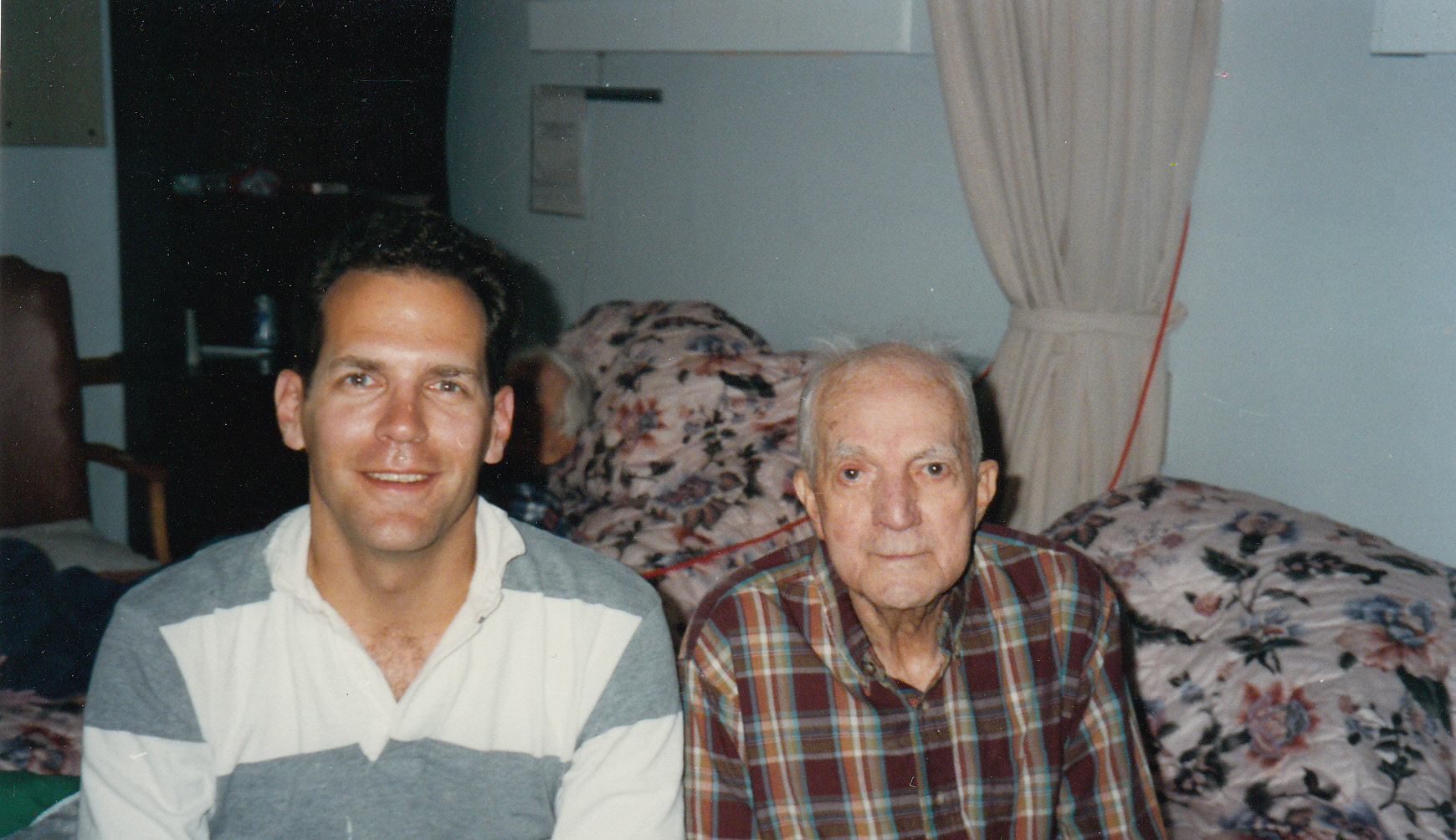
Visiting Gramps in his care facility.
He endured another five years of negotiating Gramps’ financial mess with collection agencies, utility companies, the state of Ohio, and the IRS.
LESSON LEARNED: In retrospect(!), Grandma might have been covering for Gramps’ mild cognitive impairment. It’s so easy for one spouse to slowly take over for the other, especially if they’re elders who are not yet ready to face the challenges of a diagnosis and the logistics of next steps. Everything can work out all right for months— as long as both of the couple stay healthy.
When they gradually fail at managing their affairs, it might take years for the problems to pile up before other family members or neighbors can step in. When an elder’s cognition is declining, their easiest response is “No thanks, I’m fine.”
While Dad was dealing with Gramps, I was still on active duty and my brother was busy with his sales career. We visited Gramps a couple of times and tried to talk with Dad about his own affairs. Between 1988-2011, however, our father’s perpetual answer to our helpful offers was “I’m fine, boys, and I won’t do to you guys what my father did to me.”
In 2002 when Gramps passed away (age 97, after 14 years in long-term care) my brother and I again suggested that Dad consider at least a POA– and once again we said we were happy to help with any other disability/estate planning.
I didn’t know how to guide a disability discussion, and Dad was dismissive. As our parent, he didn’t see the need to give us a POA or have us help him manage his money, thankyouverymuch. Years later I recognized that these pronouncements were accompanied by the Dad Body Language indicating that these discussions were closed. I’d known Dad for *my* entire life as a towering avatar of reliability and invulnerability, and maybe he saw himself that way too.
For the rest of my father’s life (even after I’d gained the military experience to know better), I told myself stories which were no longer true.
After settling Gramps’ estate, Dad eventually updated his own will. The lawyer (a longtime friend) did a great job with the will, but neither my father nor the lawyer ever addressed disability planning.
LESSON LEARNED: Our family still didn’t know how to have a constructive discussion about disability planning. (We would’ve benefited greatly from Cameron’s book.) By 2002 Dad had largely withdrawn from society, and he felt that he had plenty of time to deal with any disability planning. Unfortunately he never took the steps, and we didn’t know how to support him or motivate him.
LESSON LEARNED: Our family also didn’t understand how powers of attorney worked: regular POAs are invalid when the grantor’s cognition becomes impaired. *Durable* POAs remain valid during impaired cognition and dementia, and a DPOA would’ve avoided the conservator path. In addition, DPOAs and conservator appointments are still widely ignored by financial corporations unless they’re on the firm’s own forms.
Caregiver Stress– And Worse.
Dad’s decades of caregiving for Mom and Gramps left him with a horrible case of chronic caregiver burnout. From later evidence it was highly likely that he’d been clinically depressed since the 1980s, and possibly for most of his adult life.
We’ll never know if he ever sought counseling or more psychological help. He’d never talk about a subject like that with us, of course, and I never found anything in his medical records.
LESSON LEARNED: Caregiver stress is real. Take care of yourself and learn how to ask for help. Communication is even harder when you’re burned out (and maybe clinically depressed). Along with respite care and full-time care facilities, please find a caregiver support group. In-person monthly meetings are best, but even online meetups can help share the burden and relieve some of the stress.
You can benefit from counseling after your caregiver years, simply to recover from the emotional impacts. Grief is a forest fire with new growth: the damage never completely goes away, but new growth surrounds it. You’ll never stop grieving, but you’ll develop a better perspective on it.

Grief persists while new growth surrounds it.
Dad’s burnout made him very cynical about healthcare. In the 1980s-90s he despised “being a lab rat” and he avoided doctors. During those decades he never had any major accidents or illnesses requiring medical care, and he never sought preventive care— not even a flu shot. In 1999 when he finally visited a doctor for a minor hiking injury, his “routine” blood test showed advanced prostate cancer. Back then the treatment was a radical prostatectomy.
He was 65 years old at that diagnosis— the same age I am at the time of this post.
Being my father, he told “us boys” that he didn’t want us to take care of him after the surgery. When we asked about visiting nurses, he insisted that he already had help. Also being my father, his “help” meant that he called a taxi to take him home after the hospital discharge. And since he’s my father who never seemed to be sidelined by illness or pain, he recovered quickly.
LESSON LEARNED: Practice your preventive care– *especially* if you’re a caregiver or if you have a family history of anything. The military wants to keep servicemembers fit to fight, and after our service we should use that experience (and discipline) to stay fit for a full & happy life. Find a way to maintain your own health, even if it’s as rudimentary as flu vaccines and walking on a treadmill.
Long-Term Care Insurance
We all moved on with our lives. Dad eventually moved to an apartment in Grand Junction. I retired from active duty (on Oahu, where my spouse and I still live today) and my brother stayed near Denver.
In 2004 I offered Dad a chance to sign up for the Federal Long-Term Care Insurance Program, because I’d learned he was eligible as the parent of a military retiree. He thought his policy was good enough.
We did the math, and he was right: his John Hancock LTC policy was even more comprehensive & cheaper than the FLTCIP.
Years later, though, this Hancock insurance turned out to be a separate problem in our lives. Generous LTC policies like Dad’s were woefully underpriced (due to optimistic actuarial projections) and those payouts nearly bankrupted the company.
This led Hancock to play defensive corporate hardball with tactics familiar to many military veterans: lie and deny until they die. I’ll never do business with them, and our family has self-insured for our long-term care contingency.
The good news from our LTC discussion is that he designated me as his emergency contact if he stopped paying his LTCI premiums. (This is a common backup with LTC insurers.) He even sent me $1000 to cover the premium “in case I needed the money.”
LESSON LEARNED: Read this post’s “Related articles” (at the end) about long-term care insurance and John Hancock. The FLTCIP has also closed to new clients for at least two *more* years and may never re-open to military families. When you assess your needs for long-term care insurance, use an independent insurance broker to analyze permanent life insurance policies which have a long-term care rider. They’re expensive and imperfect, but they’re better than the FLTCIP and other 20th-century policies.
Keep talking with your loved ones (Cameron Huddleston’s book again) by sharing your own plans for your health and your long-term care.
Medical Signs Of Potential Dementia
In 2005 (age 71) Dad’s body stopped regulating his blood pressure, despite his years and miles of hiking. We never got an answer on the cause. (It could have been genetic, or his extra 25 pounds on a mediocre carb-heavy diet, or his fondness for salty food.) He and his doctor went through nearly six months of different BP medications (and nasty side effects) before settling on lisinopril.
There’s a strong correlation between BP and dementia, and we’ll never know how compliant he was with this prescription.
In mid-2008 he noticed symptoms of “slipping memory”, and his primary care physician gave him a referral to a geriatrician for cognitive testing. Dad didn’t mention it to us— even if he had remembered it, he wouldn’t have wanted us to worry. I only know about this referral because in 2011 I found the PCP’s visit summary misfiled in Dad’s four-drawer cabinet.
There was no record of any visit from the referral. Apparently the PCP never followed up, or Dad insisted he was fine, or he never revisited the PCP.
Finally in late 2009 (age 75) Dad sent us his hand-written letter that his slipping memory (the term he used for the rest of his life) made it too hard for him to use e-mail. Due to his hermit habits, with months between e-mails and years between visits, it was our first clue that he was struggling.
LESSON LEARNED: Keep the lines of communication open. (Yes it’s a theme.) If in-person visits are impractical, and an elder’s hearing or vision is too impaired for video calls, then find another way to keep talking. Even e-mails or texts are useful for knowing that they’re still in touch.
“Communication” includes sharing your health information with other family members who need to know about their family medical histories.
Dad’s letter earned him all sorts of the wrong kind of attention.
My brother and I immediately visited Dad’s 2BR apartment (in Grand Junction) for a family reunion. By then Dad was clearly (even to us) in early-stage dementia, yet he was coping with this new normal because of his engineer’s huge cognitive reserve. (Writing as an engineer: this hypothesis suits my confirmation bias.) Back then my brother and I knew nothing about Alzheimer’s, but with Gramps’ history and Dad’s BP prescriptions we were thinking chronic medication side effects or intermittent vascular dementia.
Dad was functioning with his lifelong habits of checklists, wall calendars, notebooks, Post-It notes, and fridge/freezer labels. He was cooking & eating his usual meals, although he regularly searched his kitchen cabinets (in an engineer’s clockwise spiral, of course) to remember where he’d put the dinner plates.
He admitted that he occasionally struggled to balance his checkbook. (He wrote a dozen paper checks per month and might have forgotten to enter them in his register.) His contingency for that problem was letting his checking account grow to a “buffer” of $25,000 (over $37K in 2026!) so that he didn’t have to worry about bouncing monthly payments of a few thousand dollars.
My brother and I didn’t have a diagnosis for Dad’s cognitive decline, and we didn’t even understand the different types of dementia. We had no idea how to cope with his symptoms or guide his behavior.
LESSON LEARNED: Denial and procrastination are far too frequent among the families of people struggling with mild cognitive impairment. Ignorance makes it easy to delude yourself into thinking everyone will be all right. As your elders reach their 70s, make the time to learn more for yourself about potential dementia symptoms and medication side effects. Awareness won’t avoid the problems, but they’ll help you handle them more effectively.
Communicating With Dementia
Today I know that early-stage Alzheimer’s patients can no longer follow a conversation– let alone a logic flowchart or a caregiver discussion. The easiest answer that an elder can give in these confusing situations is “No thanks, I’m fine.”
During our visit, Dad shut down all discussions of POAs, checkbook help, or any other support. His comment about his $25K buffer in his checking account was his example of how he was “Just fine, boys.” (It’s a recurring theme, right?) At one point when I forgot a detail of an old family story, he even teased me a little about *my* slipping memory. When I suggested visiting a few community assisted-living facilities (as Gramps had done in the 1970s) Dad said “Nah, that’s for old people.”
The second evening of our visit we watched “The Sound Of Music” on TV, a family favorite which we’d seen at least 82 gazillion times over the last four decades. At the dramatic peak when the family escaped from the Nazis, Dad said “Ah geez, this movie isn’t going anywhere, I’ve had enough” and changed the channel. He’d enjoyed Julie Andrews’ movies & songs many times since the 1960s but he didn’t even recognize her.
When Dad showed us around Grand Junction, his driving was flawless. Yet he admitted that he sometimes forgot how to get back home after errands, and he’d drive an (engineering) expanding search grid until he recognized his surroundings. He said his worst-case solution was a card in his wallet with the contact info of my brother and me. If his search grid didn’t help his short-term memory then he planned to call 911 and have the police contact us.
Dad even told me that he started his 10-mile mountain hikes by going uphill until he was tired. If he got lost, he knew to head downhill until he reached a path, a road, or the parking lot.
After our second day of this family reunion, my brother had to return to work (in Denver). After three days, it was clear that I’d overstayed my welcome. I headed home too.
LESSON LEARNED: After every visit with a loved one who’s struggling, make the time to communicate with your other family members about what you’ve seen and heard. Share data without trying to diagnose or advocate, but make it clear that you’re concerned about next steps.
Tactics If When Elders Refuse Your Help
Back home on Oahu, I consulted Vivia from our local Ho’okele Health Innovations startup. I know the co-founders well and I trust their experience. I was also still blissfully unaware of my ignorance.
Their advice (revealed gradually and tactfully among many questions) was that there’s no easy answers. My best approach was to avoid arguing with Dad (to preserve what was left of our communication) and to wait him out. They suggested that I hire a geriatric care manager in his area, have them start a client file, and give them the info to step up when the crisis happened.
LESSON LEARNED: I’ve heard from first responders that they love this approach. While they’re busy with the 911 call, it’s a tremendous help to hear from a GCM who can coordinate with the hospital… because that’s how most of these “wait ‘em out” situations finally end.
The GCM we hired in Grand Junction said the hospital and the police routinely asked her if she had their latest patient/victim in her files for family notifications.
After our late 2009 visit, my brother and I checked in with Dad occasionally. His hearing loss (and his refusal to use hearing aids) made phone calls a frustrating experience for everyone, but we’d try to leave voicemail and we’d hope that he’d check in with us.
Since phones and e-mail conversations were out of the question, I used letters and snail mail. His few (hand-written) responses were variations on “I’m fine, boys” with visibly declining vocabulary and handwriting. He never phoned us again, and after six months he stopped writing letters.
LESSON LEARNED: Alzheimer’s patients gradually lose the ability to comprehend what they hear or read, and they’re not aware of it. Our calls & letters only helped keep open the lines of communication with him. It also made me feel better, and I was still blissfully ignorant optimistic that this icon of my life would take care of himself.
LESSON LEARNED: “Wait him out” might be good advice for social elders, but it’s a Very Bad Idea for hermits. Even when he was alone in his apartment we should have maintained regular face-to-face contact (at least weekly) to check on meals, housecleaning, laundry, groceries, and doctors. We could have asked him to help us do our own chores or to drive us to “our” doctor appointments while we at least socialized the idea of helpers for his daily life– and while we tried to encourage assisted living.
Instead, I later learned (from Dad’s credit-card receipts) that he spent 2010 drinking himself into a duodenal ulcer.
As a classic social drinker from the 1950s, alcohol was a constant presence. (He offered me my first beer at age 13, but I digress.) He usually had beer or wine with restaurant lunches. As soon as he got home from work he’d have a watery scotch and “top it off” for dinner. After dinner he might have another watery scotch.
In early-stage Alzheimer’s, you don’t have the short-term memory to keep track of anything, let alone your alcohol consumption… even when you’re sober.
By the back half of 2010 he was up to a pint of Wild Turkey or Old Grand-Dad per day. His credit cards showed that he’d still go out to lunch, but he’d stopped buying groceries for his usual breakfasts & dinners at home.
LESSON LEARNED: This was a surprise to us, and the solution is harsh. Find a way to make alcohol less attractive. Remove alcohol from their home, or replace it with another liquid like water, tea, or non-alcoholic beer. In addition, if you have any family history of dementia or excessive alcohol use, then maybe it makes sense for you(!) to stop using alcohol now. The following paragraphs demonstrate how I found the motivation to stop my alcohol consumption.
At 3AM on 27 February 2011 I got the hospital phone call: Dad was recovering in the ICU. The ER surgeon’s first question was whether my father was an alcoholic– Dad’s stomach had no food and his ulcer had leaked alcohol into his peritoneal cavity. He was still unconscious but he was out of danger. He was weak from malnutrition and had a long recovery ahead.
I later learned that Dad woke up at midnight in horrible pain from the ulcer. He’d stopped using phones because of his hearing loss, and by then I doubt he remembered how to dial 911. Being Dad, he put on his coat and started walking down the apartment stairs to drive himself to the Emergency Room.
A neighbor (coming home from a late shift) saw Dad in the parking lot and could tell he was hurting. Dad was incoherent with pain (and alcohol), so the neighbor drove him to the ER. (Dad would have wrecked his own SUV if he’d tried to drive.) The neighbor and the ER team could smell the alcohol but they interpreted Dad’s pain & words as a heart attack.
The doctor couldn’t get Dad to lay still for an EKG, and eventually he lost consciousness. The EKG was fine, they moved him to a CT scanner, and they found the ulcer in time. (The surgeon used the term “slash & mop.”) The hospital did an outstanding job of saving his life.
I called the GCM, who visited the ICU and helped with the admissions paperwork. I flew in the next morning and my brother came over after work.
LESSON LEARNED: Hiring a GCM in advance is worth the time saved in a crisis.
Although my father didn’t understand what had happened, doctors were authority figures in his life. He wanted to go home but he politely agreed with the “prescription” for six weeks in a rehab facility. We all scrambled to find a care facility in Denver (near my brother), and Dad was discharged after four days in a recovery room.
As Dad recovered, he let me “borrow” his keys to fetch clothes & toiletries. I had copies made at the local hardware store. When he was asleep I’d drive over to search his apartment and assess the chaos.
Although checklists, calendars, and Post-Its were still everywhere– they’d been neglected for weeks. His fridge and freezer were empty. His mail was piling up and his bills hadn’t been paid for two months. He had a two-foot stack of daily newspapers in a closet.
LESSON LEARNED: Don’t waste your time on explanations to a dementia patient. They can’t follow the logic and they’ll feel patronized– or even argumentative.
Find polite ways to get them to comply with an authority figure like doctors or nurses. Find ways to motivate a dementia patient to work with you, like bringing them something they want if they give you something you need.
Financial Caregiving
During Dad’s hospital stay I made a rookie caregiver mistake… and it eventually cost us nearly $10K to recover from it.
He was restless in the recovery ward, and he hadn’t paid his bills since December 2010. As he sobered up, he kept fretting that he’d forgotten to pay his rent (he was right). He needed something to occupy his attention or he’d wander all over the hospital.
I solved those problems by fetching his mail and his checkbook. He struggled to fill out his checks, so I wrote in the blanks. He signed them and I dropped them in the mail.
When those checks were processed and eventually deposited back at his small-town bank, the teller knew (from the small-town gossip network) that he’d been in the hospital. She recognized the different handwriting styles on the checks and alerted her manager. The bank cleared the bills but the manager left voicemail for Dad to call her.
When I explained the situation to the manager, she sympathized but she still locked his checking account. (This account received his pension & Social Security deposits.) She knew Dad, and he might have been able to cajole her into agreeing to a DPOA if he was having a good day, but he never left the care facility again. It’s really hard to get a notary to visit a care facility, too.
LESSON LEARNED: By then I’d already found Dad’s bank login & password, so I should have gone online and paid his bills for him. Yes that’s a misdemeanor (or maybe a felony?) but I was being a fiduciary and the bank would never have noticed the difference.
The following week, after long discussions with our GCM and a lawyer, we petitioned the probate court for appointments as conservator (me) and guardian (my brother). My well-meaning naive mistake set us back several months and nearly $10K in legal fees. I also paid over $25K of Dad’s care-facility expenses (out of my own money) before we finally had the authority for Dad to reimburse us.
It’s a very good thing that my spouse and I were already financially independent and could sell a few shares of our investments to cover Dad’s expenses. I’m sure the care facility would have understood our legal delays in accessing his accounts… and I’m equally sure they would have piled on the extra fees & interest charges.
Once we had our court appointments, Dad’s final six years were less difficult– but never less stressful.
LESSON LEARNED: If a loved one needs chronic care, where will they find the money to pay for it? How long will your family’s emergency fund last? How (and when) can you access their assets to set up payments? What other community resources are available to you?
Military Service
Here’s an important point for military families– especially draftees before 1973.
When I met with our GCM and a lawyer about the next steps for Dad’s care, the lawyer’s very first question was “Is your father a military veteran? Do you have a copy of his DD-214 discharge papers?”
Dad was wealthy enough (and insured) to pay for long-term care, but caregiving professionals still want to know about veteran’s benefits like VA Aid & Attendance, VA healthcare, survivor benefits, eligibility for an Armed Forces Retirement Home, state Veterans Homes, and other support.
Dad was a typical Cold War conscript, drafted in 1956– right after being hired by Westinghouse Electric as part of his co-op college degree in electrical engineering. When he finished recruit training and Armor School, he was declared to be in a “critical occupation” and transferred (as a private) to the Army’s Individual Ready Reserves (inactive status) for six years.
Being my Dad, he rarely talked about his Army service– even after I joined the Navy. I heard more about his service from my grandparents, uncles, and aunts than from him.
Also being my Dad, he had a huge four-drawer file cabinet full of important papers and correspondence going back to the 1930s. Despite his meticulous retention and tabbed folders, I had no idea where his DD-214 could be.
The “good” news is that I knew (from our family stories and photos) roughly when he was drafted and when he was sent home. Even without his DD-214 I was able to determine that he’d never served for long enough on active-duty orders that would qualify him for veteran’s benefits.
Apparently his military service wasn’t important to him, because it took me over a year to finish sorting through all of his files. I finally found his DD-214 tucked away in a thick folder of “Miscellaneous”, and it was still creased into the original envelope. He’d apparently opened it and then tossed the entire envelope in the file folder.
His only service memorabilia was a couple of graduation certificates and marksmanship awards. It took me months to find those too.
The lawyer was very knowledgeable, professional, and polite– but I was embarrassed. I’d been retired from active duty for nearly nine years by then, and I still didn’t know about elder VA benefits? Worse, I was even more stressed by my ignorance and worried about what other gaping deficiencies in my knowledge would affect my Dad’s care.
LESSON LEARNED: Store a copy of your DD-214 in a safe place for a caregiver’s use. If there’s an elder vet in your family then check with them on their DD-214. Consider learning more about their career– and their military benefits. You can research their eligibility for VA healthcare and other benefits on the VA’s websites.
If you’re not familiar with any of this, then contact a Veteran Service Officer (they’re free) or your local chapters of the American Legion, Disabled American Veterans, or Veterans of Foreign Wars. They have far more experience at helping families with these questions.
More Caregiver Stress
During Dad’s residence in his long-term care facility, I learned a lot about financial caregiving.
I spent six years under the benevolent oversight of the Denver probate court, which required regular reports and detailed accounting. My conservator’s appointment had to be renewed each year (after my reports had been approved) and I’d even had to sign an extradition agreement permitting a Colorado judge to reel me in from Hawaii if I misbehaved.
Dealing with the financial bureaucracies of care facilities, insurance companies, and pharmacies is hard enough. Doing it under the probate court doubled my caregiver paperwork– and my personal stress.
I had to include a comprehensive daily expense register with my annual reports. I also had to project his annual expenses and summarize his investment performance. If Dad was going to need Medicaid benefits, the state wanted to know long in advance.
Those reports were probably rubber-stamped by the judge as they re-issued my appointment, but every year I was asked questions by a clerk of the court or had my own questions for their pro-se (“self help”) office… and more forms to fill out.
The Denver probate court was very professional and responsive. Yet every time I had to submit more correspondence, I reflected on how all of this could have been avoided with a durable power of attorney.
During Dad’s final six years, that DPOA oversight by our family added reams of paperwork (and more caregiver stress) to our lives.
When he passed away, all of his accounts were distributed by beneficiary designations. Although we had to file his will with the probate court, his remaining assets were below the threshold for probate. We never had to request an executor’s appointment as the estate’s personal representative, and I only needed his Estate ID number for his estate tax return.
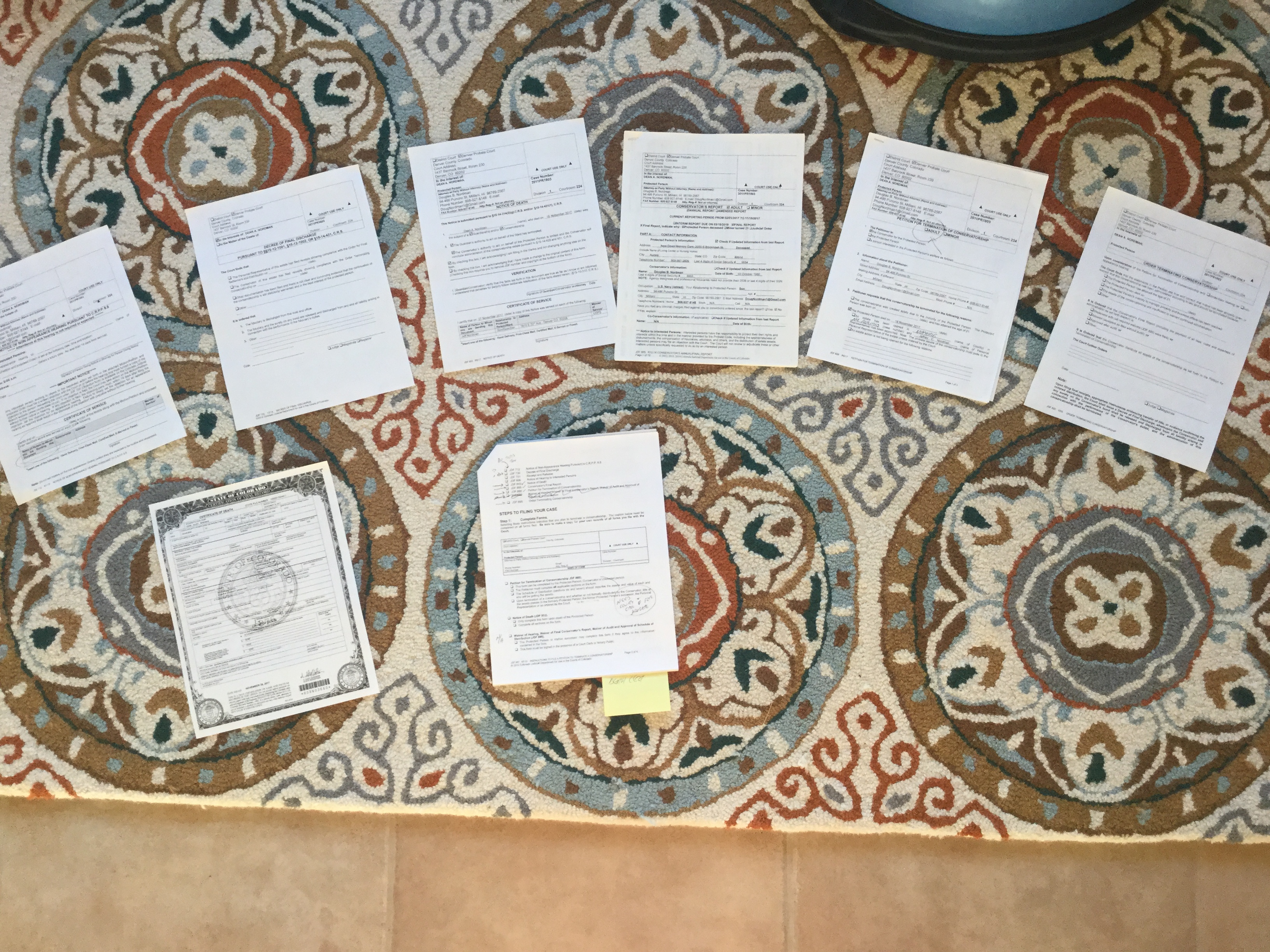
Death certificate + seven more legal forms.
However I also had to file eight separate forms with the probate court to close out my conservator’s appointment. I’m sure they were just as tired of processing them as I was of preparing them.
LESSON LEARNED: As hard as it can be to have an estate plan, a disability plan, a durable POA, and maybe even a revocable living trust– maintaining a conservator’s appointment is far more work and stress.
Our Own Family Plan (This Time We Really Mean It)
In 2016, when our daughter returned to the U.S. from overseas duty, we gave her a durable power of attorney over our Fidelity Roth IRAs and our joint taxable account. (Fidelity makes this painful to execute, yet it’s worth the effort for its reliability.) We also added her as a joint owner of our checking accounts, although a designation as an “authorized signer” or “trusted user” may be more appropriate.
More importantly, our daughter takes great comfort in understanding how to manage our finances if necessary. Our generations talk about our money moves All. The. Time. (usually over a weekly family dinner) and our daughter knows how to step up when it’s necessary.
Over the next few years, my spouse and I had the difficult discussions with an estate-planning lawyer to put the final touches on our disability plan. It’s held up well since then. Our design is an extreme example, and the lawyer was initially very reluctant to implement it. Our daughter is comfortable with the paperwork and the law firm, and we’ll keep refining our tactics.
I still have no idea how the rest of my life will turn out. We might not ever need any of this.
Yet unlike my father & grandfather, I have a contingency plan and it’s already in place.
As I frequently tell our daughter & son-in-law: we may be the world’s greatest parents, but we’re doing this so that nobody else should have to suffer our caregiver stress.
We’re treating them the way that we wish we’d been treated, and we’re present in our granddaughter’s life in a way that our daughter never had a chance to experience.
The final LESSON LEARNED:
If you know Cameron Huddleston, you might conclude that she’s an angel among caregivers. I met her in 2017 at a FinCon when she was caring for her mother while writing “Mom and Dad, We Need to Talk.”
She interviewed me for part of a chapter, and we’ve stayed in touch.
You can guess what she advises, but I highly recommend the book for its guidance on how to set up the conversations– and her scripts on how to avoid being dismissed with “I’m fine.” We met up again at the Bogleheads 2025 conference, where she gave her talk on financial caregiving. (Cameron has a YouTube channel, and her talk will be on the Bogleheads channel.)
We even ended up having small breakout sessions with other Bogleheads attendees.
As I wrote earlier: if you’re a caregiver, I strongly recommend joining a caregiver support group. (In-person is best, but even online can be helpful.) In addition to the emotional support, you’ll learn a lot faster from people who are willing to share. If you’re under caregiver stress then the group could even save your life.
Call To Action
We professsional bloggers are expected to conclude our ramblings with a ToDo list. Here’s yours:
1. Read or listen to Cameron Huddleston’s book, and work on communications among your generations.
2. Start building your disability plan with a durable power of attorney.
3. Create your disability plan.
I’m happy to answer questions about the details, and if you’re on Oahu then I strongly recommend interviewing estate-planning lawyers like Sterling & Tucker.
There are no affiliate links or paid ads in this post. Try your military base library or local public library before you pay money for these books– in any format.
Military Financial Independence on Amazon:
 |
|
Raising Your Money-Savvy Family on Amazon:
 |
|
Related articles:
In Memoriam: My Father (includes links to all of my financial posts about his long-term care)
Yet Another John Hancock Long-Term Care Insurance Update
Will Your Retirement Plan Handle Long-Term Care Needs? How Your Genome Impacts Disability, Caregiving, And Estate Planning
Family Estate Planning For Your Disability
“Mom and Dad, We Need to Talk” by Cameron Huddleston (all formats)
Extension of Suspension Period for Federal Long Term Care Insurance Program
(Effective 19 December 2024 for two more years)
Military families: hearing aids
VA Veteran Service Officers
VA Eligibility for Health Care


 Military Financial Independence
Thanks for the article. I will look up Cameron’s book as I am at the stage talking to my father as he has been diagnosed with Alzheimer’s. We have noticed all the signs of not being able to read or watch tv due to the short term memory to follow it. It is extremely tough trying convince him of anything