
Whether or not you’re financially independent, when was your last physical exam?
This post updates our medical tourism travels for our third visit to world-famous Bumrungrad Hospital.

Awesome skyline nights.
If you’ve never been there (or in Thailand) then please read this 2014 post first for more context about our Bangkok trips.
And of course if you want to see the rest of our 29 days in Bangkok, feel free to stalk my (totally public) Facebook album. All of the photos have captions, because I really dig seeing these FB memories for years after we’re back home.
As I wrote on this blog over a decade ago, the two biggest obstacles to financial independence are inflation and healthcare– yet everyone (especially military retirees) seems to have more options for handling inflation.
Healthcare is complicated, especially for vets who aren’t supported by the VA or by retiree Tricare. Fortunately medical tourism is one of the global solutions to healthcare expenses: if Bangkok is not part of your travel plans then
you can still pay for outstanding medical care in Europe, South America, Mexico, or the rest of Latin America.
I’ve also learned that if you’re eligible for Tricare Select, then you might even get back most of your money. Thank you to the readers who recommended filing a claim: Gordon Hembree, Nick Makrides, John Kim, and everyone else who chimed in about Tricare reimbursements.
Tricare Prime
I’ve been a military retiree for 23 years, and we’ve spent most of that time on Tricare Prime. It’s a good program, especially if you’re raising active teens. Yet you quickly learn that if you neglect to get a referral from your primary care manager, then Tricare Prime might regretfully decline to pay your claim.
In 2014, during one of our family trips to Bangkok in our Tricare Prime years, we tried one of Bumrungrad Hospital’s comprehensive physical exams. Hypothetically we could have requested a referral from our Oahu PCM, but we didn’t even try. Instead we were happy to pay what seemed like a very reasonable fee for concierge medical care. In 2016 we repeated the process.
That was it for a while, because before we got around to our next Bangkok trip: pandemic. That set us back a few years, because medical tourism only works if you can travel.
In 2022 when my spouse started her Reserve pension, we empty-nesters belatedly realized that we could also switch to Tricare Select. We greatly appreciate the flexibility of visiting any ol’ doctor without authorizations or referrals, yet we were also still in our old Prime mindset of seeking referrals & pre-authorizations.
Tricare Select… Going Overseas
In 2024 when we decided to make our first Bangkok trip in eight years, it never even occurred to us to chat with Tricare.
At age 64, I was still way behind on my routine medical maintenance. In addition, a cardiopulmonary checkup suddenly seemed like a Really Good Idea. We might have been emotionally affected by the news that a friend, a retired Marine who seemed ready to live forever, had just gone through triple bypass surgery. (He’s doing fine now.) I already have a little calcium sludge in one of my cardiac arteries, and I wondered how that would show up on an EKG during a treadmill stress test.
I wanted to learn what cardiovascular symptoms to watch out for in case (um, just as an example) they happened to manifest on a longboard during heavy-duty North Shore winter surf.
My spouse and I have been married for 38 years, so I’ll spill a little more tea about her side of our medical tourism: she’s not a big fan of regular physical exams. (I can hear our daughter rolling her eyes already.) In my spouse’s defense, she’s disgustingly healthy (especially compared to my genome) and she’s gotten away with her attitude for decades.
Since 2022 I’d been politely (well, all right, maybe rather bluntly) nagging her to get even a routine post-pandemic checkup. She offered a compromise: if we visited Bangkok again then she’d do a Bumrungrad concierge physical.
I bought our (non-refundable) plane tickets before she could reconsider.
Back In Bangkok
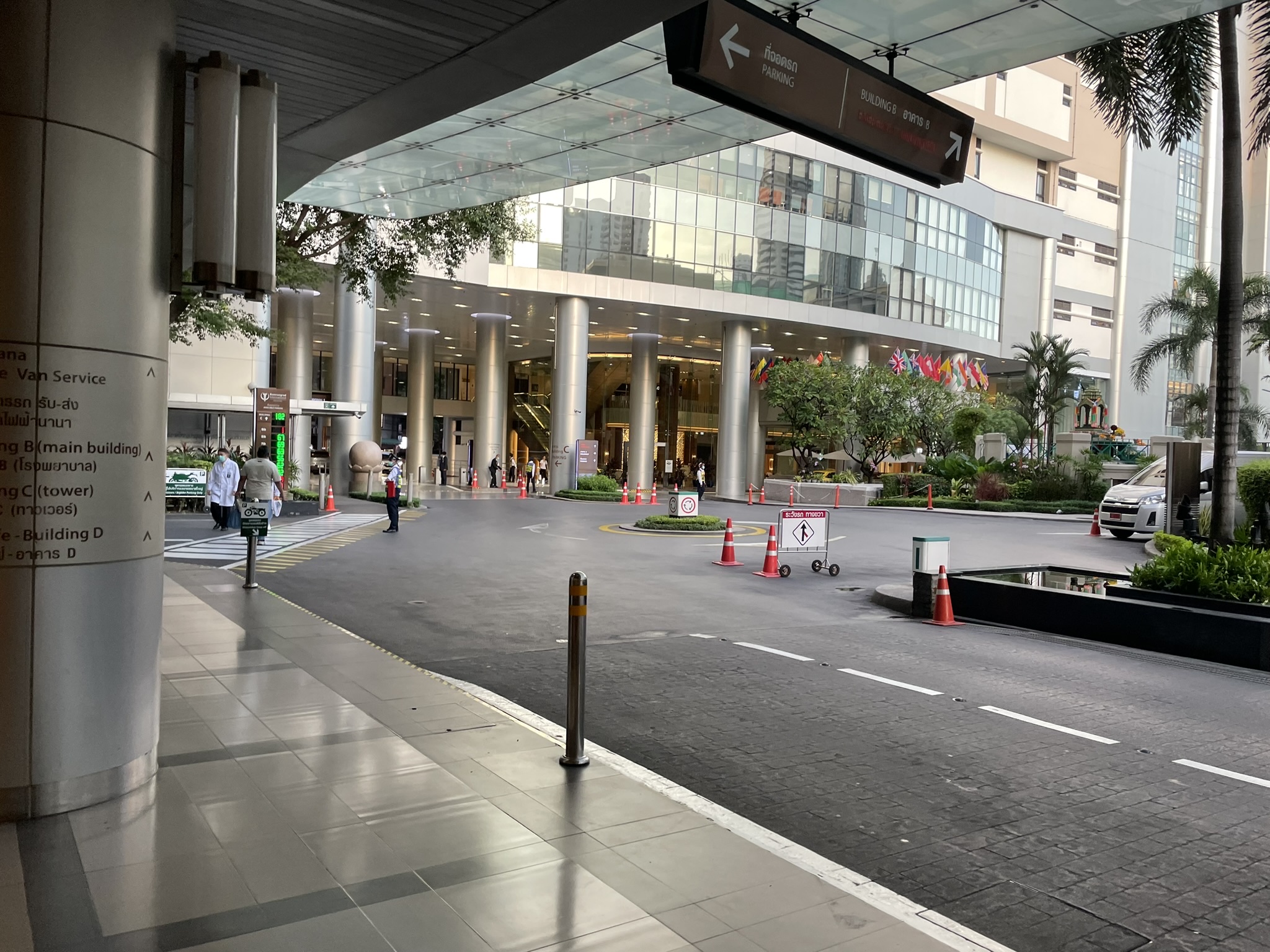
Concierge medicine.
Although Bumrungrad is still using the same building, they’ve updated their process since 2016.
This time, the biggest challenge was arranging appointments (and payments) online. The Bumrungrad website wants to charge a credit card before picking the appointment, and when I logged in from Oahu then my Costco Citi Visa kept timing out at Bangkok Bank’s site.
I never solved that problem.
Instead, on our first morning in our Bangkok apartment we walked over to Bumrungrad, and they had plenty of appointments over the next few days. (If I read their spreadsheet correctly, it looked like they handle about 150 patients per day from all around the world.) The hospital’s cashier had no problem charging my credit card in person, either.

Bumrungrad takes Tricare!
That afternoon I wrote about our appointments in my Facebook feed, and I was greatly surprised to learn from a couple of vets that at least 75% of the expense might be covered by Tricare Select. D’oh!
Sure enough, Bumrungrad’s website lists Tricare as an insurer.
After a protracted in-person discussion with Bumrungrad’s cashier about referrals & authorizations, we decided that I’d pay up front and we’d file our own claims.
The Comprehensive Vitality Programs
It turned out that my spouse and I are still healthy. Mostly.
This time I signed up for the “Comprehensive Male Vitality” package. This was by far my most comprehensive (and expensive) exam ever, and it adds a body composition analysis. (Electrical impedance, not a DEXA scan.) It also includes a hormone screening which might guide my future choices in supplements.
Both my spouse and I are amused by the stock photos marketing accompanying their packages. After extensive parsing of the options (not based on the photos), she chose the basic “Comprehensive Program Female” version.
The U.S. military’s Defense Health Agency could still outsource all their physicals to a Bumrungrad crew. At the very least they should license the hospital’s new tracking software that moves us smoothly among the stations.
My 2016 Bumrungrad checkup used clipboards with our headshots. The staff could use the photo to look around the waiting area and quietly walk over to us to discuss next steps.
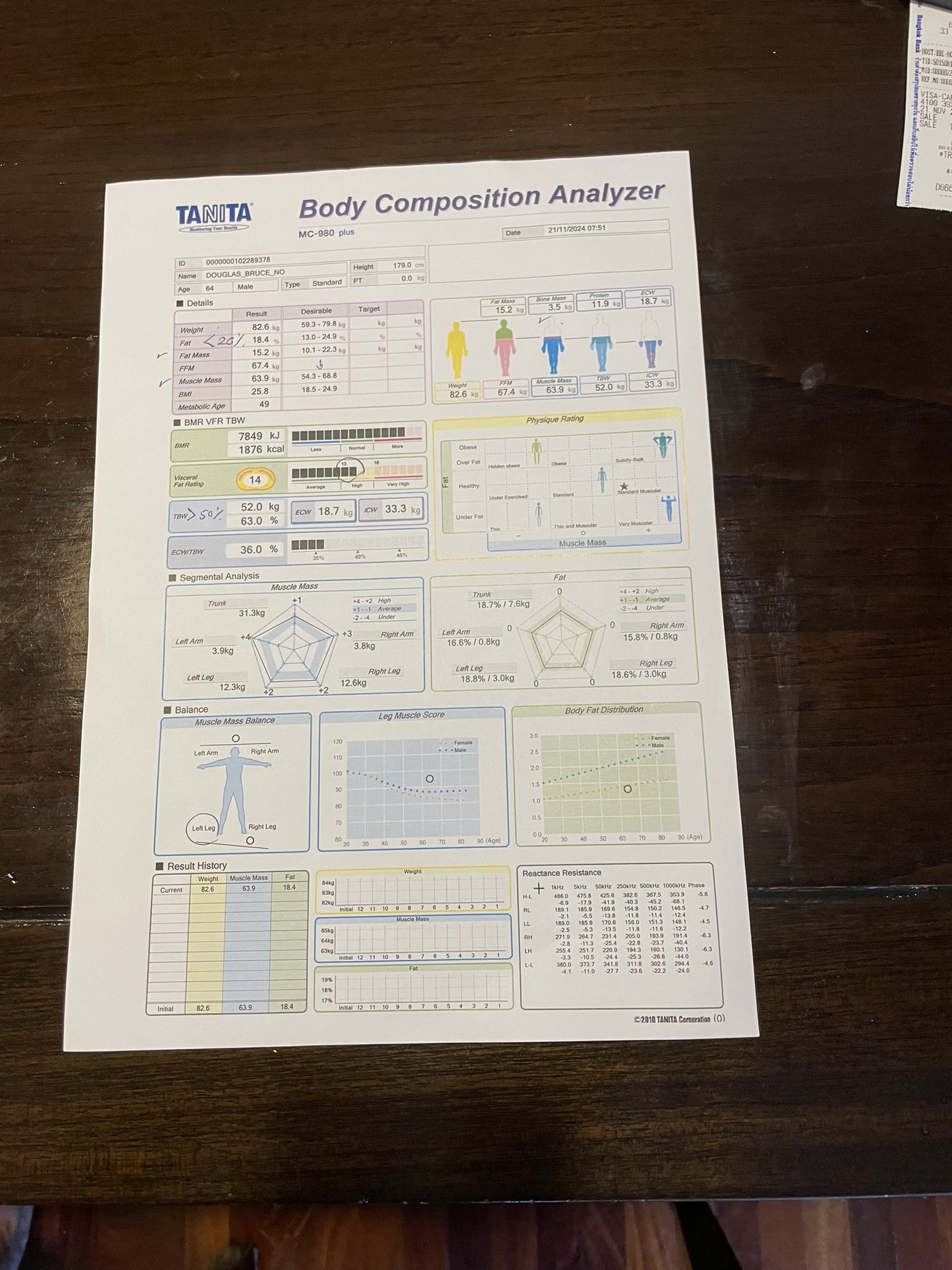
Motivation.
In 2024 we had a one-page checklist, barcoded wristbands, and a pager. We moved through all of the stations in under three hours, and sometimes they were waiting for me at the next one before I finished the previous one. I rarely waited more than five minutes between stations, and the results populated the database as we went through the gantlet. The longest delay was 15 minutes after the last exam while we changed from scrubs back into street clothes and waited (at the buffet lounge) for our chat with the family doctor.
Because of the various parameters of my exam, I had to fast for 12 hours (not even drinking water) beforehand. Once we did the blood draw and the body composition test, I had a bottle of water. I had my late brunch (a gourmet menu!) after I finished the rest of the exam.
This was my first-ever body composition analysis, and I’m sure they threw in some feel-good vibes. The analysis claims that my metabolic age is a whippersnapper 49 years old. The rest of this image can be summarized as “surfing muscles.”
It was interesting that the machine immediately noted my left leg is slightly shorter than my right— due to my left knee’s bone-on-bone cartilage erosion. The doctor also got mildly excited about my chest X-ray showing a little thoracic spondylosis, with the possibility of my left leg eventually messing up my spine and my right hip. The vertebrae curve is very slight, and I’m pretty sure I’ve seen it on X-rays for at least 30 years. Now we know what to watch for during the next 30 years, because I’m certainly in no hurry to replace my left knee.
The very next step after the body composition analysis was five test tubes of blood with a large-caliber needle. The phlebotomist even noted that my hemoglobin was low, and smiled with relief when I asked if it could be due to donating blood (on Oahu) a week before flying to Bangkok. I didn’t even think to mention it until they asked about my iron consumption. Of course when I left that station my hemoglobin was even lower.
The lipid panel flagged my higher cholesterol numbers (again, *sigh*), and it already included a check of my Lp(a) lipoprotein risk factor. (In Hawaii medicine, Lp(a) is an extra test that has to be outsourced to a California lab.) The family doc started to gently ease into the statin discussion, so I volunteered my ApoB protein number and my coronary artery calcium score. (Those are topics for a whole ‘nother post.) He’d never heard of desmosterol in the brain’s cholesterol synthesis (another topic for that future organ-recital post) but he agreed with my Oahu doc on starting 5mg of rosuvastatin. This is fine.
Treadmills and EKGs
I’ve always enjoyed Bumrungrad’s treadmill test & EKG. Judging from the reactions and comments of the techs, I suspect that most of their (less fit) patients struggle and end up hitting their target heartrate in only a few minutes.
In a possibly-related fitness coincidence, they still limit the treadmill to patients of less than 150(!) kilos. Yeah, I started the treadmill test last November at 83 kilos– but then I walked off more fat in Bangkok and four months later I’m at 78 kilos for my first time since 1970s high school. Surfing for life, dude.
Once the EKG electrodes were attached to my chest, my sitting pulse rate was 52 bpm. They decided that (at my age) my treadmill target would be 132. (When I’m using a treadmill, I keep my pulse around 125.) All of the parameters are displayed next to the treadmill, so I could watch the numbers as they cranked up the speed & incline.
As I watched the display I discovered that if I stretched out my stride a bit then I could actually slow down my accelerating pulse. They seemed a little surprised that my heartrate was taking so long to get up there.
It was all fun&games, chatting with the staff about the numbers– until I had a premature atrial contraction* which briefly spiked the EKG to 173 bpm.
*(I had to look up that term.)
This is apparently not unusual, or at least they’ve seen it before.
The monitor changed its font color from green to a wall of red, a beeper went off, a tech suddenly put a supporting hand on my back, a doctor teleported into the room, and another tech backed off the treadmill speed.
The cardiologist crowd huddled around the EKG printout. “Please keep walking, sir. How do you feel? Ahhhh, all right, that looks fine now.”
A minute later they decided everything was fine and we rolled on. My heartrate reached 132 bpm at just short of 10 minutes, with a 14-degree incline and a slow jogging speed. The post-treadmill analysis decided I’d had a “skipped beat” or a PAC instead of atrial fibrillation.
That was a fun conversation to listen in on, especially if you’ve heard about afib from your… older friends.
The rest of the checkup stations were routine.
Reviews And Reports
Later I learned that a friend (living in Bangkok) is the marketing genius who persuaded the JW Marriott catering staff to sponsor the upgrade of Bumrungrad’s buffet services in the patient lounge. (Thank you again, MikeH, we enjoyed it!) It was all yummy, and the attendants ensured that I didn’t even have to make my own cappuccinos.
Once again, the most valuable part of this exam was reviewing everything with a family doctor for nearly 45 minutes. He patiently answered all of my questions, especially when he heard me sling some of his technical vocabulary. (I was probably clogging the patient pipeline with my questions.) He even walked me through hormone chemistry to suggest that I might benefit from more DHEA.
They e-mailed our detailed records two weeks later, and I can go over those with my Oahu family doc for a second opinion. I’m not sure that my decision-making skills (let alone my life choices) would benefit from restoring my testosterone levels to those of my 20s or 30s, but I’m willing to do the experiment.
My spouse’s exam went well, too, although there were a couple of questions for further research. I’m still (politely yet firmly) nagging her about the followup: “As your most likely future first responder and primary caregiver, dear…”
It’s her story to tell, although there’s a 75% chance that everything is fine. Just fine.
For the rest of you military families, it’s worth repeating another of my decade-old paragraphs: if you’re a servicemember who’s a little concerned about symptoms that may affect your eligibility for submarine pay (or any other specialty pay), then consider an off-the-record trip to Bumrungrad. You’ll have to burn leave, but a few months of that specialty pay will cover your expenses.
Even if you’re in the Reserves or National Guard, you can obtain education & reassurance about your future without feeling stigmatized. Perhaps you’ll avoid the risk of being unfairly benched by your service while the military docs do further research. I’m sorry that the American military healthcare system discourages full disclosure about our concerns, but its higher priority is force readiness– not so much our personal issues between career and health.
We will return to Bumrungrad in a few years. Next time I’ll be ready with my Medicare* card and my Tricare For Life supplemental insurance.
*(Medicare won’t reimburse outside the U.S., of course, but I’m just about finished with Tricare Select.)
Tricare Select Paid For (Almost All Of) It!
I’ll repeat a couple paragraphs for those who may be skimming the headers.
During this Bangkok trip, I posted about our Bumrungrad visit and showed the receipts. (That’s part of my totally public Facebook album. Feel free to browse.) Before the end of the day, my Facebook friends began telling me that we could get Tricare to pay for the exams.
I spent more time on Bumrungrad’s website, and sure enough: they take Tricare.
I doubt that Tricare Prime would have authorized a referral, but Tricare Select lets us choose any medical provider.
The Bumrungrad staff was very polite with my Tricare questions, but it was clear that they were not eager to file the claim for us. We weren’t worried– we could file our own claim when we got back home.
The wheels of Tricare’s bureaucracy turned very slowly, but eventually they reimbursed us.
Let me pause for a moment to mention that this was the first time I have ever– in my entire life– filed a Tricare claim.
I started with my timing mistake of sending the claim to my Tricare Select Western Region contractor on 24 December, only a (holiday) week before they surrendered their contract to the new provider. I’m sure the old contractor was overwhelmed with a surge of last-minute claims– and perhaps a bit disgruntled about losing the contract– so I was unsurprised by a total absence of response for a month.
At the end of January, we finally got a couple of letters announcing that our claims had been punted over to the Tricare Overseas Program.
It may look like a rookie mistake– and it was my rookie claim– but there’s nothing in any of the Tricare websites that tells a Tricare Select sponsor to file with Tricare Overseas if they just happen to be passing through an overseas area during their slow travel.
In early March (69 days after I filed) our checks arrived. We paid $2507.98 up front and received $2229.16 on the claims for an 89% reimbursement. Tricare Overseas disallowed a few procedures as “not medically necessary” or “noncovered” and diverted another $150 to our deductible.
Mahalo nui loa hana hou to the alert readers who reminded me about Tricare Select claims!
Once again, I can stop worrying about reimbursement bureaucracy (and insurance companies!) and continue managing the rest of my longevity.
There are no affiliate links or paid ads in this post. Try your military base library or local public library before you pay money for these books– in any format.
Military Financial Independence on Amazon:
 |
|
Raising Your Money-Savvy Family on Amazon:
 |
|
Related articles:
Why You File Your Veterans Disability Claim (Not Just How)
What Happens When (Not Just How) You File Your VA Disability Claim
What The VA Really Does With Your Disability Claim
What Happens After Your VA Disability Claim Has Been Approved
Medical Tourism at Bangkok’s Bumrungrad Hospital
Lifestyles In Financial Independence: Your Mortality
Economic Refugees at RetireEarlyLifestyle.com


 Military Financial Independence